
You should not read First Aid cover-to-cover as your main strategy. That’s the wrong game for almost everyone.
The Short Answer
Here’s the direct answer you’re looking for:
- First Aid should be your reference map, not your primary textbook.
- Your core learning should come from questions + explanations.
- You use First Aid:
- to organize, tag, and connect what you learn from questions and videos
- to patch gaps and reinforce high-yield facts
- Reading it straight through, like a novel or a textbook, is:
- slow
- low-yield
- miserable
- and usually forgotten in 2 weeks
There are a few narrow exceptions where a semi-cover-to-cover pass can help. I’ll get to those. But if you’re asking “Which is better?” the answer is:
Use First Aid mainly with questions. Not as a solo cover-to-cover read.
Let’s break it down in a way that actually helps you plan.
What First Aid Is (And What It’s Not)
I’ve watched a lot of students treat First Aid like a holy book. They carry it everywhere, highlight every line, and then panic when they can’t remember page 274’s weird glycogen storage disease detail.
That’s a misunderstanding of what First Aid actually is.
First Aid is:
- A high-yield outline of Step-style content
- A checklist of topics you’re expected to know at a minimum
- A scaffolding to hang info from questions, Anki, and videos
- A fast review tool in the final weeks
First Aid is not:
- A full textbook that teaches concepts from scratch
- A story-based resource that builds intuitive understanding
- Designed for linear reading the way Robbins or Costanzo are
- Good at explaining why something is true
If you treat a sparse outline like a textbook, you’ll feel lost and dumb. You’re not dumb. You’re using the tool wrong.
The Two Main Strategies (And Who They Work For)
You’re basically choosing between two approaches:
- Cover-to-cover (or almost) reading of First Aid
- First Aid used with questions and other active tools
Let me be clear: I’m heavily biased toward #2, because it actually works for most real students with real time constraints.
But let me lay them out fairly.
| Strategy | Who It Fits Best | Main Risk |
|---|---|---|
| Full cover-to-cover read | High-scorers with lots of time | Passive, poor retention |
| Section-by-section with UWorld/AMBOSS | Most students | Slightly slower pages |
| First Aid only as quick reference | Students using heavy video + Anki | Missing small FA-only facts |
| Multiple FA passes + minimal questions | Memorizer types (not recommended) | Weak test-taking skills |
Strategy 1: Cover-to-Cover
Who this might work for:
- You already have a strong foundation from class and dedicated Anki (e.g., did Zanki/AnKing properly, not pretend-Anki)
- You’re aiming for a top percentile score and have 8–12+ weeks of dedicated time
- You’re very good at extracting structure and making your own questions or flashcards from outlines
Even then, a pure cover-to-cover approach is still suboptimal. At best, you:
- Skim a section
- Immediately reinforce it with lots of questions
- Use Anki to convert key facts into something your brain won’t toss out overnight
If you’re thinking: “I’ll read the whole thing twice, then do questions,” that’s a mistake. You’re delaying the most efficient learning activity (questions) in favor of something that feels productive but is weak for retention.
Strategy 2: First Aid + Questions (The Workhorse Model)
This is what works for most people:
- Do a question block (UWorld/AMBOSS) in timed or tutor mode.
- For each question:
- Understand the concept from the explanation.
- Open First Aid to the relevant section.
- Mark, annotate, or add margin notes with what you just learned.
- Quickly skim the surrounding bullets in First Aid (same page or adjacent pages) to pick up related facts.
- Make or review Anki cards if that’s part of your system.
Result:
- You see material in question form first (how the exam actually tests it).
- First Aid becomes your customized, annotated guide, not a generic outline.
- You repeatedly hit the same FA pages from different angles (renal questions, pharm questions, path questions) and the material actually sticks.
Why “Questions First, First Aid Second” Wins
Let me spell out why the question-first approach beats cover-to-cover reading for almost everyone.
1. The exam is question-based, not outline-based
You’re not graded on your ability to recite First Aid. You’re graded on your ability to:
- Interpret a messy vignette
- Identify the one detail that differentiates two diagnoses
- Recall a mechanism or association under time pressure
Questions force you to:
- Retrieve info (active recall)
- Apply it in context
- Learn from your mistakes in a concrete way
Reading First Aid line-by-line is recognition, not recall. Your brain says “Yeah, yeah, I’ve seen that before.” That’s almost useless on test day.
2. Questions reveal what actually matters
USMLE questions are written to target decision points, not every micro-detail of First Aid.
You’ll notice certain lines in First Aid correspond to:
- Frequent question themes (e.g., “ACE inhibitors: decrease GFR – do not start in bilateral renal artery stenosis”)
- Classic path images or buzzwords (even if buzzwords are de-emphasized, patterns still exist)
When you connect a First Aid bullet directly to a painful question you missed, you remember it. It now has emotional weight.
3. Questions give context; First Aid fills gaps
First Aid by itself is “What.”
Questions and explanations give you the “Why” and “How.”
Example:
- First Aid says: “Crohn disease – transmural inflammation, skip lesions, fistulas.”
- A question gives: 27-year-old with abdominal pain, weight loss, perianal fistula, kidney stones, colonoscopy image. Now your brain attaches a story, labs, imaging, management. Way stickier.
When you then annotate that into First Aid, you’ve transformed a bare bullet into a miniature concept hub.
How to Use First Aid With Questions (Step-by-Step)
Here’s a practical system that I’ve seen work repeatedly.

| Step | Description |
|---|---|
| Step 1 | Start Question Block |
| Step 2 | Review Explanations |
| Step 3 | Open First Aid Section |
| Step 4 | Annotate Key Points |
| Step 5 | Make/Review Anki Cards |
| Step 6 | Quick Skim of Nearby Topics |
| Step 7 | Repeat with Next Block |
Daily flow (during dedicated)
- Do 40–80 questions per day, broken into blocks.
- After each block, spend serious time reviewing:
- Why each answer is right or wrong
- What concept you actually missed
- Jump into First Aid:
- Find the relevant page/section
- Highlight only what ties to questions or feels truly high-yield
- Add small notes like “UWorld Q 224 – pt w/ lupus nephritis” or key lab patterns
- If you’re using Anki:
- Make 3–10 cards from that review, max. Don’t explode your deck.
Over time, you’ll end up touching most of First Aid, but in a way that follows your weaknesses and the question bank’s emphasis, not in rigid page order.
When (If Ever) Should You Read First Aid Cover-to-Cover?
There are a few scenarios where a more linear read is reasonable. But even here, I’d still combine it with questions.
Scenario 1: Early M2, long runway, weak Step 1 exposure
You’re 9–12 months out, you want structure, and your school curriculum is disorganized.
Reasonable plan:
- Do a slow, partial pass of First Aid aligned with your systems block.
- Pair it with a video resource (Boards & Beyond, Pathoma, Sketchy, etc.)
- Then start light questions early (e.g., 10–20/day).
You’re not memorizing First Aid. You’re using it to see the “universe” of what Step cares about while you still have time to lay foundations.
Scenario 2: Last 2–3 weeks before your exam
Here, a more FA-heavy approach makes sense:
- You’ve done a ton of questions.
- Your foundation is mostly there.
- Now you want to tighten the net and catch leaks.
This might look like:
- System-based or subject-based passes:
- “Today: cardio path + pharm sections in FA, but quickly.”
- Cross-checking your weak areas from NBME/UWorld self-assessments against FA pages.
- Rapid mini-reads of high-yield charts, bugs/drugs tables, biostats formulas.
This is not “sit and read from cover to cover in order.” It’s targeted passes across most of the book with a bias toward weak spots.
Scenario 3: You’re already a high scorer and like outlines
If your NBME/UWorld self-assessments are consistently strong and you actually enjoy structured outlines, a once-through semi-linear read (while still doing questions daily) can help with polish.
But you’ve already proven you can learn and retain effectively. You’re the exception, not the rule.
How Much of First Aid Do You Actually Need To Touch?
You do not need to memorize every cell of every table.
But you should be familiar with:
- All systems chapters (cardio, renal, neuro, etc.)
- Micro + pharm sections at least once or twice in some depth
- Biostats and ethics well enough to not miss gimme points
Think in terms of coverage, not perfection.
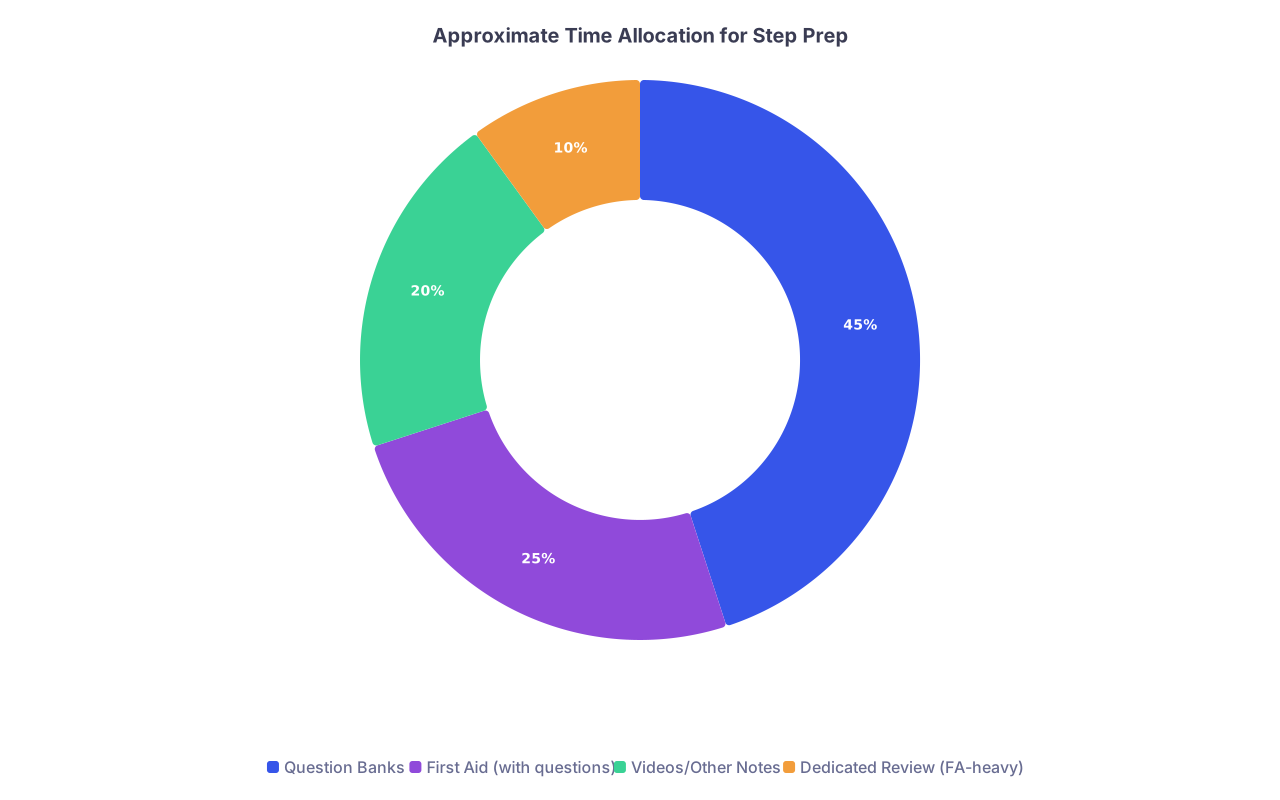
| Category | Value |
|---|---|
| Question Banks | 45 |
| First Aid (with questions) | 25 |
| Videos/Other Notes | 20 |
| Dedicated Review (FA-heavy) | 10 |
A realistic breakdown for many students:
- ~40–50% of time: questions + explanations
- ~20–30%: interacting with First Aid (usually post-question)
- ~10–25%: videos or class notes for weak conceptual areas
- ~5–10%: pure First Aid review near the end
If you notice you’re spending 70–80% of your time “reading First Aid” and not doing questions, that’s a red flag.
Common Mistakes With First Aid
These are patterns I see over and over.
The Highlighter Massacre
Every sentence is highlighted. Which means nothing is highlighted. If everything is “high yield,” nothing is.The Fake Security Pass
“I read First Aid twice; I’ll be fine.” But your question bank performance is weak because you never trained test-taking or real application.The Late First Aid Panic
Ignoring FA for months, then trying to binge-read the entire book in 7 days. You’ll just drown.The No-Annotation Purist
Treating First Aid like it’s sacred and cannot be written in. Wrong. You should absolutely make it your own – minimal but targeted annotations are gold.Trying to memorize First Aid before starting questions
Backwards. Use questions to tell your brain what matters in FA.
How To Decide Your Own Plan (Reality Check Framework)
Here’s a blunt decision guide:
Ask yourself these questions:
How far out is my exam?
4–6 months: You can afford some structured FA exposure + early questions.
- 1–3 months: Questions first; FA only as support and review.
What do my practice tests say?
- Weak across the board: You need concept help (videos/text) + questions; FA is reference.
- Narrow weaknesses: Use FA heavily in those sections, guided by missed questions.
What’s my learning style honestly?
- If you’ve always learned well from outlines + flashcards and proved it with scores, more FA time might help.
- If outlines make you zone out, over-reading FA will just waste time and make you anxious.
Use this rule:
If your question bank performance is not improving, you don’t need more First Aid reading. You need better review and deeper understanding of explanations.
FAQs
1. Is it ever okay to do a full First Aid pass before I touch questions?
I wouldn’t recommend it. At minimum, start doing a small number of questions early (even 10–15/day) while you’re exploring First Aid. Pure passive reading without any question exposure lets you build an illusion of competence that shatters the first time you sit for a practice block. Better to get humbled early and adjust.
2. How many times should I “go through” First Aid?
Stop counting passes. It’s meaningless. What matters is:
- Have you touched each major section at least once or twice?
- Have you annotated it with insights from questions?
- Are you using it in the last few weeks to patch weak spots?
For many students, this ends up feeling like 1–2 loose “passes,” but it’s really dozens of targeted mini-passes driven by questions.
3. Should I annotate First Aid with everything from UWorld?
No. That’s how you turn a dense book into an unreadable brick. Annotate:
- Repeated high-yield pearls
- Concepts that FA presents poorly but UWorld explains well
- Your personal weak associations (e.g., “I always confuse these two drugs – note difference here”)
If you’re rewriting half of UWorld into FA, you’re overdoing it. Use Anki or a separate note system for bigger explanations.
4. What if my school pushes a “read FA cover-to-cover” plan?
Smile, nod, and then do what actually works. Schools often give generic advice because it’s easy to standardize. You’re the one taking the exam. Use FA enough to be comfortable with its structure, then lean hard into questions and active learning. You can blend their advice by doing some structured FA reading early, but don’t let it crowd out question practice.
5. If I have very little time left (2–3 weeks), should I focus more on First Aid or questions?
At that point, it’s a mix:
- Use NBME/UWorld self-assessments to identify weak areas.
- Do targeted question sets in those areas.
- Immediately reinforce those topics with First Aid pages.
If your foundation is decent, skew a bit more toward First Aid + rapid review in known weak sections. If your foundation is shaky and your practice scores are low, prioritize questions + explanations even this late, with FA as quick reinforcement.
Key takeaways:
- Don’t treat First Aid like a novel. Treat it like a high-yield map you annotate with what you learn from questions.
- Make questions the core of your prep; let First Aid support and organize that learning, not replace it.
- Use FA more heavily early for structure or very late for cleanup—but never at the cost of consistent, serious question practice.