
It is Sunday night. You open your study tracker and realize you are 480 questions behind where you planned to be.
Your dedicated period starts in three weeks. You still have class. You still have shelf exams. Your “do 80 questions a day” plan? Dead on arrival.
Someone in your group chat just posted their Anki stats and a screenshot: “100% complete on UWorld, 65% correct, 4 weeks out 🎉.”
You stare at your own stats: 23% of the bank done. Or maybe 40%. Either way, you feel the same pit in your stomach.
Here is the good news: You can recover.
Here is the bad news: Not with the plan you had.
What you need now is not motivation. You need a recovery protocol. A tight, 4-week, no-drama system that:
- Gets you through a realistic number of questions
- Raises your score, not just your “questions completed” percentage
- Keeps you from burning out in 10 days and crashing right before the exam
That is what I am going to give you.
Step 1: Diagnose the Damage (30–45 minutes, not all day)
Do not spend three hours making a perfect spreadsheet. You need a fast, clear picture of where you are and what is possible in 4 weeks.
1.1: Get your true baseline
Do this today or tomorrow morning:
- Take a timed, random, mixed block:
- Step 1: 40 questions (NBME-style or UWorld random mixed)
- Step 2: 40 questions (preferably UWorld, random mixed)
- Do it exam conditions:
- No notes
- No pausing
- Quiet room
- Time limit set exactly as the real exam
- Review only enough to categorize your performance:
- Percent correct
- Rough breakdown: content gaps vs. dumb mistakes vs. misreading vs. time pressure
Do not obsess over every explanation right now. Your goal is a snapshot, not enlightenment.
1.2: Quantify your Q-bank deficit
Open your main Q-bank (UWorld, AMBOSS, etc.) and write down:
- Total questions in the bank
- Questions completed
- Questions remaining
- Days until:
- Your exam or
- End of your dedicated block / major shelf
Now do the math:
| Item | Example Value |
|---|---|
| Total questions in bank | 3,000 |
| Completed | 900 |
| Remaining | 2,100 |
| Days until exam | 28 |
| Max sustainable Q/day | 80 |
If you have 2,100 remaining and 28 days, that is 75 questions/day.
If your max sustainable rate is ~60/day with proper review, then no, you are not finishing the whole bank. And that is fine.
The worst thing you can do now is cling to a fantasy number and then collapse on day 10.
1.3: Set a realistic question target
Pick a daily question range you can actually maintain with full review:
- If you still have full-time classes/rotations:
- 40–60 questions/day on weekdays
- 60–80/day on weekends
- If you are in full dedicated:
- 60–80 questions/day, every day
Be honest. If 60 questions with real review already takes you 5–6 hours, do not schedule 100/day. That is how people fry themselves and then “rest” for 3 days by doomscrolling, losing any progress they gained.
Step 2: The 4-Week Recovery Framework
We are not doing “wing it and hope” anymore. You need a 4-week structure with specific roles for each week.
Here is the high-level framework:
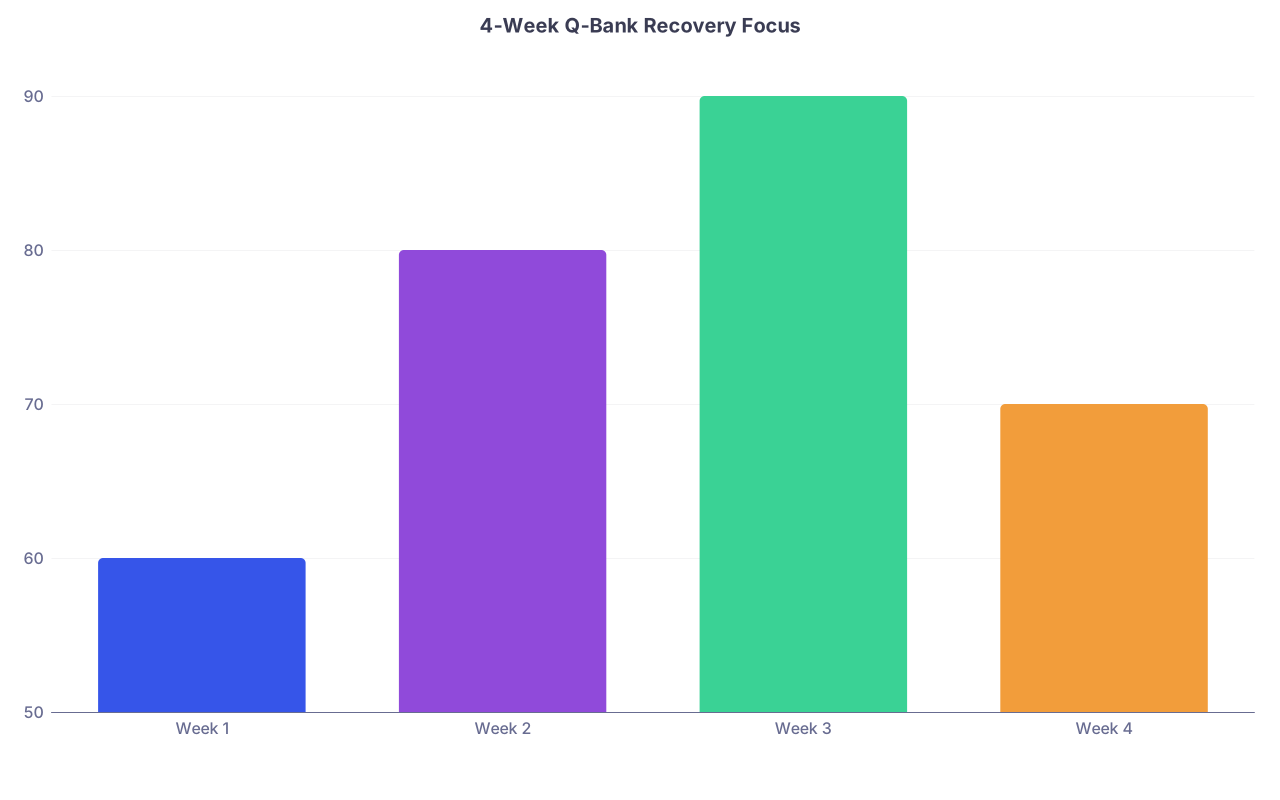
| Category | Value |
|---|---|
| Week 1 | 60 |
| Week 2 | 80 |
| Week 3 | 90 |
| Week 4 | 70 |
Think of it as:
- Week 1 – Stabilization & Triage
- Week 2 – High-Yield Volume
- Week 3 – Exam Simulation
- Week 4 – Sharpen & Protect
I will go through each week and lay out:
- Daily block structure
- How many questions
- How long on review
- What to sacrifice and what to keep
Week 1: Stabilization & Triage (Stop the bleeding)
Goal:
- Build a sustainable daily Q-bank routine
- Identify your top 3–4 weak systems/topics
- Stop the anxiety-driven context switching and plan-chasing
Your daily structure (Week 1)
Aim for 1–2 blocks per day with full, slow review.
Example for a student with classes/clinical on weekdays:
Weekday template:
- Block: 40 questions (timed, random, mixed if Step; or subject-focused if you are very early)
- Time: ~1 hour for the block
- Review: 2–3 hours
- Optional: 20–40 extra questions in tutor mode at night if you have brainpower left
Weekend template:
- Morning: 40-question timed block + 2–3 hours review
- Afternoon: 40-question timed block + 2–3 hours review
- Evening: Light content review/Anki only (no more big blocks)
How to review in Week 1 (no, not reading every word)
You do not have time to read every single sentence of every explanation like scripture. You need targeted review.
For each question, do this:
Classify the miss:
- Did not know the fact / concept gap
- Misread / anchored on wrong clue
- Knew it but could not apply
- Rushed due to time
For content gaps:
- Write 1–2 bullet summary in a running doc or notebook
- If you use Anki and it actually works for you, turn that summary into a card
- If you have 10+ misses in the same topic (e.g., renal phys, acid-base, OB triage), flag it for system-based review hour later in the week
For process errors (misreading, rushing, not reading all options):
- Write a short process rule that you will enforce:
- “Underline the rate or time course in each question stem.”
- “Always read all answer choices before locking in.”
- “If the question is asking for ‘next step,’ do not pick a diagnostic test if you already have the diagnosis.”
- Write a short process rule that you will enforce:
Let me be direct:
If you do not fix your exam process errors, no amount of extra questions will save you.
System triage: Decide your top 3–4 weak zones
At the end of Week 1, take 30 minutes and list:
- Systems where you consistently miss questions
- Repeat pathologies (e.g., glomerulonephritis types, murmurs, shock types, acid-base, abdominal pain differentials, OB emergencies, etc.)
Pick 3–4 main weak zones. These will become your focused content blocks in Weeks 2–3.
Week 2: High-Yield Volume (Controlled aggression)
By Week 2 you should have a stable routine and some emotional control back. Time to push volume without blowing up your brain.
Goal this week:
- Hit your max sustainable question volume (usually 60–80/day)
- Maintain full review discipline
- Layer in focused system repair sessions on your weakest topics
Daily structure (Week 2)
For most students in dedicated, this is the sweet spot:
- Block 1 (morning): 40 questions, timed, random, mixed
- Review 1: 2–3 hours
- Break: actual break, not YouTube “break” that turns into 90 minutes
- Block 2 (afternoon): 20–40 questions
- Review 2: 1.5–2 hours
- Evening: 60–90 minutes of focused content review on one weak system
Clinical / full-time responsibilities? Modify:
- 1 major 40Q block on busy days
- Add 20–40 questions on lighter days or weekends
- Use commute time or dead time for light review (Anki, flashcards, summary notes)
How to integrate system repair
Do not “study cardio” for 6 hours with random resources. That is how people waste time.
Instead:
Use your Q-bank performance to decide what inside a system is killing you:
- In cardio: murmurs? heart failure drugs? EKG patterns?
- In OB: third-trimester bleeding? fetal heart tracings? postpartum complications?
For that micro-topic, do:
- 20–30 min of tight content review from 1 trusted source:
- Boards & Beyond / OnlineMedEd clips
- First Aid / Step Up
- A focused section of AMBOSS articles
- Then 10–15 Q-bank questions on that topic, immediately, if your bank allows filtering
- 20–30 min of tight content review from 1 trusted source:
You want immediate practice after content, not just passive consumption.
Week 3: Exam Simulation & Pattern Training
By Week 3, question volume alone is not enough. You need to practice how the exam feels.
Goal:
- Add full-length style blocks (2–3 blocks back-to-back)
- Start using NBMEs or official practice exams if you have not already
- Sharpen pattern recognition and timing
Weekly structure (Week 3)
Plan 2–3 “heavy days” and 3–4 “standard days.”
Heavy day template (simulated exam portions):
- Morning:
- 2 back-to-back 40Q timed blocks (80 questions total, minimal break between)
- Then 3–4 hours review
- Late afternoon:
- Very light: Anki / high-yield summary pass / flashcards
Standard day template:
- 1 standard 40Q timed block + review
- 20–40 extra mixed Qs or focused Qs
- 60–90 minutes content review for a weak topic
You should also slot in one NBME / practice exam this week if your timeline allows.
Pattern recognition training (the part most people skip)
At this point, you have seen enough questions that patterns should start to emerge. You are going to make them explicit.
Do this 2–3 times this week:
- Pick 15–20 questions you got right AND wrong from recent blocks in the same system (e.g., renal, OB, cardio).
- Skim the stems quickly and ask:
- What are the giveaway clues that push you toward diagnosis A vs B?
- What are the classic traps for this topic?
- Build a small “Pattern List” for each system. Example, for shock:
- Hypovolemic: low JVP, cold extremities, narrow pulse pressure, dry mucous membranes
- Cardiogenic: high JVP, pulmonary edema, S3, MI history
- Distributive (septic): warm extremities early, wide pulse pressure, high CO, infection source
- Common trap: septic shock vs. anaphylaxis (look for exposure + urticaria, wheezing)
This pattern list becomes your high-yield rapid review in Week 4.
Week 4: Sharpen, Protect, and Prioritize
Final week. This is where students often do something dumb:
- They suddenly decide they must finish every last question in the bank and do 120/day.
- Or they add a new resource. Or they change their whole routine.
Do not do that.
Goal for Week 4:
- Maintain moderate-high question volume but protect mental bandwidth
- Prioritize weak zones and common patterns
- Get comfortable with exam-day length, timing, and energy
Weekly structure (Week 4)
Your priorities shift:
- 40–80 questions/day max
- 1 more practice exam (if timing allows and you have one left)
- Daily 30–60 minutes of Pattern List and weak-topic refresh
Example schedule:
Day 1–2:
- 40Q mixed timed block + review
- 20–40Q focused on remaining high-yield weak topics
- Evening: Review pattern lists for 1–2 systems
Day 3:
- Full practice exam (NBME or comprehensive self-assessment)
- Light review same day, deeper review next day
Day 4–6:
- Back to 40–80Q/day
- Heavy focus on explaining misses from practice exam and closing remaining gaps
Day -2 and Day -1 before exam:
I do not care how behind you feel. These are not 200-question days.
Day -2:
- 40–60 mixed questions, light review
- Pattern List review (especially your chronic weak systems)
- Final check of logistics (route to test center, materials, sleep schedule)
Day -1:
- Optional: 20–30 easy questions just to stay warm, or none at all
- Skim pattern lists, formulas, algorithms
- Eat, hydrate, go to bed early
- No new topics, no trying to “cram” entire chapters
What If You Truly Cannot Finish the Q-Bank?
Let me say this clearly: Finishing the bank is not the goal. Raising your score is.
You are not a failure if your Q-bank shows 72% complete on test day. I have watched many students score 240+ / 250+ / 260+ on Step exams and never touch the last 300 questions.
Here is how to prioritize when you are behind:
| Priority Level | Question Types |
|---|---|
| Tier 1 | Mixed random timed blocks |
| Tier 2 | Questions in your weakest systems |
| Tier 3 | Questions in moderate systems |
| Tier 4 | Very obscure topics / ultra-rare diseases |
If you must drop something:
- Drop ultra-low-yield content first (zebras, weird syndromes, one-off rare metabolic disorders).
- Keep:
- Cardio, Pulm, Renal
- Neuro, IM staples (DM, HTN, infections)
- OB/GYN basics, Peds basics (for Step 2)
- Pharmacology with high test frequency
- Ethics, biostats, management algorithms
When in doubt, look at NBME or official practice exams: they tell you what the test writers care about. Mirror that.
Fixing the Hidden Killers: Sleep, Time, and Distraction
If you have made it this far and still think, “I will just grind harder,” you have missed a critical piece.
Falling behind on Q-bank blocks is almost never just about laziness. I keep seeing the same hidden killers:
- Fragmented days with no protected study blocks
- Constant device distraction
- Garbage sleep and late-night “panic study” that does not stick
- Spending 45 minutes on one impossible question explanation
So you fix them.
1. Protect 2–3 daily “no-interruption” blocks
Your brain does its best work in uninterrupted chunks.
Pick 2–3 blocks of 60–120 minutes per day where:
- Phone in another room, Do Not Disturb on
- No messaging, group chats, or “quick” social media checks
- Everyone around you knows you are unavailable
Use these blocks for:
- Timed question blocks
- High-intensity review of misses
2. Cap review time per question
If you are spending 10+ minutes re-reading a single explanation, you will not survive 2,000 questions.
Set hard caps:
- Average: 2–4 minutes per question for review
- Max: 5–6 minutes for truly complex path-heavy questions
- If it is some obscure, never-seen-before syndrome, and the explanation starts reading like a genetics textbook?
- Get the main takeaway.
- Move on.
3. Fix your sleep window
You will not outrun sleep debt with coffee.
- Fix a consistent sleep window (e.g., 11 pm–7 am or midnight–7:30 am)
- Protect it like a meeting with program leadership
- No big study blocks past your usual sleep time; quality nosedives and retention tanks
This is not about being “healthy.” It is about not walking into your exam with a brain that feels like wet cardboard.
Tools and Tracking: Just Enough Structure
You need tracking that helps you course-correct, not a second job.
Use something simple:
- A note, spreadsheet, or app that captures:
- Questions done per day
- Approximate % correct
- Top 2–3 weak topics from that day
Example daily log entry:
2026-01-05
- 80 Q (40 + 40 mixed) – UWorld Step 2
- 64% correct
- Weak: hyponatremia management, COPD exacerbation tx, fetal heart tracings
- Action tomorrow: 30 min hyponatremia review + 10 Q; 10 Q FHT; watch 1 video on COPD management
That is enough. You do not need a color-coded 12-tab spreadsheet.
How This Actually Feels (Reality Check)
Let me reset expectations.
If you are behind on Q-bank blocks and start this 4-week protocol:
- Week 1 will feel slow and uncomfortable. You will want to chase volume to quiet the anxiety. Do not.
- Week 2 will feel hard but productive. You will be tired, but your “I have seen this before” feeling will start growing.
- Week 3 you will have days where you score worse on a practice exam than you hoped. That is normal. You use that data to refine, not to spiral.
- Week 4 you will be tempted to panic and overhaul everything. Resist. You are sharpening now, not reinventing.
Students who do best are not the ones who feel confident all 4 weeks. They are the ones who keep executing the plan despite the anxiety.
A Concrete 4-Week Example Plan
To make this even more tangible, here is what a real 4-week recovery plan can look like for a Step 2 student who is 1,800 questions behind with 4 weeks to go.
Assumptions:
- Total bank: 3,000
- Done: 1,200
- Remaining: 1,800
- Goal: 1,300–1,500 more questions with real review (not all 1,800)
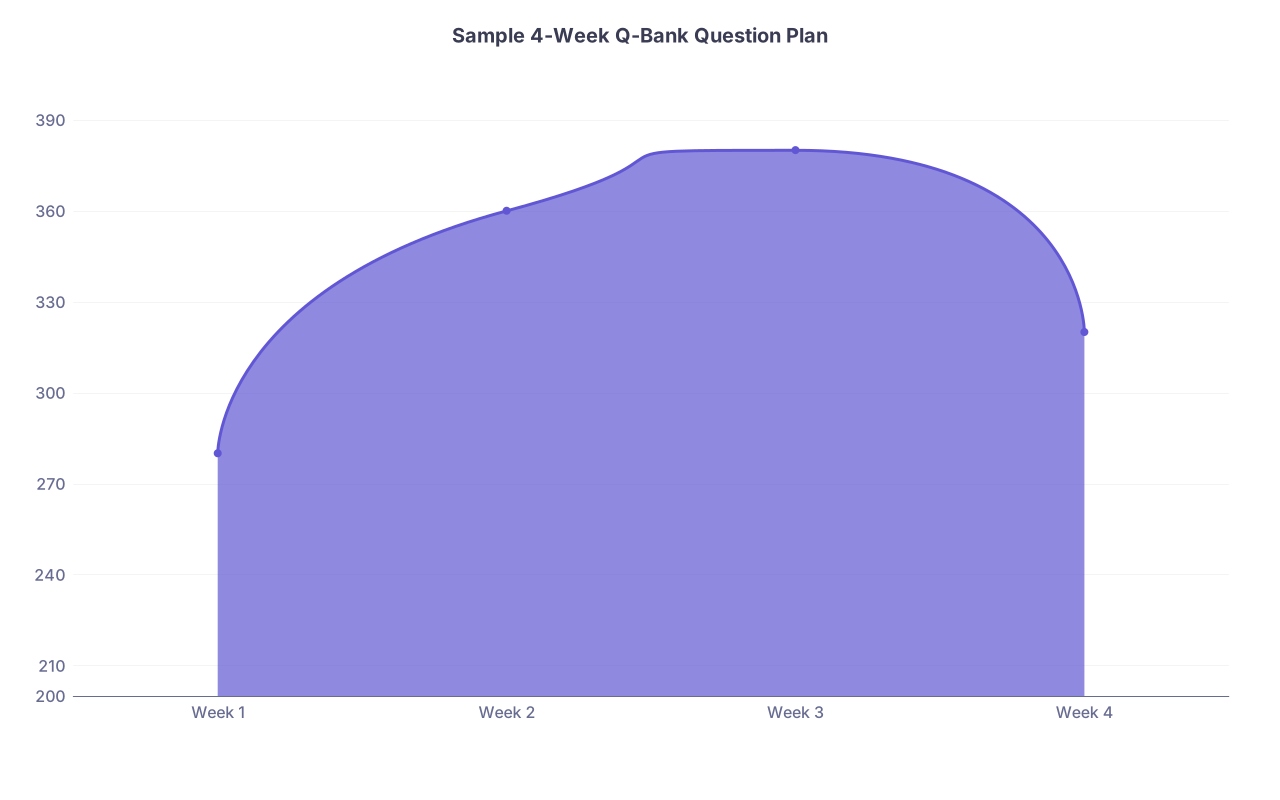
| Category | Value |
|---|---|
| Week 1 | 280 |
| Week 2 | 360 |
| Week 3 | 380 |
| Week 4 | 320 |
Week 1 (280 Q):
- 40 Q/day × 5 weekdays = 200
- 40 Q × 2 blocks on one weekend day = 80
- Focus: Stabilize review process, identify top 4 weak areas
Week 2 (360 Q):
- 60 Q/day × 5 weekdays = 300
- 30 Q/day × 2 weekend days = 60
- Focus: Weak-area repair + higher volume
Week 3 (380 Q):
- 2 days with 80 Q (2 full blocks) = 160
- 3 days with 60 Q = 180
- 1 practice exam day (~40 scored Qs equivalent, depending on test) = 40
- Focus: Simulation and pattern recognition
Week 4 (320 Q):
- 60 Q/day × 4 days = 240
- 40 Q on Day -5 and Day -4 each = 80
- Last 2 days: minimal or no questions
- Focus: Solidify patterns, protect brain for test day
Total over 4 weeks: ~1,340 questions with full review.
Not perfect. But realistic, and enough to move your score meaningfully.
What You Do Today (Not Tomorrow)
You do not fix being behind on Q-bank blocks with a good feeling. You fix it with a decision and the first 24 hours of execution.
Here is your next step today:
- Pick one Q-bank (no more resource hopping).
- Right after you finish reading this, set a 60-minute timer.
- Do a 40-question timed, mixed block. No pausing, no notes.
- Take 90–120 minutes to review it the way I described:
- Classify misses
- Capture 1–2 bullet summaries per true content gap
- Note 2–3 process rules to enforce tomorrow
Then, tonight or first thing tomorrow, map out:
- Your daily question target for the next 7 days
- When those blocks will happen (actual time slots, not vibes)
- Your top 3–4 weak systems to work on this week
Do that, and you are not “the person who is behind on Q-bank blocks” anymore.
You are the person running a 4-week recovery protocol.