
You are sitting in the library at 9:45 p.m. UWorld is open. You just missed a question on fructose metabolism for the third time this week. The explanation mentions aldolase B, essential fructosuria, hereditary fructose intolerance, and somehow ties it to an infant who vomits after fruit juice. You flip to First Aid. One crowded chart. Five tiny boxes. It is not sticking.
You do not need “more biochemistry.” You need the right pathways, the real question patterns, and a clean map of which resources are actually worth your time.
Let me break this down specifically.
The Biochem Reality Check on Step 1
Step 1 biochemistry is not “memorize every enzyme.” That myth wastes more study hours than almost anything else.
The exam reliably tests three things:
- Pathway choke points (rate-limiting enzymes, key regulators, committed steps).
- Disease patterns tied to single-enzyme defects or cofactor deficiencies.
- How to jump from a vignette → pathway defect → lab pattern → clinical consequence.
If your study approach is: “I will memorize glycolysis and TCA start to finish,” you will drown and still miss questions. If your approach is: “I will identify the 20–30 truly testable nodes and learn how they show up in UWorld/NBME vignettes,” you will be fine.
Let’s make that second approach explicit and tie it to specific resources.
Big-Picture Map: Where Biochem Actually Shows Up
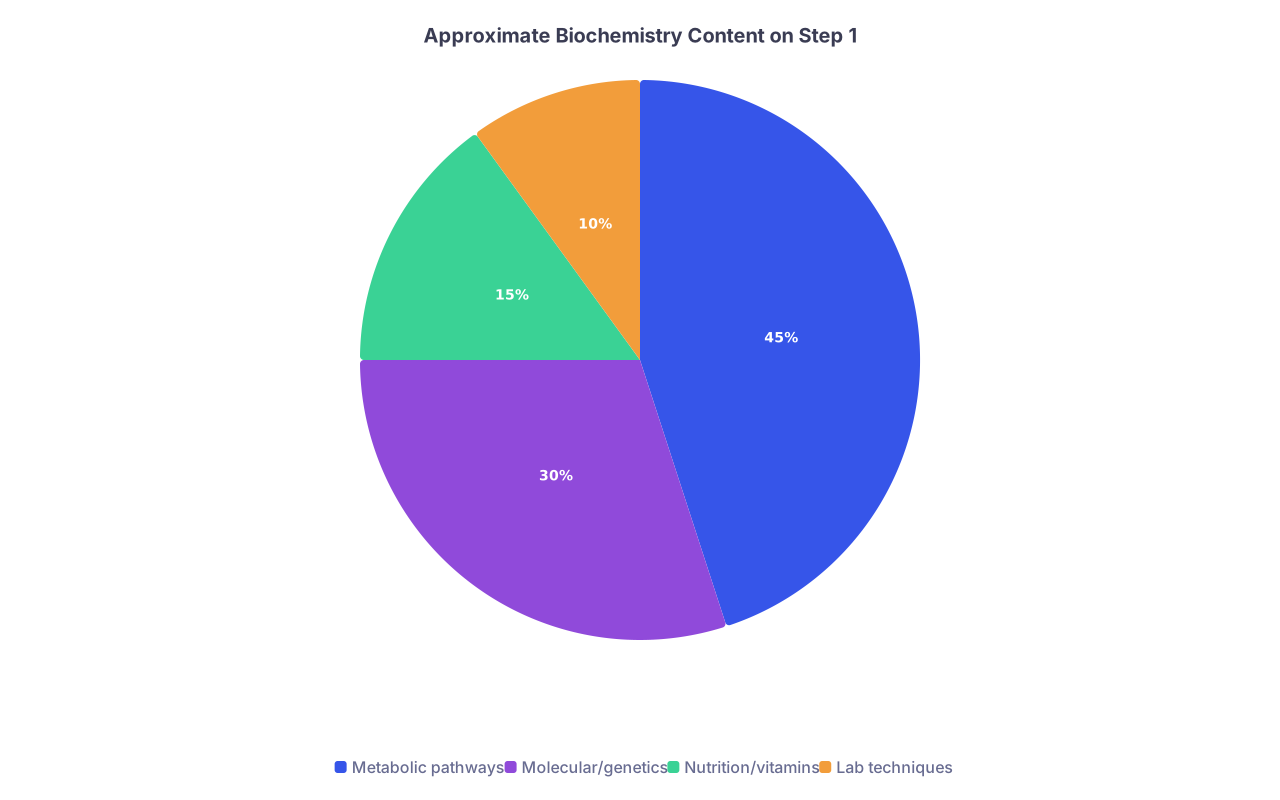
| Category | Value |
|---|---|
| Metabolic pathways | 45 |
| Molecular/genetics | 30 |
| Nutrition/vitamins | 15 |
| Lab techniques | 10 |
You can think of Step 1 “biochem” as four buckets:
Classic metabolic pathways
Glycolysis, TCA, urea, glycogen, FA metabolism, amino acid metabolism, fructose/galactose, pyruvate dehydrogenase, etc.Molecular biology / genetics
DNA replication/repair, transcription/translation, triplet repeat disorders, imprinting, chromosomal abnormalities.Nutrition & vitamins
Water-soluble vs fat-soluble deficiencies, cofactor roles, toxicity patterns.Lab techniques
PCR, Western/Northern/Southern, ELISA, flow cytometry, blot interpretations.
This article is about Bucket 1 primarily, with enough of 2 and 3 to prevent predictable misses. Bucket 4 is lower yield and resource-light.
Now, we align pathways → question patterns → best resource for each.
Core Metabolic Pathways: What Step 1 Actually Cares About
1. Carbohydrate Metabolism: Glycolysis, Gluconeogenesis, Pyruvate
You are not being tested on every enzyme. You are being tested on choke points and “what happens if this step fails?”
High-yield nodes and patterns:
Hexokinase vs glucokinase
Pattern: Fasting vs fed states, liver vs peripheral tissues, MODY-like presentations, enzyme kinetics graphs.
Typical stem: Young non-obese patient with mild hyperglycemia, strong family history, abnormal glucokinase function.Phosphofructokinase-1 (PFK-1) and PFK-2 / Fructose-2,6-BP
Pattern: Hormonal regulation by insulin/glucagon, fasting vs post-prandial, effect of glucagon on glycolysis in liver.
They love asking: “What happens to glycolysis and gluconeogenesis when glucagon is high?”Pyruvate fates
4 fates you must know cold:- Pyruvate → Acetyl-CoA (pyruvate dehydrogenase, PDH)
- Pyruvate → Oxaloacetate (pyruvate carboxylase)
- Pyruvate → Lactate (lactate dehydrogenase)
- Pyruvate → Alanine (ALT, Cahill cycle)
Question pattern: Thiamine deficiency, PDH deficiency, chronic alcoholism with lactic acidosis, newborn with neurologic deficits worsened by carbohydrate load.
Lactate dehydrogenase and anaerobic metabolism
Pattern: Ischemia, exercise, NAD+ regeneration, conditions causing lactic acidosis.
Resource match:
- First Aid (FA): Good for the enzyme table and summary figure. Do not memorize every intermediate – focus on bold enzymes and regulation notes.
- Boards & Beyond (B&B) Biochemistry “Glycolysis & Gluconeogenesis” videos: Clear, clinical framing and Step-style questions built into the lecture.
- Anki: Use a targeted deck (e.g., AnKing tagged for “Biochemistry – Metabolism”) to hammer those few key enzymes and regulators.
Where students screw this up:
They memorize full pathway diagrams instead of: “Which 2–4 enzymes are repeatedly embedded in vignettes and why?”
2. TCA Cycle & Oxidative Phosphorylation
Step 1 does not care if you remember “aconitase.” It cares about:
- Entry into TCA: PDH, pyruvate → acetyl-CoA
- Rate-limiting enzyme: Isocitrate dehydrogenase
- α-ketoglutarate dehydrogenase (thiamine dependent, similar complex to PDH)
- Electron transport chain (ETC) inhibitors and uncouplers
- ATP production vs oxygen consumption patterns
High-yield vignettes:
- PDH deficiency (infant with lactic acidosis and neurologic defects, improved with ketogenic diet).
- Thiamine deficiency (alcoholic started on glucose before thiamine → worsened confusion).
- ETC poisons:
- Cyanide, CO: block Complex IV (↓ O2 consumption, ↓ ATP, normal proton gradient).
- Oligomycin: ATP synthase inhibitor.
- 2,4-DNP, high-dose salicylates: uncouplers (↑ O2 consumption, ↓ ATP, heat).
Resource match:
- FA: Learn the small ETC inhibitor table by heart. It is pure question fodder.
- B&B “TCA Cycle & Oxidative Phosphorylation”: Worth watching once at 1.5x speed to cement mechanism → effect patterns.
- UWorld: Do not skip ETC poison questions. They solidify how to reason from “this drug blocks X” to changes in O2 consumption/ATP.
3. Glycogen Metabolism and Glycogen Storage Diseases (GSDs)
This is where a lot of people drown in names. The exam is predictable if you compress it.
You really care about 4 types: I, II, III, V. (You should recognize IV by pattern, but it is rarer.)
Core associations:
Type I – Von Gierke (Glucose-6-phosphatase deficiency)
- Severe fasting hypoglycemia
- ↑↑ glycogen in liver, hepatomegaly
- Hyperuricemia, lactic acidosis
- Question pattern: Infant with doll-like facies, big liver, fasting hypoglycemia.
Type II – Pompe (Lysosomal acid α-1,4-glucosidase)
- Cardiomegaly, hypertrophic cardiomyopathy
- Hypotonia, early death
- “Pompe affects the Pump” is not a joke; it’s how they test it.
Type III – Cori (Debranching enzyme)
- Milder version of type I, normal blood lactate
- Some debranching issue, still gluconeogenesis intact.
Type V – McArdle (Muscle glycogen phosphorylase)
- Exercise intolerance, muscle cramps, myoglobinuria.
- Second-wind phenomenon due to increased blood flow.

Resource match:
- FA: Memorize the GSD table. This is non-negotiable.
- Sketchy or Pixorize (if you use them): The Glycogen Storage Disease videos are high-yield and turn painful memorization into 1 or 2 watch sessions.
- Anki: One card per disease: enzyme, main organ, and classic vignette phrase.
If you are short on time: learn I, II, V perfectly. Recognize III as the “Cori – milder Von Gierke, normal lactate.”
4. Fructose and Galactose Metabolism
These are exam darlings because they are clean, single-enzyme defects with clear “when symptoms start” patterns.
You must differentiate four entities:
Essential fructosuria – Fructokinase deficiency
- Autosomal recessive, benign.
- Fructose spills into urine.
- Often asymptomatic adult with positive copper-reduction test but negative glucose oxidase test.
Hereditary fructose intolerance – Aldolase B deficiency
- Severe, life-threatening.
- Symptoms start after introduction of fruit/juice/honey.
- Vomiting, lethargy, seizures, hepatomegaly, hypoglycemia.
- Therapy: Strict avoidance of fructose and sucrose.
Classic galactosemia – Galactose-1-phosphate uridyltransferase deficiency
- Presents soon after breastfeeding or formula with lactose.
- Failure to thrive, jaundice, hepatomegaly, cataracts, E. coli sepsis risk.
Galactokinase deficiency
- Benign, infantile cataracts, “difficulty tracking objects,” but no severe liver disease.
Question patterns:
- Age of onset relative to specific dietary trigger (breast milk vs fruit juices).
- Hypoglycemia and liver failure vs isolated cataracts.
- Reducing substances in urine tests (positive for all these, but not glucose oxidase for non-glucose sugars).
Resource match:
- FA: Tiny chart, huge yield. You should be able to reproduce it by hand.
- UWorld: The fructose/galactose questions train the “trigger food + symptom onset” reasoning. Do not just memorize; parse the pattern.
Where people get this wrong: They memorize “enzyme name ↔ disease name” but cannot pull it from a clinical vignette. Step 1 cares about the vignette.
5. Urea Cycle, Ammonia, and Amino Acid Metabolism
Very testable and often under-studied.
You need:
Urea cycle’s purpose: Convert toxic ammonia (NH3) to urea for renal excretion.
Key enzymes:
- Carbamoyl phosphate synthetase I (CPS I) – mitochondrial, rate-limiting step.
- Ornithine transcarbamylase (OTC) – most common urea cycle disorder.
OTC deficiency pattern:
- X-linked.
- Hyperammonemia, vomiting, poor feeding, lethargy.
- Elevated orotic acid in blood/urine (carbamoyl phosphate shunted to pyrimidine synthesis).
- No megaloblastic anemia (distinguishes from orotic aciduria).
Hyperammonemia effects:
- Cerebral edema, asterixis, slurred speech, somnolence, vomiting, coma.
- Mechanism: Excess NH3 depletes α-ketoglutarate (↓ TCA), glutamate/glutamine issues.
Amino acids you must know by disease:
- Phenylalanine → Tyrosine → DOPA → Dopamine → NE → Epi (tie to PKU, tyrosinase in albinism).
- Branched-chain amino acids (Leu, Ile, Val) in maple syrup urine disease (MSUD).
- Cystine in cystinuria (kidney stones).
- Homocysteine and methionine pathways (homocystinuria).
| Disorder | Defect / Enzyme | Key Clues in Stem |
|---|---|---|
| PKU | Phenylalanine hydroxylase or BH4 | Musty odor, fair skin, ID |
| MSUD | Branched-chain α-ketoacid DH | Sweet-smelling urine, neurologic sx |
| Homocystinuria | Cystathionine β-synthase (usually) | Marfanoid, lens subluxation, clots |
| Cystinuria | Tubular transport of COLA aa | Hexagonal kidney stones |
Resource match:
- B&B “Amino Acids & Urea Cycle”: Simplifies what most schools overcomplicate.
- FA: Memorize the PKU/MSUD/homocystinuria tables. Step 1 asks them relentlessly.
- Anki: Each of these diseases deserves 2–3 well-made cards.
6. Lipid Metabolism: FA Synthesis, β-Oxidation, Ketones, Lipoproteins
This feels overwhelming if you chase every enzyme. Do not.
High-yield structures:
FA synthesis vs β-oxidation:
- Synthesis: Cytosol, uses citrate shuttle to bring acetyl-CoA out of mitochondria, requires NADPH.
- β-oxidation: Mitochondria, carnitine shuttle for long-chain FA entry.
- Key defect: Systemic primary carnitine deficiency → weakness, hypotonia, hypoketotic hypoglycemia.
Ketone bodies:
- Made in liver mitochondria (HMG-CoA synthase).
- Used by muscle and brain during starvation and DKA.
- Pattern: Diabetic with fruity breath, metabolic acidosis, ketonuria.
Lipoproteins:
- ApoB-48: Chylomicron assembly.
- ApoB-100: VLDL → IDL → LDL.
- ApoC-II: Activates lipoprotein lipase (LPL).
- ApoE: Remnant uptake.
- Disorders:
- Type I hyperchylomicronemia (LPL or ApoC-II deficiency) → pancreatitis, eruptive xanthomas, creamy supernatant.
- Type IIa familial hypercholesterolemia (LDL receptor or ApoB-100 defect) → tendon xanthomas, premature CAD.
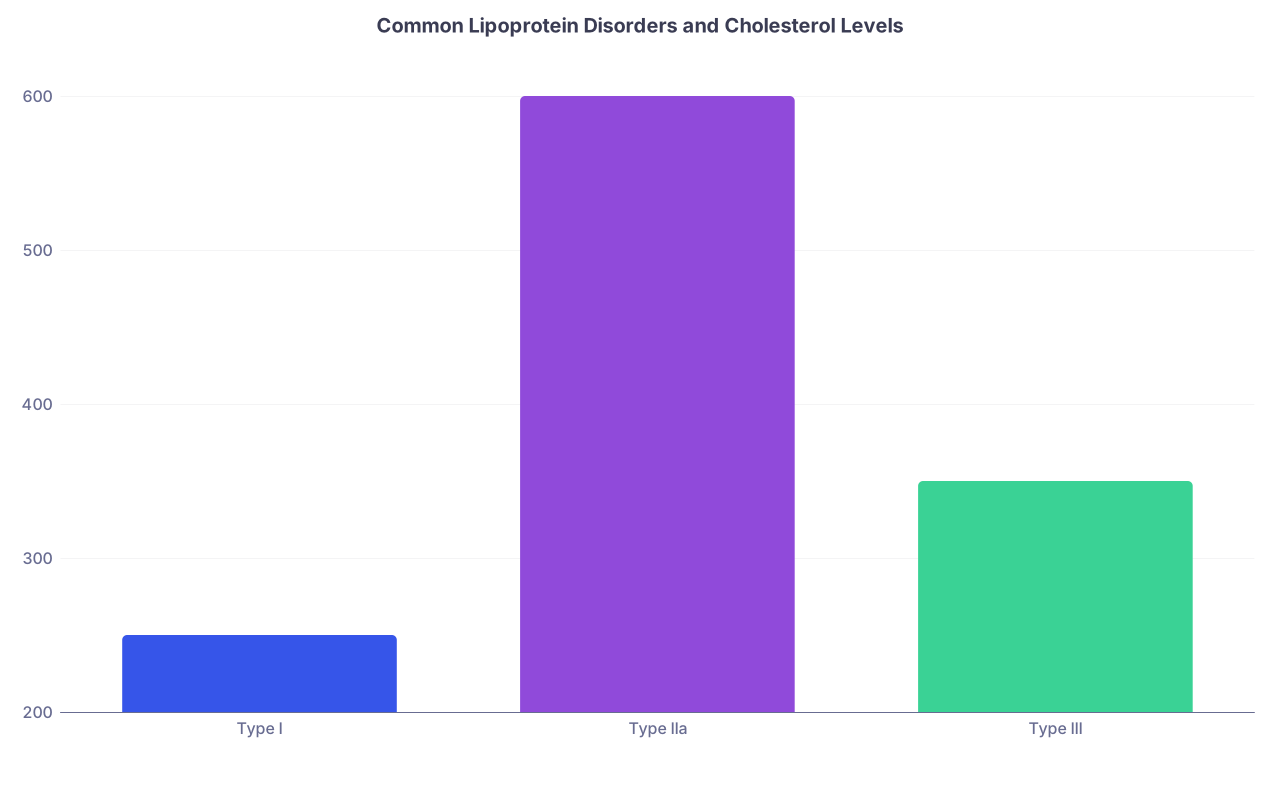
| Category | Value |
|---|---|
| Type I | 250 |
| Type IIa | 600 |
| Type III | 350 |
Resource match:
- FA: Lipoprotein chart is high-yield and finite. Memorize the apolipoprotein functions and major disorders.
- B&B “Lipid Metabolism”: Clarifies the carnitine shuttle / ketone story with clinical vignettes.
- UWorld: Pay attention to pattern recognition – pancreatitis + creamy serum = Type I, tendon xanthomas = Type IIa.
7. Vitamins and Cofactors: The Hidden Biochem Questions
Most “vitamin” questions are actually metabolic questions in disguise.
You must know:
Thiamine (B1): PDH, α-KGDH, branched-chain α-ketoacid DH, transketolase.
- Wernicke-Korsakoff, dry/wet beriberi.
- Question pattern: Alcoholic given IV glucose without prior thiamine → confusion, ataxia, nystagmus.
Riboflavin (B2): FAD, FMN.
- Cheilosis, corneal vascularization.
Niacin (B3): NAD+, NADP+.
- Derived from tryptophan.
- Pellagra: Diarrhea, Dermatitis, Dementia.
- Drug cause: Isoniazid or carcinoid (tryptophan depletion).
Pyridoxine (B6): Transamination, decarboxylation, heme synthesis.
- Isoniazid use leads to deficiency, neuropathy, sideroblastic anemia.
Biotin (B7): Carboxylation reactions.
- Avidin in raw egg whites causing deficiency (Step loves this).
Folate (B9) and B12: DNA synthesis, megaloblastic anemia patterns, neurologic differences (B12: dorsal columns, lateral corticospinal tracts).
This is not just “memorize deficiencies.” It is: if an enzyme setup includes “requires TPP as cofactor,” your brain should go: thiamine; what happens if it is missing?
Resource match:
- FA vitamin pages: Memorize them. They are among the most “direct question-to-book” segments of First Aid.
- B&B “Vitamins”: One of the highest-yield biochem lectures, period.
How Step 1 Biochem Questions Are Built
Now, the part most people skip: how NBME question writers actually structure biochem questions.
Pattern 1: Vignette → Enzyme Defect → Accumulated Substrate
Example skeleton:
- Infant, normal at birth → new food introduction → vomiting / FTT / hepatomegaly.
- Labs: Hypoglycemia, maybe reducing substances in urine.
- Ask: “Which substrate accumulates?” or “Which enzyme is deficient?”
Your mental steps:
- Age + diet trigger → choose pathway (fructose vs galactose vs glycogen vs urea).
- Match pattern (benign vs lethal; cataracts vs liver failure).
- Map to single enzyme and proximal metabolite.
Resources that train this exact reasoning best: UWorld, NBME practice forms, and B&B Q&A embedded in lectures.
Pattern 2: Cohort / Pharmacology Twist
They like to fold biochem into pharm:
- “A new drug inhibits x enzyme in cholesterol synthesis; what happens to intracellular cholesterol and LDL receptor expression?”
- “An experimental drug uncouples oxidative phosphorylation; what happens to oxygen consumption and ATP production?”
You recognize these as: “biochem concept + experimental drug” questions. They come straight from:
- FA small tables on ETC inhibitors, uncouplers, statins and HMG-CoA reductase.
- UWorld questions that show graphs (e.g., Michaelis-Menten, Lineweaver-Burk) tied to enzyme kinetics.
Pattern 3: Graphs and Kinetics
Enzyme kinetics is often under-resourced by students but easily covered.
You need to:
- Interpret Vmax and Km from a Michaelis-Menten curve.
- Understand effect of competitive vs noncompetitive inhibition on Vmax and Km.
- Recognize Lineweaver-Burk line shifts:
- Competitive: same Vmax, increased Km (x-intercept moves toward 0).
- Noncompetitive: decreased Vmax, same Km (y-intercept increases).

| Step | Description |
|---|---|
| Step 1 | Vignette |
| Step 2 | Carb or AA disorder |
| Step 3 | Urea cycle |
| Step 4 | Pompe / FA metabolism |
| Step 5 | Match trigger + organ |
| Step 6 | Check orotic acid, megaloblasts |
| Step 7 | Check carnitine or lysosomal enzyme |
| Step 8 | Pick enzyme/substrate |
| Step 9 | Identify category |
A focused 30–45 minute session with B&B enzyme kinetics plus associated Anki is usually enough to make this section painless.
Resource Strategy: Matching Biochem Content to Tools
Instead of “do everything,” use a curated match.
| Task / Topic | Best Primary Resource | Secondary / If Time Allows |
|---|---|---|
| Core pathways (glycolysis, TCA) | Boards & Beyond | First Aid diagrams + Anki |
| Inborn errors (GSD, AA disorders) | First Aid tables | Sketchy/Pixorize, Anki |
| Lipids & lipoproteins | First Aid + B&B | UWorld explanations |
| Vitamins/cofactors | First Aid + B&B | Anki drilling |
| Enzyme kinetics & regulation | B&B short videos | UWorld graphs |
| Vignette pattern practice | UWorld + NBME forms | Any extra Qbank (AMBOSS, etc.) |
How to put this into a 2–3 week micro-plan during dedicated:
- Day 1–3: B&B core metabolism videos (glycolysis, TCA, ETC, glycogen, lipids) at 1.5x–2x speed + skim FA diagrams the same day.
- Day 4–6: Amino acid disorders, urea cycle, fructose/galactose, vitamins (B&B + FA tables).
- Parallel: Do 10–15 targeted UWorld biochem questions per day. Tag “marked” any question relying on pathway logic.
- Daily: 30–40 Anki cards specifically tagged “biochemistry metabolism / vitamins / lipids.”
If you are closer to exam and short on time, compress:
- One solid evening: FA biochem tables only – vitamins, glycogen, fructose/galactose, AA disorders, lipoproteins.
- Next day: 40–60 UWorld biochem questions + review.
- That alone will patch many of the most-missed questions.
Common Biochem Study Mistakes (And Cleaner Alternatives)
Mistake: Trying to redraw full pathway diagrams from memory.
Alternative: Redraw only the rate-limiting enzymes and branching points (where multiple fates diverge).Mistake: Memorizing disease names separate from clinical stories.
Alternative: Always attach one “tagline” to each disease:- McArdle: “Exercise intolerance + myoglobinuria.”
- Von Gierke: “Severe fasting hypoglycemia + hepatomegaly.”
- OTC: “Boy with hyperammonemia + orotic acid, no megaloblastic anemia.”
Mistake: Treating vitamins as trivia.
Alternative: Tie them to the enzymes they support:- B1 → PDH, α-KGDH, branched-chain DH.
- B6 → transamination, heme synthesis.
- B7 → carboxylases (pyruvate, propionyl-CoA, acetyl-CoA).
Mistake: Ignoring UWorld explanations once you see the right answer.
Alternative: For biochem specifically, read the entire pathway explanation. If the question showed fructose intolerance, you should be able to explain why aldolase B is the choke point and what accumulates upstream.
FAQs
1. How much time should I devote to biochemistry in my dedicated Step 1 period?
For most students, 5–7 focused days spread over the first 2–3 weeks of dedicated is enough. That does not mean 7 full days of only biochem. Realistically: 2–3 hours on biochem topics on those days, alongside your regular UWorld blocks and system review. If your baseline is very weak, you might front-load with B&B for 3–4 days, then mostly rely on questions and FA tables afterward.
2. Is it worth doing a biochemistry-heavy Qbank like Kaplan or AMBOSS just for this subject?
Usually no. UWorld + NBME forms + your main video resource (B&B or similar) cover 95% of what you will see. If you already own AMBOSS and have extra time, their biochem questions can be useful for variety, but I would not purchase a separate resource just for biochem. Volume past a certain point gives diminishing returns compared to deeper review of missed UWorld questions.
3. Do I really need to memorize the entire urea cycle and TCA cycle?
You need to know:
- Purpose of each cycle.
- Where the key defects typically occur (CPS I, OTC for urea; PDH, isocitrate DH, α-KGDH for TCA context).
You do not need to recite every intermediate. If you can explain the clinical picture of OTC deficiency, hyperammonemia, and why orotic acid increases, you are ready for Step-level questions.
4. Are Sketchy or Pixorize worth it specifically for biochemistry?
For certain topics, yes. Their strength is in painful memorization zones: glycogen storage diseases, lysosomal storage diseases, some vitamin/cofactor stories. If you are already using Sketchy/Pixorize for micro/immunology, their biochem videos are a good supplement. I would not start a new subscription just for biochem, but if you have access, use them for the storage disease and vitamin sections.
5. How do I know if my biochem level is “good enough” before the exam?
Use NBME practice exams. Look at your performance on the “Biochemistry & Genetics” segments (or related content grouping). If you are consistently missing pathway/vitamin questions, review FA tables and redo the related UWorld questions you got wrong. When those misses slow down and most of your remaining misses are obscure or hyper-niche, you are at diminishing returns. Move on.
6. My school emphasized molecular and genetics much more than metabolism. Should I rebalance?
Yes. Step 1 still tests classic metabolism heavily. If your curriculum leaned into CRISPR, epigenetics, and obscure lab techniques while barely touching glycogen and amino acid disorders, you have a gap. Fix it with:
- FA metabolism and vitamin sections.
- B&B metabolism videos.
- 150–200 UWorld biochem/metabolism questions.
That combination will cover the chunk of biochemistry that actually moves your score.
Key points to walk away with:
- Step 1 biochemistry is about choke points and disease patterns, not every intermediate in a pathway.
- Match each pathway to its strongest resource: B&B for conceptual clarity, FA for tables and enzymes, UWorld/NBME for vignette pattern training.
- If you can flawlessly handle fructose/galactose, GSDs I/II/V, urea cycle (especially OTC), AA disorders (PKU/MSUD/homocystinuria), lipoproteins, and vitamin-linked enzymes, you have already covered the majority of high-yield biochem on Step 1.