
The reason residents push certain question banks isn’t “because they’re objectively better.” It’s because of ego, money, nostalgia, and how they themselves barely survived their exams.
Let me tell you what actually drives those recommendations you see on Reddit, Discord, and in the resident workroom.
What residents really care about when they push a Q‑bank
Most people assume that when a PGY-2 on medicine tells you, “You have to use X, Y is garbage,” they’re summarizing some rigorous internal comparison of educational quality.
No. That’s not what’s happening.
Here’s what’s really in play when a resident endorses a question bank to a med student:
Confirmation of their own past choices
If they used UWorld + Anki and scored a 250 on Step 2, their brain is heavily invested in the story: “I did well because I chose correctly.” That’s self-preservation. The idea that some cheaper or newer resource might be just as good — or better — undercuts their narrative. So they double down and push what they used.The trauma effect
Residents remember what they were grinding at 1 a.m. the month before their exam. If the interface was blue and white with a certain layout (you know which one I mean), that visual is now linked in their head with “I suffered and passed.” The suffering becomes part of the brand. They’re not just recommending a Q‑bank; they’re recommending their war story.Paid and unpaid influence
You think all those “ambassador,” “tutor,” or “mentor” roles are charity? Many residents are getting:- Discounted subscriptions
- Affiliate links/commissions
- “Free for you, if you ‘share with your students’” deals
They won’t always say that out loud. But they do nudge you toward what’s feeding their wallet or CV.
What matches their current identity
An academic neurology resident at UCSF is far more likely to push resources that look heavy on pathophys, text explanations, and “thinking like a neurologist,” not necessarily what’s easiest to memorize. A busy community EM resident will gravitate toward fast, high-yield, app-based stuff you can do between patients. Both then universalize their preference as “the best.”Program culture and quiet pressure
At some places, the PD or chief quietly sets the “official party line” on exam resources.
I’ve heard these exact words in a closed faculty meeting:
“We want our residents on UWorld only. If students ask, just tell them that’s the gold standard.”
That message trickles down into the advice you’re getting.
So when someone in a short white coat says, “Use this, not that,” they’re not neutral. They’re talking out of their own history, incentives, and environment.
Follow the money: who’s getting what?
Let’s be blunt. The exam-prep ecosystem is a business first, education second.
There are a few main money streams shaping what gets pushed to you:
- Affiliate links from social media, blogs, and “study influencers”
- Discount codes for “brand ambassadors” (often residents, sometimes MS4s)
- Institutional deals with schools and residency programs
- Content collaborations with “star scorers” or high-achieving residents
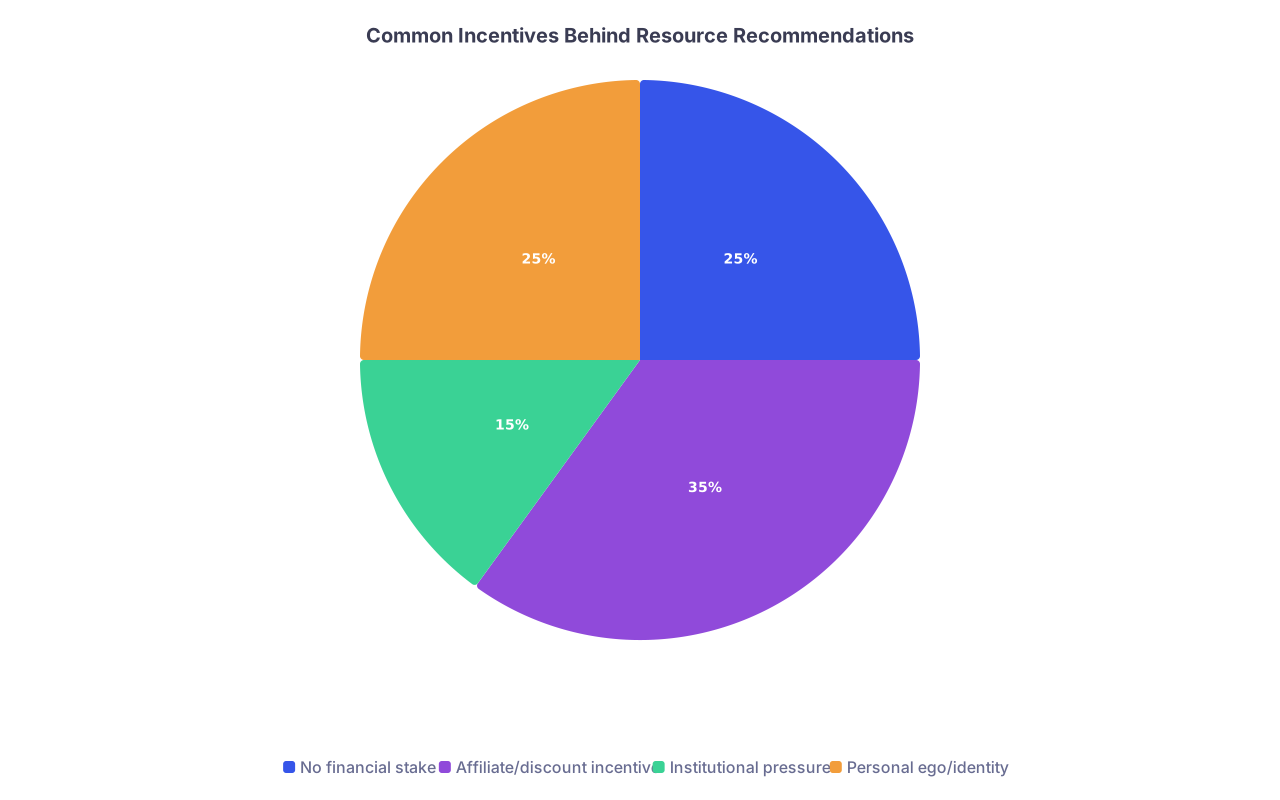
| Category | Value |
|---|---|
| No financial stake | 25 |
| Affiliate/discount incentive | 35 |
| Institutional pressure | 15 |
| Personal ego/identity | 25 |
Do those percentages have hard data behind them? No. But they’re close to what I’ve actually seen playing out over the years in multiple programs.
Here’s how it shows up in your life:
You ask a resident:
“Should I use UWorld or AMBOSS for Step 2?”
They say, “Honestly, they’re both good, but AMBOSS has amazing explanations, here’s my code — it gives you 10% off.”
Translation:
- They probably do like AMBOSS.
- They also probably get a kickback, points, or a free extension if they hit a certain number of sign-ups.
Do I think that automatically makes their advice bad? No. But you need to understand the background.
I’ve also seen the reverse: institutional contracts where a school buys 2-year access to a certain Q‑bank for everyone, and then faculty very conveniently start saying, “You really don’t need anything else.” Not because it’s true. Because it’s what the dean signed off on.
The Q‑bank hierarchy no one tells you about
Residents won’t always say this out loud, but in the workroom, there’s an unspoken caste system for question banks — especially around Steps and shelf exams.
It roughly looks like this:
| Tier | Typical Resident View | Common Use Case |
|---|---|---|
| S-tier | “Non-negotiable” | Step 1/2 prep, core |
| A-tier | “Excellent adjunct or alternative” | Shelf + Step, specific styles |
| B-tier | “Fine but not primary” | Extra questions, early prep |
| C-tier | “Only if desperate or broke” | Filler, last-minute cramming |
For most residents I’ve worked with:
- UWorld lives in S-tier by default.
- AMBOSS usually sits in high A-tier.
- Specialty-specific or newer Q‑banks (Boards & Beyond Qs, Rosh, niche apps) float in A/B-tier depending on the resident’s experience.
- Random, cheap, no-name Q‑banks sit in C-tier unless proven otherwise.
Here’s the key: that hierarchy is emotional, not purely data-driven.
When a resident says, “If you don’t do all of UWorld, you’re screwed,” what they actually mean is, “Everyone I know who did well finished UWorld.” That’s survivor bias. You’re not hearing from the people who did all of UWorld and still bombed.
At one large IM program I know, the chiefs looked back three years and quietly mapped Step 2 scores vs. resources used. Their conclusion in a nutshell:
- People who did a lot of high-quality questions scored higher.
- The specific brand mattered less than everyone thinks.
- But yes, the top scorers disproportionately used UWorld as their main bank.
You’ll never see that nuance on a subreddit thread. You’ll just see “UWorld or enjoy your 210.”
Why older residents give outdated or skewed advice
This one no one likes to admit.
Your PGY-3 who took Step 1 in 2018? They’re giving advice for a different exam, a different scoring environment, and a different level of competition.
Step 1 is pass/fail now. Their brain still thinks in three-digit score flex and “you need two UWorld passes.” They remember NBME 13 and 15, not the current retired ones you have access to. They studied when the culture was: “If you’re not getting 260, you’re behind.”
So what do they do? They recycle their old recipe.
Same ingredients. Different kitchen.
I’ve heard residents tell first-years:
“You must start UWorld in M1. Slow drip, 10 questions a day. That’s how you get a 260.”
Insider truth:
That same resident barely made it through UWorld once, started in February of M2, and crammed 80 questions a day at the end. Memory is… selective.
They’re protecting their ego and status. “I’m the one with the big score, the one who knows the system.” That doesn’t mean they’re lying; it means they’re narrating their past in the most flattering way possible.
So when you hear someone say, “Trust me, I scored 250+ and this is the only way,” you should translate that to:
- “This is one way that worked for the 2018 version of the exam for a certain type of student.”
Not gospel.
The subtle program-level politics around question banks
Now let’s talk about the stuff students don’t see.
Programs care deeply about board pass rates. They live and die by them for accreditation and reputation. So directors quietly shape what resources get pushed — especially for in-training exams and specialty boards.
Common behind-the-scenes moves:
- A PD makes a deal with a Q‑bank to get discounted or free access in exchange for “feedback” or “pilot testing.” Suddenly, that Q‑bank is called “required.”
- Chiefs are told, “We want everyone finishing at least 1,500 questions from X by the in-training exam.” Words spread: “Our program uses X; it’s the best.”
- Residents who score high get asked what they used, and those answers are turned into official slides for the new class. No nuance, no small n, just “Our top scorers used these resources.”
Then those same residents go teach med students and repeat the party line. Not because they’re corrupt. Because repetition works.
I’ve sat in meetings where a PD said:
“We’re not officially endorsing any specific product… but if students ask, you can mention we’ve had very good outcomes with [Brand].”
Everyone in the room understood the assignment.
You, as a med student, hear this as, “The program recommends [Brand], so it must be the best.”
What it really means is, “We had a few good years with this combo, and we’re scared to change anything.”
Why med students fall for the “one true Q‑bank” myth
You’re exhausted, anxious, and surrounded by noise. You want certainty.
“Just tell me what to use so I don’t fail.”
Residents, especially confident ones, step into that vacuum and give you certainty. Strong opinions, simple rules:
- “UWorld or don’t bother.”
- “If you’re not using X for shelves, you’re throwing away points.”
- “AMBOSS is overkill, only do it if you’re gunning for 260.”
These lines circulate because they’re clean and easy to remember. They’re also wrong in the absolute sense.
Here’s the unsexy reality most residents won’t spell out:
- Multiple major Q‑banks are good enough to get you an excellent score.
- The best one for you depends heavily on your learning style, schedule, and foundation.
- Question volume and consistency matter more than the logo at the top of the screen.
But “do 4,000+ high-quality questions consistently, review them intelligently, and pair with targeted content review if your base is weak” doesn’t sound as cool as:
“Bro. UWorld. Twice. Done.”
How to actually choose a Q‑bank without getting played
You want to use residents as a resource without becoming a pawn in their narrative or someone’s marketing.
Here’s how you do that like an adult, not a premed chasing Reddit karma.
1. Ask why, not just what
When a resident pushes a specific bank, don’t stop at “OK, thanks.” Ask them:
- “What did you like about it specifically?”
- “What didn’t you like?”
- “When during your prep did you use it — early, or more in the last push?”
- “Did you use anything else, and how did it compare for you?”
When you force them into details, the magic fades. You start hearing stuff like:
“Well, I started UWorld late, so I only got through 60%. I liked the interface. Explanations were kind of long, but I just skimmed them.”
Now you understand their actual behavior, not the myth.
2. Separate their level and your level
Residents are often athletic, high-functioning test-takers who would score 230+ with almost any reasonable resource combo and some discipline. They underestimate how different your situation might be.
If you barely passed your last systems block, your needs differ from the class genius who “just did questions.”
Ask: “If you were starting from a weaker foundation, would you still use only that bank? Or would you pair it with something else?” The answer will often shift.
3. Look at alignment, not hype
Match the bank to what you actually struggle with.
- If you need to build understanding and context: banks with strong explanations and cross-links (like AMBOSS) might serve you better.
- If you already know the content decently and need test-format exposure: a large, high-fidelity bank (UWorld, etc.) is logical.
- If you’re failing classes, you probably need integrated content + Qs, not just raw questions.
But none of that fits into a convenient one-line recommendation, so residents rarely get this granular unless you push them.
How residents really used their Q‑banks (not the story they tell)
Let me give you a pattern I’ve seen over and over.
Resident narrative: “I did every single UWorld question twice, read every explanation, and that’s how I got my 250.”
Reality, when you sit them down and actually reconstruct their schedule:
- They did ~60–75% of UWorld, mixed with NBMEs and maybe one other bank.
- They did a “second pass” on blocks they flagged or felt weak on, not literally the whole thing.
- They skimmed a lot of explanations.
- They guessed more than they remember.
- They ramped question volume massively in the last 4–6 weeks.
They condense all that into a simple story because that’s what memory and ego do. Their brain wants a clean cause-and-effect: “I worked hard, I did X, therefore outcome Y.”
You see that story and think you need to copy it exactly. You don’t.
Your goal is the principles behind their success, not their mythology:
- They engaged deeply with a large volume of high-quality questions.
- They learned from their mistakes in a structured way.
- They stayed consistent in the last months before their exam.
That can be done with more than one bank.
A brutally honest comparison lens you should use
Different banks have different “personalities.” Residents don’t always articulate it, but they feel it.
Here’s a simple lens I’ve used when advising students, stripped of branding worship:
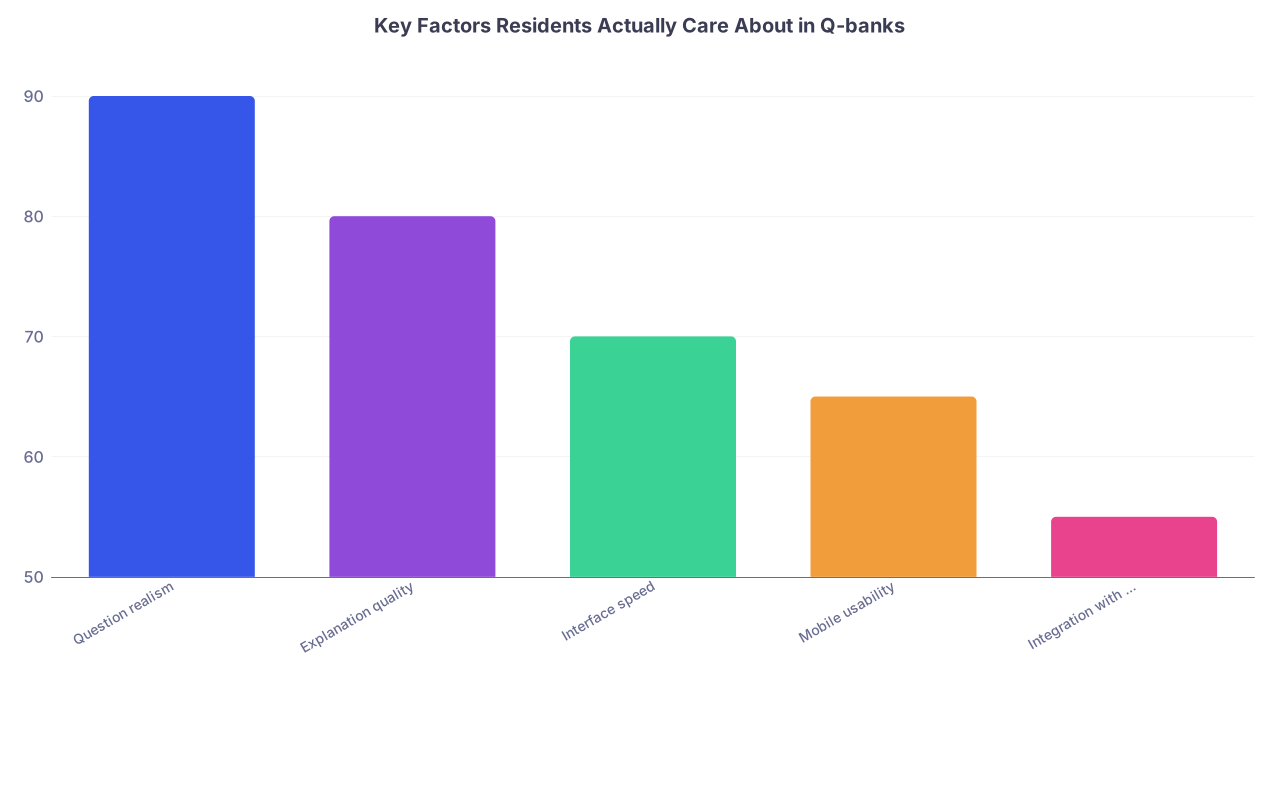
| Category | Value |
|---|---|
| Question realism | 90 |
| Explanation quality | 80 |
| Interface speed | 70 |
| Mobile usability | 65 |
| Integration with notes/Anki | 55 |
When residents say “X is the best,” they usually mean:
- It felt most like the real exam.
- It felt like they were learning something from every missed question.
- It didn’t get in their way with a clunky interface.
- It matched how they liked to study (reading vs. fast-skimming vs. deep diving).
You should talk to 3–5 residents and listen for patterns in those dimensions, not just the name of the bank.
If everyone says:
“Bank A felt like the real thing, but Bank B taught me more early on.”
Then your logical move might be:
- Bank B early → Bank A in the last dedicated push.
Not “only Bank A because that’s what they shout the loudest about.”
Putting this into your actual timeline
Let’s anchor this in something concrete so it’s not just theory.
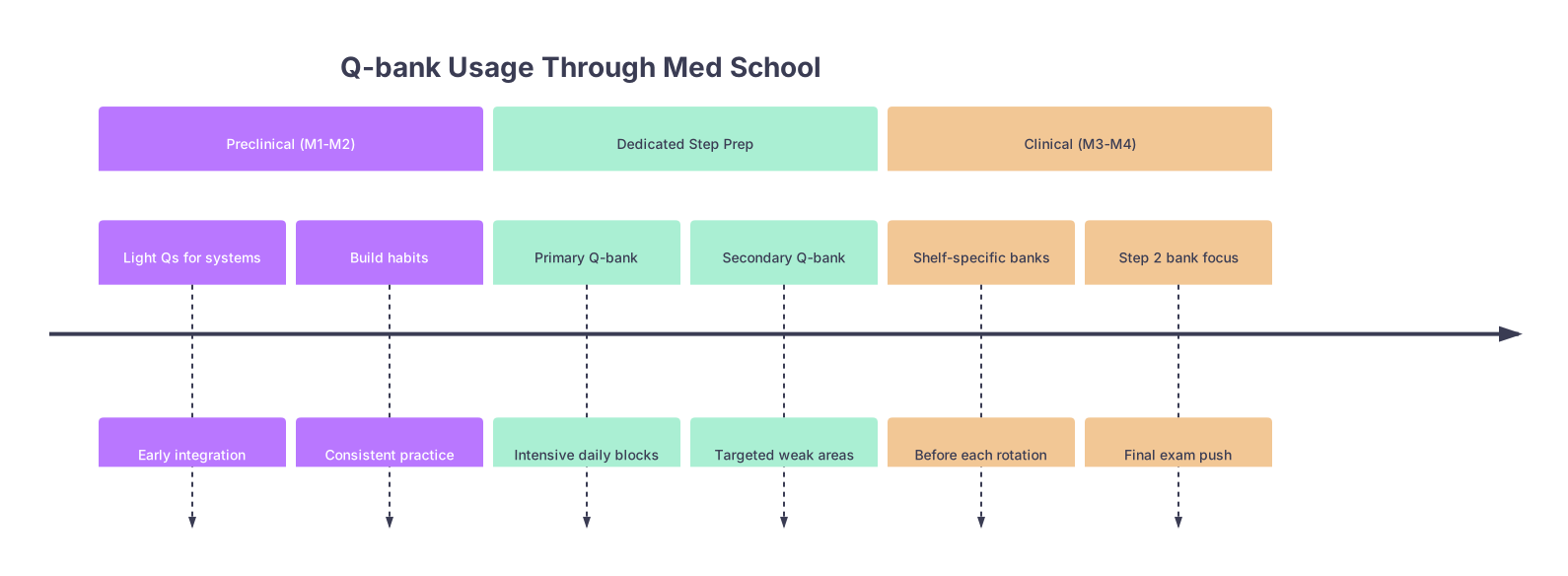
| Period | Event |
|---|---|
| Preclinical (M1-M2) - Light Qs for systems | Early integration |
| Preclinical (M1-M2) - Build habits | Consistent practice |
| Dedicated Step Prep - Primary Q-bank | Intensive daily blocks |
| Dedicated Step Prep - Secondary Q-bank | Targeted weak areas |
| Clinical (M3-M4) - Shelf-specific banks | Before each rotation |
| Clinical (M3-M4) - Step 2 bank focus | Final exam push |
Across that arc:
- You do not need to be on the “perfect” bank from day one.
- You do need to be on some serious question resource once your basic sciences stop being pure theory.
- Residents are most helpful when you ask them specific questions:
“What would you use for IM shelves if you had 3 weeks vs. 8 weeks?”
“If you were retaking Step 2 with a 220 baseline, how would you structure your Q‑banks?”
Those questions smoke out real strategy instead of branding slogans.
The quiet truth: most residents don’t care what you use
I’ll say the quiet part out loud.
Most residents are trying to get through their own 80-hour weeks, survive night float, and barely remember to eat lunch. When they push a Q‑bank to you:
- Some vaguely want to be helpful.
- Some like hearing themselves be the “expert.”
- Some are indirectly selling.
But very few are sitting at home thinking, “I hope Sarah in MS2 uses the right bank or I’ll feel terrible.” They recommend, then they go back to scut, notes, and sign-out.
That means the responsibility lands squarely on you: filter their advice.
Take what applies. Discard what doesn’t. Do not hand over the steering wheel to someone whose main qualification is “I survived this three years ago with a different exam blueprint.”