
The majority of board prep “grind” you see on social media is exactly how strong students quietly wreck their scores.
You’re not losing points because you’re lazy. You’re losing points because the resource ecosystem is designed to pull you into traps that feel productive and are, score-wise, lethal.
Let’s go through the 9 biggest board prep resource traps that tank strong students’ scores—and how to avoid getting sucked into each one.
1. The “Too Many Resources” Flex That Dilutes Your Score
The most common disaster: turning Step/Level prep into a collector’s hobby.
You know this setup. Shelf full of:
- UWorld
- AMBOSS
- Kaplan Qbank
- Boards & Beyond
- Sketchy
- Pathoma
- AnKing
- BRS Physiology
- First Aid
- Random Reddit-recommended extras “just in case”
Then you try to “use them all” because:
“I don’t want to miss anything.”
This is how strong students turn a 245 into a 225.
The mistake is not owning multiple resources. The mistake is pretending you can deeply use more than a small core set in the time you have. Every extra “main” resource dilutes:
- Repetition
- Integration
- Feedback loops (do question → review → retain → see again)
You do 40% of three things instead of 100% of one thing. Boards don’t reward partial mastery.
Here’s the rule that almost nobody follows but high scorers quietly do:
Pick 1 primary Qbank + 1 primary content resource + 1 spaced repetition system. Everything else is bonus/targeted, not main.
Typical high-yield core setups I see work:
| Qbank | Content Video/Text | Spaced Repetition |
|---|---|---|
| UWorld | Boards & Beyond | Anki (AnKing or similar) |
| UWorld | Pathoma + FA | Anki |
| AMBOSS | AMBOSS Library | AMBOSS cards/Anki |
| UWorld | Sketchy (micro/pharm) + FA | Anki |
If you’re “seriously” trying to do:
- UWorld + AMBOSS blocks daily
- Full B&B videos
- Full Sketchy
- 1000+ new Anki cards …you’re not rigorous, you’re scattered.
Avoid this trap:
- Decide your 3 core pillars in writing.
- Everything else goes in a “bonus / if-time” bucket.
- If a new resource comes in, one old one must become “bonus.” No infinite additions.
2. The Passive Resource Binge (YouTube, B&B, Sketchy, Lectures)
Another quiet killer: binge-watching board resources like Netflix and calling it “studying.”
You sit down for “8 hours of Boards & Beyond.” You watch videos at 1.5x speed. You nod along. It “makes sense.” You retain maybe 10%.
Two months later: UWorld feels like a foreign language. You’re mad because you “covered this.”
No, you didn’t. You consumed it.
The mistake here is confusing familiarity with mastery. Your brain loves passive content because it feels good—no struggle, no active recall, no discomfort.
I’ve watched students with color-coded B&B schedules and beautiful Notion dashboards walk straight into below-average scores because they never:
- Forced themselves to retrieve info
- Struggled through questions
- Translated passive knowledge into test-taking skill
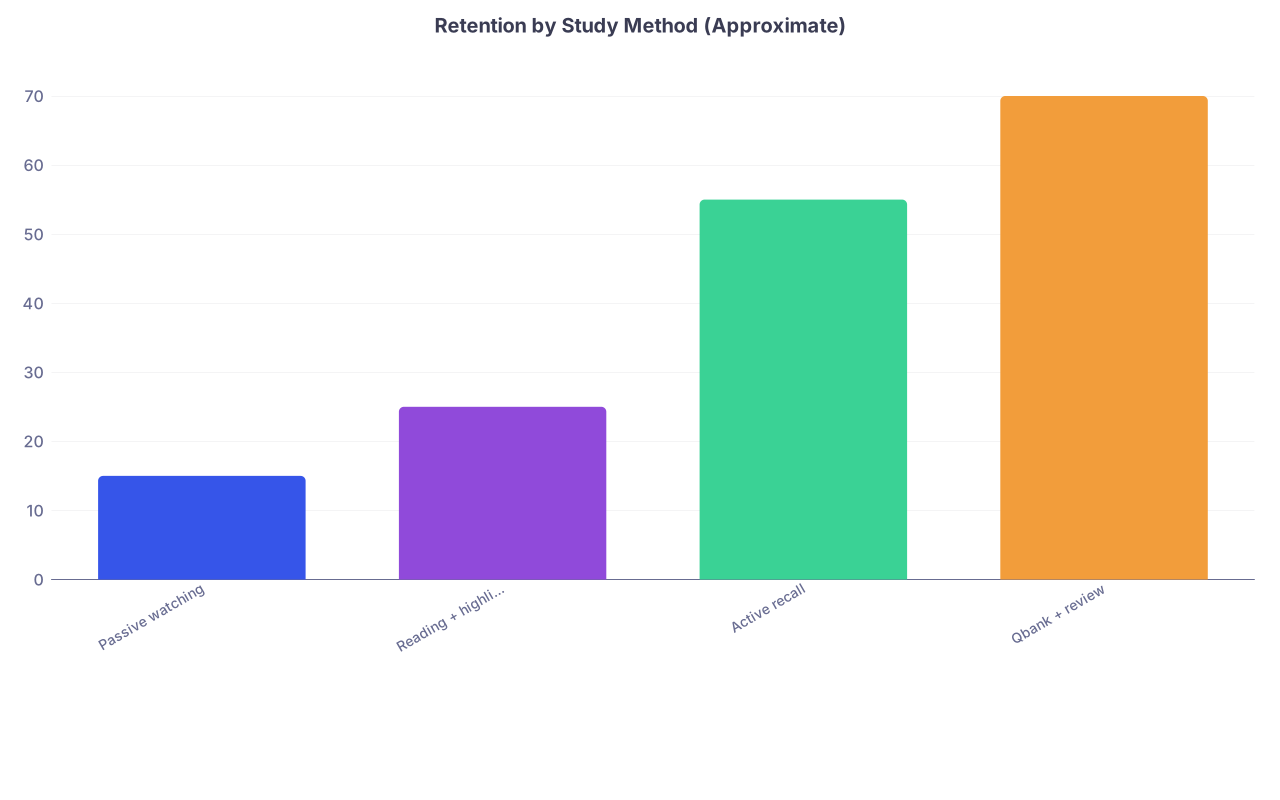
| Category | Value |
|---|---|
| Passive watching | 15 |
| Reading + highlighting | 25 |
| Active recall | 55 |
| Qbank + review | 70 |
Those numbers aren’t exact, but the pattern is real.
Avoid this trap:
- Never watch a video without a specific outcome: “After this, I will answer these 10 questions on X.”
- Stop making “full resource completion” the goal. Make “I can answer these questions correctly” the goal.
- For every 1 hour of video, you should have at least 1 hour of active work (questions, flashcards, teaching, writing from memory).
If your schedule is 70–80% passive resources, you’re walking straight into a score drop.
3. Double Qbank Syndrome: Splitting Focus, Halving Gains
Using more than one Qbank is not automatically wrong. But it’s one of the quickest ways to sabotage strong students when done badly.
Classic pattern:
- You start UWorld.
- It feels hard. You’re at 50–55%.
- You panic: “Maybe I need more exposure.”
- You buy AMBOSS/Kaplan/etc.
- You start doing mixed blocks from both.
- You finish neither properly. Your review becomes shallow, scattered, rushed.
Now:
- Your question-review loop is broken
- You see too few repeats to reinforce learning
- You lose track of progress because metrics are split
The illusion: “More questions = better prepared.” The reality: “More half-reviewed questions = artificially low yield.”
The worst version is doing:
- Qbank A in “learning mode” (no timer, checking after each Q)
- Qbank B in timed blocks So you never learn how to think in exam conditions efficiently with one resource.
Avoid this trap:
- Make one Qbank your “exam simulator” (usually UWorld).
- Only add a second Qbank if:
- You’re ahead of schedule, AND
- You’ve done a full pass of your primary bank with serious review, OR
- You need targeted exposure (e.g., AMBOSS for tricky medicine topics).
- Do not start a second bank because your percentages feel low. Low percentages early are normal.
If you’re under 65–70% through your first bank and already deep into a second, you’re probably hurting your final score.
4. Anki Abuse: Mistaking Volume for Mastery
Anki is powerful. It’s also one of the most misused tools in med school.
Here’s the trap:
- You import a giant deck (AnKing or similar).
- You “must” keep up with 800–1200 reviews a day.
- You spend the best hours of your brain power flipping through cards like a robot.
- You have no brain left for Qbank blocks, deep review, or actual understanding.
I’ve seen students brag about: “I did 1,500 Anki reviews today.”
Then they struggle to break 220/230 because all their time went into shallow recognition on cards they barely made their own.
Common Anki mistakes:
- Treating every premade card as sacred
- Never suspending low-yield or redundant cards
- Doing cards late at night in exhaustion mode (zero retention)
- Using Anki instead of reading explanations in depth
Look at this pattern:
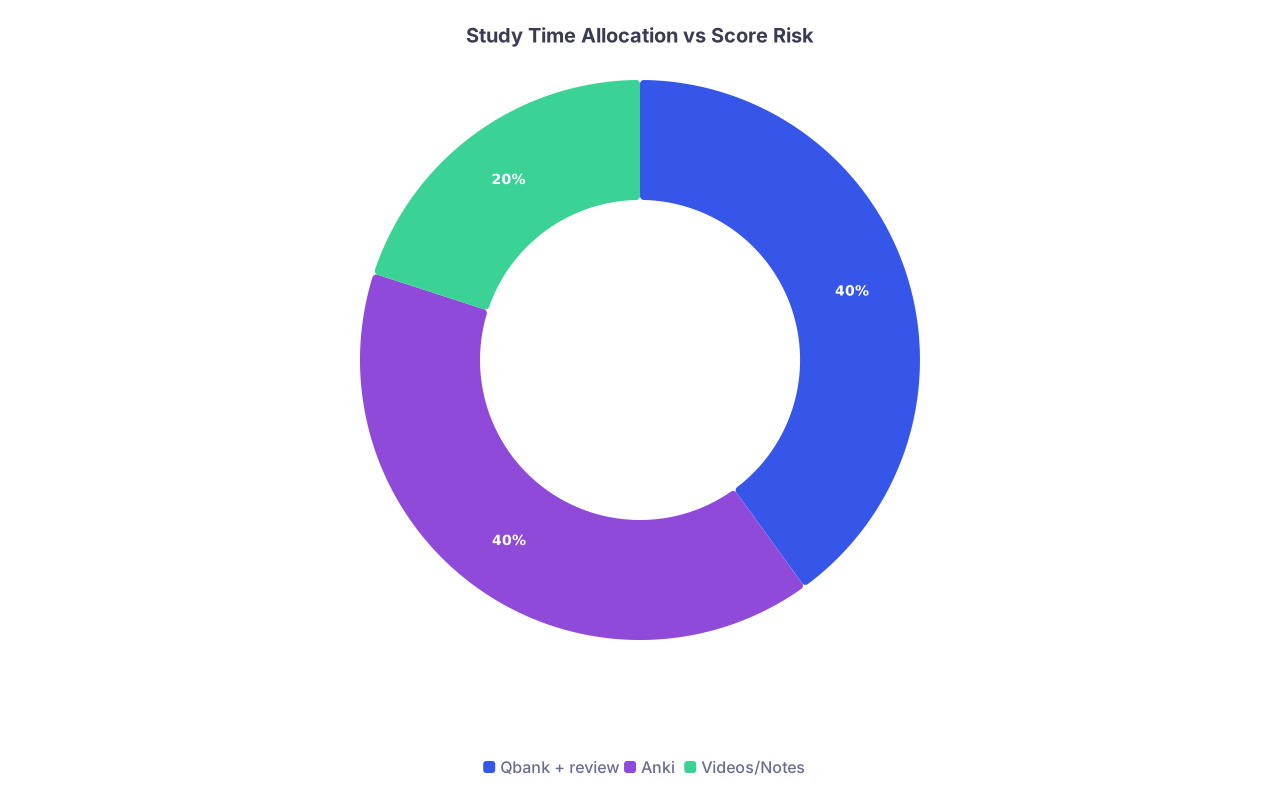
| Category | Value |
|---|---|
| Qbank + review | 40 |
| Anki | 40 |
| Videos/Notes | 20 |
If your day looks more like:
- 70% Anki
- 20% videos
- 10% questions You’re not preparing for a test. You’re gaming a flashcard app.
Avoid this trap:
- Anki is a support tool, not the main event.
- Cap your daily reviews at a number that lets you still do at least one full Qbank block + solid review (for most people, 300–500 mature reviews, adjusted to your pace).
- Ruthlessly suspend:
- Overly detailed cards you always miss
- Obscure minutiae that never show on exams
- Convert missed UWorld concepts into targeted cards, instead of just trusting pre-made decks.
If Anki stress is higher than Qbank stress, your priorities are backwards.
5. The Social Media Study Aesthetic Trap
Instagram and Reddit are full of “perfect” board prep plans:
- 3 Qbanks simultaneously
- Entire video series at 2x speed
- Legend-level Anki streaks
- Handwritten notes in 5 colors
- 12-hour daily schedules with no breaks
You copy this. Because the person posted a 260-something score or claims “250+ first try.”
What you’re not seeing:
- Their baseline test-taking skill
- Their actual efficiency (not what they wrote in a caption)
- What they quietly didn’t finish
- Their mental health and burnout levels
The trap is externalizing your plan. Letting strangers’ screenshots dictate your bandwidth instead of starting from:
- Your timeline
- Your weaknesses
- Your actual energy limits
- Your school schedule and life constraints
I’ve watched strong students throw away a well-designed, realistic plan to copy some random Reddit “7-week cram” schedule… then flame out by week 2.
Avoid this trap:
- Use online plans as reference, not gospel.
- Any plan that assumes:
- Zero fatigue
- Zero life obligations
- Perfect concentration for 10–12 hours daily …is fantasy. Treat it as such.
- Design your schedule based on:
- Your current NBMEs/COMSAEs
- Your honest daily energy (e.g., you’re cooked after 6 focused hours? Plan for 6.)
- Your actual exam date and back-calculate.
If your plan looks amazing on paper but feels impossible by day 3, it’s not “you being weak.” It’s the plan being stupid.
6. “Review Lite”: Glancing at Explanations Instead of Studying Them
Resource trap hidden inside Qbanks themselves.
You do the block. You see the score. You check the correct answer. You kind of skim the explanation. You move on.
You’ve basically thrown away 60–80% of the value of each question.
The trap: treating questions as “tests” instead of “learning vehicles.”
This is what I see from students who tank despite “finishing UWorld”:
- Average review time: 10–15 minutes for a 40-question block
- Only read wrong answer explanations
- Never write anything down
- Never connect the question to a bigger concept or Anki
- Never revisit particularly tricky ones
Good question review is slow, deep, and honestly a little painful. That’s where the score comes from.

| Step | Description |
|---|---|
| Step 1 | Finish Qbank Block |
| Step 2 | Check Score |
| Step 3 | Review All Questions |
| Step 4 | Move On |
| Step 5 | Read Full Explanation |
| Step 6 | Update Anki / Notes |
| Step 7 | Tag Weak Topic |
| Step 8 | Concept Clear? |
Avoid this trap: For each question (right or wrong):
- Can you explain out loud:
- Why the correct answer is right?
- Why each wrong answer is wrong?
- If not, you haven’t actually “reviewed” it.
- For missed questions:
- Write a one-line takeaway. Not rewriting the stem—just the concept.
- Turn repeated misses into cards or quick notes.
If you’re “doing” 80 questions a day but fully reviewing only 10 of them, cut the volume and double the depth. Your score will thank you.
7. Over-Trusting Your School’s Curriculum as “Board Prep”
Big trap, especially at non-top-tier schools, but I’ve seen it happen at “big name” places too.
Faculty say: “Our curriculum is board-focused.” “We integrate Step content.” “We’re above the national average.”
Students believe it. They:
- Skip dedicated board resources during preclinical years
- Trust school exams as “enough”
- Start real board prep way too late
Then they meet their first NBME or UWorld block, and it’s a punch in the face.
The hard truth: even good medical schools are teaching:
- What they value
- What their faculty research in
- What fits logistics of courses
Not necessarily the exact shape and nuance of NBME/COMLEX questions.
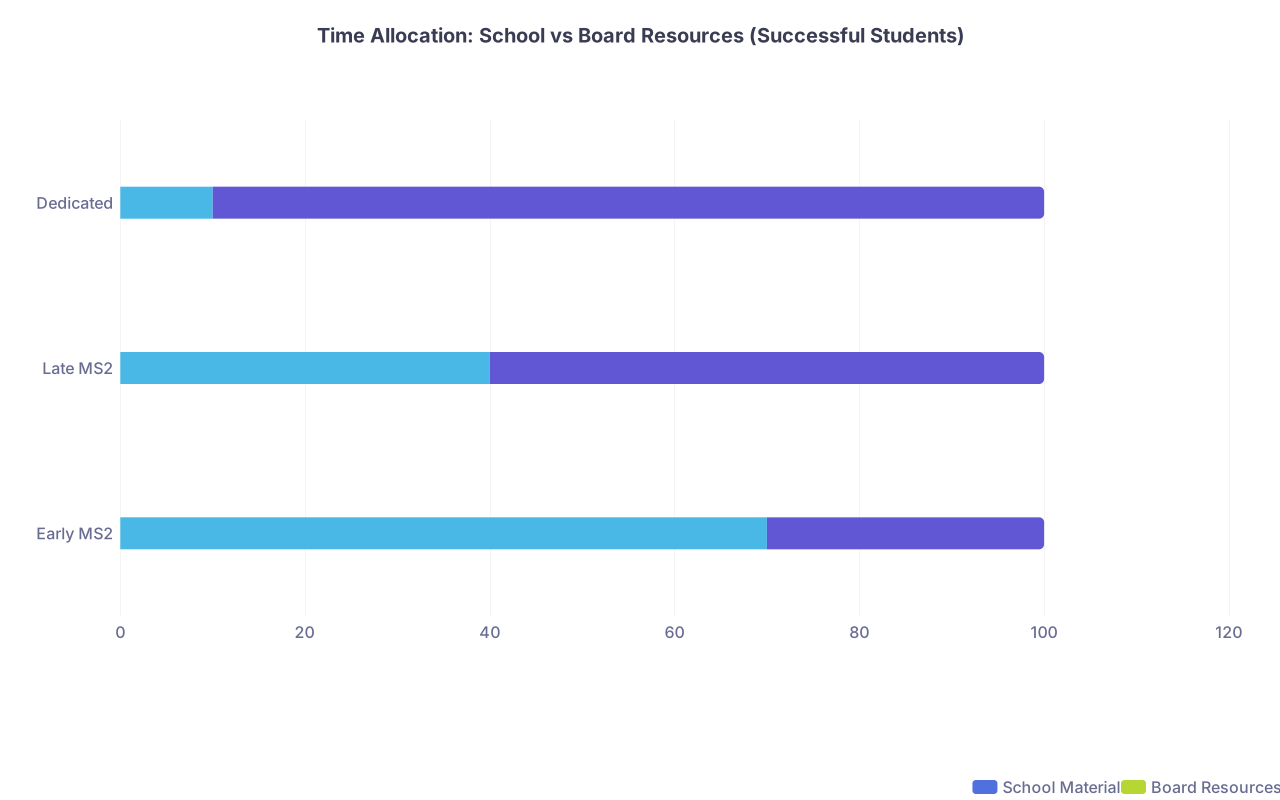
| Category | School Material | Board Resources |
|---|---|---|
| Early MS2 | 70 | 30 |
| Late MS2 | 40 | 60 |
| Dedicated | 10 | 90 |
Avoid this trap:
- Use school as the floor, not the ceiling.
- Starting in MS2 (and honestly late MS1), you should be:
- Doing some board-style questions alongside each system
- Using board-aligned resources (Pathoma, Sketchy, etc.) when possible
- Treat “we are board-focused” as marketing, not protection.
If your first serious board-style exposure is 4–6 weeks before test day, you’re walking in underprepared no matter how high your class rank is.
8. The Last-Minute Resource Hop: Panic Switching
You will have a moment during prep where your scores plateau or drop. That’s normal.
The mistake is what many strong students do next:
- Change everything
- Abandon their main Qbank mid-way
- Start a whole new video series
- Download a new 30k card deck
- Essentially reset their learning environment when they most need consolidation
Panic-switching feels proactive. “My scores stalled with UWorld, I’ll switch to AMBOSS.”
But what you’ve really done is:
- Lost all the value of repeat exposure
- Introduced new style/noise right before the exam
- Sacrificed depth for novelty
I watched an MS2 with consistently 240–245 NBME projections throw away their core plan 3 weeks before Step 1 to follow a friend’s “better” schedule. They tanked a full 15–20 points on test day compared to their practice average.
They didn’t get dumber. They just lost continuity.
Avoid this trap:
- If your scores stall:
- First, analyze why: content gaps? test-taking errors? fatigue? rushing review?
- Adjust how you use your existing resources before adding or switching:
- Longer review time
- Blocking similar topics for a few days
- Doing more untimed/learning blocks temporarily
- Only add a new major resource if there’s a clear, specific deficit:
- e.g., weak in neuroanatomy → target-specific videos or AMBOSS library, not “new everything”
Stability beats novelty in the final 6–8 weeks.
9. Ignoring Practice Exams and Score Feedback
NBMEs/COMSAEs are not optional. They are your reality check. Refusing to take them or pushing them to the very end is essentially flying blind.
The trap:
- “I’ll do more content first so I don’t waste an NBME.”
- “I don’t want to see a low score—it’ll freak me out.”
- “I’ll just trust my Qbank percent.”
Then you walk into the actual exam with a self-created fantasy of where you stand.
I’ve seen this excuse dozens of times:
“I was averaging 65–70% on UWorld, I thought I was fine.”
No NBMEs. No calibration. Just vibes.
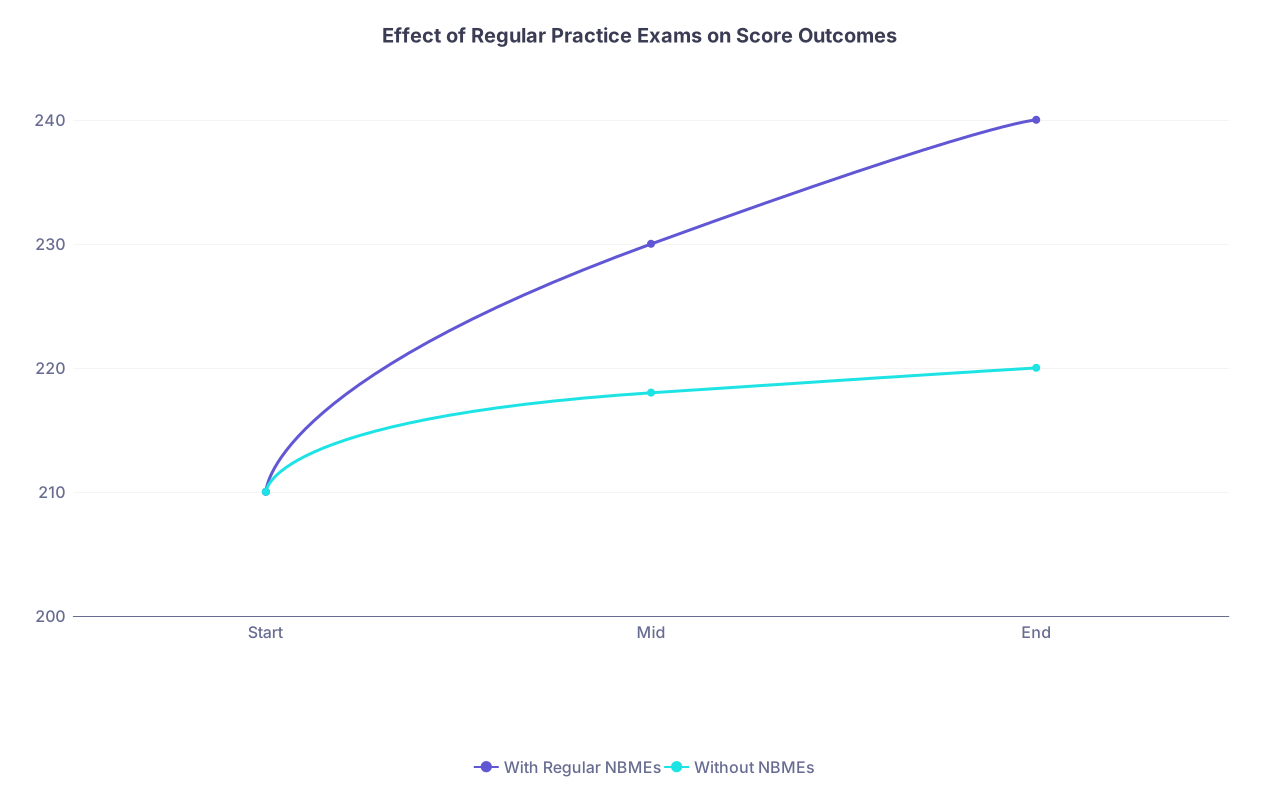
| Category | With Regular NBMEs | Without NBMEs |
|---|---|---|
| Start | 210 | 210 |
| Mid | 230 | 218 |
| End | 240 | 220 |
Again, the numbers are illustrative, but the pattern is real: feedback drives targeted improvement.
Avoid this trap:
- Schedule your practice exams before you start dedicated:
- Example: one NBME/COMSAE near the start of dedicated, then every 1–2 weeks.
- Treat low scores as diagnostic, not identity-threatening.
- After each exam:
- Categorize misses: content vs misreading vs time vs strategy.
- Adjust resource usage based on this, not your mood.
If you’re 3 weeks from your exam and haven’t taken at least 2–3 full practice tests, you’re choosing uncertainty.

How to Stay Out of These Traps (Without Becoming a Monk)
You don’t need a perfect system. You need to avoid dumb, high-cost mistakes.
A sane, trap-avoiding approach usually looks like this:
- 1 main Qbank (UWorld or AMBOSS) → used thoroughly, reviewed deeply
- 1 main content backbone (Pathoma + B&B + FA/AMBOSS/whatever combo that fits you)
- 1 memory system (Anki or similar) → controlled, pruned, not your entire life
- Regular practice exams at defined intervals
- Small, targeted add-ons for specific weaknesses (Sketchy for micro/pharm, a short pharm review, etc.)
And then—this is the part everyone hates—sticking with that plan long enough to let it work, instead of panicking and chasing every new shiny resource.

FAQ (4 Questions)
1. Is it ever smart to use two Qbanks from the start?
Occasionally, but rarely. If you’re very early (MS1/MS2 systems-based) and using:
- One Qbank in tutor mode by system (e.g., AMBOSS),
- And saving another (UWorld) strictly for dedicated in timed mixed blocks, that can work. But if both are being used as “main” banks in the same phase, you’re usually diluting your learning. Most people are far better off mastering one deeply, then using a second only if time clearly allows.
2. How many Anki reviews per day is too many during dedicated?
If Anki is regularly eating so much time or mental energy that:
- You skip or rush Qbank blocks, OR
- You can’t do solid question review, it’s too many. For most students, once you’re hitting 500+ daily reviews and feel constantly behind, you’re in the danger zone. I’d rather see you do 250–400 focused reviews and high-quality Qbank work than 1000 half-conscious card flips.
3. Do I need to completely finish UWorld before my exam?
No. Finishing UWorld is helpful, but not at the cost of rushed, shallow review. I’d rather a student do 70% of UWorld with slow, surgical review and strong retention than 100% with skimmed explanations and no reflection. If you’re close, sure, push to finish. If you’re far, focus on doing what you touch well and using NBMEs to fill gaps.
4. Are school exams a good predictor of board performance?
They’re a weak predictor at best. Doing well in your curriculum means you can learn and grind—great. But the exam format, question style, and emphasis on integration for boards are different. I’ve seen A students score below average on boards after trusting their internal exams as “enough prep.” Use school tests as a foundation, not a forecast. Your real predictor is performance on repeated, well-reviewed board-style questions and practice exams.
Key points to walk away with:
- More resources do not equal more points. Depth with a few beats shallow contact with many.
- Question banks and practice exams are your primary training ground. Everything else is support, not the main event.
- The biggest score killers aren’t lack of effort—they’re scattered effort. Protect your focus, your time, and your review quality, and your score will follow.