
The most common Step prep mistake is not laziness. It is copying someone else’s resource list and calling it a plan.
You know the script. A classmate scores a 250+ on Step 2 or crushes a shelf. They post a breakdown: “I used UWorld x2, Anki, OnlineMedEd, two Qbank add-ons, Sketchy, Boards & Beyond, AMBOSS…” You screenshot it and decide: “I’ll just do exactly that.”
That shortcut is seductive. It is also one of the fastest ways to sabotage your boards prep.
Let me walk through why copying a friend’s resource list so often backfires, the red flags to spot early, and what to do instead so you do not burn three months on a plan that never had a chance.
The Hidden Problem: You Are Copying the Output, Not the Process
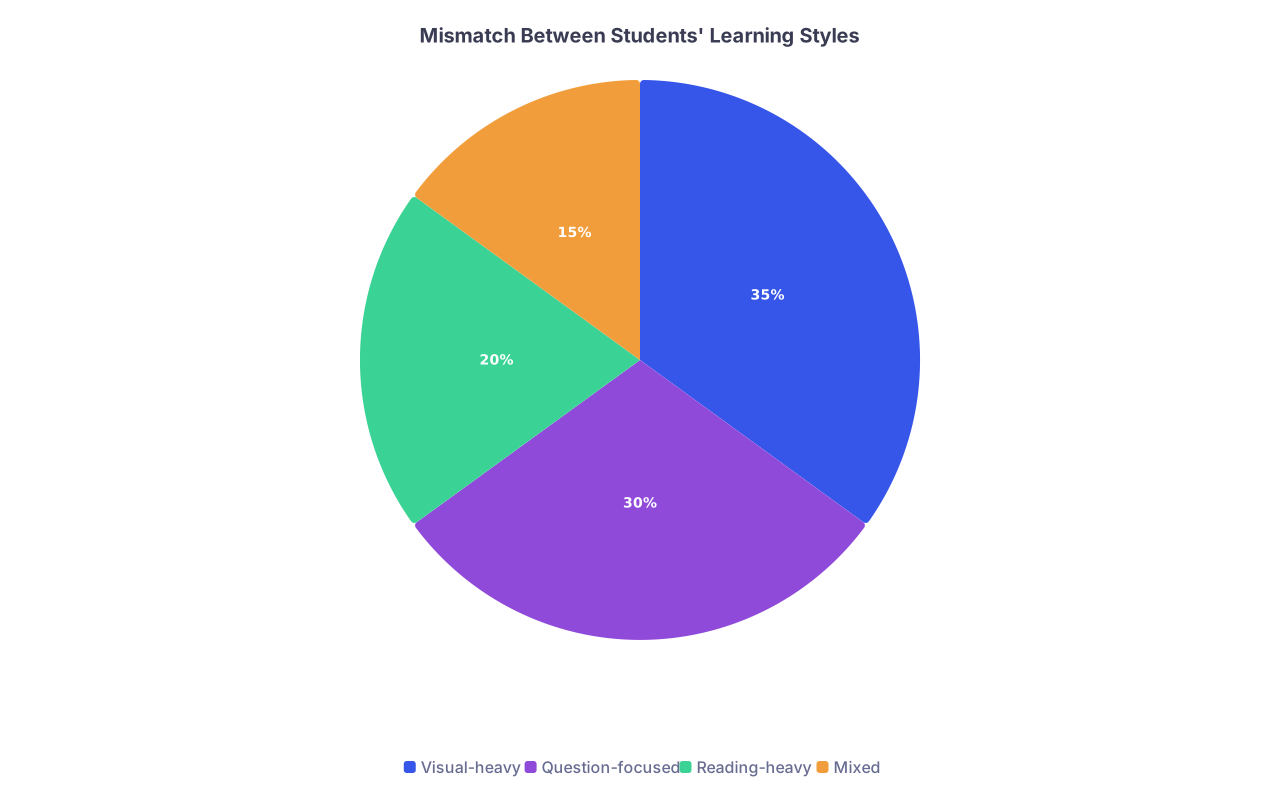
| Category | Value |
|---|---|
| Visual-heavy | 35 |
| Question-focused | 30 |
| Reading-heavy | 20 |
| Mixed | 15 |
The first big mistake: you see the end result (“these are the resources I used”) and assume that equals “this is what caused the score.”
You miss everything underneath:
- Their baseline knowledge.
- Their learning style.
- Their schedule, obligations, and mental bandwidth.
- How they actually used each resource.
A real example I watched up close:
- Student A: Top of the class, strong preclinical foundation, watched maybe 20% of Boards & Beyond, ran UWorld once carefully, used a small, targeted Anki deck, scored 255.
- Student B: Middle of the class, weak cardio and neuro, copied Student A’s resource list exactly, tried to “squeeze in” B&B only for the systems she felt weak in, speed-ran UWorld, half-committed to Anki. Ended at 225 and shocked.
Same resource list on paper. Completely different reality.
You cannot see:
- That your friend may have been barely using half those resources.
- That their “2 passes of UWorld” were actually one careful pass plus a skim of incorrects.
- That they were already scoring 70s on class exams while you were hanging on at 60.
When you copy the list, you are copying the visible layer and ignoring the structure beneath it. That is like trying to copy someone’s fitness routine by only buying the same protein powder.
The Overload Trap: Too Many Resources, Too Little Mastery
The most predictable failure pattern: resource hoarding followed by shallow learning.
You grab your friend’s list:
- UWorld
- AMBOSS
- Anki (full decks like AnKing or Lightyear)
- Pathoma
- Boards & Beyond or Sketchy
- +/- niche books or review PDFs
On paper, this looks “comprehensive.” In practice, you create an impossible task.
Here is what tends to happen:
- Week 1–2: You try to “do everything.” Videos in the morning, qbank in the afternoon, Anki at night. You are permanently behind.
- Week 3–4: You start skipping videos “for now.” Your Anki review pile explodes. You rush qbank questions to hit some arbitrary “X questions per day” goal.
- Week 5+: Panic mode. You start guessing on questions, skimming explanations, and your scores plateau or drop. You feel like you are working nonstop and learning nothing.
The problem is not that the resources are bad.
The problem is that copying someone else’s menu almost always gives you more inputs than you can realistically process with depth.
The boards reward:
- Retrieval practice.
- Repetition.
- Consolidation.
Not “I lightly touched 14 different platforms.”
If you find yourself saying “I am using everything, but I do not feel solid on anything,” you are already in the overload trap.
Misaligned Learning Style: You Are Forcing Yourself Into Their Brain

Your friend might be a visual learner who lives on Sketchy and Boards & Beyond and soaks up long-form explanations effortlessly.
You might not be.
I have seen these mismatches blow up over and over:
- A question-focused learner (learns best by doing questions, then targeted review) copies a video-heavy plan. They spend 4 hours a day passively watching content, half-remember it and cannot apply it on questions.
- A narrative learner (needs context and understanding) copies a “just do UWorld 80 questions/day + review FA/Anki” plan. They get hammered on every block because they do not understand the physiology beneath the memorized facts.
- A slow, deep learner copies the “I did 100 questions per day + all my cards” plan. They fall behind by day 3 and spend the rest of the dedicated period feeling like failures.
Watching someone else’s “perfect” plan work for them while it clearly fails for you is demoralizing. It pushes students into a dangerous mindset: “I guess I am just not smart enough.”
Often, the truth is much less dramatic: you are just using someone else’s strategy on your brain.
That is a fixable problem.
Context Blindness: You Ignore the Parts of Their Life That Made It Possible
You also do not live your friend’s life.
They may:
- Have no kids, no job, no caregiving responsibilities.
- Have parents paying rent so they can study 10 hours a day.
- Be on pass/fail rotations with attendings who barely care where they are.
You may:
- Be on malignant surgery or IM month during your “study” time.
- Have a commute, a partner, a toddler, or financial stress swallowing hours and mental bandwidth.
- Be recovering from burnout or depression.
Copying a resource list without matching the context is fantasy.
If someone tells you they:
- Did two full qbanks.
- Watched every single B&B or OME video.
- Cleared 1,000+ Anki cards per day.
- Read a review book cover to cover.
…you need to ask: “Over how many months? During what rotation? With what other obligations?”
If they say:
- “Oh, I started second year and just kept doing some boards stuff every day.”
- “I was on a chill research year for half of it.”
- “My clerkship schedule was light. We left at 3 most days.”
Then you know right away: you cannot just paste their list onto your calendar and expect similar results.
Data Denial: Copying a Plan Even When Your Scores Say It Is Not Working
Here is a quieter but deadly mistake. You copy someone’s plan, your scores do not move, but you cling to the plan because “it worked for them.”
The red flags:
- You have been on the same resource combo for 4–6 weeks and your qbank percentages or NBME scores are flat or trending downward.
- You are still missing the same category of questions (e.g., endocrine, renal phys, psych pharm) despite “covering” those topics with the same resources your friend swore by.
- You feel like you are going through motions just to say you checked off resources, not because you are actually learning.
Yet you think:
- “If I just finish the second pass of this qbank like they did, it will click.”
- “They said it all came together in the last month; I should just keep grinding the same way.”
No. If your data is telling you this combo is not working for you, continuing just because it worked for someone else is superstition, not strategy.
I have watched students:
- Do a miserable, rushed second pass of UWorld because some high-scorer wrote “UWorld x2 is essential.”
- Force themselves through 50+ Zanki tags/day they do not understand because “everyone uses this deck.”
- Watch videos on 2x for hours while their practice scores stagnate, telling themselves this is just what one “has” to do.
The boards do not reward loyalty to a resource list. They reward adaptation based on actual performance.
The Nuance People Never Publish in Their “Step Score Reports”
People rarely tell the whole story in those score breakdown posts and hallway flexes. Not because they are lying. Because they forget how messy their own process actually was.
What they usually omit:
- The things they tried and abandoned. (“I did AnKing for 3 weeks, hated it, and switched to making my own cards.” You will never see this in the clean Instagram post.)
- The resource they barely used. (“I had AMBOSS but only did 200 questions.” On the report it looks like “resources used: UWorld + AMBOSS.”)
- The early failed NBMEs. (“I started at a 198.” What they publish: “Final: 245.”)
So when you copy their list, you copy their cleaned-up retrospective story, not the trial-and-error they lived through.
You skip the experimental part and pretend there is a finished “correct” list. There is not.
A Better Approach: Build a Minimal, Personalized Core — Then Adjust

| Step | Description |
|---|---|
| Step 1 | Baseline Self-Assessment |
| Step 2 | Core = Qbank + Targeted Notes |
| Step 3 | Core = Videos + Limited Qbank |
| Step 4 | Core = Text + Qbank |
| Step 5 | Add 1-2 Support Resources |
| Step 6 | Track Scores & Stress Weekly |
| Step 7 | Continue & Refine |
| Step 8 | Remove or Replace Resource |
| Step 9 | Primary Mode? |
| Step 10 | Improving? |
I am not telling you to reinvent everything from scratch or ignore what worked for others. That is just another extreme.
Here is the safer, smarter alternative to blind copying.
1. Start with you, not with them
Ask yourself:
- Do I learn best by:
- Doing questions and reading explanations?
- Hearing and visualizing pathways and mechanisms?
- Reading structured text and making outlines?
Pick a core resource strategy that matches that.
Examples:
- Question-focused core: UWorld + detailed review + brief notes / limited Anki.
- Video-focused core: Boards & Beyond or OnlineMedEd + one qbank.
- Reading-focused core: high-yield text (e.g., Step Up / similar) + one qbank.
Key point: one main qbank. One primary learning mode. Not six.
2. Limit your initial resource list
Use your friend’s list as a menu, not a prescription.
Choose:
- 1 main qbank (UWorld or AMBOSS, usually).
- 1 primary content resource (videos or text).
- Optional: 1 memory aid system (Anki or Sketchy, not both full-blast as a default).
That is it for the first 3–4 weeks. You earn extra resources later, after you prove you can handle the core.
3. Match your plan to your actual life
Look honestly at your schedule:
- On surgery with 5 a.m. rounds? You cannot run a 5-resource plan. Period.
- On an easy elective? You can afford a heavier video and Anki load.
Build a weekly skeleton, not a fantasy day:
- “On busy days I will do 20–30 questions + review.”
- “On lighter days I will do 40–60 questions or a mix of questions and 2–3 focused videos.”
If your friend’s list demands 5–6+ hours per day and you realistically have 3–4, you either cut resources or extend your timeline. You do not just hope the hours appear.
4. Use other people’s success stories surgically
Instead of copying the entire thing, pull specific tactics:
Examples:
- “They flagged every question they guessed on and reviewed those at the end of the week.” That is a tactic you can adopt within your own core resources.
- “They journaled missed questions by pattern (e.g., misread question, weak concept, poor processing).” Again, adopt the method, not the resource spread.
- “They switched from passive watching to active pause-and-recall during videos.” That improves any video plan.
Mining tactics is smart. Copying unfiltered resource lists is not.
5. Let your data and stress be your guide
Set up two checkpoints:
- Objective: qbank percentages, NBME/COMSAE practice scores.
- Subjective: daily stress level, burnout symptoms, ability to actually concentrate.
If, after 3–4 weeks:
- Your performance is stable or improving, and
- You feel tired but not destroyed,
you can consider adding a single supporting resource (e.g., Sketchy micro if micro is a persistent weakness).
If:
- Scores are flat or down, or
- You feel chronically behind, anxious, and skimming everything,
your move is not to add more. It is to cut.
Drop the least used or least effective resource. Shrink your world until you can do what remains with depth.
Practical Red Flags: When Copying a Friend’s List Is Already Hurting You
Here are concrete signs the plan you copied is working against you:
- You cannot explain how each resource fits into your day. You are just “trying to get through them.”
- You regularly think, “I should do X because they did X,” instead of “I do X because it clearly helps me.”
- Your Anki review count is unmanageable (500+ overdue) and you keep resetting or suspending random cards out of panic.
- You are watching videos at 1.75–2x speed and zoning out, but you are afraid to stop because “everyone uses this.”
- You are finishing question blocks but barely reading explanations, telling yourself you will “come back later” (you will not).
- You feel guilty whenever you consider dropping a resource, as if you are betraying the formula.
If two or more of those are you, the copied plan is already backfiring.
A Quick Comparison: Copy-Paste Plan vs. Tailored Plan
| Aspect | Copy-Paste Friend’s List | Personalized Core Plan |
|---|---|---|
| Number of resources | 4–8 | 2–4 |
| Basis | What worked for someone else | Your learning style + schedule + baseline |
| Feelings by week 3 | Behind, scattered, guilty | Tired but grounded, clear what matters |
| Adjustment trigger | “But they did it, so I should too” | “My scores/stress tell me to add or cut” |
| Risk of burnout | High | Moderate to low (if monitored) |
The second column is how people accidentally burn out. The third is how people quietly, boringly, successfully prepare.
No drama. Just consistent, focused work with a sane resource set.
FAQ: Copying Friends’ Resource Lists for Boards
1. My friend scored 260+ using five different resources. Should I at least try to do the same?
No. Their score does not prove all five resources were necessary. It only proves that they got that score while using those tools in their specific context. Start with a lean, realistic plan that fits your life, then adjust if you clearly have bandwidth and data supporting expansion.
2. Is there any situation where copying someone’s plan makes sense?
The only time it is semi-reasonable is when your situation matches extremely closely: same school, same curriculum, very similar grades, similar responsibilities and time, and you have a similar learning style. Even then, you should treat their plan as a template to modify, not a script to obey.
3. How do I know if I am using too many resources?
Three quick checks:
- You cannot describe in one sentence what each resource is doing for you.
- You feel behind every single day despite studying consistently.
- Your scores are not improving despite spending large chunks of time “covering” material.
If that is you, cut down to one main qbank + one main content resource and rebuild from there.
Key points:
- Copying a friend’s resource list without matching their context, baseline, and learning style is one of the fastest ways to waste your boards prep.
- Fewer resources used deeply will almost always beat a bloated list used superficially.
- Let your own performance data and stress levels, not someone else’s score report, drive how you choose and adjust your board prep resources.