
It’s late March. You matched. You’re relieved, your family is thrilled, your group chat is full of celebration screenshots.
But under all that: a pit in your stomach.
Your Step scores are on the low end for your specialty. Maybe you barely passed Step 1 on the second try. Maybe your Step 2 CK is a 219 going into an IM or EM program where your co-interns will be 250+ monsters. Maybe your school exams have always been a grind and you’re walking into residency thinking, “They’re going to find out I’m the weak link.”
You’ve got a few months before orientation. Enough time to either spin in anxiety and doom-scroll Reddit… or to use this window like a professional who knows their weak points and armors up.
This is where you are:
- You already matched. Damage to “competitiveness” is done and irrelevant.
- Scores are no longer for applications. They’re a proxy for how you’ll handle in-training exams, board certification, and just plain keeping up.
- You want a concrete, resource-focused plan that actually makes you better before July. Not vague “read more” advice.
Let’s build that.
1. Get Real About Your Situation (Not Your Ego)
Before picking resources, you need an honest snapshot of what you’re up against.
Skip the feelings for a minute and answer these concrete questions:
What’s actually weak?
- Bare pass on Step 1 (or multiple attempts)?
- Low Step 2 CK (e.g., <225 when matched into a relatively competitive field)?
- Shelf exams consistently below average?
- Or you just feel slow and scattered when reading and answering questions?
What specialty did you match into?
- Knowledge-dense: IM, peds, FM, anesthesia, neuro.
- Procedure-heavy: surgery, EM, OB/GYN.
- Board-pass-rate-sensitive: FM, IM, peds, psych (programs get judged hard on this).
How much runway do you actually have?
- 3–4 months with light responsibilities? Whole different plan.
- 4–6 weeks because you’re traveling or working another job? We’ll be ruthless.
Now, match that to your goal. And be honest:
Your goal right now is not to “be brilliant.” It’s:
- Avoid being the obvious knowledge liability on day one.
- Set yourself up to pass your specialty boards and in-training exams.
- Build a system that you can continue in residency, not just pre-residency cramming.
That means your resources must do three things:
- High-yield core knowledge
- Question-style thinking
- Realistic daily workload
Let’s get specific.
2. Core Reality: Weak Scores Need Structure, Not Just More Books
If your scores are weak, your problem is usually not “I didn’t own enough resources.” It’s:
- Unstructured studying
- Passive reading instead of active practice
- Poor recall of previously “learned” material
- Not enough repetition
So everything I’m about to recommend is anchored on this structure:
- One core text / video resource for foundations
- One question bank as your main training ground
- One spaced repetition system (Anki or similar) to actually retain any of this
No more than that. If you pile on 6 resources, you’ll dabble in all and master none. I’ve watched too many residents “start” 3 Qbanks and finish none.
3. Specialty-Specific Resource Game Plans
Here’s where we stop being generic. You matched already; now we plan for in-training exams (ITE) and later board exams.
I’ll break it down by broad specialty group, with concrete resource sets you can use.
| Specialty Group | Core Text/Review | Main Qbank | Extra (Optional) |
|---|---|---|---|
| IM | MKSAP (students/early) | UWorld IM or MKSAP Qs | NEJM Knowledge+ |
| FM | AAFP Board Review | AAFP Qbank | UWorld mixed IM/FM |
| Peds | PREP | PREP Qs | MedStudy Peds |
| EM | Rosh Review | Rosh Qs | EM:RAP C3 or EM Boot Camp |
| Surgery | SCORE | SCORE Qbank | TrueLearn Surgery |
| Psych | Lange/APA review | Beat The Boards or NEJM+ | Question banks attached to main course |
This table is a starting frame. I’ll add detail by group.
Internal Medicine / Transitional / Preliminary Medicine
If you matched IM or a prelim year with heavy medicine:
Core knowledge:
- MKSAP (Student or Early Residency version): Gold standard for IM. Concise, clinically focused. Don’t read it cover-to-cover now. Use it with Qs.
- Alternative if you want something lighter: Step-Up to Medicine as a “quick and dirty” refresher before diving into deeper resources as an intern.
Questions:
- MKSAP Qbank or UWorld Internal Medicine (if you still have access):
- Do random-timed blocks of 10–20 questions.
- Focus on explanation understanding, not just correctness.
Strategy for a weak-scorer:
- Don’t binge-read full MKSAP sections. Pick a system per week (cardio, pulm, ID), do 10–20 questions/day from that system, then read targeted sections for missed questions.
- Keep a small Anki deck of “stuff-that-keeps-burning-me” — not everything, just your genuine blind spots.
Family Medicine
Your risk: FM boards are broad, and many programs quietly panic about board pass rates. If your test history is shaky, you’ll be on their radar whether they say it or not.
Core:
- AAFP Board Review (video + syllabus) – accessible, board-style, and focused on exam content rather than esoterica.
Questions:
- AAFP Qbank (very exam-focused).
- Supplement with UWorld (IM-heavy) for adult medicine depth if time allows.
Plan:
- 20–30 questions/day, biased toward bread-and-butter: HTN, DM, prenatal care, well-child checks, derm basics, MSK, psych, preventive care.
- One topic-focused video or chapter per day (e.g., asthma management, contraception, common rashes).
Pediatrics
If you matched peds and your scores are weak, you must respect how detail-heavy pediatric boards and ITEs are.
Core:
- PREP (American Academy of Pediatrics): this is the standard, yes it’s dense.
Questions:
- PREP Qbank – these mimic real ITE/boards style better than generic Step-ish Qbanks.
Plan:
- Ignore the idea of “finishing PREP before residency.” That’s fantasy.
- Instead: 15–20 PREP questions/day, targeted review of explanations, and build a small deck of repeated misses (e.g., vaccine schedules, congenital heart disease patterns, developmental milestones).
Emergency Medicine
EM is deceptively test-heavy: you’ll face in-service exams, plus written and oral boards later.
Core:
- EM:RAP C3 or EM:RAP CorePendium – high-yield audio + text. Great if you like learning while walking or driving.
- Alternatively: EM Boot Camp for concise, visual explanations.
Questions:
- Rosh Review for EM – honestly, non-negotiable if your scores are already weak.
- Their questions are super board-aligned and explanations are clean.
Plan:
- Focus heavily on life-threatening / high-yield patterns:
- Chest pain, shortness of breath, abdominal pain, altered mental status, pediatric emergencies, trauma.
- 20 Rosh questions/day, timed, with post-block review.
- Use audio (EM:RAP) while exercising or doing chores to reinforce major topics you keep missing.
General Surgery
If you barely scraped through Step and you’re heading into gen surg, here’s the blunt truth: your life will be time-poor. You need something you can continue even when on q4 call.
Core:
- SCORE curriculum (if your future program provides it; many do).
- If not yet available to you, use Surgical Recall as pre-residency scaffolding. It’s not “board review” but it makes you fluent in the language and thinking.
Questions:
- SCORE Qbank or TrueLearn Surgery In-Training Exam Qs.
Plan:
- Right now, focus on:
- Trauma basics
- Post-op complications
- Fluids/electrolytes
- Abdominal pain differentials
- 10–15 high-quality questions per day (this is realistic with your pre-residency time; later in residency you’ll be happy to hit 5–10 on some days).
- Use question explanations to drive targeted reading in SCORE or a concise surgical text.
Psychiatry
Psych boards are tricky if your test-taking is weak because they involve:
- Nuance (diagnostic criteria)
- Long stems
- Treatment subtleties
Core:
- Lange Q&A Psychiatry or a structured board review text (like Massachusetts General Hospital Psychiatry Board Review).
- Or a dedicated board course text if you know you’re high-risk.
Questions:
- Beat The Boards or NEJM Knowledge+ Psychiatry when available; both are structured for exams.
- If money is tight, lean on book-based question sets and any question banks your school/library offers.
Plan:
- Emphasize:
- DSM-5 disorders (major categories + must-not-miss)
- First-line vs second-line treatments
- Side effect profiles, black-box warnings, and interactions
- 15–20 questions/day with a small Anki deck focused on diagnostic criteria and drug facts.
4. Your 8–12 Week Pre-Residency Plan (With Weak Scores in Mind)
Now, let’s turn this into an actual schedule you can follow without burning out before July.
Assume you have ~10–12 weeks and can commit 2–3 focused hours/day, 5–6 days/week. If you have less time, cut volume, not structure.
Weekly Structure
Questions:
- 100–150 questions per week (about 15–25/day on weekdays).
- Mix of random and system-focused blocks.
Targeted review/reading:
- 1–2 hours/day reading/explaining around your missed questions.
- No reading “for fun” without questions anchoring it.
Spaced repetition:
- 20–40 Anki cards/day from a custom deck of your own misses.
- If you try to start a massive premade deck now, you will drown. Don’t.
Here’s a sample 4-day micro-schedule (repeat with new topics):
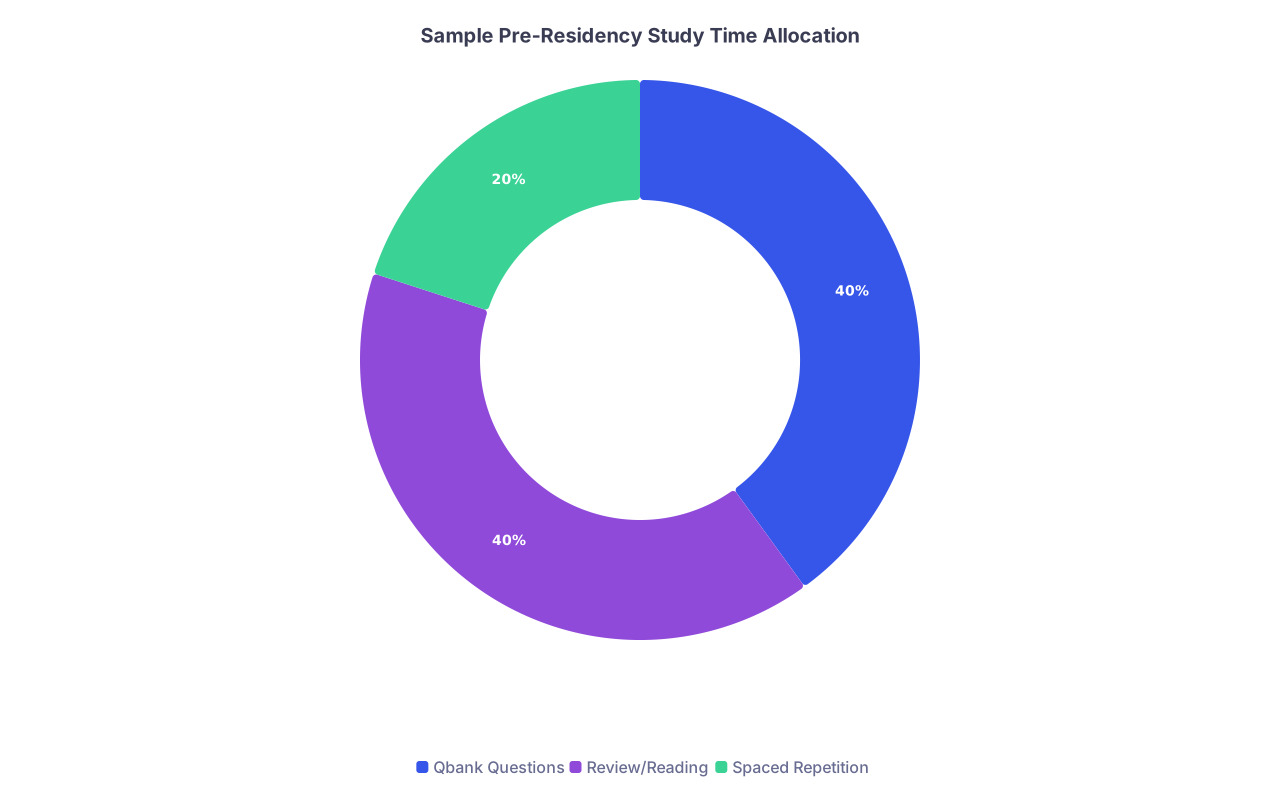
| Category | Value |
|---|---|
| Qbank Questions | 40 |
| Review/Reading | 40 |
| Spaced Repetition | 20 |
- 40% of time: doing questions
- 40%: reviewing explanations + short targeted reading
- 20%: Anki / flashcards
This ratio works for weak test-takers because it keeps you in active retrieval mode instead of drowning in text.
5. Fixing the Test-Taking Problem, Not Just the Knowledge Gap
Weak scores usually aren’t purely knowledge. They’re often:
- Poor time management per question
- Misreading stems
- Panicking when you don’t immediately know the answer
- Not having a repeatable process
You can actually train this.
A simple question-answering process
For every single Qbank block before residency, force this pattern:
- Read the last line of the question first (“What is the next best step?” “Most likely diagnosis?”).
- Skim the answer choices quickly.
- Now read the stem once, calm, pen in hand:
- Underline age, vitals, key words (acute vs chronic, recent meds, risk factors).
- Before looking back at answers, say to yourself (out loud or in your head):
“I think the answer should be ___ because ___.” - Then match your predicted answer to the closest option.
Why? Because this builds clinical reasoning instead of answer-choice hunting, which burns weak test-takers.
When reviewing questions:
- For every miss, write a one-sentence takeaway:
- “Young woman with RUQ pain + oral contraceptives → hepatic adenoma, not FNH.”
- “DON’T give beta-blockers in acute cocaine-associated chest pain.”
- Turn that into a card or a 2–3 bullet note. Not a paragraph.
6. Cheap and Free Resources If You’re Broke (Or Just Done Paying)
You might have spent thousands on applications, flights, and deposits. You’re sick of subscriptions. Fine. Let’s be strategic.
High-yield low/zero cost options:
Amboss (trial + occasional institutional access)
Good for organized, quick topic reviews and their question bank. If your med school still gives you access, squeeze it.Your future program’s resources
Email your incoming chief or coordinator:- “Hi, I’m really motivated to hit the ground running. Do incoming interns get early access to SCORE/MKSAP/Rosh/etc.? I’d love to start using it now if possible.” Sometimes they’ll add you early or share institutional login info.
Podcasts / audio
- IM/FM: Curbsiders, Core IM
- EM: EM:RAP, EMCrit, Core EM
Use them while commuting or exercising. They’re not Qbank replacements, but they reinforce patterns and language.
Old textbooks / PDF chapters from your school library
Use them surgically. If Qbank keeps burning you on, say, cirrhosis complications, go read just that one focused chapter.
7. Managing the Psychological Piece So You Don’t Self-Sabotage
Let me be blunt: if you walk into residency with a “I’m the dumb one” script looping in your head, you’ll freeze, avoid asking questions, and ironically learn slower.
You’re not trying to prove that past scores were “wrong.” You’re trying to build competence now.
A few rules to keep your head straight:
Stop sharing your Step scores.
- Your co-interns don’t need them.
- Your attendings already saw your file or don’t care.
- Repeating them out loud just digs the shame trench deeper.
Set performance metrics you control:
- “I will do 100 questions per week.”
- “I will finish my review of all major ICU topics by July 1.”
- “I will maintain my Anki reviews daily.” Not: “I will be the smartest intern.”
Practice saying “I don’t know” in a competent way:
- “I’m not sure, but my instinct is X because Y.”
- “I’m not certain, I’d like to look that up after rounds.”
Residents with weaker test histories often overcompensate with fake confidence or go totally silent. Both backfire. The right move is humble + prepared.
8. How to Transition This Plan Into PGY-1 Life
The biggest trap: you crush a few weeks of pre-residency studying, then July hits, you’re drowning, and everything collapses.
So whatever you start now must be sustainable at 30–60 minutes/day once you’re an intern.
Think forward:
- Can you keep doing 10–15 Qbank questions per day?
If yes, build that habit now. - Can you review Anki 20 minutes before bed?
Start that exact routine now. - Weekly structure idea as an intern:
- Weekdays: 10–15 questions/day
- One weekend chunk: 1–2 hours to review a topic you saw a lot on the wards and felt shaky on.
Set up your accounts and decks so that on July 5th, exhausted after call, you don’t need to make decisions. You just open the app and do your minimum.

9. Sample 6-Week Action Plan (If You’re Starting Late)
If it’s already May and you start in late June, here’s a realistic template:
Week 1–2:
- Choose and set up:
- 1 main Qbank
- 1 core text/video source
- A small custom flashcard system
- Focus on your specialty’s bread-and-butter:
- IM: cardio, pulm
- FM: HTN, DM, preventive care
- Peds: infections, vaccines, dehydration
- EM: chest pain, SOB, abdominal pain
- Surg: post-op complications, trauma
- Psych: mood disorders, anxiety, psychosis
Week 3–4:
- Add complexity:
- IM: renal, ID
- FM: prenatal care, peds basics
- Peds: neonatology, fever in kids
- EM: trauma, sepsis, toxicology basics
- Surg: acute abdomen, ICU basics
- Psych: substance use, personality disorders
- Start mixing some random blocks instead of only system-tagged.
Week 5–6:
- Mostly random blocks within your specialty content. Simulate in-training style.
- Keep notes on recurring weaknesses and hit those chapters specifically.
- Taper slightly in last 5–7 days before orientation so you don’t start residency already exhausted.

| Step | Description |
|---|---|
| Step 1 | Matched with Weak Scores |
| Step 2 | Choose Core Resources |
| Step 3 | Set Weekly Qbank Targets |
| Step 4 | Create Small Custom Flashcard Deck |
| Step 5 | Daily Routine: Qs + Review + Cards |
| Step 6 | Track Weak Topics |
| Step 7 | Targeted Reading on Weak Areas |
| Step 8 | Transition Plan for PGY-1 |
10. What To Ignore Right Now
Let me save you time and anxiety. You do not need to:
- Read full-length massive textbooks cover-to-cover.
- Start three competing question banks “for variety.”
- Spend hours in random online forums doom-reading about malignant programs.
- Try to “catch up” to a fictional co-intern who did a research year in your field and quotes guidelines in their sleep.
Your win condition is simple:
- You know the common stuff cold.
- You have a functioning system for continuing-to-learn questions and spaced repetition.
- You aren’t paralyzed by your past scores.
That’s it.
Key Takeaways
- You already matched; now the game is: build actual competence, not cosmetic competitiveness. One core resource, one Qbank, and a small, targeted flashcard system are enough if used consistently.
- Aim for 100–150 questions per week plus focused review, biased toward bread-and-butter topics in your specialty, with a daily routine that you can shrink but not abandon once residency starts.
- Stop obsessing over past scores. Use this pre-residency window to build habits and resources you can carry into PGY-1, so you’re not the intern who’s both sleep-deprived and starting from zero.