
It’s March of M3. You just got your shelf score back from IM and it’s… fine. Not great. Not terrible. You’re sitting in the call room scrolling Reddit threads about Step 2 CK and every other post is some random stranger’s “resource list.”
UWorld. Amboss. OnlineMedEd. Anki. Boards & Beyond. Divine. Sketchy. Some people used all of them. Some people used two. Everyone “highly recommends” whatever they happened to pass with.
You’re trying to decide what to use for Step 2, and in the back of your mind is this thought you do not want to fully say out loud:
“Step 1 is pass/fail now. Step 2 is the number that’s going to follow me.”
Let me tell you why that thought is correct—and why your choice of Step 2 CK resources matters a lot more than whatever you did for Step 1.
And I’ll tell you what attendings and PDs say when you are not in the room.
The quiet shift: Step 2 is the new filter
Programs used to say: “We don’t screen by Step score, we holistically review.” That was never fully true. But now, with Step 1 pass/fail, they have even less reason to pretend.
Behind closed doors, here’s what changed:
Before:
- Step 1: Main numeric filter
- Step 2: “Nice to see,” maybe used to confirm Step 1
Now:
- Step 1: Binary noise
- Step 2: Primary numeric filter. Period.
I’ve sat in meetings where the PD pulls up the spreadsheet and the first visible columns are: School, Class Rank/Quartile, Step 2 CK, Research count. That Step 2 column isn’t decoration. It’s the sorting key.
So when you think about “resources for Step 2,” you’re not picking study aids. You’re picking the tools that will determine the only standardized number most programs will ever see on you.
Your Step 1 resource mistakes could be hidden by “Pass.” Your Step 2 resource mistakes are going to be printed on every ERAS report.
Why Step 2 resources matter more than Step 1
On paper, it sounds backwards. Step 1 was the basic science monster, Step 2 is “just clinical knowledge,” right?
That’s exactly the trap.
For Step 1, most of you used the same three things: First Aid (or Boards and Beyond), UWorld, Anki. The ecosystem was fairly standardized. Even if you flailed a bit, the sheer volume of Step 1 guidance online kept you from going completely off the rails.
Step 2 is different. There is no universally agreed-upon “bible.” The exam changed, the blueprint shifted towards management and next best step, and the market exploded with products trying to be “the new gold standard.”
That means two things:
- It’s very easy to waste 3–4 months in the wrong mix of resources.
- The alignment between your resources and how Step 2 actually tests you matters a lot.
Step 1 was heavy recall and pattern recognition. Step 2 cares if you think like a halfway-competent intern. Not if you memorized ten different pneumonia risk factors. Whether you know what to do with the patient in front of you.
Resources that teach you to think that way will raise your score. Resources that keep drilling raw facts like it’s Step 1 with a stethoscope slapped on? They will cap you.
And yes, I’ve watched people get stuck in the 230s and 240s because of this.
What program directors really look at now
Let me be blunt: a 252 on Step 2 CK does not make you God’s gift to medicine. But it absolutely moves your file from “maybe later” to “let’s actually read this.”
PDs deny cutoffs publicly. In private, they share them with their coordinators.
| Specialty Tier | Common Step 2 CK Filters* |
|---|---|
| Super competitive (Derm, Ortho, ENT, Plastics, NSG) | 250+ to stand out, 240s often soft floor |
| Competitive (Rads, Gas, EM at strong places) | 240+ competitive, <230 often tough sell |
| Mid (IM, OB/GYN, Gen Surg community/low-tier academic) | 230–240 solid, <220 risky outside home/state |
| Less competitive (FM, Psych, Peds) | 220+ usually fine, but 240+ opens doors at top programs |
*Not official, not published. But I’ve heard these numbers come out of PDs’ mouths.
Why this matters for resources: you don’t need “the best” resource list. You need the correct system to push you into the bracket where your application actually gets read.
The wrong resources—or too many—don’t just waste time. They flatten your growth right where you can’t afford plateau: that 230 → 245 jump.
The single biggest Step 2 mistake: treating it like Step 1
You know what I see all the time?
Someone who did well on Step 1 (or would have, if it were still scored), tries to brute-force Step 2 the same way:
- Massive Anki decks
- Seven different video series
- Random “comprehensive” notes that are actually just Step 1 with a new label
- Barely any timed mixed blocks
They’re clinging to content security instead of shifting into decision-making mode.
Step 2 questions are not asking, “What’s the mechanism of this drug?” They’re asking, “What are you going to do, right now, for this 67-year-old with mild chest pain, normal troponin, and risk factors?”
And that’s where resource choice either trains your brain the right way—or locks it in Step 1 mode and quietly sabotages your score.
The resources that matter for Step 2 fall into three buckets:
- Question banks (your primary learning engine)
- Explanatory frameworks (videos, notes, concise texts)
- Reinforcement tools (Anki, small review decks, targeted references)
If you pick wrong in bucket 1, I don’t care what you use for 2 and 3. You’re building on sand.
The core of Step 2 prep: Qbanks, and why your choice is not neutral
Let me lay this out without sugarcoating.
There are really three Qbank tiers that matter for Step 2 CK:
| Tier | Resource | Role |
|---|---|---|
| Non‑negotiable Core | UWorld | Primary Qbank, closest to NBME style |
| Strong Supplement | Amboss | High-yield explanations, good for weak areas |
| Situational | Kaplan / Others | Only if you’ve exhausted the above or are remediating |
If someone tells you they prepped for Step 2 without UWorld and “did fine,” what they are really telling you is: “I got lucky that my test lined up with my shelves and my clinical exposure.”
Program directors know this. When residents talk about the exam, they talk in UWorld language. “This felt like UWorld but slightly easier/harder” is literally how people describe their test on the drive home.
UWorld: How you use it matters more than whether you use it
I’ve seen people do 2 full passes of UWorld and land at 232.
I’ve seen others do 60–70% of UWorld, slow and surgical, and hit 255+.
The difference is not “hard work.” It’s how they used the resource.
The people who plateau do this:
- Untimed, tutor mode, system-based blocks
- 10–20 questions at a time
- Reading every single explanation top to bottom like a textbook
They feel productive. They are not training the actual exam skill: fast, mixed clinical reasoning, under fatigue.
The ones who jump:
- Start timed, random blocks way earlier than they feel ready
- Use missed questions to build short, focused notes or cards on concepts, not details
- Revisit explanations only to clarify reasoning, not to memorize every sentence
So yes, your choice of Qbank matters. But your pattern of use matters more. Step 2 is a performance test, not an encyclopedic test.
Supplementary resources: when they help and when they just dilute you
Here’s the part vendors will not tell you: every additional resource has a cognitive tax. Not just in time, but in contradictory frameworks.
Attendings see this game from the other side. M4 gives a long, confused answer on rounds, and the attending asks, “Where did you learn that?” The answer is usually, “Uh… I watched this video/used this deck…”
What they really mean is: “I’ve consumed so many different explanations that I can’t tell which one is actually correct for boards vs for real life.”
Let’s be precise about what helps for Step 2 CK.
Videos (OnlineMedEd, Boards & Beyond, etc.)
They’re useful if:
- Your clerkship teaching was trash
- You never really understood the foundations of a topic (e.g., renal, acid-base, OB)
- You use them early, during rotations, not 3 weeks before your exam
They hurt you when:
- You binge-watch entire series “just to feel more prepared”
- You’re re-learning things you already know instead of doing questions
- You’re chasing the illusion of coverage instead of level-raising your weak spots
Amboss
Amboss is strong. The integrated library, the “attending tip,” the scaffolding—they’re excellent for quickly patching gaps after a bad shelf or a string of wrong UW questions.
But I’ve seen students treat Amboss as a second full Qbank equal to UWorld. That’s unnecessary for most people. Amboss shines as:
- A targeted supplement for weak systems (neuro, OB/GYN, heme/onc)
- A fast second look if you have time after one solid run of UWorld and NBMEs
Using both heavily, in parallel, from day one usually means this: you diluted your pattern recognition. You see fewer questions from each bank, your repetition drops, and your retention falls.
Anki and prebuilt decks
Let me say this clearly: huge Step 2 decks can absolutely kill your score if you use them wrong.
They help when:
- You make or heavily prune your own cards based on your missed questions
- You keep it small and focused: management algorithms, “next best step” flows, quick triage rules
They hurt when:
- You adopt a 20k-card Step 2 deck two months before your test
- You spend 3–4 hours a day “keeping up with reviews” instead of doing questions
- You treat card completion as the main metric of progress
You’re not in M1 anymore. You don’t need to memorize the Krebs cycle. You need to not miss preeclampsia management at 3 a.m. when you are mentally tired.
Timing: Step 2 prep is not just a “dedicated period”
This is where I see a lot of students blow it because they copied Step 1 culture.
Step 1 had this big, dramatic, “dedicated” block. You could be mediocre all preclinical and then turn it on for 6–8 weeks and fix a lot of damage.
Step 2 doesn’t work like that, not if you want to be above average.
Your real Step 2 prep started the day you walked onto your first clerkship. Not in a motivational poster way. In a resource choice way.
The students who crush Step 2 usually do this:
- During each rotation, they run 0.5–1 pass of the relevant UWorld section
- Treat each shelf like a mini-Step 2 that forces them into mixed clinical thinking
- Use one consistent framework resource (like OME or Amboss articles) across the whole year
By the time they hit their “dedicated” Step 2 window, they are not learning medicine from scratch. They’re just consolidating and moving everything into NBME-style form.
The ones who get burned:
- “Save UWorld for dedicated”
- Rely entirely on random school-provided shelf books or outdated PDFs
- Bounce between three different resources every clerkship and never build a stable pattern
Then they hit their 4–6 week Step 2 block and realize: “Oh. I’m not polishing. I’m building.” That is late. Very late.
A sane, high-yield Step 2 resource strategy (that PDs would quietly approve of)
Let me pull this together into something concrete, because theory is useless if it doesn’t survive your actual schedule.
Phase 1: Clerkship year (slow burn, high leverage)
Your main resources:
- UWorld Step 2 CK (system/rotation-based at first, then gradually more mixed)
- Either Amboss or a single video/notes framework (not all of them)
Your pattern:
- For each rotation: target 50–75% of the relevant UWorld questions during the block
- Read brief explanations, write down or card only recurring weak points
- Use your chosen framework resource to shore up confusing topics, not everything
You’re not trying to be exam-ready yet. You’re trying to make sure that by the time you reach “dedicated,” nothing on Step 2 feels like a brand-new language.
Phase 2: 6–8 weeks before Step 2 (actual score-building)
Now your resources narrow, not expand.
Primary:
- UWorld (finishing first pass, then incorrects or marked)
- NBME practice exams + UWSAs
Secondary:
- Small Amboss blocks for trouble areas
- Your own short notes/Anki with highly curated cards
Your focus shifts from “Do I know enough content?” to “Am I making the correct decision fast enough, often enough, under fatigue?”
This is where most people mess up by chasing more resources instead of more reps in the right format.
To make it painfully clear: during this period, adding a brand-new video series or a huge card deck is almost always a net negative.
How PDs interpret your Step 2 performance (the part no one tells you)
On the other side of all these choices is a single three-digit number.
Here’s what that number actually whispers to a program when they see it:
260+: “This person adapts fast, has strong pattern recognition, and likely did not waste time in the wrong resources.” You will get read almost anywhere your application isn’t obviously misaligned.
245–259: “Solid. Probably used UWorld well, decent clinical reasoning. We don’t worry you’ll struggle with in-service exams.” For many specialties, this is a sweet spot.
230–244: “Fine, but we’re looking at the rest of your file for red or green flags.” If you’re applying to a competitive field, your research, letters, and school reputation now have to carry weight.
<230: “We need a reason to take a chance.” This is where things like upward trend, strong home letters, unique contributions, or being from the home institution matter a lot.
Is this harsh? Yes. Is it fair? Not always.
But when you understand that is how the number is read, you stop playing with your resource list like it’s a buffet and start treating it like an investment portfolio.
Because that’s exactly what it is.
The behind-the-scenes truth: most students are using too much, not too little
I’ve watched internal review data at a few schools. Here’s the pattern that keeps coming up, and nobody publishes it:
Students who did moderately well (235–245 range) almost always used:
- 1 primary Qbank
- 1 secondary learning resource
- Limited, focused Anki or self-made notes
Students who underperformed their potential often used:
- 2–3 Qbanks
- 2–3 video platforms
- Multiple big pre-made Anki decks
- AND random PDFs / notes from upperclassmen
They weren’t lazy. They were drowning in resources.
Everyone loves to say “use what works for you.” I’ll be more direct: if “what works for you” involves five different primary resources, it does not work. You are just getting away with it because you’re smart and the bar is low in your class.
Step 2 raises the bar. The exam doesn’t care that watching videos feels productive. It only cares whether you can pick the right answer in 90 seconds on question 235 of your test.
Choose resources that train that. Ruthlessly cut the ones that don’t.
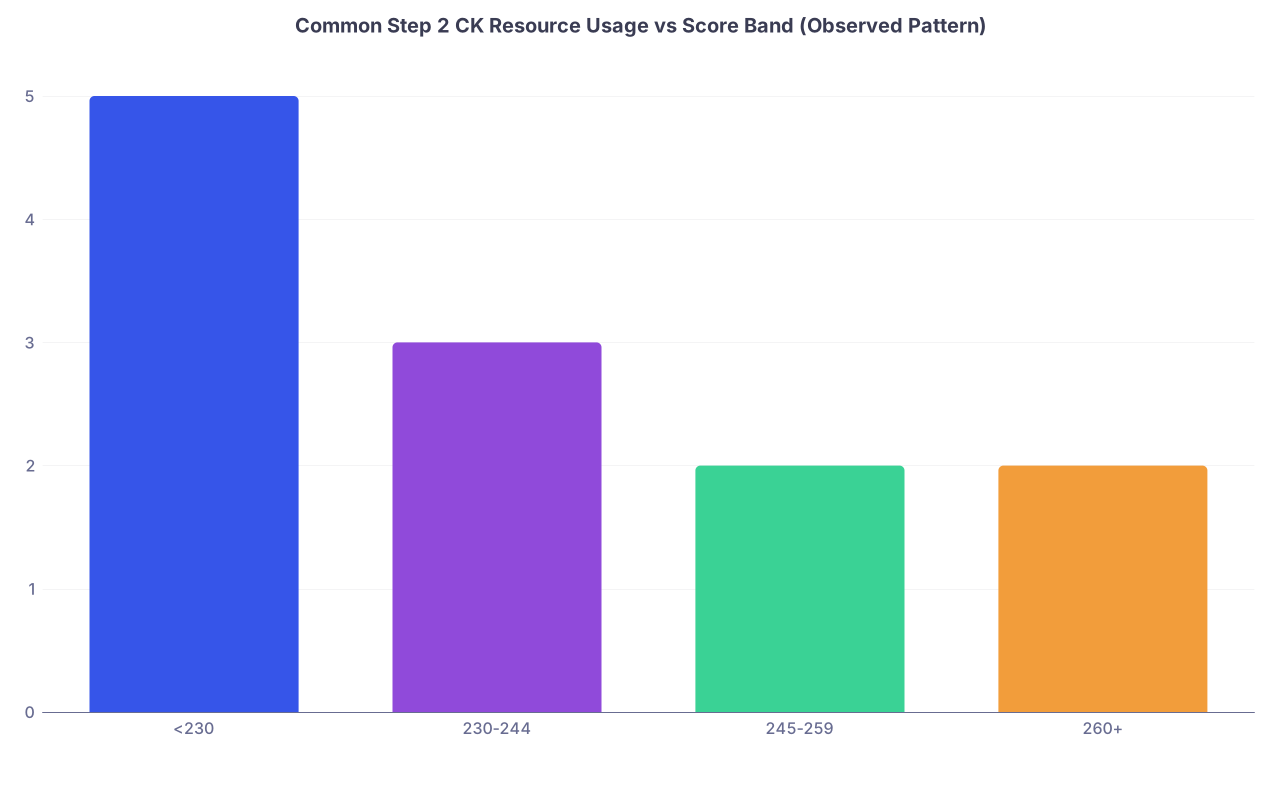
| Category | Value |
|---|---|
| <230 | 5 |
| 230-244 | 3 |
| 245-259 | 2 |
| 260+ | 2 |
(Approximate average number of major resources students report using in each score band in internal advising data sets. More isn’t better.)

| Step | Description |
|---|---|
| Step 1 | Start Step 2 Planning |
| Step 2 | Finish UW + NBMEs |
| Step 3 | Prioritize UW during late M3 |
| Step 4 | Add targeted Amboss/notes only |
| Step 5 | Stay with current core resources |
| Step 6 | NBMEs to assess |
| Step 7 | Schedule exam |
| Step 8 | Have you done UW on rotations? |
| Step 9 | Score plateaued? |