
The way you choose your exam prep resources is outing you to program directors.
They can tell who’s a serious test-taker and who’s just playing “study cosplay” before you ever step into an interview room. Not because they stalk your Amazon orders—because of the patterns they see year after year in scores, in how people talk about prep, and in how residents perform once they show up.
Let me walk you through what they actually notice, what they talk about behind closed doors, and which choices quietly signal: this person knows what they’re doing.
What Program Directors Actually See (That You Don’t)
Program directors don’t see your bookshelf. They see outcomes.
They sit with spreadsheets: Step scores, shelf scores, in-training exam percentiles, board pass rates. Then they hear residents talk about how they studied. Patterns appear, and those patterns get remembered.
This is the quiet part no one says out loud: over time, PDs and core faculty form strong opinions about certain resources and study behaviors, and they absolutely stereotype applicants based on them.
Things they pay attention to:
- Whether your board scores match what a “serious prep pattern” usually produces
- How you talk about prep during interviews and on away rotations
- Whether you sound like someone who trained to take exams or someone who just “used some resources”
And they talk. The IM PD and the surgery PD at the same hospital trade notes about trends. Chiefs tell them which interns can’t interpret simple acid–base at 2 a.m. They look backward: “How did this person prep?” Then they form mental buckets.
You want to live in the “this one takes exams seriously” bucket.
The Resource Signature of a Serious Test‑Taker
No, there isn’t one magical resource that proves you’re serious. But there is a pattern. And most PDs can smell it from your score report and your story in about two minutes.
There are five big tells they pay attention to.
1. Question Banks: How You Used Them, Not Just Which One
Everyone says they used a Qbank. That’s meaningless.
Program directors care about how you used it, how early, and whether your choices line up with your performance.
The serious test‑taker pattern for Step 1, Step 2, and shelves looks like this:
- A primary Qbank, used in tutor mode early, then in timed blocks later
- Completed close to 100% of questions (not “I got through like 60% but reviewed my wrongs closely”)
- Mixed blocks by system and difficulty once content review is done
- Second pass or a complementary Qbank for weak areas if there’s time
What PDs learn over time:
- The “I only did half of UWorld but I watched a lot of videos” crowd performs inconsistently and often underperforms their NBME practice tests.
- The “I crushed every question bank twice and barely reviewed rationales” crowd tends to have surface-level pattern recognition and gets exposed on nuanced clinical decisions during residency.
They listen for specifics:
If you say in an interview, “I used a question bank,” that’s fluff.
If you say, “I did 40 mixed UWorld questions a day in tutor mode starting six months before my dedicated, then shifted to 80 timed mixed questions per day during dedicated and reset my lowest systems,” that sounds like someone who lives in the 230–250+ world.
They’ve heard this kind of breakdown from their strongest residents. The phrases are burned into their brains.
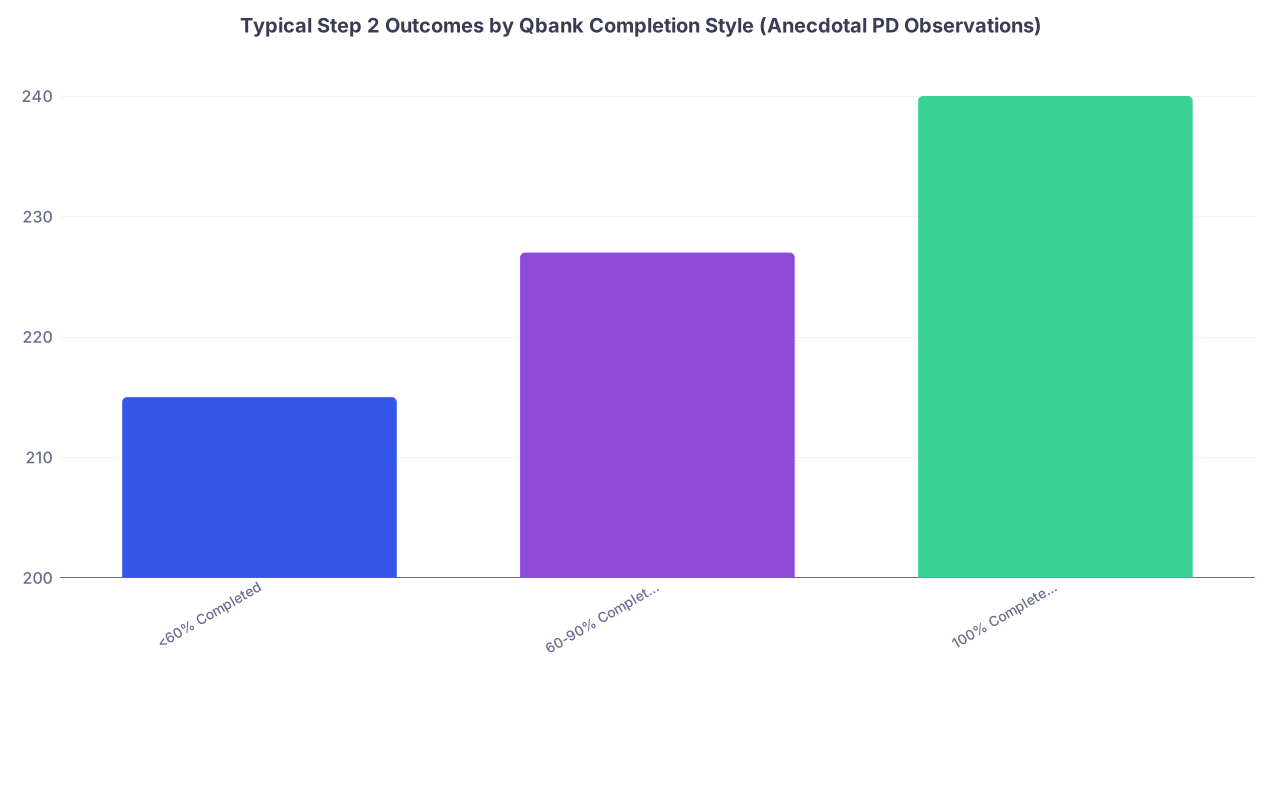
| Category | Value |
|---|---|
| <60% Completed | 215 |
| 60-90% Completed | 227 |
| 100% Completed + Review | 240 |
These are not controlled trials. These are patterns directors see when they cross-reference: “How did you prep?” with “What did you score?” after listening to hundreds of people.
You want to sound like someone who trained with questions the way athletes train with reps. Intentional, progressive, data-driven.
The Red-Flag Resource Choices PDs Quietly Judge
There are certain stories that make PDs internally wince, even if they’re smiling on the surface.
I’ve heard versions of these in closed-door rank meetings more times than I can count:
“Great personality, but listen to how they described studying for Step 1. That’s why they have a 205.”
Or: “If they used that strategy for boards, I don’t trust them with our in‑training exam.”
Here are the big red flags.
1. “Video Maximalists” With Weak Scores
This is the classic one:
“I used Boards and Beyond, Pathoma, Sketchy, OnlineMedEd, and then some YouTube channels. I watched everything on 1.5x speed.”
Translation to an experienced PD:
You binged passively and did not grind enough questions.
Faculty have watched tons of students who bragged about finishing every video series but never finished UWorld. Many landed in the low 210s or failed a shelf here and there. Over time, PDs form a mental shortcut:
Heavy video + light Qbank = passive learner = risk.
Video isn’t the problem. But when your resource stack is 90% video subscriptions with no strong Qbank story and your score is mediocre, the pattern is glaring.
2. “I Just Used Class Notes”
Every PD has at least one story like this:
Student: “Honestly I just used my school’s notes, I felt they prepared me well.”
Outcome: Below-average Step score, struggles on off-service rotations.
What directors hear: You didn’t take ownership. You let your curriculum dictate your prep. Serious test‑takers build their own system with external resources that are proven.
Relying on internal lecture slides for boards is like training for a marathon by “just walking a lot in the hospital.” It’s activity, not preparation.
3. Random Free Stuff and No Spine
The “everything is free” approach:
- Free Anki decks downloaded without structure
- Random YouTube videos
- PDF dumps from upperclassmen
- “A little bit of AMBOSS, a little bit of UWorld when my friend gave me access”
PDs have heard this in various forms. The problem isn’t frugality. The problem is chaos.
Serious people pick a backbone—one main Qbank, one main reference, one primary deck—and then add extras. Dabblers collect resources like Pokémon and never build depth.
4. Over-Reliance on Commercial Courses as a Crutch
Some PDs have a visceral reaction to certain commercial courses—especially when a student only did the course and not much else.
On a rank meeting once, an associate PD literally said, “He sounded like a commercial for [big test prep company]. Those kids usually underperform because they think the course will do the work.”
If all you can say is, “I took the [Brand Name] live course and followed their schedule,” it can sound like you outsourced your strategy and just followed a script. They want self-directed learners.
What Impresses PDs: The Serious Prep Blueprint
Now let’s flip it. What actually sounds like a serious test-taker to program directors and attendings who’ve seen this play out?
Three big themes: structure, data, and alignment between your choices and your outcome.
1. Clear Primary Resources With a Backbone
Serious students can name their core stack in one breath:
“For Step 2, I used UWorld as my main Qbank, AMBOSS as a reference for explanations, NBME practice exams to track progress, and Anki (light) for things I kept missing.”
Notice the structure:
- One main Qbank
- One main explanation/reference resource
- One spaced-repetition element
- Formal practice exams as checkpoints
You’d be surprised how rare that level of clarity is when you actually ask people. The residents PDs trust most talk this way. Organized. Intentional.

2. Early, Iterative Use of Question Banks
PDs can distinguish the last‑minute cram artist from the slow-burn grinder by how they describe timing.
The serious template sounds like:
- Started doing system-based questions early in the course
- Integrated Qbank questions with blocks, not just saved for “dedicated”
- Switched to mixed blocks before the real exam
- Used performance data to double down on weak areas
When someone says, “I didn’t really start questions until dedicated because I wanted a solid foundation first,” most seasoned faculty have one thought: you were behind before you started.
That pattern has burned too many people.
3. Deliberate Use of Anki and Spaced Repetition
Anki itself isn’t impressive. Anyone can download a deck and sync it to their phone.
What impresses PDs is when it’s clear you used it like a professional uses a tool:
- Targeted cards on your misses, not just mindless Zanki firehose
- Consistent daily reviews during clerkships, not multi-day lapses
- Focus on high-yield concepts, images, algorithms
The people who say, “Yeah, I tried Anki but it wasn’t for me,” often overlap with those who plateau on NBME practice tests.
The people who say, “I did 200–300 targeted reviews a day tied to what I was missing in UWorld,” often have the higher Step 2 CK scores. PDs connect those dots.
How This Leaks Out During Interviews and Rotations
You’re probably thinking: they don’t see what I subscribed to. So how can they tell?
They listen. And they watch how you think.
A few common scenarios.
Scenario 1: The Interview “How Did You Prepare?” Question
They don’t always ask it directly as “What resources did you use?” Sometimes it’s framed as:
“Tell me about a time you prepared for something high‑stakes.”
Or: “How did you approach Step 1/2?”
Weak answer:
“I used a bunch of resources—videos, question banks, some Anki. Mostly followed what my friends did.”
Strong answer:
“I treated Step 2 like a job. Six months out, I started 20–40 UWorld questions a day in tutor mode linked to my rotations. I tracked my weaknesses—OB, renal, heme-onc—and adjusted my schedule around those. Two months out I moved to 80 timed, mixed blocks per day and used NBME exams every 2 weeks to recalibrate. I kept a small deck of Anki cards only for concepts I repeatedly missed.”
The second answer screams: serious test-taker. Even if the exact resources are different, the pattern—deliberate, data-driven, iterative—is what PDs lock onto.
Scenario 2: On Service With You at 3 a.m.
They’re not consciously thinking, “What resources did this person use?” at 3 a.m. during sign-out. But your resource decisions show up in your cognition.
- Do you recognize bread‑and‑butter patterns instantly? That’s heavy question-bank exposure.
- Do you know management algorithms cold (DKA, ACS, sepsis bundles)? That’s usually integrated Qbank + Anki.
- Do you bog down in minutiae but miss priorities? That’s classic passive video overload with not enough timed questions.
Attendings who’ve been around long enough can almost guess which type of prep you did based on how you reason through cases. They won’t always say it, but they see it.
The Specific Resources PDs Quietly Respect (and Why)
No, there’s no formal list taped in a PD office. But there are patterns in what they hear from their highest-performing residents.
Let’s be blunt: certain names come up over and over when PDs ask an intern who crushed Step 2 or an in‑training exam, “How did you study?”
This is the rough, reality-based hierarchy many PDs implicitly form:
| Resource Type | Typical PD Perception |
|---|---|
| Major Qbanks (UWorld, AMBOSS) | Core, serious, expected |
| Official practice exams (NBME/COMSAE/CCS) | Gold standard benchmarks |
| High-yield texts/guides (First Aid-style, concise handbooks) | Solid if combined with Qbank |
| Videos (Boards & Beyond, Sketchy, OME) | Useful adjuncts, not sufficient alone |
| Massive general review books | Old-school, often inefficient |
Program directors aren’t sitting there ranking resources on a whiteboard. But they hear outcomes tied to these all the time. Over time you see comments like:
- “Most of my residents who did well used UWorld heavily.”
- “Our COMLEX-only students who finally touched UWorld for Step 2 tended to jump ahead.”
- “People who rely entirely on videos and PDFs struggle on our in‑training exam.”
They’re not scientists in this context. They’re pattern recognizers.
What PDs Think When They See a Score–Resource Mismatch
There’s another subtle layer: how your story fits your outcome.
When Your Score is High but Your Story is Sloppy
Example: Step 2 CK 255, but you say:
“Honestly I winged it. I just did some questions the last month and it worked out.”
Do some PDs believe you? Not really. Most think you’re either downplaying your effort, lack insight, or you’re naturally gifted but not systematic.
Genius without process can be a liability in residency. They like process.
When Your Score is Mediocre but Your Story is Perfect
Example: Step 2 CK 222, but your study story sounds like a textbook:
“I did 80 UWorld questions a day for three months, fully reviewed every explanation, did Anki daily, and took four NBMEs.”
Many PDs will think: either you’re exaggerating, or your execution was poor, or you lack metacognition. They might still like you, but there’s a cognitive dissonance there. The best applicants have alignment: thoughtful resource strategy + respectable outcome.
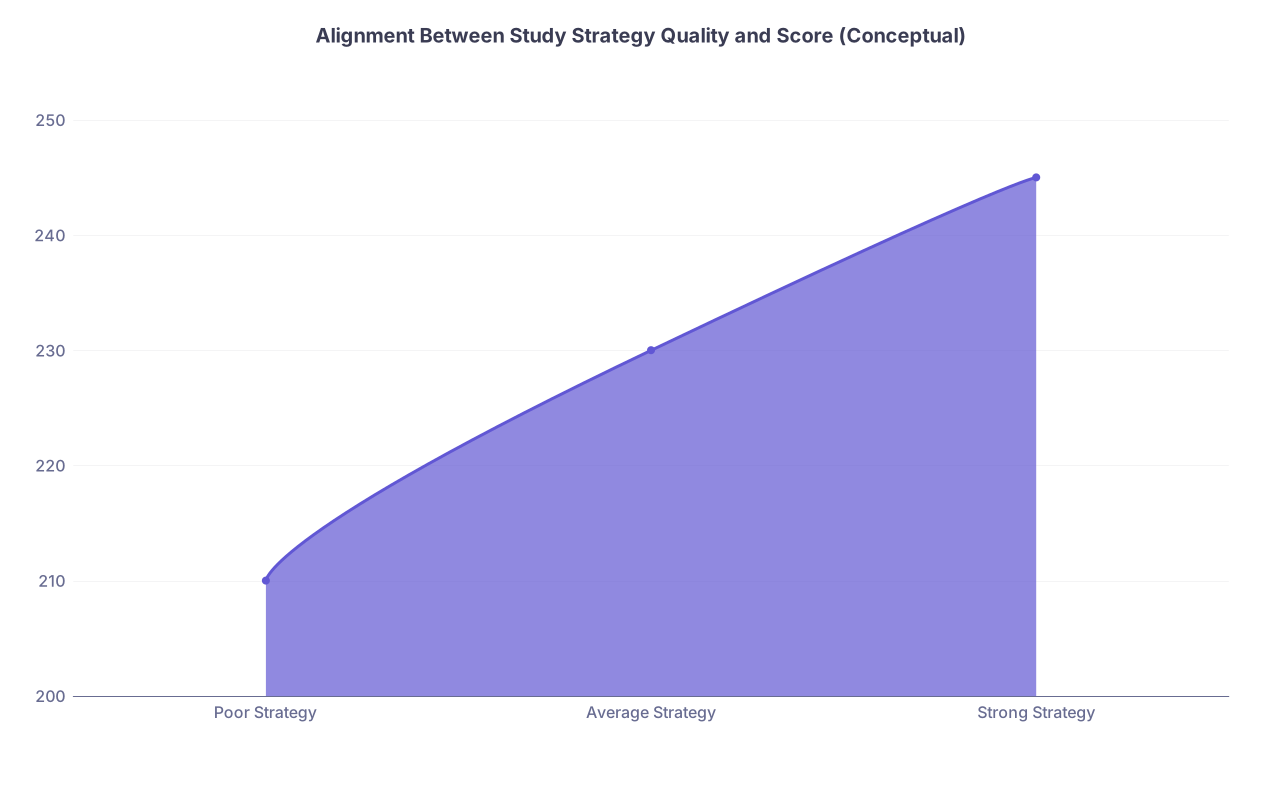
| Category | Value |
|---|---|
| Poor Strategy | 210 |
| Average Strategy | 230 |
| Strong Strategy | 245 |
They don’t expect perfection. But they expect your story and your score to make sense together.
How to Build a “Serious” Resource Plan (That Would Survive PD Scrutiny)
Let me be direct. If you want your behavior to look like the people PDs quietly respect, your prep needs three things:
- A clear backbone
- Progressive question practice
- Honest feedback loops
Here’s a pattern that consistently produces the kind of residents PDs like to train.
For Pre-Clinicals / Step 1 (If Still Scored or for Foundations)
- Pick one major Qbank and commit. Even if you’re early, start with tutor-mode questions by system parallel to your coursework.
- Use a single condensed reference text (or a tight digital resource) as your “anchor.” Don’t spread yourself across five.
- If you use Anki, make it targeted. Keep new cards tied to questions you got wrong, not random chunks of a giant community deck.
For Clinicals / Shelves / Step 2
- Tie every rotation to a Qbank schedule. For IM, that might be 40–60 medicine questions per day plus a focused shelf-reading source.
- Layer in timed mixed blocks at least 4–6 weeks before your big exam.
- Schedule NBME or practice exams regularly and adjust based on the results.

| Step | Description |
|---|---|
| Step 1 | Start Clinical Year |
| Step 2 | Rotation-specific Qbank blocks |
| Step 3 | Track Weak Systems |
| Step 4 | Targeted Anki / Review |
| Step 5 | NBME Practice Exam |
| Step 6 | Maintain Volume, Add Mixed Blocks |
| Step 7 | Intensify Focus on Weak Areas |
| Step 8 | Dedicated Period with Timed Mixed Blocks |
| Step 9 | Real Exam |
| Step 10 | Score on Track? |
If you described something like that to a PD and backed it with a solid score, they’d mentally file you as: serious, self-directed, low-risk for failing boards.
The One Thing PDs Care About More Than the Brand Names
At the end of the day, they’re not hiring you for your UWorld subscription. They’re hiring you for your ability to:
- Face a knowledge gap
- Choose tools intelligently
- Execute a plan consistently
- Adjust based on data when you’re wrong
Your resource list is just a proxy. A clue. A reflection of how you attack hard problems.
When a PD hears a well-structured, disciplined story about how you used question banks, Anki, and references—and then sees strong, consistent scores—what they see is someone who will not collapse when it’s time for in‑training exams or boards.
They see someone who will keep their program’s board pass rate safe. And that matters more than anyone admits on the brochure.

FAQs
1. If I couldn’t afford every big-name resource, does that hurt me with PDs?
No. They’re not auditing your bank account. What they care about is how you used what you had. One solid Qbank + smart repetition + official practice tests beats six subscriptions you barely touched. When you talk about your prep, focus on your strategy and consistency, not how many platforms you bought.
2. Should I name specific resources during interviews, or keep it vague?
Name them. Vague sounds like you’re faking it. “I used UWorld as my primary Qbank and AMBOSS to read around missed questions” is perfectly fine. It shows you had a plan. Just don’t sound like a brand commercial; frame it in terms of your process: what you did, why, and how you adjusted.
3. Do program directors really care about Step resource choices once scores are pass/fail?
They care about the pattern, not the label. Even with Step 1 pass/fail, they still see Step 2 CK, shelf scores, and in‑training exams. The same resource behaviors—heavy passive watching vs. structured active practice—show up in those outcomes. The pass/fail label just changed the packaging; it didn’t change how they recognize who’s serious.
Key points to walk away with: your resource choices create a visible pattern in your scores and your thinking, and program directors have been watching those patterns for years. Question-bank-centered, structured, data-driven prep screams “serious test-taker.” Passive, scattered, friend-driven prep screams “risk.” Build your resource plan so that, if you had to explain it to a PD, you’d sound like someone they’d trust with their board pass rate—and their patients.