
The way most students handle research year and boards is backwards.
They treat research as the main job and boards as “future me’s problem.” Then 9 months later, they panic, buy three new resources, and wonder why their first full-length is 40 points below their goal.
If you’re in a research year and you know boards are coming (Step 1, Step 2, COMLEX, whatever), your real job is simple: turn question practice into a habit that survives crazy research weeks, looming abstracts, and random 5 p.m. “we need these stats tonight” emails from your PI.
Let’s build around that reality, not fantasy.
Step 1: Get Clear On Your Actual Situation
You cannot copy some YouTube “perfect research year + 260 Step” schedule and expect it to work. You have to build from your constraints.
Look at your life honestly. Ask:
- What is my research load really like?
- When during the week am I mentally fried vs. functional?
- When are my board exams, roughly? (month/year is enough)
Most people fall into one of three buckets. Be honest which one you’re in:
| Pattern | Research Load | Control Over Schedule |
|---|---|---|
| Lab Rat | 8–10 hrs/day bench or data work | Low–Medium |
| Clinical Researcher | Mix of chart review, clinics, meetings | Medium |
| “Soft” Research Year | Writing, remote projects, lighter load | High |
If you’re truly doing 60+ hours/week in a demanding lab with a PI who thinks weekends are a social construct, your board prep structure will look different than someone writing papers mostly from home.
But one rule does not change: during a research year, you are not in full-time exam prep mode. You’re in maintenance and gradual ramp mode.
Target in your head: you’re trying to hit a minimum viable question volume each week, not grind like it’s dedicated.
Step 2: Decide Your Baseline Question Goal (And Make It Boring)
You need a non-negotiable baseline. Not a dream number.
Think in weekly totals, not daily. Research is lumpy. Some days, your PI destroys your plans. Weekly goals are more forgiving.
Use this as a rough guide:
- Heavy research (50–70 hrs/wk): 80–120 questions/week
- Moderate research (35–50 hrs/wk): 120–180 questions/week
- Lighter research (≤35 hrs/wk): 180–240 questions/week
If you’re aiming for a very competitive score (e.g., Step 2 > 250, COMLEX > 650), push toward the higher end once you’re 6–9 months out, but don’t start there if you’ve been doing zero.
Here’s what that actually means in practice:
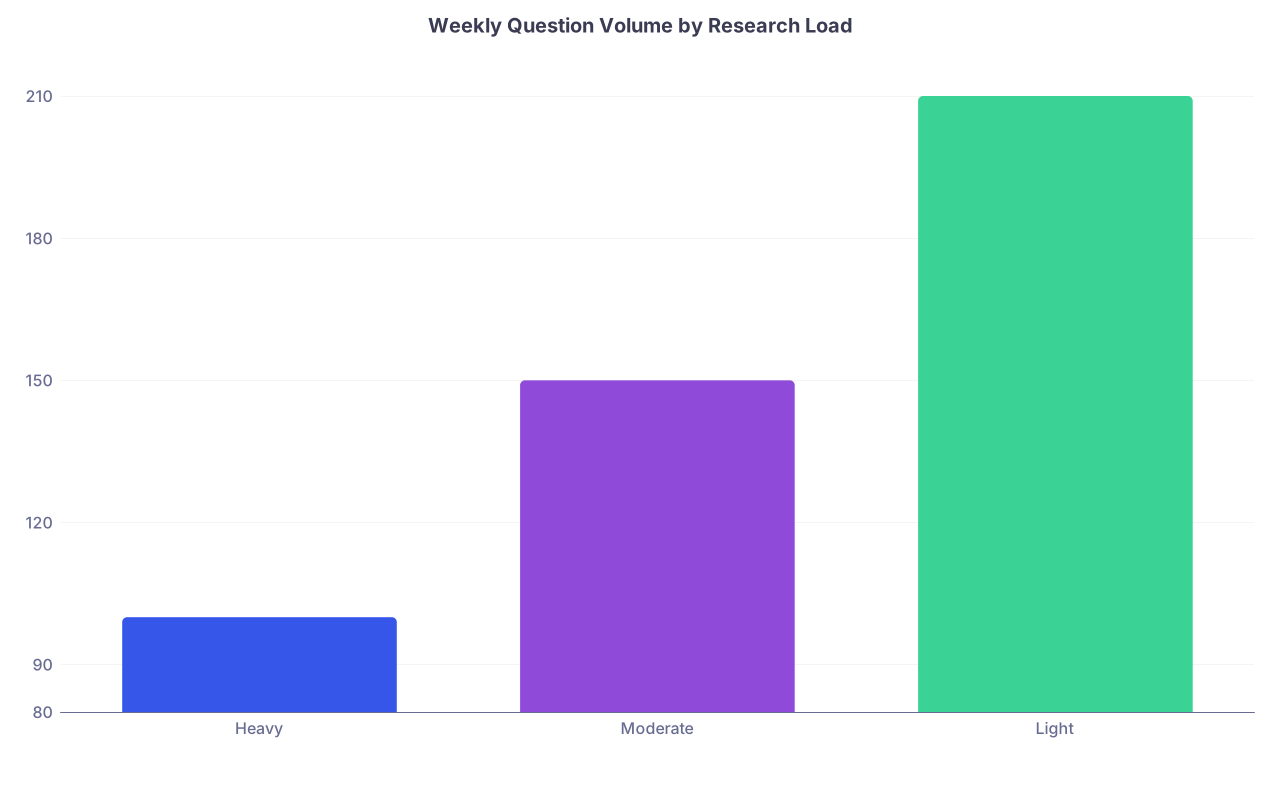
| Category | Value |
|---|---|
| Heavy | 100 |
| Moderate | 150 |
| Light | 210 |
100 questions/week is 15 questions/day with one day off, or 25 questions four days/week. That’s not heroic. That’s “I scroll less and say no to some nonsense.”
At this stage, your success metric is not “perfect review.” It’s “questions are a default part of my week.”
Step 3: Build A Question Schedule Around Your Research Reality
You’re not a full-time student. You need an unglamorous, repeatable pattern that survives chaos.
Use one of these templates and adjust:
Template A: Early-Morning Grinder (good for busy labs)
- 6:30–7:00 a.m.: 10–15 questions, timed, random or system-based
- 7:00–7:20 a.m.: Quick review of explanations, flag tough ones
- Evenings: Optional flashcards/Anki for 15–20 minutes
This works if your brain still functions in the morning and your lab runs your days.
Template B: Split Blocks (good for remote/write-heavy work)
- Lunch: 10–15 questions, quick review
- Evening: 10–15 questions, deeper review on 3–5 concepts
You hit 20–30/day without ever doing a full 40-question block. That’s fine in research year. Volume + consistency win.
Template C: Weekend Heavy (for brutal Mon–Fri)
- Weekdays: 5–10 questions/day, minimal review (just read answers)
- Saturday: 40–60 questions + focused review
- Sunday: 40–60 questions + focused review
Ugly? Yes. But I’ve seen residents do this with Step 3 and still pass comfortably. If five days get wrecked by lab or clinics, you need big anchors on the weekend.
Anchor times help. “I do questions at 7:30 every morning before lab” is better than “I’ll fit questions in somewhere.”
Step 4: Integrate Content, Don’t Just Collect Questions
Doing questions without consolidating them is like pipetting samples into the trash. Convinces you you’re working, changes nothing.
For research year, you need a light but rigid review loop:
- Do the block (10–20 questions).
- For each missed or guessed-right-but-iffy question:
- Identify the one concept that burned you.
- Give it a 1–2 line summary in your own words.
- If you use Anki, make a single, simple card. If not, keep a running “concept doc” sorted by system.
Example from a real student’s notes I saw:
- “Valvular lesions – which are preload dependent? (HCM + MVP worse with ↓ preload; aortic stenosis better with ↑ preload.)”
- “Steroid side effects – chronic use → neutrophilia via demargination, not increased production.”
Short, sharp, and you’ll actually read it again.
The key is not to reproduce the textbook. You want a small pile of recurring weak spots that you see again and again over months.
Step 5: Adjust Your Resource Stack For a Research Year (Not For Instagram)
During research year, your job is coverage and familiarity, not hyper-optimized last-2-month perfection.
For Step 1/Step 2/COMLEX during research year, this is enough for most people:
- One main Qbank (UWorld, AMBOSS, or for COMLEX add COMBANK/TrueLearn)
- A light primary reference:
- Step 1-ish: Boards & Beyond videos or a solid systems text
- Step 2-ish: OnlineMedEd or similar high-yield review
- Anki only if you already know it works for you
What you do not need during research year:
- Three Qbanks you barely touch
- Watching every single video series “just in case”
- Starting a 5,000-card Anki deck from scratch if you’ve never stuck with flashcards before
Be ruthless here. Every resource you add has a cost. Time, guilt, cognitive load. Most of it will not move your score; doing more questions will.
Step 6: Sync Your Research Projects With Your Study Plan
Here’s where a lot of people miss a cheat code.
Your research isn’t just a distraction. It’s content exposure. You can ride that.
If you’re doing:
- Cardiology research → emphasize cardio questions and concepts
- ICU/critical care projects → pulmonary, renal, acid-base, shock
- Outcomes research in OB/GYN → OB/GYN + stats/epi
When you spend the whole day arguing with your co-author about hazard ratios and confidence intervals, that night is the perfect time to do 10–15 biostats questions. Your brain’s primed.
Make your weekly question mix roughly:
- 60–70% broad/systematic coverage (random or rotating systems)
- 30–40% systems that match your research projects
You’re building “hooks” between real cases/papers and your board content. That’s how you make things stick without extra hours.
Step 7: Use Your Research Calendar To Plan Board Milestones
If your research year is structured around:
- Abstract deadlines
- Manuscript submissions
- Big data pulls
- Conference months
Then you need to stage your board prep around those, not pretend they don’t exist.
Example of a sane structure if your exam is at the end of research year:
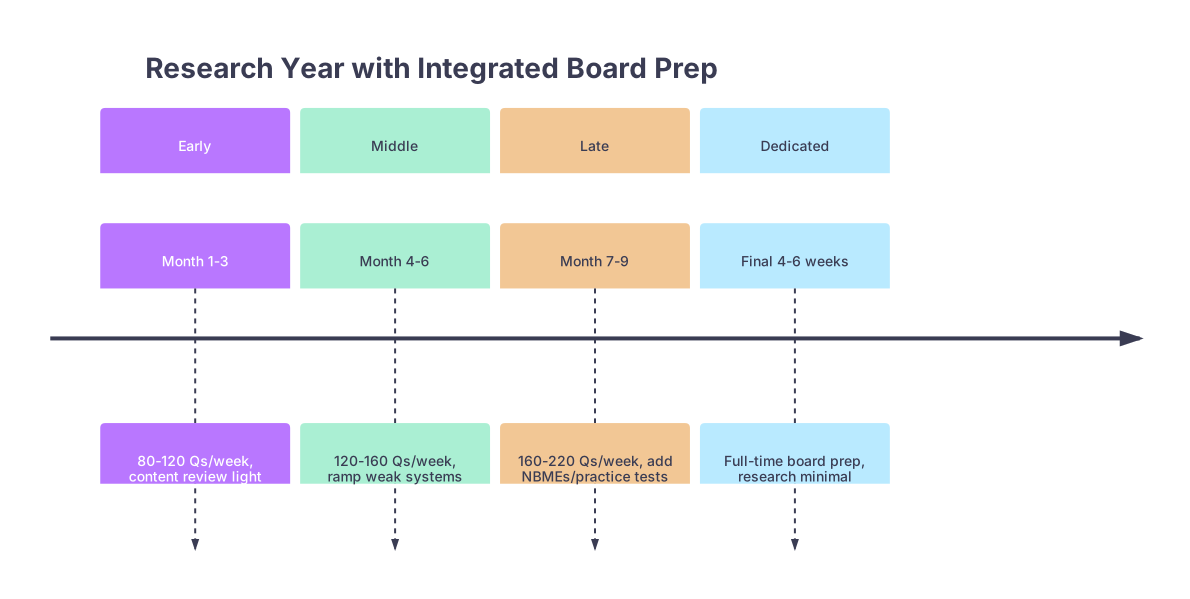
| Period | Event |
|---|---|
| Early - Month 1-3 | 80-120 Qs/week, content review light |
| Middle - Month 4-6 | 120-160 Qs/week, ramp weak systems |
| Late - Month 7-9 | 160-220 Qs/week, add NBMEs/practice tests |
| Dedicated - Final 4-6 weeks | Full-time board prep, research minimal |
Now lay this on top of your research year:
- Big abstract due in Month 4? Don’t plan to jump from 100 → 220 Qs/week that month.
- Conference in Month 8? Fine. Make that a “practice test + review” month, not a major data-collection month if you can control it.
You won’t control everything. But many students never even ask their mentor, “Can we aim to have X project mostly wrapped before [month], because my boards are in [month]?”
Good PIs respect that. Bad ones don’t. At least you’ll know which you have.
Step 8: Handle Exhaustion Weeks Without Imploding Your Habit
You will have weeks that just blow up:
- “We need this abstract submitted by Sunday.”
- “The attending wants 50 more charts reviewed before Friday.”
- “The IRB came back and we need to re-do half the analysis.”
Those weeks are dangerous. Most students go:
Good week → 150 questions
Disaster week → 0 questions
Next week → demoralized, “I’ll restart later” → 0–20 questions
And the slide begins.
Your goal in disaster weeks is not to maintain volume. It’s to avoid zero.
Set a floor: 5–10 questions/day, no review required. Just read the explanations once. That’s it.
Sounds trivial. It’s not. You’re keeping the neural circuits “boards matter” alive, even in chaos. The ramp back up is easier, and you avoid the psychological cliff of restarting from nothing.
Step 9: Add Full-Lengths and NBMEs Without Wrecking Your Research
At some point, you must simulate the real exam. During research year, you can’t pretend you have wide-open days every week. You probably have 1–2 “protected-ish” days a month.
So:
- Start practice NBME/COMSAE/CCSSA exams about 3–6 months before your target exam.
- Aim for one practice exam every 4–6 weeks while in full research mode.
- Protect that day like a surgery case. Block it on your calendar. Tell your co-authors you’re “off the grid” that Saturday until 3 p.m.
Then you do the unglamorous part: review.
You do not need to dissect every single question from every practice exam the same day. But you should, within a week:
- Identify 2–3 systems that tanked your score.
- Add 30–50 questions from those systems to your next 1–2 weeks.
- Capture 5–10 specific concepts in your weak-spot notes/Anki.
Rinse, repeat. No elaborate spreadsheets needed.
Step 10: Protect Your Brain From Research Burnout Before Dedicated
Here’s what I see over and over:
- Student works themselves into the ground for 11 months of research.
- They finally stop, take a week “off” before dedicated.
- That week is mostly lying in bed, scrolling, feeling dead.
- First two weeks of dedicated are spent just getting their brain to function again.
You cannot walk into dedicated totally torched and expect to perform. You’re not a robot; you’re a tired human who just spent a year in meetings and Zoom.
So 1–2 months before your planned dedicated:
- Start gently declining non-essential research tasks.
- Push hard to finish major projects or at least get them to “waiting on co-author” stage.
- Be explicit with your PI: “My board exam is in [month]. I need [X weeks] of real prep time. I can’t take new big tasks after [date].”
If they react like this is unreasonable, that’s information. You may still have to eat a few things, but at least you won’t be blindsided.
Your dedicated period should feel like: “Finally, I can focus,” not “Now I have to recover from a year-long beating.”
Step 11: Common Traps – And What To Do Instead
A few patterns I’ve seen up close:
The “Pure Research Until 3 Months Out” Plan
- Zero questions for 9 months, then all-day grind.
- Outcome: overwhelmed, inefficient, plateaued.
- Fix: Even 60–80 questions/week for months beats this disaster.
The Content Hoarder
- Spends months in videos, barely touches Qbank.
- Writes beautiful notes; scores mediocre.
- Fix: Make questions your primary activity, reading your secondary.
The Perfectionist Reviewer
- Does 20 questions, spends 3 hours reviewing every option choice like it’s a pathology exam.
- Burns out, can’t hit volume.
- Fix: Shorten review. Focus on patterns and concepts, not dissecting every sentence.
The Guilt Spiral
- Misses a few days, feels like a failure, stops entirely.
- Fix: Have a written rule: “If I miss 3 days, I restart with 10 questions only the next day. No catch-up, no drama.”
You’re in a long game. You don’t need perfect weeks. You need relentless re-starts.
Step 12: A Simple Weekly Template You Can Actually Use
Let’s say you’re mid-research year, moderate load, Step 2 in ~8 months. Here’s a workable week.
- Mon–Thu:
- 10–15 questions in the morning (mixed or by system)
- 15–20 minutes in the evening skimming missed concepts or doing Anki
- Friday:
- 10–20 questions only; allow yourself a lighter review day
- Saturday:
- 30–40 questions late morning
- 45–60 minutes targeted review of your worst system that week
- Sunday:
- Off, or 5–10 super light questions if you’re anxious
That’s 120–160 questions/week without you ever touching a 6-hour study marathon. You will be shocked what 6–9 months of that does.
Then, as exam gets closer:
- Add a practice exam every 4–6 weeks.
- Bump a few days from 10–15 → 20–25 questions.
- Tighten your weak-system focus based on NBME performance.
Update your plan monthly. Not daily. Not every time your friend posts their Anki stats.
Key Takeaways
- During a research year, your job is not to “grind boards.” It’s to build an unbreakable, boring habit of weekly question practice that survives chaotic research demands.
- Start with a realistic weekly question target, align it with your research calendar, and treat question blocks like appointments, not optional extras.
- Use research to your advantage by syncing question topics to your projects, protecting your dedicated period from burnout, and avoiding the all-or-nothing traps that wreck most people’s board prep.