
The resources students obsess over for boards are not the ones program directors quietly push on their own residents.
Let me be blunt: the average MS2 boards strategy you see on Reddit or YouTube would get laughed out of most chief meetings. PDs and core faculty have their own “short list” of board prep playbooks they steer residents toward—because they’ve watched what actually works over hundreds of trainees, not just the one or two who happened to score a 270 and became internet famous.
You rarely hear this list publicly. I’m going to walk you through it.
The Hidden Rule: PDs Don’t Care What’s Popular, They Care What’s Predictable
Residents are a liability if they fail boards. They cost the program money, ACGME headaches, and accreditation risk. So PDs quietly converge around a small set of resources that:
- Map tightly to the exam blueprint
- Are stable year to year
- Have good tracking and analytics so they can monitor you
- Don’t burn residents out with fluff or fancy interfaces
Nobody in a CCC meeting is saying, “But his Anki stats were amazing.” They’re saying:
- “Did she finish her assigned qbank?”
- “What were his in-service percentiles?”
- “Has she done X, Y, Z review course yet?”
Those X, Y, Zs are what you need to know.
The Core Playbook Every PD Wants: “Questions + One Anchor Resource + Scheduled Assessment”
Strip away brand names and specialties and the PD playbook looks like this:
Questions
- One primary knowledge spine
- Regular timed assessments
- Tight feedback loop with faculty/chiefs
The brands vary by exam, but the pattern barely changes.
Let’s go specialty by specialty and then I’ll give you the meta-rules.
USMLE / COMLEX in Medical School: What Faculty Actually Push
Med schools are more open about their recs than residencies, but there’s still a difference between “what we tell the whole class” and “what we tell the students we’re worried about.”
Step 2 (since Step 1 is pass/fail now)
Here’s the unvarnished truth: for Step 2, the faculty-level playbook is basically this:
- UWorld as non‑negotiable
- One book (maybe)
- An NBME schedule that’s treated like religion
The stuff residents keep hearing from clerkship directors in the hallway sounds like:
“Just do UWorld twice and you’ll be fine.”
“If you’re under 230 on Step 1, I want you doing CMS and NBMEs early.”
Translation: they’re not impressed with stylish resource stacks. They want you deep in one high-yield qbank and actually touching real NBME-style questions regularly.
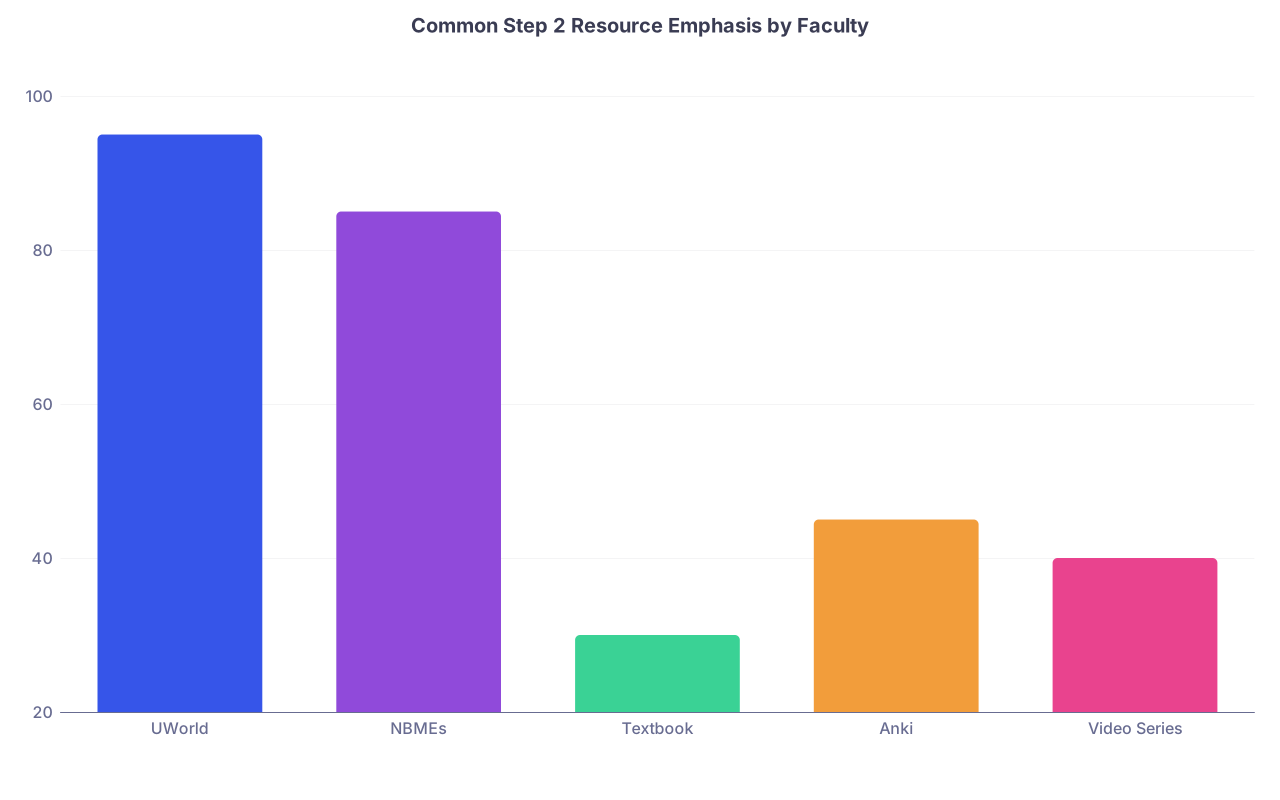
| Category | Value |
|---|---|
| UWorld | 95 |
| NBMEs | 85 |
| Textbook | 30 |
| Anki | 45 |
| Video Series | 40 |
The rough “PD-approved” Step 2 playbook looks like:
- Primary qbank: UWorld (or the COMLEX-equivalent like COMBANK/COMQUEST for DOs)
- Anchoring text (optional): Step-Up to Medicine or Boards & Beyond videos for weak systems
- Assessments: NBMEs + UWorld self-assessments on a pre-defined calendar
Faculty get very nervous when they see students spreading across 6 different question banks instead of actually finishing one.
Internal Medicine: What IM PDs Really Recommend
I’ve sat in IM academic office hours where the same names get repeated over and over. You want the PD playbook? It’s not a mystery inside the building.
The IM board-prep spine most PDs lean on:
- Qbank: UWorld or ABIM-specific qbank (MedStudy, BoardVitals). UWorld still dominates for many.
- Main content spine: MKSAP or MedStudy
- Assessment: ITE (In-Training Exam) + self-assessment modules (MKSAP/MedStudy tests)
The residents who succeed tend to follow a pattern like this:
Year 1:
- Do the ITE “cold” to see where you fall
- Start MKSAP topic-based questions tied to your rotations
- Build a habit of daily questions (10–20), not last-minute cramming
Year 2:
- PDs start tightening the expectations: “I want you >= 50th percentile on ITE or I’m assigning MKSAP sections.”
- Many programs require or “strongly encourage” one full pass of MKSAP questions before PGY-2 ends
Year 3:
- Targeted clean-up: redo weak-topic MKSAP sets, maybe trial a second qbank if you crashed ITE
- Timed blocks to simulate the real exam
- PDs and chiefs start checking that you’ve at least purchased or have access to MKSAP/MedStudy and actually use it

Here’s what IM PDs don’t recommend to their own residents, though you’ll see it all over student forums:
- Jumping between 3–4 qbanks “for variety”
- Relying primarily on passive video courses without questions
- Delaying serious prep until the last 3–4 months
The unspoken rule in IM: MKSAP (or your program’s chosen equivalent) plus a complete run through the qbank is the default, not the “extra.”
General Surgery: The Brutal but Effective Formula
Surgical PDs are some of the most direct about this. They care less about pretty interfaces and more about what correlates with ABSITE and board passage.
The classic surgery playbook used in a lot of academic programs:
- Qbank: TrueLearn/Score-based ABSITE banks, sometimes paired with SESAP
- Anchor: SCORE curriculum modules and/or Surgical Recall early on
- Assessment: ABSITE every year – and they treat it like a dress rehearsal for your entire career
Many programs literally structure their didactics around SCORE. I’ve watched PDs say, dead serious:
“If you’re doing things we haven’t vetted—fine, but if your ABSITE drops, you’re on my curriculum only: SCORE and TrueLearn. That’s it.”
The ones who fall into trouble? Residents who think their case volume is enough and treat ABSITE as “just another test.”
Surgery PD mentality is very simple:
- Do you open SCORE regularly?
- Are you doing questions all year?
- Did your ABSITE percentile go up or down?
If the answer to that third one is “down,” your autonomy in picking resources disappears very quickly.
Pediatrics, OB/GYN, and the Other “Lifestyle” Fields Everyone Underestimates
You’d be surprised how many students think, “Peds boards are easy,” and then quietly fail their first try. PDs in these fields know this pattern quite well.
Most of the pediatrics PDs I know rely on a similar structure:
- Qbank: MedStudy Peds, PREP questions (AAP), BoardVitals in some places
- Anchor: MedStudy Peds books or digital equivalents
- Assessment: ITE and sometimes mandated PREP question quotas
For OB/GYN:
- Qbank: Exxcellence, TrueLearn, ACOG resources
- Anchor: APGO modules, ACOG guidelines
- Assessment: CREOG in-training scores driving who gets “board support plans”
| Specialty | Primary Qbank | Main Anchor Resource | Key Assessment Tool |
|---|---|---|---|
| Internal Med | UWorld / MedStudy | MKSAP / MedStudy | ITE |
| General Surg | TrueLearn / SESAP | SCORE Curriculum | ABSITE |
| Pediatrics | MedStudy / PREP | MedStudy Peds | ITE + PREP |
| OB/GYN | TrueLearn / Exxcellence | ACOG / APGO | CREOG |
| EM | Rosh / PEER | Tintinalli/EMRAcram | ITE |
The throughline: PDs pair one recognized qbank with one recognized content spine and track you via your in-training and board-style scores. They’re not impressed when you show up talking about the latest niche app that hasn’t proven itself in any data they care about.
Emergency Medicine & Anesthesia: Pattern Recognition on Steroids
EM PDs have a very simple radar: can you crush pattern recognition under time pressure?
For EM, the PD-favorite combo usually looks like:
- Qbank: Rosh Review is almost standard at this point; sometimes PEER, sometimes BoardVitals on top
- Anchor: Tintinalli for depth, EMRA or similar summary resources for quick read
- Assessment: EM ITE + how you perform on Rosh-reported metrics
Rosh is designed to look and feel like the actual exams, and PDs like the metrics. I’ve heard more than one EM PD say:
“If they’re doing well on Rosh, I stop worrying.”
Anesthesia is similar in spirit:
- Qbank: TrueLearn or ACE questions
- Anchor: Big Blue/Barash or similar anesthesia texts
- Assessment: BASIC and ADVANCED exam pass rates, plus ITEs
Anesthesia PDs will straight-up say, “You need to finish X number of ACE/TrueLearn questions before BASIC.” And they check.
The Real Reason PDs Push Certain Resources: Data and Control
You need to understand the politics here.
Programs get evaluated on board pass rates and in-training performance. PDs are not picking resources because they “like the UI.” They’re picking resources because:
- They can see completion stats
- They can see performance analytics tied to specific residents
- They’ve correlated those tools with their own program’s outcome data over several years
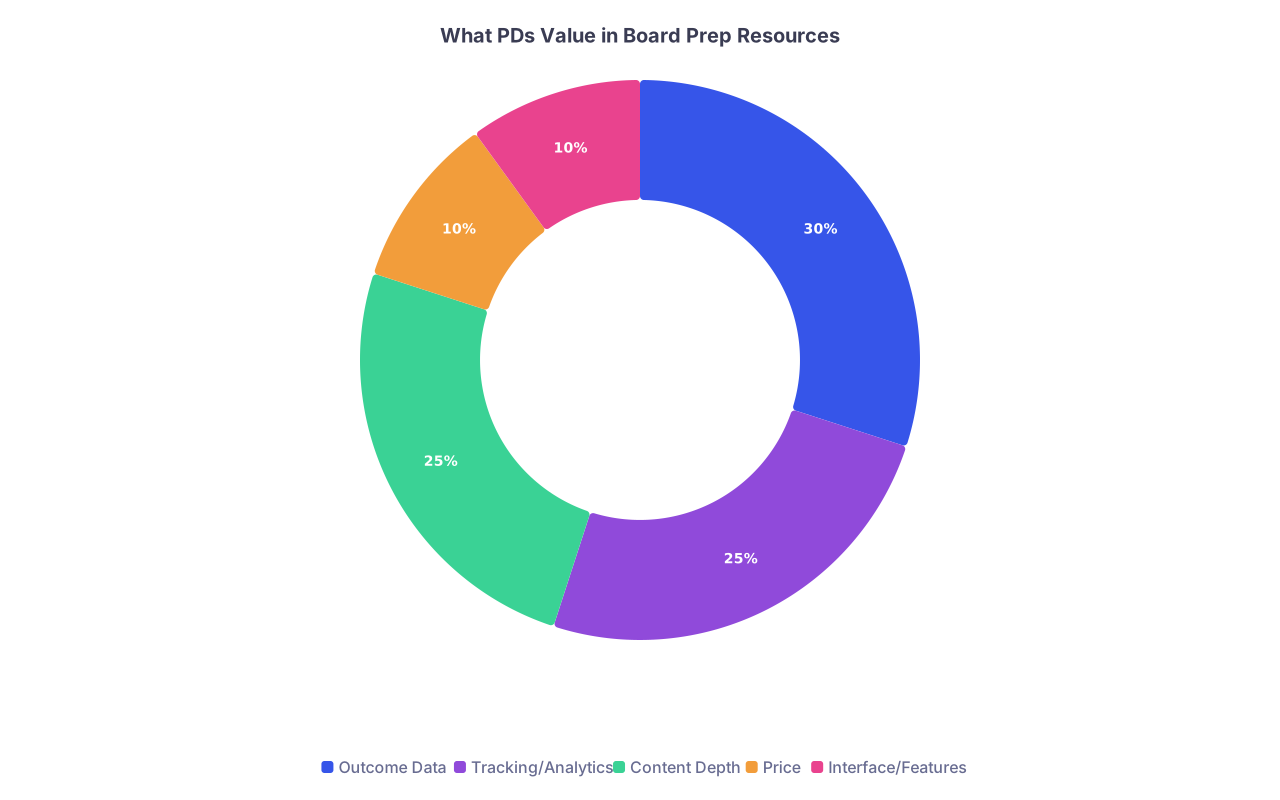
| Category | Value |
|---|---|
| Outcome Data | 30 |
| Tracking/Analytics | 25 |
| Content Depth | 25 |
| Price | 10 |
| Interface/Features | 10 |
Behind closed doors, what you’ll hear in PD meetings sounds like this:
- “The cohorts that actually finished MKSAP had a 100% pass rate.”
- “Residents who were top quartile on Rosh almost never failed.”
- “People bouncing between 4 different resources worry me.”
So when they recommend a prep playbook, it’s not random. It’s based on institutional memory and their own small-scale “studies,” even if they never publish them.
How PDs Actually Want You to Use These Resources
This is where students and junior residents mess it up.
PDs are not saying “buy MKSAP/Rosh/TrueLearn and feel good about yourself.” They have a very specific model in mind when they suggest these.
1. Early, Continuous, Boring Consistency
Most faculty don’t tell you this bluntly, but here it is: the residents who crush boards are doing questions all year, not for 6 panicked weeks.
They want to see you:
- Doing a small, steady number of questions daily or several times a week
- Revisiting your missed questions
- Tying question review back to a single reference (your “anchor” resource)
What they don’t want:
- A month-long question binge followed by dead silence the rest of the year
- “I’m saving the good questions for last” (they actually want you to struggle early and often)
2. Treating In-Training Exams Like Practice Boards
The ITE, ABSITE, CREOG, etc. are not “just another test” in faculty eyes. They’re early-warning systems.
What happens after a bad score is usually quite structured:
- Below a certain percentile → mandatory meeting with PD or APD
- Customized “board remediation plan” → almost always includes:
- Assigned qbank (and sometimes a minimum question quota)
- Required review course (sometimes at your own expense, sometimes funded)
- Check-ins with a faculty mentor or chief
I’ve watched PDs outline plans like: “You will finish all MKSAP cardiology and nephrology questions by X date, and we’ll review your performance and explanations in monthly meetings.”
If you show you’re doing the work before you bomb an ITE, they’re grateful. If they have to chase you after, they’re irritated.
What Med Students Should Steal From These Resident Playbooks
You’re in medical school, not residency, but you can absolutely copy the PD mindset now and save yourself a ton of pain.
Here’s how to adapt it:
Pick one primary qbank per exam phase and commit.
For Step 2, that’s almost always UWorld. If you want a second, fine, but not until you’ve basically exhausted the first.Pick one main anchor resource.
That might be a video series, a book, or a structured curriculum (Boards & Beyond, OnlineMedEd, etc.). The point is to have one place you return to for deeper clarification.Set a real assessment calendar.
Don’t wing NBMEs “when I feel ready.” That’s how people end up running out of practice tests in the final month. Lay out every NBME/UWorld SA from day one and reverse-engineer your study plan.Create your own “PD oversight.”
This is the part nobody does. You need someone—a mentor, upperclassman, or even a brutally honest friend—to look at your plan and your practice scores and call you out when you drift. Programs do this formally with residents. You need a lighter version of the same accountability.

| Step | Description |
|---|---|
| Step 1 | Set Exam Date |
| Step 2 | Map NBME/UWSA Schedule |
| Step 3 | Choose Qbank + Anchor Resource |
| Step 4 | Daily/Weekly Question Blocks |
| Step 5 | Monthly Practice Test |
| Step 6 | Review Performance with Mentor/Peer |
| Step 7 | Adjust Resources/Volume |
| Step 8 | On Track? |
- Ignore the resource flex culture.
PDs are not impressed that you “have subscriptions to four banks.” They want depth, not breadth. Adopt that mentality now.
What PDs Say Off the Record About Common Mistakes
Let me give you a few lines I’ve actually heard around conference tables:
- “He has an impressive study stack, but nothing is actually finished.”
- “She watched every video at 2x speed and did almost no questions. I’m not shocked by that score.”
- “If they would just commit to MKSAP and quit improvising every month, our pass rate would be untouchable.”
Patterns PDs roll their eyes at:
- Residents chasing “the new hot resource” every cycle instead of sticking with the institutional standard
- People who refuse to do the program’s recommended curriculum because “Reddit says X is better”
- Over-reliance on flashcards with no timed, block-style practice
Med students fall into the same traps, just with different brand names.
How to Talk to PDs and Faculty About Your Plan (Without Sounding Clueless)
If you want to sound like you know what you’re doing, steal their language.
Instead of:
“I’m trying a bunch of different resources and seeing what sticks.”
Say something like:
“My primary spine is UWorld plus [anchor resource]. I’ve mapped out my NBMEs every 3–4 weeks and I’m adjusting based on those scores. If you had to add just one more tool, what would you pick for your own residents?”
That last line is the kill shot: “What would you pick for your own residents?” You’ll see their posture change. They’ll stop giving generic advice and tell you the real playbook.
And if you hear the same names come up from multiple attendings? That’s your answer. Use those. Commit.
FAQs
1. How many qbanks should I use for a major exam like Step 2 or ABIM?
For most people, one high-quality primary qbank is enough if you actually finish it thoughtfully. A second qbank can help for exposure and confidence, but only after you’ve nearly exhausted the first. PDs worry more about incomplete use of one good tool than about not having enough variety.
2. Are review courses (live or online) worth it, or are they just a money grab?
For the average, self-motivated resident or student, they’re optional. For people who’ve underperformed on in-training exams or practice tests, PDs often treat them as mandatory structure and remediation. They’re not magical; they’re scaffolding. Courses help the disorganized much more than the already-disciplined.
3. Do PDs care if I use Anki or other flashcards?
Most PDs don’t care as long as your objective metrics look good: ITE percentiles, NBME scores, qbank performance. Flashcards are invisible to them. If your scores sag and you tell them your “Anki stats are great,” they’ll quietly conclude your priorities are backward.
4. How far in advance do PDs expect residents to start “real” board prep?
For most core specialties, they expect consistent question use from PGY-1, not a last-minute sprint. Formal, exam-focused prep usually ramps up 6–9 months before the board date, but their ideal is that you’ve been treating ITEs and program-assigned resources seriously the entire time.
5. What’s the single biggest sign to a PD that a resident’s board plan is solid?
It’s not what you bought; it’s what you’ve finished and how your scores are moving. A resident who can say, “I’ve completed all of [program-endorsed qbank], my ITE percentile is climbing year to year, and I’m tracking weak areas with one anchor reference,” will almost never trigger PD anxiety about boards.
Key points to walk away with:
First, PDs and faculty quietly converge on a small set of proven resources—one primary qbank, one anchor curriculum, and scheduled assessments—and they care far more about completion and consistency than variety. Second, their board prep playbooks are built around data and control: in-training scores, analytics from endorsed tools, and visible improvement over time. If you borrow that mindset now—commit to a spine, map your assessments, and treat metrics seriously—you’ll be studying like the people who have to bet their careers on trainees passing these exams.