
The tier list your classmates argue about in the group chat is not the tier list that matters.
The only ranking that really affects your life is the one academic chiefs and clerkship directors carry around in their heads when they look at your score report, ask, “What did you use to study?” and silently decide whether you actually prepared like an adult or just clicked pretty interfaces.
Let me tell you how they actually rank USMLE question banks when they’re talking to each other. The conversations you are not in the room for.
What Program Leadership Really Cares About
Here’s the part students usually miss: faculty and academic chiefs don’t actually care which Q-bank you like.
They care about three things:
- Does this resource correlate with students not blowing up our score averages?
- Does it train them to think like the real exam or just pattern-recognize buzzwords?
- Can we predict anything about a student’s performance based on what and how they used it?
When I sit in meetings with academic chiefs, the PowerPoint doesn’t say “UWorld is nice and feels good.” It says things like:
- “Students who complete >75% of Bank X with performance above Y tend to score ≥Z.”
- “Students relying on Bank Y as primary tool are over-represented in <220 failures.”
- “The new third-year cohort is over-using Bank Z and under-using UWorld. We need to fix that.”
Do they track this? Yes. Quietly. And they absolutely talk about which Q-banks are helping or hurting.
The Real Tier List (How Chiefs Quietly Sort Q-Banks)
Let me give you the unsanitized version. This is roughly how most serious academic chiefs rank the major USMLE Q-banks in their heads.
| Tier | Q-Bank (Common View) | How Academic Chiefs Actually See It |
|---|---|---|
| S | UWorld | Non-negotiable gold standard |
| A | NBME Forms | Score calibration & wake-up calls |
| B | Amboss | Strong adjunct, not primary |
| C | Kaplan | Decent, but dated in feel |
| C | USMLE-Rx | Early content exposure only |
Notice what’s missing? All the shiny secondary banks, boutique question platforms, and “AI-personalized” apps. Chiefs barely register most of those. They lump them into one mental bucket: “If they’re asking me whether they can use this as a UWorld replacement, the answer is no.”
Now let’s talk about how each tier really works behind the scenes.
S-Tier: UWorld – The Non-Negotiable Currency
Every serious academic chief I know has some version of this line:
“If they didn’t do UWorld, I don’t know what their ‘studied’ even means.”
UWorld isn’t “popular.” It’s institutional. It’s the default against which everything else is judged.
How Chiefs Actually Use UWorld Data
Most schools that take board outcomes seriously quietly do the same thing:
- Track who completed UWorld (not who “had access”).
- Track approximate correct percentages.
- Correlate that with Step score ranges per class.
- Use that to advise, warn, or panic about specific students.
I’ve been in meetings where an academic chief scrolls through a spreadsheet and says, “Anyone with <55% on first pass UWorld and who didn’t finish at least 60% of the bank is now on our high-risk list.”
Does everyone get told that? No. They don’t want to create a self-fulfilling anxiety spiral. But the list exists.
Why UWorld Sits Alone at the Top
From the faculty side, UWorld is trusted because:
- Question style is consistently closer to the real exam than anything else.
- Explanations actually teach, not just justify answers.
- The difficulty requires actual understanding, not buzzword hunting.
And the big one: generation after generation of data shows the same thing. Students who methodically grind through UWorld, with real review and reflection, very rarely completely crash on boards unless something else major is wrong (burnout, life event, underlying content gaps from preclinical).
You will hear students say, “UWorld isn’t like the real exam anymore.” Faculty roll their eyes at this. They’ve been hearing that since COMLEX was on stone tablets. The in-house data still says: UWorld performance is the most reliable single predictor available that schools can actually monitor.
A-Tier (But Misunderstood): NBME Forms
Students think of NBMEs as “practice tests.”
Academic chiefs think of them as early warning imaging. They don’t tell you everything, but when they look ugly, everyone pays attention.
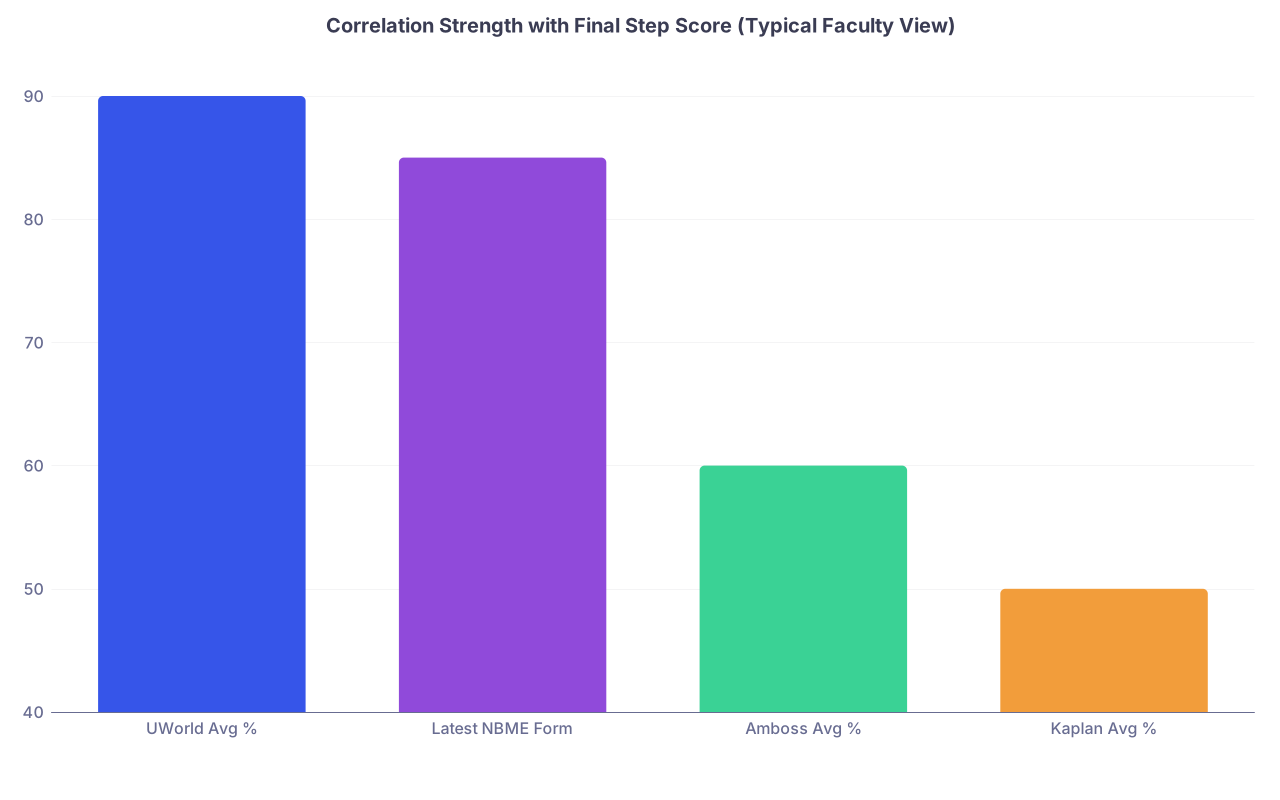
| Category | Value |
|---|---|
| UWorld Avg % | 90 |
| Latest NBME Form | 85 |
| Amboss Avg % | 60 |
| Kaplan Avg % | 50 |
Are those numbers from a published paper? No. They’re the rough mental weights many chiefs use when they’re informally predicting scores from your platform data.
NBMEs sit high in the mental tier list because:
- They’re written by the same organization that writes the real exam.
- They provide standardized, comparable data across cohorts.
- They get used in promotion and remediation decisions, whether anyone advertises that or not.
I’ve watched remediation committees say things like:
- “His UWorld is 65%, but his last two NBMEs are 202 and 205. He’s not ready.”
- “Her UWorld is only 55%, but she’s trending from 210 → 222 → 232 on NBMEs. I feel okay about her test date.”
Students romanticize “one more pass of content.” Chiefs romanticize “one more NBME trend point in the right direction.”
When a student bombs an NBME three weeks out and wants to take Step anyway, the academic chief doesn’t think, “Maybe they’ll do great because they love AnKing.” They think, “We have a preventable fail on our hands if we allow this.”
B-Tier: Amboss – The Secret Favorite… with Limits
Amboss is like that resident everyone loves to work with but won’t make chief. Extremely useful. Very smart. Not the one you put in charge of the entire service.
Most academic chiefs like Amboss more than they’ll admit publicly because:
- The library fills in dangerous gaps when preclinical teaching is weak.
- Questions commonly hit weird-but-real concepts that appear on test day.
- Explanations are well-structured and quick to digest.
But here’s the catch: over-reliance on Amboss alone raises quiet red flags.
Patterns I’ve seen:
- Students who did only Amboss and no UWorld: disproportionately represented in “solid, but underperforming compared to class” scores. Think 205–220 when their in-house exams suggested 225+.
- Students who used Amboss as adjunct after or alongside UWorld: often among the most conceptually sharp on wards. Their foundations are simply deeper.
When chiefs hear “I used UWorld and Amboss,” they think: Good. When they hear “I skipped UWorld and just did Amboss because I liked the interface more,” they think: Poor judgment, prone to following vibes over data.
Amboss holds B-tier status because it’s powerful but not primary. A smart second line. Not the main therapy.
C-Tier: Kaplan & USMLE-Rx – Legacy and Training Wheels
Let me be blunt: the only people who still push Kaplan or Rx as primary Step prep in 2026 either have a financial contract, haven’t looked at real Step exams in a decade, or are working off outdated institutional inertia.
How Chiefs Privately Talk About Kaplan
In meetings, Kaplan is usually described like this:
- “Good for foundational content if students start early.”
- “Somewhat more old-school and pattern-based.”
- “Not harmful, but not the sharpest signal of readiness.”
When a student says, “I did Kaplan and felt good, so I didn’t need UWorld,” chiefs silently categorize them as at risk for being blindsided by newer-style questions.
Kaplan questions often skew toward “classic stem, classic answer” style. Great when you’re first learning. Less great when the exam has shifted toward integration and subtlety.
They’re not angry if you used Kaplan. They’re worried if you only used Kaplan and think that’s sufficient.
USMLE-Rx: Early Crutch, Not Final Weapon
USMLE-Rx is treated internally by many schools as:
- Useful to get second-years thinking in question format.
- Helpful for exposing the First Aid universe in interactive form.
- Not remotely enough as final Step prep.
Plenty of students start Rx early and do fine. That’s not the issue. The issue is the student who proudly says, “I completed all of Rx” like that sentence alone guarantees a passing Step score.
When chiefs hear that, what they actually think is: “Great, now show me your UWorld and NBME data.”
The Quiet Things Chiefs Infer From Your Q-Bank Choices
Here’s what no one tells you: when you say, “I mainly used X,” they aren’t just hearing resource preference. They’re inferring personality traits, study habits, and risk tolerance.
Some examples I’ve personally watched play out:
“I hate UWorld, the interface is so ugly. I prefer ___.”
Translation in their heads: This student prioritizes comfort over performance. May avoid high-yield discomfort elsewhere too.“I did like 40% of UWorld but my percentages were low, so I switched to easier banks to build confidence.”
Translation: Emotion-driven decision-making, poor tolerance of struggle, likely underprepared.“I finished UWorld early, reset it, and then used Amboss to backfill weak areas, with NBMEs every 2–3 weeks.”
Translation: This student treats prep like a serious project. Good self-monitoring. High reliability.
No one says any of that to your face. But when your name comes up for “Is this student ready to progress?” these narratives matter.
How They Actually Use Q-Bank Data in Policies
At many schools, there’s a layer of “shadow policy” that students only half-hear about.
Examples I’ve seen in real policy documents and behind closed doors:
- “Students with fewer than X cumulative UWorld questions completed may NOT be allowed to take Step on originally scheduled date without committee review.”
- “Students scoring below Y on last two NBME forms but persisting in test date without program approval will be considered non-compliant with academic recommendations.”
- “For at-risk students, mandated use of specific Q-bank(s) with monitoring of performance.”
They’re not doing this to be controlling. They’re protecting their Step statistics because low pass rates become accreditation problems, which become hospital and residency reputation problems. They will absolutely sacrifice your scheduling preferences to protect the institution-wide numbers.
The Q-bank you choose signals whether you understand the stakes or you’re still approaching this like an undergrad midterm.
The Combo Patterns Chiefs Quietly Prefer
Most academic leaders who are actually engaged with board outcomes roughly favor combinations like these:
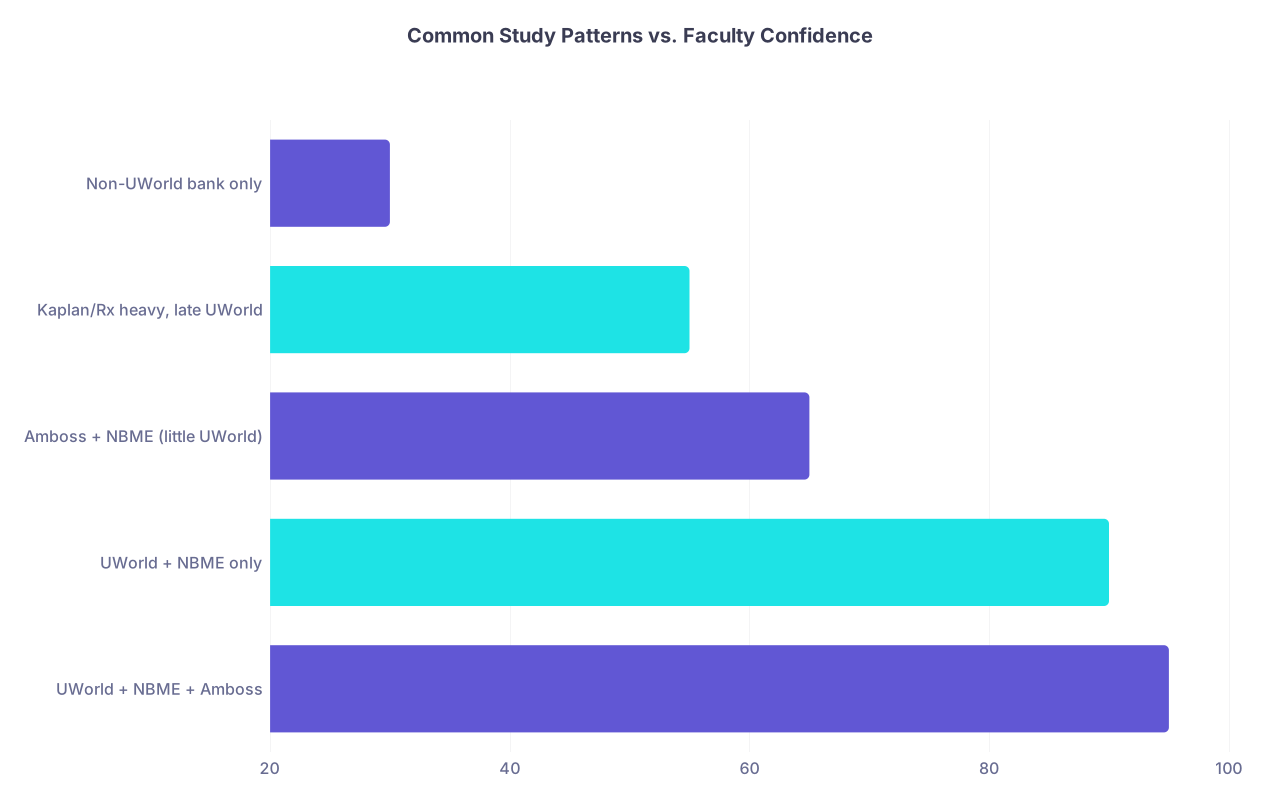
| Category | Value |
|---|---|
| UWorld + NBME + Amboss | 95 |
| UWorld + NBME only | 90 |
| Amboss + NBME (little UWorld) | 65 |
| Kaplan/Rx heavy, late UWorld | 55 |
| Non-UWorld bank only | 30 |
Again, not from a paper. From the way committees talk when no one’s recording.
If you want the pattern that makes chiefs relax:
- UWorld as the backbone.
- Regular NBME forms for calibration.
- Amboss (or occasionally Kaplan) as early or supplemental material, not a substitute.
- Honest self-assessment based on those numbers, not denial.
The combos that make chiefs nervous:
- Anything that uses “bank X felt more like the test to me” as a reason to ignore UWorld or NBME trajectories.
- Plans that don’t involve any formal practice forms until 2–3 weeks out.
- “I watched a lot of videos and just did some questions here and there.”
They’ve watched that movie too many times. The ending doesn’t change.
How This Carries Into Residency Selection
Here’s a subtle piece: residency faculty don’t care which Q-bank you used. They care what your scores are and how you carry yourself clinically.
But academic chiefs and clerkship directors absolutely notice patterns like:
- Residents who crushed boards and function well clinically often describe a disciplined, UWorld-heavy prep.
- Residents who barely passed and constantly feel behind often describe scattered, multi-resource, Q-bank-lite prep with lots of “I jump around depending on how I feel.”
Does that mean using UWorld magically makes you a good resident? Of course not. But board prep behavior is a decent proxy for how you approach long-term, high-stakes challenges.
When the associate program director says in a closed-door meeting, “This school’s grads usually handle boards well; they take prep seriously,” about your med school, that’s partly about institutional culture around Q-banks and assessment.
Your choices aren’t happening in a vacuum. They feed back into how future graduates from your school will be treated.
If You Want to Be on the “Safe” Side of the Quiet Tier List
Let me strip away all the marketing and give you the no-spin version of what most academic chiefs would secretly sign off on:
- UWorld is not optional. It’s the language of the exam.
- NBME forms are not “extra practice.” They’re your diagnostic imaging.
- Amboss is a fantastic supplement, especially for building true understanding, but it does not replace the above.
- Kaplan and Rx are fine as early, pre-dedicated training wheels. They are not your final form.
- Boutique banks and apps might be fun. They will not save you from ignoring the big three above.
If your plan is:
“I’ll do some random Q-bank that my friends like, then some NBMEs at the end and pray.”
You are betting against about a decade of internal data most schools quietly compile. That’s not courageous. It’s naive.
If your plan is:
“I’ll treat UWorld like my primary job, use Amboss or similar to deepen weak concepts, and let NBME trend-lines be my reality check.”
You’re aligned with how the people who control your graduation paperwork actually think.
FAQs
1. Is it ever okay to do Amboss instead of UWorld if I really hate UWorld?
You can do whatever you want. The question is what it signals and what risk you’re taking. From a chief’s perspective, choosing Amboss over UWorld because of interface preference or “vibe” is a bad trade. UWorld has the track record. Amboss is excellent as a second-line resource, but the institutional data almost always treats UWorld performance as the primary metric. If you insist on skipping it, you should compensate with aggressive NBME monitoring and accept that you’re stepping outside the path that has the most data behind it.
2. Do schools actually see my UWorld and Amboss performance data?
Some do. Some do not. I’ve seen both. At a minimum, many schools ask you to self-report percentage completed and scores on formal surveys, especially if you’re on an academic watch list. Others purchase institutional dashboards or ask you to bring screenshots. And even if they don’t see raw numbers, they infer a lot from your NBME scores and how you talk about your prep. Don’t assume your Q-bank usage is invisible just because there’s no automatic integration.
3. If I’m scoring low 50s on UWorld, should I switch to an “easier” bank to feel better?
That instinct is exactly what gets students in trouble. Chiefs have seen this pattern repeatedly: student’s ego gets bruised by UWorld, they flee to a softer bank, their confidence recovers while their actual readiness stagnates, then Step day is a reality check. A smarter move is: slow down, do fewer questions per day, review explanations ruthlessly, fill gaps with something like Amboss library while continuing UWorld, and use NBMEs to see if your understanding is genuinely improving. Protect your learning, not your feelings.
Years from now, you won’t remember your Q-bank subscription dates or which interface had the nicest highlight feature. You will remember whether you treated this exam like a professional obligation or a glorified school test. Chiefs and directors can tell the difference long before your score report comes back.