
How Attendings Really Judge Your Q-Bank Choices on Rotations
It’s 8:15 p.m. You’ve finally signed out your last patient, wolfed down cold cafeteria fries, and you’re staring at your laptop in the call room. Your senior mentioned UWorld for medicine, someone else swears by AMBOSS, your class GroupMe is buzzing about some sketchy “high-yield” question app nobody’s heard of.
You’re exhausted, broke, and trying to decide: what Q-bank should I actually be using on this rotation—and does anyone up the food chain even care?
Let me ruin the illusion for you: they do.
Not always consciously. Not always fairly. But the Q-bank you use, how you talk about it, and how you use it absolutely affects how attendings, fellows, and seniors read you as a learner.
You think you’re choosing a study tool.
They think they’re seeing your judgment.
Let me walk you through how that really plays out behind closed doors.
What Attendings Actually Know About Q-Banks (More Than You Think, Less Than You Hope)
There’s this myth among students that attendings live in some pre-UWorld era and have no idea what you’re using. Wrong.
Here’s how it really breaks down:
- Most academic attendings know the “big three”: UWorld, AMBOSS, and whatever subject-specific bank dominates their field (like TrueLearn/NEJM Knowledge+ for IM boards, Rosh for EM, etc.).
- Younger faculty and chiefs absolutely know which banks are serious and which are trashy “board-style” clones.
- Program directors? They don’t care which interface you like. They care what your choice says about how you think.
Behind the scenes, I’ve heard some version of this more times than I can count:
“If they tell me they’re doing 40 UWorld questions a night, I automatically believe they’re taking this seriously.”
“If they say they’re ‘reviewing Anki’ but can’t answer basic management questions, I assume they’re hiding behind cards and not actually thinking.”
“If they’re quoting random apps I’ve never heard of instead of the standard resources, I wonder about their judgment.”
Fair? Not always. Real? Every single day.
The Hidden Signal in Your Q-Bank Choice
Attendings don’t sit down and say, “I will formally evaluate this student based on their Q-bank selection.” That’s not how it happens.
But they do infer:
- How serious you are about the shelf
- Whether you’re anchored in evidence-based resources
- Whether you have a pattern of choosing shortcuts over substance
Let me be blunt. When you say:
“I’m mostly using UWorld for this rotation.”
Translation in their head: They’re using the gold standard. Good.“I like AMBOSS for quick clinical context and UWorld for depth.”
Translation: They’re thinking about tools strategically. Solid judgment.“I just do questions from some free app I downloaded, they’re quick.”
Translation: This person cuts corners. I can’t fully trust their foundation.“Honestly I haven’t started questions yet, just watching Sketchy/YouTube.”
Translation: They’re behind and rationalizing it with ‘learning style’.
They don’t always say it out loud. But they say it in the workroom. During eval meetings. In the hallway after you step out.
What they actually respect
Most attendings respect three things:
- You’re using a serious, widely recognized Q-bank for that rotation.
- You can apply what you’re learning to real patients.
- You’re not chasing shiny distractions at the expense of fundamentals.
And they absolutely notice when your Q-bank stories don’t match your performance on rounds.
The Unspoken Q-Bank Hierarchy (How They Really Rank Them)
Every specialty has its own unofficial hierarchy. No one hands it to you. You just learn it over time. So let me shortcut that for you.
Broad clinical rotations (IM, Surgery, Peds, OB/GYN, Family)
For these, the conversation in most academic settings still sounds like this:
“Are you doing UWorld questions yet?”
“Do you have AMBOSS? The articles are nice when you’re on the floor.”
UWorld is still the default currency. AMBOSS is the respected partner. The rest are extras.
| Rotation Type | Most Respected Core Bank | Common 'Good Sign' Combo | Mild Red Flag Choice |
|---|---|---|---|
| Internal Medicine | UWorld | UWorld + AMBOSS | Only random free apps |
| Surgery | UWorld | UWorld + specialty text | No questions, just videos |
| OB/GYN | UWorld | UWorld + niche OB resource | Non-clinical-style questions |
| Pediatrics | UWorld | UWorld + AMBOSS | Only pre-clinical style bank |
| Emergency Medicine | Rosh/ACEP/EM-specific | EM bank + UWorld/AMBOSS | General Step bank only |
If you’re on internal medicine, and you tell an attending you’re “mainly using some app because it has flash quizzes,” they’re polite. Then later they say to your senior:
“How’s this student doing? I worry they’re not really attacking the shelf.”
Specialty-specific Q-banks
On elective or sub-I’s, the bar tightens.
- EM folks love hearing Rosh, ACEP, or EM-specific banks.
- Neuro people perk up if you mention using resources tied to AAN or higher-level question sets.
- Cards attendings respect anything clearly aligned with boards or strong IM foundations.
The pattern is simple: if your Q-bank choice reflects awareness of what serious residents and fellows use, you look like you’re already thinking like one of them.
How Your Q-Bank Behavior Shows Up on Rounds
Q-bank talk doesn’t live in isolation. Attending impressions crystallize when what you say you’re doing matches (or doesn’t match) what you can do under pressure.
Scenario 1: The “I Do 40 Questions a Night” Student
You tell your attending you’re doing 40 UWorld questions each evening on medicine. That sets expectations.
Now on rounds, they’re watching:
- Do you know first-line management cold?
- Do you recognize bread-and-butter presentations without flailing?
- Can you handle basic, board-level questions about that patient’s condition?
If yes, they mentally connect: “Serious effort → solid improvement → this person is going places.”
If no, they think something very different:
“Either they’re rushing and not learning, or they’re exaggerating what they’re doing. Neither is good.”
You don’t want them even thinking that second sentence.
Scenario 2: The “I Haven’t Started Questions Yet” Student
This one is brutal. I’ve heard it in resident rooms:
Student: “I haven’t started UWorld yet, I want to get my foundations down first with lecture notes and videos.”
Resident (later in the workroom): “Yeah, they’re gonna get smoked on the shelf.”
When you say you’re “focusing on understanding first” and delaying Q-banks, most attendings hear:
- “I underestimated how fast this rotation goes.”
- “I’m using comfort resources instead of growth resources.”
- “I’ll likely cram later and hope it works out.”
They know how it ends. They’ve watched too many students fail the shelf with that exact plan.
How Q-Bank Choices Influence Evaluations (Yes, Indirectly)
Nobody is docking you direct eval points because you picked AMBOSS over UWorld. That’s not how it works.
But the pattern of your choices feeds their overall judgment of you.
What they actually write
Behind the curtain of evals, the comments that matter sound like this:
- “Consistently prepared and clearly reading around patients.”
- “Demonstrated strong fund of knowledge and improving clinical reasoning.”
- “Limited understanding of common conditions despite being near end of rotation.”
- “Seems to rely on surface-level memorization rather than deeper understanding.”
Your Q-bank behavior affects which one of those they click.
If you’re doing serious questions, reviewing them thoughtfully, and tying them to patients you saw yesterday, that shows up as a more confident, more accurate student. They remember that.
If you’re piecing together random apps, passive videos, and last-minute cramming, that shows up too. You look scattered. Unreliable.
How to Talk About Your Q-Bank Use (Without Sounding Like a Gunner or a Mess)
Attendings don’t want your full learning autobiography. But they do occasionally ask some version of:
- “How are you studying for the shelf?”
- “What are you using to review this stuff?”
- “Anything working particularly well for you?”
This is where students accidentally out themselves.
What sounds good
Something like:
“I’m using UWorld as my main question bank and I try to do 20–30 questions most days. I also use AMBOSS articles to read around patients I see on the floor.”
That sounds mature. Reasoned. Not fake.
Or:
“My goal is at least 15 high-quality questions a day during the week and more on weekends. I’ve noticed questions on hyponatremia and CHF really helped on patients we had last week.”
That tells them: you are actually connecting studying to patient care. Not just grinding in a vacuum.
What sounds bad
“Honestly I’m so busy, I don’t really have time for questions right now.”
They hear: priorities off.
“I’m mainly watching YouTube videos and will do questions closer to the shelf.”
They hear: procrastination dressed up as a strategy.
“I just do questions on my phone randomly when I have downtime.”
They hear: no real plan, probably not learning deeply.
If you’re going to bring up Q-banks at all, make sure it fits a narrative of deliberate practice, not random activity.
The Real Reason Attendings Push Certain Q-Banks
Let me decode a few things you’ve probably heard on the wards.
“Just do UWorld, you’ll be fine.”
Translation:
They don’t have time to give you a full curriculum. UWorld has enough breadth and depth that if you actually do it properly, you won’t embarrass yourself on the shelf or as an intern. They’ve seen that pattern enough to trust it.
“AMBOSS is great for reading around your patients.”
Translation:
They like that AMBOSS forces you to think clinically, not just memorize disconnected factoids. It aligns better with how they think on rounds: algorithms, workup, treatment ladders.
“Those sketchy little phone apps won’t help you here.”
Translation:
They’ve seen students who rely on those perform poorly. On both shelves and on the wards. So they mentally classify those tools as unserious.
There’s also a self-interest angle: when you use mature, evidence-based resources, you ask better questions. You embarrass them less on rounds. You make their team look better. Everyone wins.
How to Choose Q-Banks for Each Rotation (From the Attendings’ Side of the Table)
Let’s simplify this from the vantage point of someone who’s going to be judging you.
Your guiding principle: Pick what a serious, board-bound resident in that field would use as a core tool, then scale it to your level.
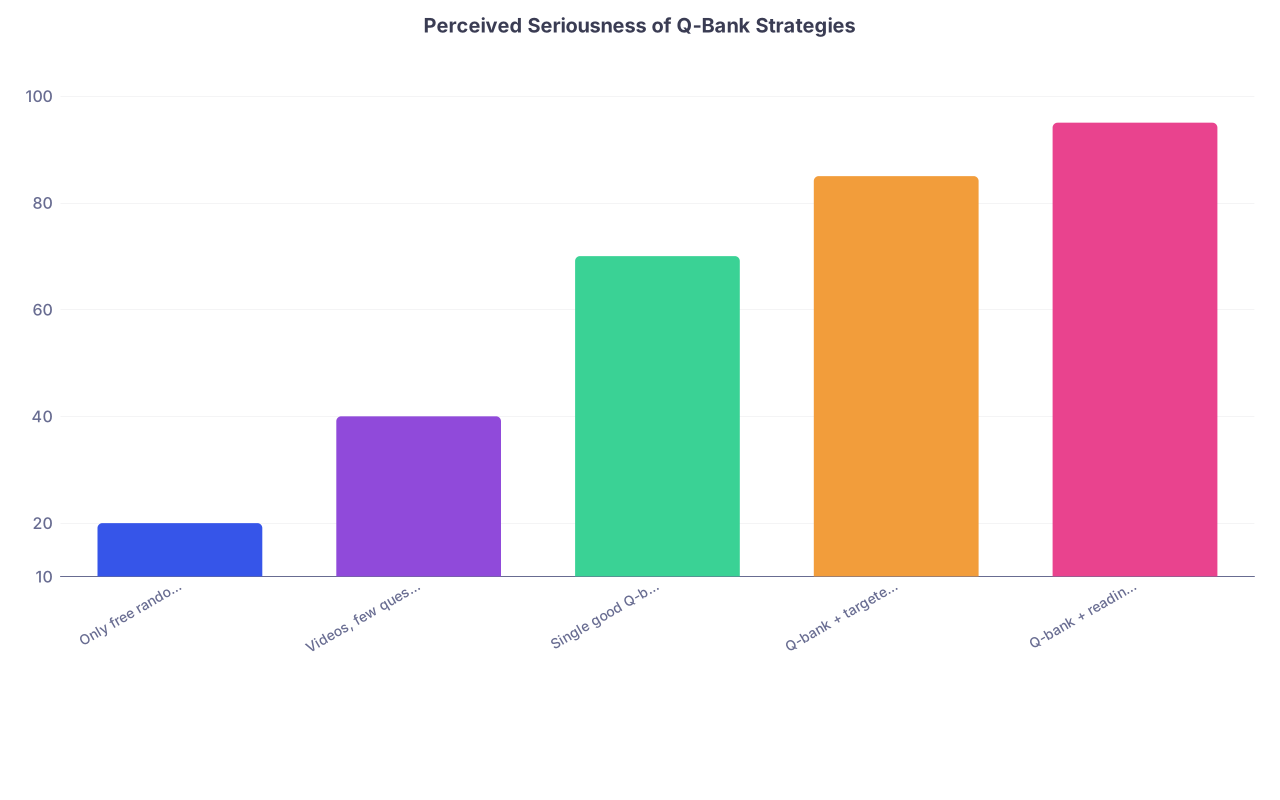
| Category | Value |
|---|---|
| Only free random apps | 20 |
| Videos, few questions | 40 |
| Single good Q-bank | 70 |
| Q-bank + targeted reading | 85 |
| Q-bank + reading + case discussions | 95 |
Internal Medicine
What impresses them:
- UWorld as your backbone
- AMBOSS articles for reading around your patients
- Consistent daily questions, even if just 15–20 on busy days
What concerns them:
- No questions until the last 1–2 weeks
- Reliance on pre-clinical style banks that don’t mirror shelf-level vignettes
- “I’m just using lecture notes and hoping it sticks”
Surgery
They know you’re tired. They know the hours are brutal. But:
- Using UWorld for surgery/IM sections → good sign
- Doing questions on perioperative management, fluids, sepsis, trauma → very good sign
- Only watching operative videos and putting off questions → red flag
OB/GYN / Peds / FM
They don’t need you to be a walking subspecialist. They need to see effort and pattern recognition.
Use UWorld if available, or a trusted shelf-specific bank your school recommends, and do questions consistently. When your answers on rounds sound like the rationales from a solid Q-bank, they notice.
How to Actually Use Q-Banks So Attendings See the Difference
Here’s the part students miss: attendings don’t see your score percentages. They see your output.
So the goal isn’t “do a ton of questions.” It’s “let those questions visibly change how I present, reason, and manage patients.”
If you really want them to feel your Q-bank work:
Tie last night’s questions to today’s patients.
“I did a block on hypercalcemia yesterday—this patient’s labs are exactly like one of those vignettes.”Borrow the language of good Q-banks.
When you say “first-line” vs “second-line,” “hemodynamically unstable,” “next best step,” that’s question-bank thinking applied correctly.Let your assessment and plan reflect pattern recognition.
Instead of hand-wavy impressions, you offer structured, stepwise plans that sound eerily like well-written explanations. That’s what makes attendings think: “This student is ahead of the curve.”
The One Thing You Should Absolutely Avoid
If you remember nothing else from this whole thing, remember this:
Do not use your Q-bank choice to justify weak performance.
I’ve heard it too many times:
- “Yeah I missed that, my Q-bank didn’t really cover this topic.”
- “I’m using [obscure app], the questions are easier, so I haven’t seen this yet.”
- “UWorld hasn’t really asked me about that, so I didn’t think it was important.”
Every time a student blames their resource, the attending thinks:
“No. You chose that resource. This is about your judgment, not the app.”
You can say “I’ll read more about that” or “I clearly need to tighten up on that topic.” That shows ownership.
Blaming the Q-bank shows immaturity. And they remember it when they fill out your evaluation.
Quick Reality Check: What Actually Matters Most
Let me zoom out for a second. The attending doesn’t ultimately care what your Q-bank logo is.
They care that:
- You’re using a resource serious enough to build a real foundation.
- You’re doing questions early and consistently, not in a panic.
- You can apply what you learn to their patients, on their service.
- You don’t hide behind “learning style” excuses when you’re underperforming.
You can do that with UWorld. With AMBOSS. With a small combination of the two. Could you technically piece it together with some lesser-known banks? Maybe. But you’ll be fighting both the content and the perception problem.
Why make it harder?
What Attendings Say When You’re Not in the Room
To really drive this home, here are a few things I’ve personally heard in post-rotation meetings:
“That student clearly did a lot of questions. Their management was sharp and they anticipated my next step.”
“They kept saying they were ‘reviewing’ but not actually doing practice questions. Barely improved all month.”
“I asked how they were studying and they quoted apps and random resources. No mention of UWorld or AMBOSS. Honestly their knowledge base matched that.”
“I don’t care what they used. I care that by week three they still couldn’t handle basic chest pain workup.”
Notice the pattern? Q-banks are never the only thing. But they’re an easy window into everything else: your planning, your maturity, your willingness to struggle with hard questions instead of clinging to comfort.

| Step | Description |
|---|---|
| Step 1 | Choose Q-bank approach |
| Step 2 | Serious, vetted bank |
| Step 3 | Random/weak tools |
| Step 4 | Consistent daily questions |
| Step 5 | Inconsistent or last-minute |
| Step 6 | Stronger clinical reasoning on rounds |
| Step 7 | Shaky performance, gaps in basics |
| Step 8 | Positive eval phrases, trust, strong LORs |
| Step 9 | Neutral/weak evals, concern about readiness |
FAQ: How Attendings Really Judge Your Q-Bank Choices
1. Do attendings literally care which specific Q-bank I use (UWorld vs AMBOSS, etc.)?
They care less about the brand and more about whether it’s a widely respected, rigorous resource. UWorld and AMBOSS check that box almost everywhere. When you pick something obscure, weak, or clearly “lite,” they question your judgment. When you pick something serious and use it consistently, they assume you’re doing the real work.
2. Is it bad if I don’t start questions until halfway through the rotation?
From their perspective, yes. They’ve watched that movie. It usually ends with a mediocre or bad shelf performance and a student who never quite “clicks” on the wards. Early questions—even a small daily dose—signal that you understand how steep the curve is and you’re not waiting to panic-study.
3. What if my school pushes a different Q-bank than what attendings mention?
Then your script is simple: “Our school provides [X], so I’m using that as my base, but I’m supplementing with [UWorld/AMBOSS] questions because I’ve heard they’re closest to the shelf/real life.” That tells them you’re respecting your curriculum and thinking like a grown-up about external standards.
4. How many questions per day actually looks ‘serious’ to an attending?
They don’t have a specific number in mind. What impresses them is consistency and visible improvement. For a busy rotation, 15–30 solid, reviewed questions most days is perfectly credible. Bragging about “80 questions a night” but presenting like you’ve never seen a CHF patient before just makes them doubt everything you say.
5. Will my Q-bank choices affect my letters of recommendation?
Indirectly, yes. No one writes, “Uses UWorld, therefore excellent.” They write, “Prepared, thoughtful, strong fund of knowledge, reads around patients.” The way you choose and use your Q-banks is one of the main engines behind those impressions. Strong questions → better reasoning → better rounds performance → better letters.
You’re in a phase of training where every choice is a quiet signal. Your Q-bank is not just a subscription; it’s a proxy for how you approach hard work, uncertainty, and standards.
Pick the resources serious people use. Use them earlier than feels comfortable. Let the questions change how you think on the wards, not just how you guess on exams.
Do that, and by the time you hit sub-internships and away rotations, you won’t just be passing shelves. You’ll already look like the intern they want you to become.
And once you’re there, we’ll have a different conversation—about how residents judge your study habits for boards. But that’s a story for another day.