
Most students switch Q-banks during dedicated for the worst possible reason—and at the worst possible time.
They don’t switch as a strategic move.
They switch as a panic reaction.
You feel it: scores plateau, a couple of bad UWorld blocks, your friend flexes their Amboss percentage—or some Reddit thread convinces you you’ve “wasted” your prep with the wrong resource. So you bail. You jump to a new Q-bank halfway through dedicated, reset everything, and convince yourself you’re “starting fresh.”
That’s how people blow 2–3 critical weeks of dedicated and walk into their exam underprepared.
Let me walk you through the landmines so you don’t become that story.
The Real Danger: Confusing “New” With “Better”
The big mistake is not switching Q-banks. The mistake is why and how you switch.
Students do this all the time:
- They see their UWorld percentage hover in the low 50s.
- They panic and decide “UWorld doesn’t match the exam” or “UWorld is too hard, it’s killing my confidence.”
- They buy a new Q-bank (Amboss, Kaplan, USMLERx, etc.).
- They start doing random questions without a plan.
- They stop doing detailed reviews “because I’ve seen this content already.”
What they actually did:
- Abandoned a high-yield, well-normed question bank right when it was starting to work.
- Reset their performance data.
- Lost familiarity with the platform they were most likely to use as their “base.”
- Burned precious dedicated time adapting to a new style instead of consolidating knowledge.
And then they blame the resources instead of their process.
Here’s the part nobody likes to hear:
A new Q-bank will always feel better for the first 1–2 weeks because it exposes your blind spots differently and your brain mistakes that novelty for “this is more like the exam.”
That feeling is a liar.
Why Mid-Dedicated Q-Bank Switching Backfires
You’re in dedicated. Time is compressed. Every decision has a cost.
When you switch Q-banks mid-dedicated without a clear, data-driven plan, you run into several predictable problems.
1. You Throw Away the Only Data That Matters
Your performance data in your main Q-bank is gold—if you don’t walk away from it.
I’ve seen this pattern repeatedly:
- Student does 40–60% of UWorld.
- They’re inconsistent: some 70% blocks, some 40% blocks.
- Their self-esteem crashes.
- They switch entirely to another Q-bank.
- Now they have:
- No full run of any single Q-bank.
- No consistent performance trend to interpret.
- No reliable baseline for readiness.
Instead of fixing their weak subjects, they reset the scoreboard.
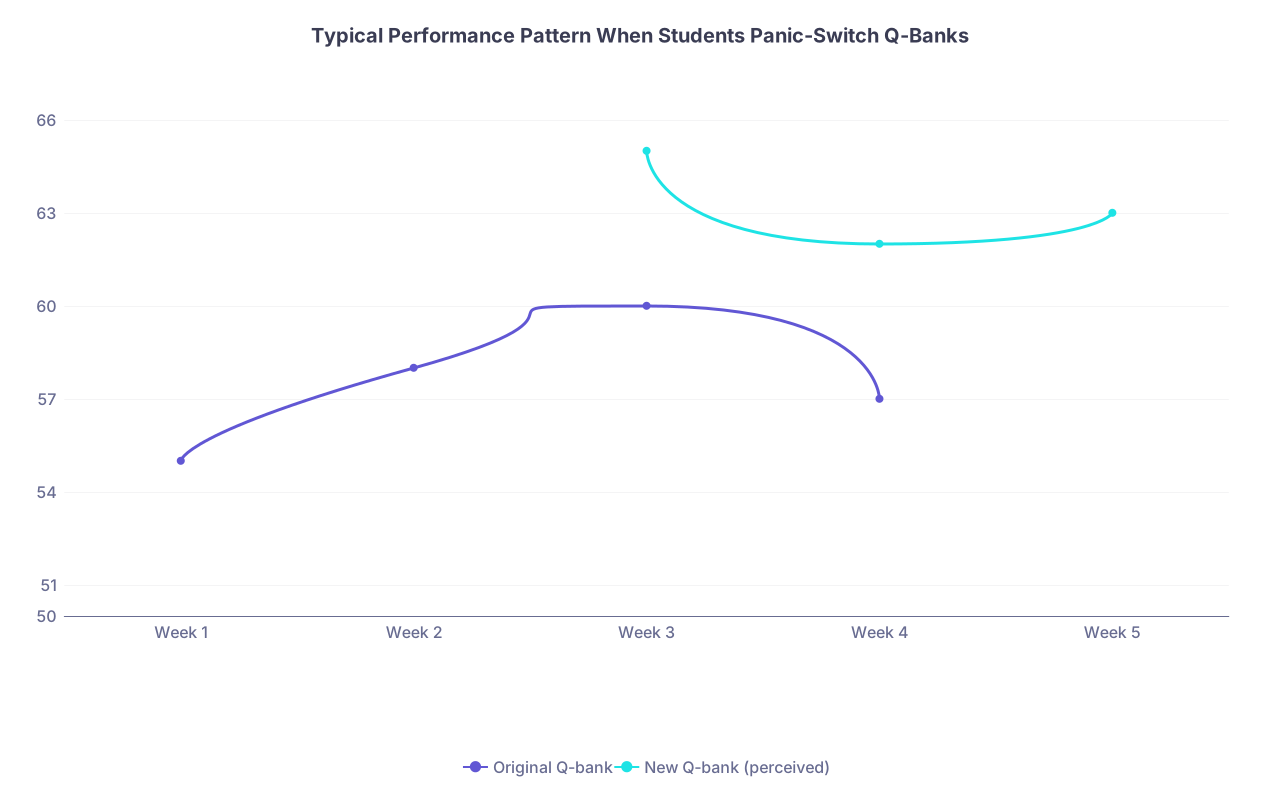
| Category | Original Q-bank | New Q-bank (perceived) |
|---|---|---|
| Week 1 | 55 | null |
| Week 2 | 58 | null |
| Week 3 | 60 | 65 |
| Week 4 | 57 | 62 |
| Week 5 | null | 63 |
What you should be doing with your primary Q-bank:
- Track performance by system and discipline (cardio, renal, pharm, etc.).
- Identify persistent weak categories.
- Design targeted review blocks around those weaknesses.
- Use the explanations and references to patch holes.
When you jump ship midstream, you lose continuity. You can’t see if your renal weakness improved. You lose the ability to say, “Okay, cardio was 45% three weeks ago, now it’s 62%—I’m moving in the right direction.”
You trade objective trends for vibes.
2. You Underestimate the Adaptation Cost
Every Q-bank has its own:
- Question-writing style
- Length
- Density of extraneous info
- Interface quirks
- Explanations style
The first 200–400 questions in any new Q-bank are partly a learning-the-platform tax.
Mid-dedicated, that tax is expensive. Your brain has to adjust to:
- How the Q-bank asks multi-step questions.
- How “tricky” they are with distractors.
- How much information is noise versus clue.
That adaptation period looks like weakness, and students often misinterpret it as, “Wow, I was behind. This Q-bank is way better / way more realistic.” No. You’re just new here.
You do not want to spend the last 3–4 weeks before your exam adapting to a platform instead of consolidating content.
The Psychological Trap: Panic, Comparison, and False Hope
This problem isn’t just logistical. It’s emotional.
1. You Use Q-Bank Switching as Emotional Pain Relief
Bad block?
Borderline NBME?
Score graph that isn’t trending cleanly upward?
The temptation is strong: “Maybe it’s the resource. Maybe if I use what my friend used, I’ll magically improve.”
Switching Q-banks becomes:
- A way to feel like you’re “doing something” instead of confronting your weak spots.
- An excuse to avoid reviewing humiliating mistakes.
- A fantasy reset button. Wipe the slate clean. New Q-bank, new me.
But here’s the truth: your knowledge base comes with you.
If your pathology fundamentals are weak, they’ll be weak in UWorld, Amboss, Kaplan, or anything else. The interface won’t save you.
2. You Get Seduced by Other People’s Scores
I’ve heard this exact sentence more times than I like:
“All my friends who scored 250+ used Q-bank X. I think I messed up using Y.”
This is survivor bias. You’re only hearing from the people who crushed the exam, not the people who used the same resource and scored in the low 220s.
- Only UWorld
- UWorld + Amboss
- Kaplan + UWorld
- Sometimes even old-school resources like USMLERx or Boards & Beyond heavy with fewer questions
The common denominator?
They picked a main Q-bank early. They did it thoroughly. They reviewed like it was their job.
They didn’t flail between platforms in week 4 of dedicated chasing some magical combination.
When Switching Q-Banks Mid-Dedicated Makes Sense
Now, I’m not saying “never switch.” I’m saying don’t do it blindly.
There are situations where adding or partially switching Q-banks mid-dedicated is rational.
Use Another Q-Bank as a Supplement, Not a Replacement
The smartest move in most cases is:
- Keep your primary Q-bank (often UWorld) as your anchor.
- Add a secondary Q-bank in a targeted way.
Examples that actually make sense:
- You’ve completed 80–100% of UWorld, reviewed thoroughly, and have 2–3 weeks left.
- You add Amboss: 1–2 blocks/day specifically in your weakest systems.
- You notice your NBME scores show weakness in ethics, communication, or obscure biostats.
- You intentionally use specific sections from a secondary bank that cover those niches better.
You’re not jumping. You’re layering.
The Worst Way to Switch Q-Banks (Don’t Do This)
Let me be concrete. This is the pattern that wrecks people.
The Classic Self-Sabotage Scenario
Timeline:
- You’re 3 weeks into dedicated.
- You’ve done 40–50% of UWorld.
- Your average is 52–55%.
- NBME score is a little below where you want it—say 200–210 when you’re aiming for 220+.
You then:
- Decide “UWorld isn’t working.”
- Buy another Q-bank (Amboss, Kaplan—doesn’t matter).
- Stop doing UWorld altogether.
- Reset your schedule to “finish this whole new bank” before the exam.
- Rush through questions with minimal explanations review “because I’m behind.”
What goes wrong:
- You never actually fix your weak foundations.
- You lose consistency with your primary Q-bank’s style.
- You end up half-finishing TWO banks instead of nearly mastering ONE.
- Your review quality falls off a cliff because you’re chasing question volume.
On test day, you feel like you’ve “done so many questions,” but your brain has shallow understanding across too many slightly different styles instead of deep understanding of the high-yield patterns.
That’s how you end up shocked by a disappointing score despite a huge question count.
A Safer, Smarter Way to Adjust Mid-Dedicated
If you’re deep into dedicated and feel like your Q-bank approach isn’t working, don’t impulsively switch. Fix your method first.
Here’s a rational mid-dedicated adjustment process.
Step 1: Diagnose the Real Problem
Before touching another resource, answer:
- Are you reviewing explanations fully, or just reading the bolded line and moving on?
- Are you annotating into a central resource (Anki, notes, sketchy-style mental hooks), or hoping passive exposure is enough?
- Are your blocks random mixed when your foundation is weak, instead of some structured system-based review first?
- Are you rushing 40–80 questions/day with poor review?
If your answer to any of those is bad, switching Q-banks is not the fix.
Your process is.
Step 2: Improve Your Review Before You Change Banks
A solid review process should look more like:
- 40 Qs takes 2–3 hours total:
- ~1 hour to do the block timed.
- 1–2 hours to review questions you got wrong and questions you got right for the wrong reasons.
- For each question, you can answer:
- What was the key concept being tested?
- Why was the correct answer correct?
- Why were the distractors wrong?
- You pull key facts or patterns into:
- Anki cards (cloze deletions, image occlusion, whatever you actually review).
- Concise notes tied to First Aid / Pathoma / Boards & Beyond.
If you haven’t been doing this, do not assume a new Q-bank will rescue you. Try 3–5 days of improved review first. You may be shocked how much your performance stabilizes.
If You Absolutely Must Switch: A Controlled Strategy
Let’s say you’ve done all that. Your review is solid. You still have strong reasons to adjust resources (e.g., you genuinely completed your main bank, or your content gaps are very specific).
Here’s how to avoid turning the switch into a disaster.
1. Keep a Clear Primary Q-Bank
Don’t go into resource polygamy. You’re not “using everything.” You always need a primary.
Example:
- Primary: UWorld (complete or almost complete).
- Secondary: Amboss (targeted blocks).
Or:
- Primary: Amboss (if that’s what you started with properly).
- Secondary: UWorld (selected blocks closer to your exam).
The mistake is abandoning your original Q-bank completely. Don’t do that.
2. Transition Gradually, Not Overnight
Wrong move: One day 100% old bank → next day 100% new bank.
Better pattern for, say, Amboss as a new secondary:
Week example (3–4 weeks out):
- Days 1–3:
- 1 UWorld block/day (mixed).
- 1 small Amboss block/day focusing on your weakest system (e.g., renal).
- Days 4–7:
- 1 UWorld block/day.
- 1–2 Amboss blocks in targeted areas.
- After that:
- Decide what gives you the best return and stick to that balance.
You’re testing fit, not abandoning ship.
3. Do Not Sacrifice NBME Practice for Q-Bank Volume
If you start thinking, “I don’t have time for NBME because I need to finish this new Q-bank,” you’ve already made a mistake.
NBMEs are non-negotiable.
| Component | Non-Negotiable? | Purpose |
|---|---|---|
| NBMEs | Yes | Score prediction, gaps |
| Main Q-bank | Yes | Pattern recognition |
| Second Q-bank | Flexible | Extra practice |
| Videos | Flexible | Concept support |
| Flashcards | Strongly yes | Retention & repetition |
Sacrificing NBMEs to cram a second Q-bank is backwards. The exam is more like an NBME than any commercial Q-bank.
Specialty Anxiety and the “I Need a 250” Spiral
I’ve seen this especially in students chasing competitive specialties (derm, ortho, optho, neurosurgery).
They set a target like 250+. Their first NBME comes back 214.
Panic.
Spiral.
Resource chaos.
They start saying things like:
- “Everyone in derm did two full Q-banks minimum.”
- “I heard Kaplan is better for Step 1’s style; I need to switch.”
- “Amboss is more like the real exam, I wasted too much time on UWorld.”
Here’s the quiet truth you won’t hear on forums:
- Most people in competitive specialties didn’t execute perfectly during dedicated.
- They had strong fundamentals from preclinical.
- They did one bank really well, plus targeted extras.
- Their edge was consistency and early work, not last-minute resource juggling.
Trying to “catch up” to someone else’s narrative by blowing up your own plan mid-dedicated is how you drift even further from your goal.
Concrete Red Flags You’re About to Make a Bad Switch
Pause if any of these are true:
- You want to switch Q-banks immediately after:
- A bad NBME.
- A week of below-average blocks.
- Hearing a classmate brag about a different resource.
- You can’t clearly articulate in one sentence:
“I’m switching because ________, and my plan is ________.” - You haven’t completed even 50–60% of your current Q-bank.
- Your Q-bank review process is rushed or superficial.
If you can’t pass that check, you’re not making a strategic move. You’re reacting out of fear.
What to Do Instead of Switching in a Panic
When you feel that urge to bail on your Q-bank mid-dedicated, here’s a safer alternative sequence.
1. Tighten Up Your Blocks
For the next 3–4 days:
- Limit to 1–2 blocks per day.
- Do them timed, random, mixed (unless your foundation is truly early/basic-level weak).
- Spend serious time on review: 2–3x block time.
2. Drill Your Worst System
From your Q-bank or NBME analytics:
- Pick your worst system (e.g., neuro, renal).
- Do system-specific blocks from your current Q-bank.
- Immediately follow with:
- Short focused content review (e.g., Pathoma chapter, FA section, Boards & Beyond video) tied to those missed questions.
- Flashcards / notes for what's repeatedly tripping you.
3. Use One Targeted Add-On Before a Full Switch
If you absolutely need a boost:
- Use a limited trial of another resource.
Example: Amboss free trial or short subscription. - Do:
- 10–20 questions in a problem system.
- Compare: are the same concepts hurting you?
- If yes, your issue is knowledge, not bank choice. Fix that first.
You’ll usually find that it’s not your Q-bank that’s the problem. It’s the cracks in your base.
A Quick Word on Step 1 Pass/Fail
People think pass/fail Step 1 reduced the pressure, so switching banks “isn’t that big a deal now.”
Wrong.
What changed is the visibility of your mistakes. The consequences are still there:
- Weak Step 1 prep → weak foundation → harder Step 2 → worse score where it actually counts for residency.
- Flailing with resources for Step 1 tends to repeat for Step 2.
If you don’t learn how to stick to a plan and resist panic-switching now, you carry that same habit into every high-stakes exam you take.
The Bottom Line: Don’t Let Panic Rewrite Your Plan
If you remember nothing else:
Switching Q-banks mid-dedicated is rarely the real solution.
Most of the time, the problem is weak review, poor planning, or avoidance of your ugly weak spots—not the resource itself.If you adjust resources, do it strategically, not emotionally.
Maintain a primary Q-bank, add secondary ones in a targeted, limited way, and never sacrifice NBMEs for question volume.Your focus should be depth, not novelty.
Master one high-quality bank with ruthless review before you chase the illusion that a different interface will save you.
Protect your dedicated. Don’t let a few bad days push you into the most common—and most costly—exam prep error.