
The books everyone buys and the books honors students actually finish are not the same thing.
You already know the public list: First Aid, Pathoma, UWorld, Sketchy, Anki. That’s the brochure version. The reality inside the library cubicles of students who consistently honor and score 250+ looks different, more ruthless, and a lot less cluttered.
Let me walk you through what really stays in their backpack, what lives permanently on the “inactive shelf,” and which sacred cows they quietly ignore while everyone else keeps wasting time.
The Hidden Rule: Fewer Books, More Reps
Here’s the first uncomfortable truth: the strongest students do not use more resources; they use fewer.
Average students hoard PDFs and Telegram drive dumps. Honors students aggressively prune. I’ve watched M2s at mid-tier schools hit 250+ with literally three core resources and a question bank, while their classmates drown under a mountain of “high-yield” nonsense.
Inside an honors student’s library, you’ll see two categories:
- Core spine books – used every week, often daily, completely marked up.
- Targeted references – pulled out for specific weaknesses, then put away again.
The rest? Decorations. Shelf-flex. “I might use this later” fantasy.
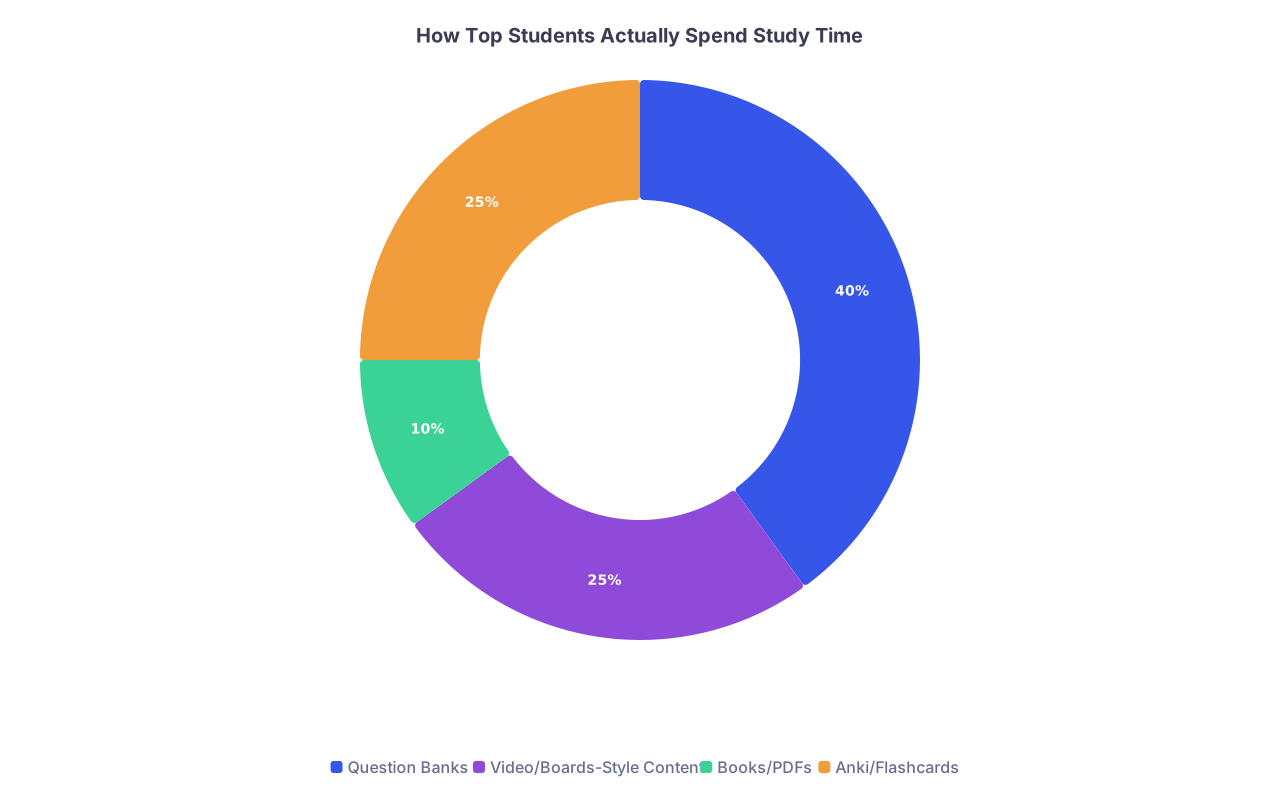
| Category | Value |
|---|---|
| Question Banks | 40 |
| Video/Boards-Style Content | 25 |
| Books/PDFs | 10 |
| Anki/Flashcards | 25 |
Those percentages are what I see when I sit with our honors kids and ask them to open their Screen Time stats and study trackers. Notice how little is pure book reading.
But some books still matter. A lot. Let’s talk about the ones that survive the cut.
The Non-Negotiables: The Books That Actually Get Worn Out
Every school has that one student who never seems to panic and quietly destroys exams. When you look in their locker, you keep seeing the same titles. They’re not special. They’re just used differently—and consistently.
1. First Aid for the USMLE Step 1 (but not how most people use it)
First Aid is not a textbook. It’s an index to the exam.
Average students “start reading First Aid” in September M2 and stall by page 96. Honors students treat First Aid like a map during dedicated and the last few months before it. They never pretend it’s their main learning source.
Here’s what actually happens with honors students:
- They don’t touch it seriously until they’ve done a solid chunk of UWorld or NBME-style questions.
- They read First Aid with a pen in hand, cross-linking to Pathoma, Sketchy, B&B videos, and UWorld notes.
- They annotate, but not like a scrapbook. Just enough to turn it into their personal “final pass” document.
You’ll see their copy with:
- Pathoma chapter numbers in the margins.
- “UW#1473” next to a weird detail that showed up in multiple questions.
- Big stars or boxes around things that matched NBME questions.
The students who bomb? They try to memorize First Aid line by line like it’s a Bible. That’s not honors-student behavior. That’s anxiety disguised as studying.
2. Pathoma (paper + video combo, not optional for most)
Yes, everybody “knows” Pathoma. But here’s what people don’t admit: the honors kids watch it more than once. And they actually read the book.
On the inside shelves of students who honor pathology and crush Step 1, I keep seeing the same pattern:
- The slim blue Pathoma book, warped from repeated use.
- Every margin filled with B&B or class lecture integrations.
- Sticky tabs on chronic confusion topics—glomerulonephritis, vasculitides, leukemias/lymphomas.
They don’t just passively watch Dr. Sattar while scrolling Reddit. They:
- Watch a short section.
- Pause and fill in the outline in the book.
- Then immediately hit 5–10 questions (UWorld or Rx) on that exact topic.
If you’re wondering why your classmate “just gets pathology,” it’s usually not talent. It’s 2–3 high-quality passes through Pathoma with active linking to questions.
3. Sketchy / Pixorize Printed Notes or Screenshots (yes, physical)
Here’s the dirty secret: a lot of honors students still print things. Even in 2026.
You’ll find:
- Printed Sketchy micro and pharm scenes, in sheet protectors or bound, with tiny notes around each image.
- Circles and arrows showing what corresponded to real questions they’ve missed.
- Pharmacology images with side effects added from UWorld stems.
The weak students just “watch Sketchy.” The strong ones use Sketchy as a visual reference they repeatedly flip back to when they miss something in a question bank.
I’ve literally seen a student pause mid-UWorld block, grab their printed Sketchy Staph aureus page, say “where the hell is this toxin represented?” and update the margin. That’s how you make those cartoons work for you.
What’s Actually in Their Bag for Preclinical Systems Exams
You’re not living in dedicated year-round. You’ve got block exams, anatomy lab, OSCEs. Honors students don’t read full textbooks for those either. They use board-style texts that translate directly into future exam points.

The Systems-Level Shortlist
Here’s what I keep seeing in actual daily rotation, especially in M2:
BRS Physiology – Especially at schools where the phys department still believes it’s 1998 and tests derivations of equations. Honors students destroy those exams by actually working through BRS end-of-chapter questions.
Costanzo Physiology (big text only for the serious) – This one divides people. The honors students at more academic programs (think UTSW, Michigan, Washington) actually read sections of Costanzo when they don’t understand a mechanism. Not cover-to-cover. Surgical strikes.
Rapid Review Pathology (Goljan) – This is fading with Pathoma and B&B dominance, but some old-school path attendings and older residents still hand this down. The honors students who use it don’t “do Goljan” as an identity; they skim select chapters (renal, heme, cardio) when Pathoma feels too thin.
Microbiology Made Ridiculously Simple (MMRS) – Surprisingly still alive. Not universally used, but in a lot of mid-tier schools, the gunner who everyone copies from will have this half-destroyed, using it mostly for mnemonics and concept reinforcement, not as a primary text.
The pattern: nothing gigantic, nothing that takes 40 hours per chapter. Concise, board-oriented, and with questions.
| Purpose | Go-To Book |
|---|---|
| Core Physio | BRS Physiology |
| Deep Physio | Costanzo Text |
| Core Path | Pathoma Book |
| Extra Path | Rapid Review (select) |
| Micro Backup | MMRS (select topics) |
If you’re wondering whether you need all of them: no. Honors students usually commit to one primary for each domain and then selectively dip into a second only when really stuck.
Step 2 / Shelf Exams: The Quiet Shift in Their Library
The students who crush Step 2 and shelves don’t cling to First Aid nostalgia. Their shelf and Step 2 libraries shift to more clinic-facing, case-based books.
Here’s what consistently shows up in their white-coat pockets and call-room lockers:
1. UWorld (yes, again) – but linked to slim references
Technically not a book, but it governs the books they keep. After a few hundred Step 2 questions, patterns become obvious:
- Miss everything endocrine? Out comes Endocrine section of Step-Up to Medicine or a slim endocrine handbook.
- Botching OB triage? They’ll pull Blueprints Obstetrics and Gynecology or Case Files OB/GYN for a weekend.
The key: they don’t read entire series. They stack question data, identify a weak domain, then hit a few high-yield chapters.
2. Case Files Series (used strategically, not religiously)
Honors students do not spend 12 hours a day with Case Files. But they absolutely use them like this:
- Before a rotation: skim 10–20 core cases on that specialty over 2–3 days.
- During: quickly reread cases for diagnoses they’ve bungled on the wards or in questions.
The most used: Internal Medicine, Surgery, Pediatrics, OB/GYN, Psychiatry. Family Medicine maybe, depending on the school.
The way they read Case Files is different:
Not “I will memorize this whole vignette.”
Instead: “What’s the workup order? What labs and imaging actually matter? How does this change management?”
3. Step-Up to Medicine (still king for IM-heavy schools)
At programs with strong medicine departments, Step-Up ends up absolutely wrecked by the students who honor IM and crush the medicine shelf.
They almost never read this cover-to-cover. They:
- Focus on cardiology, pulmonary, infectious disease, nephrology sections.
- Tie specific algorithms to UWorld question IDs.
- Add tiny scribbled NBME identifiers (e.g., “NBME 9 – weird CHF Q” in the margin).
The students who treat Step-Up like a novel and try to “finish” it burn out fast. The honors students extract algorithms and frameworks, then spend their real energy on question banks and NBMEs.
The Stuff They Buy But Quietly Abandon
This is the part nobody talks about on Reddit because it punctures the productivity aesthetic.
There are entire categories of books that sit untouched on the shelves of even top students:
Full-length mega-textbooks (Robbins full, Guyton, big pharm books) – used as a last resort, not as core study. An honors student might go to big Robbins once a month, max, to look up a confusing image.
Too many parallel resources for the same subject – having BRS Phys, Costanzo, plus Kaplan Phys means you’ll meaningfully use… exactly one and feel guilty about the rest.
Random niche Step 1 books: “High-Yield XYZ,” “Underground Step 1 Secrets,” etc. I’ve seen those on shelves with the plastic still on, next to a very dead succulent.
The biggest mistake weaker students make? Confusing ownership with mastery. Honors students will quietly sell or give away books by mid-M2 once they realize they’re dead weight. They’re unsentimental.
How Honors Students Actually Use Books with Qbanks and Anki
Resources are not isolated. The way high performers combine them is what matters.

| Step | Description |
|---|---|
| Step 1 | Morning: 40 Qbank Questions |
| Step 2 | Review Explanations |
| Step 3 | Targeted Book Chapter (Pathoma/BRS/Step-Up) |
| Step 4 | Light First Aid/Outline Review |
| Step 5 | Create/Tag Anki Cards |
| Step 6 | Evening: Anki Review + 20 More Questions |
| Step 7 | Weak Topic? |
Here’s what this actually looks like from the outside, sitting next to them in the library:
- They do a UWorld block.
- They identify 2–3 topics that felt fuzzy.
- They physically pull the relevant book (Pathoma, BRS, Step-Up) and read just that 2–4 page section.
- They add or tag Anki cards only on things they truly did not know, not every single detail.
- They move on. No spiraling down a rabbit hole of entire chapters.
The average student does the opposite: reads huge chunks “to be thorough” and then never sees it again.
Honors students have a simple rule they follow, consciously or not:
If I can’t apply it in a question, it’s decoration.
One Realistic Library Blueprint (You Don’t Need Everything)
You want something concrete? Fine. Here’s the kind of minimalist, actually used library I see in 250+ scorers and consistent honors students.
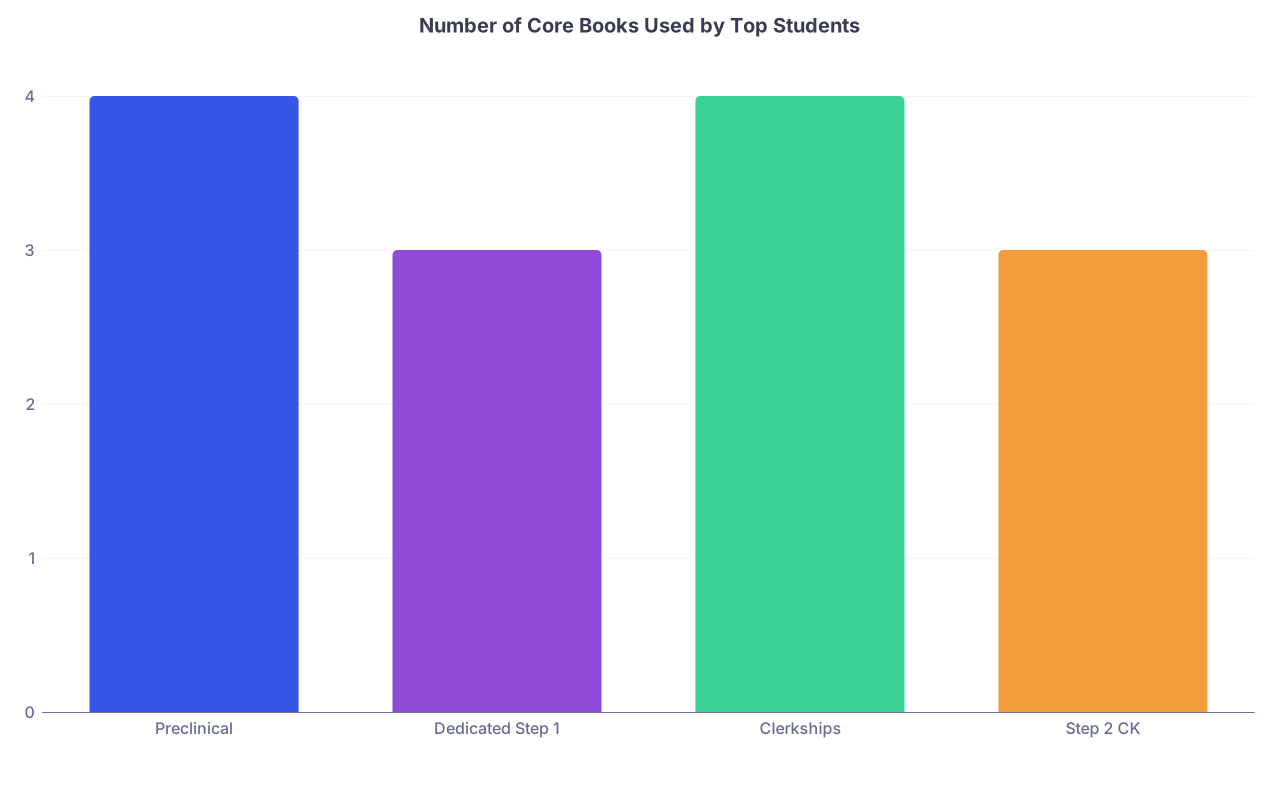
| Category | Value |
|---|---|
| Preclinical | 4 |
| Dedicated Step 1 | 3 |
| Clerkships | 4 |
| Step 2 CK | 3 |
Preclinical (M1–M2):
- Pathoma (book + videos)
- BRS Physiology or Costanzo (not both thoroughly)
- First Aid (light use M2, heavier near exams)
- Sketchy/Pixorize printouts for Micro/Pharm (used as reference)
Dedicated Step 1:
- First Aid (now as central map)
- Pathoma (fast 1–2 pass review)
- Whatever Anki deck they’ve committed to (this substitutes for extra books)
Clinical Years / Step 2:
- UWorld as the backbone
- Step-Up to Medicine (core IM)
- Case Files (for each core rotation, skimmed before/during)
- One OB/GYN or Surgery book, depending on school’s shelf style
Extra stuff might appear. But those are the ones with cracked spines and dried coffee stains.
How to Audit Your Own Library Like an Honors Student
Go stand in front of your shelf or open your iPad and be brutally honest. For each resource, ask one question:
When was the last time I meaningfully used this in the last 7 days?
If the answer is “I don’t remember” or “sometime last month,” that book is not part of your real study plan. It’s mental clutter.
Honors-level behavior looks like this:
- Commit to one primary resource per subject domain.
- Allow yourself one “backup/depth” book you touch maybe weekly.
- Ruthlessly ignore the rest until you’ve exhausted your primaries.
You don’t become an honors student by copying their bookshelf. You get there by copying their discipline in ignoring almost everything else.
A Quick Word on School-Specific Realities
At some schools, your attendings and course directors will push certain books hard:
- “You must read all of big Robbins.” (They haven’t themselves in 10 years.)
- “Our exam comes heavily from Lippincott’s Biochem.” (Maybe true for 10–20% of it.)
Honors students play this game strategically:
- They ask 1–2 upperclassmen who actually honored the course and aced the shelf: “What did you really use?”
- They skim the recommended book only enough to know its style and then pivot to Pathoma/B&B/boards-style equivalents.
- They focus on practice questions that mimic the style of exams, not full-on textbook memorization.
If your school’s exam is vignettes? Prioritize boards-style resources.
If it’s still multiple-choice fact recall out of lecture slides? You might keep one or two school-specific notes binders—but you still tie them to question banks when possible.
Bottom Line
Inside an honors student’s library, you won’t find magic titles nobody’s heard of. You’ll find:
- The same few famous books.
- Used harder, more deliberately, and with less guilt about ignoring everything else.
The difference isn’t what they own. It’s what they actually open three times a week for six months straight.
You will forget most of the titles you’ve purchased by the time you’re an attending. You will not forget the feeling of having exactly what you need on your desk—and nothing you don’t—and realizing that, for once, you’re not studying out of fear, but out of control.