
The belief that you must finish every single resource before your exam is quietly destroying your score.
Not dramatic. Just true.
You’re not failing because you don’t own enough books or Qbanks. You’re spiraling because you think “unfinished” equals “unprepared.” And that mindset makes you chase completion instead of competence.
Let’s pull this apart before it eats you alive.
Step 1: Admit the ugly truth — you will not finish everything
You already know this. That’s why you’re here.
You’ve got, what, 2–6 weeks left? And your list looks something like:
- UWorld (or AMBOSS) — only 38% done
- Anki deck — thousands of cards still due
- Pathoma — watched once, maybe?
- Boards & Beyond / Sketchy — halfway-ish
- A second Qbank you impulsively bought on sale
- Three review books you haven’t opened
And your brain keeps saying: “If I don’t finish all of this, I’ll fail. Other people are finishing everything. I’m behind. I’m screwed.”
Let me be blunt: virtually no one finishes every resource well before a major exam. The ones who claim they did?
Either:
- They started months earlier with absurd discipline, or
- They “finished” by blasting through stuff half-awake, learning almost nothing.
You’re not behind because you can’t finish everything. You’re behind if you keep pretending you can and spread yourself so thin that nothing sticks.
So the real question isn’t:
“How do I finish it all?”
It’s:
“What can I cut safely and still pass or score well?”
We can answer that.
Step 2: Understand what actually moves your score
Some resources are score engines. Others are comfort blankets.
Here’s the harsh hierarchy I’ve seen matter most for med students and board-style exams (Step, COMLEX, shelf exams, finals):
| Priority Tier | Resource Type | Keep/Cut | Notes |
|---|---|---|---|
| Tier 1 | Active Qbank (UWorld/AMBOSS) | MUST KEEP | Non‑negotiable |
| Tier 1 | Reviewing missed questions | MUST KEEP | Where learning happens |
| Tier 2 | High-yield concise notes / First Aid-style | KEEP | But not at expense of Qs |
| Tier 2 | Core videos (Pathoma, key systems) | KEEP SELECTIVELY | Only weak topics |
| Tier 3 | Massive Anki backlogs | MODIFY | Cut, reset, or suspend |
| Tier 3 | Second Qbank | CUT FIRST | Unless you finished primary |
| Tier 4 | Full re-watch of long video series | ALMOST ALWAYS CUT | No time |
| Tier 4 | Extra textbooks / long PDFs | CUT | Skim only if truly needed |
If you’re pressed for time, you protect:
- One main Qbank
- Careful review of the questions you miss
- Focused review of weak topics with a concise resource
You sacrifice:
- “Nice to have” second resources
- Huge video series you secretly know you won’t finish
- Unrealistic Anki backlogs that just generate guilt
If a choice is “more new questions” vs “rewatching 4 hours of videos,” new questions win 95% of the time.
Yes, really. Even if the videos feel safer.
Step 3: Triage your remaining time like a clinician, not a panicking student
You’re basically doing exam triage now. You can’t “treat” everything.
1. Calculate your real remaining capacity
Grab a piece of paper. No, seriously.
Write:
- Days until exam: ___
- Honest daily study hours you can sustain without breaking: ___
Then:
- Total remaining hours = days × hours
Now subtract non-negotiables:
- 10–20% for life chaos (you’ll get sick, exhausted, or mentally done some days)
- A few hours for at least 1–2 practice NBMEs/full-lengths
- 1–2 lighter review days before the exam
Whatever’s left is your real time. Way smaller than your fantasy time.
2. Give everything a brutal “worth it?” label
Take each resource and write one word next to it:
- “Core” (directly tied to exam performance)
- “Supplement” (nice but not essential)
- “Vanity” (you want it for ego/completion, not need)
Core is usually:
- Primary Qbank
- Error log / weak topic review
- One concise written/outline-style resource
Supplement:
- Some targeted videos
- Some Anki for problem topics
Vanity:
- Second Qbank with 60% untouched
- Old lectures you “feel bad” about not rewatching
- Huge decks you started late
Vanity gets cut first. No ceremony. Just gone.
Step 4: What you can cut safely (no, really)
Here’s the part you’re actually here for.
1. The Anki monster
You’re 5,000 cards behind and Anki is telling you you’re a failure daily.
You can safely:
- Suspend whole tags you’re solid on (e.g., easy micro you know cold)
- Reset the deck and only unsuspend cards from your weakest systems
- Cap daily reviews (e.g., 200 max), accept that you won’t “clear” everything
What you shouldn’t do:
- Spend 6+ hours/day trying to catch up on cards while neglecting Qbank
- Keep all cards active just because “I already started it”
Your goal now is score, not “Anki streak purity.”
2. The second Qbank
You bought USMLE-Rx, Kaplan, or something else “just in case” and now it’s haunting you.
If your main Qbank (usually UWorld or AMBOSS) isn’t 100% done:
- That second Qbank is basically optional frosting.
You can safely:
- Stop it completely
- Only use it for a very specific weak area (like biostats or ethics) if your main Qbank is genuinely weak there
You do not need:
- 5,000 extra questions to pass or even to do well
I’ve watched people do:
- 70% of UWorld well → score 240+
- 100% of 3 Qbanks poorly → barely pass or even fail
Depth > volume. Every time.
3. Massive video series
Boards & Beyond, full organ-system lectures, Sketchy everything.
With <4 weeks left, you can usually cut:
- Full rewatching of everything “just to be safe”
- Any video that feels like a podcast where your brain checks out at minute 8
You should instead:
- Watch only what’s directly tied to your weakest blocks from your Qbank
- Use 1.5–2× speed and active notes if you really need a concept refresh
If you’re debating between:
- 6 hours of videos “because that’s the plan”
vs - 6 hours of targeted questions + reviewing missed concepts
The questions win. Again.
Step 5: What you should almost never cut
There are things that are dangerous to sacrifice, even when anxious.
1. Active question practice
Cutting questions because “I want to feel more confident by rereading notes” is how scores flatline.
You should protect:
- 40–80 questions/day (depending on time and stamina)
- Careful review: why each answer is right/wrong, not just “oh, I get it”
- Writing down recurring blind spots in a tiny “last 3 days” notebook
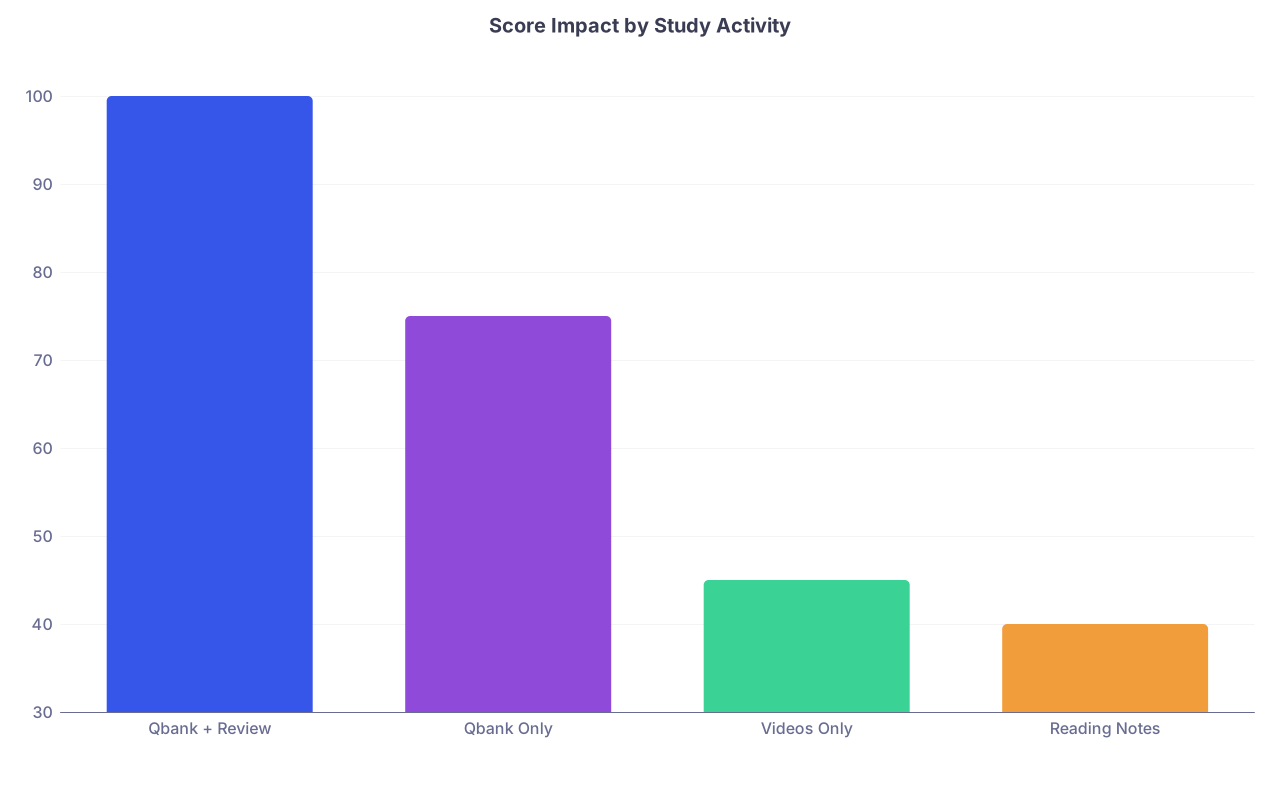
| Category | Value |
|---|---|
| Qbank + Review | 100 |
| Qbank Only | 75 |
| Videos Only | 45 |
| Reading Notes | 40 |
(Think of the bars as “relative impact on your score” — not real numbers, but the order is painfully accurate.)
2. At least one realistic full-length
I know practice NBMEs/CBSEs/COMSAEs are terrifying.
But skipping them:
- Gives you fake confidence in pacing
- Hides score range reality until it’s too late
- Robs you of the chance to adjust before the real thing
You need:
- At least 1–2 full-length practice exams in your actual time window (same start time, minimal breaks)
- A hard look at sections where you’re hemorrhaging points
If you’re cutting full-lengths to “save time for content,” you’re choosing to be surprised on exam day. Bad trade.
Step 6: Build a “salvage plan” for the time you have left
Let me outline an example, because your brain probably feels like static right now.
Say you have 14 days left, 8 hours/day you can realistically do.
You could do:
Daily core (about 5–6 hours):
- 40–60 Qbank questions in timed or tutor mode (2–3 blocks)
- Deep review of every question you miss + some you guessed on
- Jot down 5–15 “must remember” facts from each block into a tiny notebook
Targeted content (1.5–2 hours):
- Use your error log to pick 1–2 weak systems/day (e.g., cardio, renal)
- Briefly hit those topics in:
- Pathoma chapters
- First Aid/concise notes
- Short, targeted videos only if you really don’t understand
Light Anki / flashcards (30–60 minutes):
- Only key decks or custom cards based on your errors
- Hard cap. Stop when time’s up, even if cards remain.
Practice exams:
- 2 full-lengths on separate days:
- Day 10 and Day 5 before exam, for example
- Treat them like rehearsals, not IQ tests
Last 2–3 days:
- Fewer new questions
- More review of your tiny notebook, high-yield lists, formulae, common gotchas
- Sleep protection
That kind of plan raises scores. “I’ll watch everything and finish every deck” doesn’t.
Step 7: Dealing with the guilt of cutting resources
This is the part no one admits.
Even if you logically know you should cut things, you’ll feel:
- Lazy
- Behind
- Like you “wasted money”
- Afraid you’ll open your score report and think, “If only I had finished ___”
Here’s the uncomfortable truth: you will always have unfinished resources.
Everyone goes into exam day with:
- Videos they didn’t touch
- Decks half-done
- PDFs never opened
You’re not aiming for “perfect study history.” You’re aiming for enough mastery to answer real questions under time pressure.
Say this to yourself (out loud if you need to):
“I choose to leave some resources unfinished so I can actually learn the ones that matter.”
That’s not quitting. That’s strategy.
Step 8: Red flags that your plan is still unrealistic
You’re probably still overstuffing your schedule. Here’s how you know:
- You need every day to go perfectly to finish the plan
- You panic if you lose 1 hour to life stuff
- You have >2–3 “major” resources you’re still trying to finish front-to-back
- You go to bed every night thinking “I’m behind” even though you studied 8+ hours
If that’s you, cut again.
Trump-card rule: If your choice is between doing a reasonable number of questions well vs cramming in 4 different resources “lightly,” always pick depth.
Quick decision tree: what to do tonight with your mess of resources

| Step | Description |
|---|---|
| Step 1 | List all resources |
| Step 2 | Mark 1 Qbank as Core |
| Step 3 | You have more flexibility |
| Step 4 | Cut any 2nd Qbank |
| Step 5 | Cap or trim Anki |
| Step 6 | Keep only concise notes |
| Step 7 | Use videos only for weak topics |
| Step 8 | Days < 21? |
You don’t need a perfect master plan. You need a slightly-better-than-yesterday plan that’s sustainable.
FAQs (You’re not the only one spiraling about this)
1. Will I fail if I don’t finish UWorld?
No. Annoying answer, but true.
You can pass — and even do well — without 100% of UWorld if:
- You cover a majority (60–80%) of it
- You review it carefully
- You supplement with at least one full-length practice exam and targeted content review
People fail not because they hit only 75% of UWorld, but because they:
- Did questions passively
- Never reviewed their mistakes
- Ignored weak topics
If you have to choose: 70% of UWorld with deep review beats 100% rushed any day.
2. Is it okay to stop Anki completely before the exam?
Sometimes, yes.
If Anki is:
- Eating 3–5 hours/day
- Making you too tired to do questions
- Making you feel constantly “behind”
Then a temporary Anki pause, or a hard cap, can help your brain actually learn instead of just treading water.
What I like better than a full stop:
- Suspend big chunks you don’t need
- Make a small “exam-only” deck from your Qbank errors + ultra-high-yield facts
- Do 20–30 minutes/day, max
You’re not married to the giant deck you started six months ago.
3. I haven’t watched all of Pathoma/Boards & Beyond. Am I doomed?
No. That’s the perfectionist brain talking.
Would it have been nice to finish? Sure. Is it mandatory? Absolutely not.
Use them now as:
- Targeted fixes: if you keep missing glomerulonephritis questions, go watch that specific video
- Concept repair, not background noise
Plenty of students score well having only watched selected chapters that correspond to systems they struggled with.
4. My practice scores are lower than I want. Should I push the exam back to finish more resources?
Maybe. But not automatically.
Ask first:
- Are your scores trending up, flat, or down?
- Are your mistakes mostly content gaps you can fix, or test-taking/time problems?
- Can you realistically fix your biggest issues in the time left without collapsing?
Pushing the exam only helps if:
- You’re going to use that extra time with a better, more focused plan
- You’re actually going to study, not just marinate in anxiety
Sometimes, committing to a smart, trimmed plan with your current date is better than rolling forward just to collect more unfinished resources.
5. What if everyone else in my class is finishing more than me?
They’re not, honestly. They’re just posting their highlight reel.
You don’t see:
- The days they did 15 cards and scrolled Instagram the rest of the time
- The videos they “played” while half asleep
- The practice tests where they also bombed cardiology
Your brain loves to invent this imaginary “perfect student” who:
- Finished 100% of UWorld
- Did Zanki twice
- Watched every single video
- Still had time to cook and sleep 8 hours
That person doesn’t exist at scale. Stop trying to compete with a ghost.
6. What should I do today if I’m totally overwhelmed and can’t decide?
Do this. Exactly this:
- Pick one Qbank block (20–40 questions). Do it timed.
- Review every question you got wrong or guessed on. Write down key points.
- Spend 30–60 minutes reviewing the weakest topic from that block using a concise resource (Pathoma, First Aid, short video).
- If you have energy, do Anki/flashcards for just 20–30 minutes, focused only on your weak areas.
- Close everything. Go to bed at a sane hour.
Then repeat tomorrow.
You don’t need a 12-page master schedule. You need one solid block of questions, one targeted content block, and enough rest to come back again.
Open your resource list right now and cross out one whole resource you’ll officially stop trying to finish. Then plan tomorrow around the few things you’re actually going to do well.