
It’s 11:47 pm.
You’re on the group chat. Someone sends a photo of their “study setup” for the block exam or Step prep: six review books, three question banks activated, a rainbow of flashcard decks, some fancy integrated schedule printed and taped to the wall.
You look at your own desk.
One standard textbook from the library. Maybe one review book you bought used. Your free Anki deck. That’s it.
And your brain goes straight to:
“I’m already behind. They’re going to crush this exam. I’m going to fail because I don’t have enough resources.”
Let’s talk about that. Because I’ve watched this exact spiral destroy people’s confidence way more than any exam ever did.
The ugly truth: more books ≠ better prepared
Let me be blunt: a bigger pile of books does not mean a bigger score.
I’ve watched classmates with:
- One main resource + one Qbank → honor the shelf
- Ten resources stacked like a Jenga tower → barely pass and miserable
But the problem is, your brain doesn’t care about logic at 11:47 pm. It just sees “they have more” and translates it to “I’m less.”
Here’s what usually happens in real life when someone owns a ton of review books:
They use:
- One or two seriously
- Flip through three “just in case there’s something missing”
- Never open the rest except for that one guilty flip the night before the exam
And that guilt-fueled flipping? That’s not learning. That’s panic in book form.
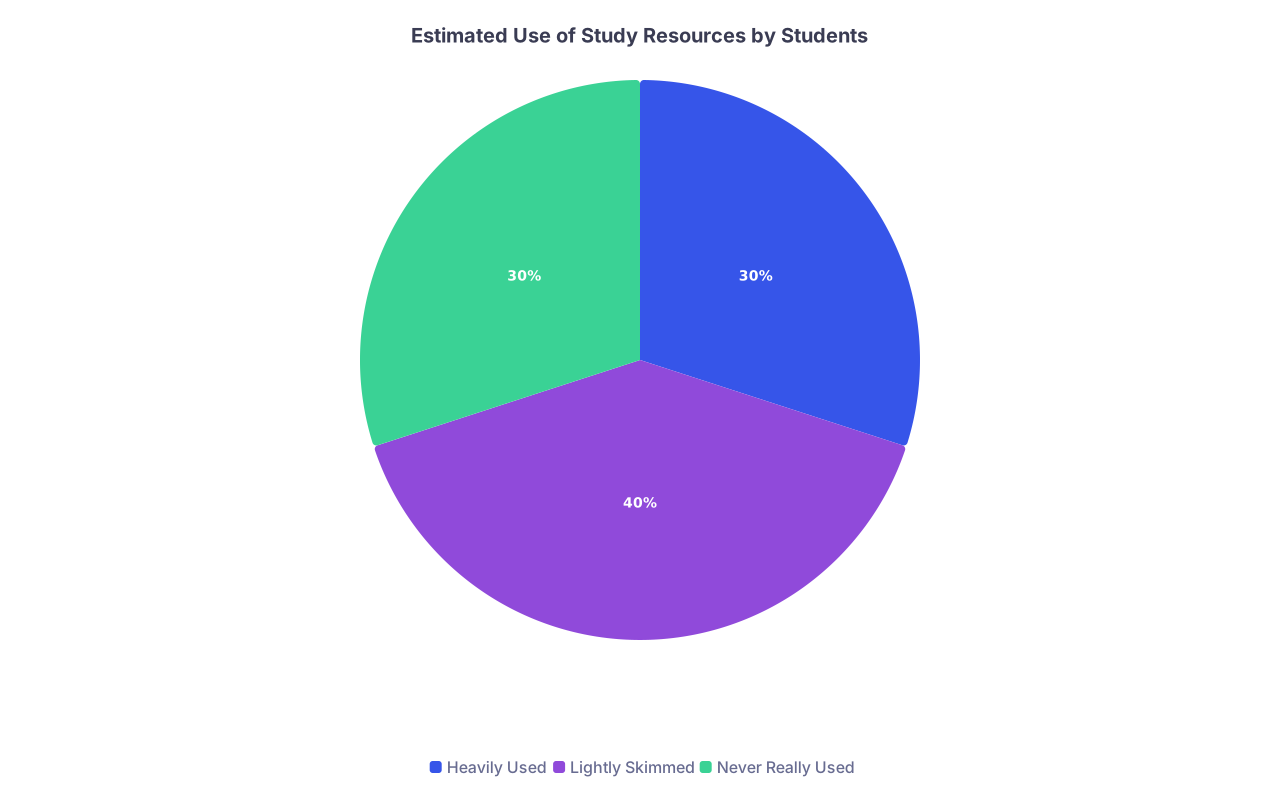
| Category | Value |
|---|---|
| Heavily Used | 30 |
| Lightly Skimmed | 40 |
| Never Really Used | 30 |
You’re worrying about what’s on their shelf. The exam is only testing what ends up in their brain. Those are not the same thing.
What actually matters more than the number of books
You know what exam score predictors actually care about? Not “books owned.”
They care about:
- How many high‑quality questions you’ve done
- How consistently you’re studying
- How many passes you’ve made through one good resource
- Whether you’re reviewing mistakes like they matter
I’ve seen this over and over: the “resource minimalist” quietly outperforms the “resource collector.”
Picture two students:
Student A (The Collector):
Has: Boards & Beyond, Pathoma, Sketchy, First Aid, UWorld, AMBOSS, Kaplan books, BRS, plus two random niche review books.
Pattern: Watches 30% of several video series, does UWorld in “tutor” and never truly reviews, feels constantly behind because they’re “not using everything they paid for.”
Student B (The Minimalist):
Has: One main resource (say, Pathoma + class syllabus) and one Qbank.
Pattern: Actually finishes Pathoma—twice. Does every Qbank question. Reviews wrong answers in detail. Doesn’t try to “sample” the whole internet.
Guess who ends up more confident on exam week. It’s not the one whose room looks like a bookstore.
The exam doesn’t give you extra points for “consulted seven secondary sources.”
Why your classmates’ book piles feel so threatening
You’re not really afraid of books. You’re afraid of what they symbolize.
Your brain is doing this:
“They have more books” →
“They know about more secret content than I do” →
“They’ll score higher” →
“I’ll be below average” →
“I’ll never match into what I want” →
“Everything is slipping away and I can’t catch up”
Zero to career collapse in about six seconds.
And med school culture makes this worse. People flex resources like status symbols:
- “I’m doing my third Qbank now.”
- “I switched from UWorld to AMBOSS to get different questions.”
- “I have like four pharm review books, they all explain it differently.”
You don’t hear:
- “I used half of one book and never finished it because I panicked and switched.”
- “I own three things I’ve literally never opened.”
- “I’m buying more resources because I don’t actually trust that I’m learning.”
But that’s what’s really going on a lot of the time.
The brutal math: too many resources actually hurt you
Here’s the part nobody advertises when they post their “study arsenal” on Instagram:
There is a hard limit to how much content your brain will meaningfully process.
You can’t:
- Watch all the videos
- Read all the books
- Do all the decks
- Finish all the Qbanks
Not in med school time. Not while you’re also sleeping occasionally and pretending to be a human being.
So every extra resource you add doesn’t just “give you more.” It also:
- Dilutes your focus
- Fractures your time
- Makes you restart the learning curve with yet another style/explanation

| Step | Description |
|---|---|
| Step 1 | See classmates with many books |
| Step 2 | Buy more resources |
| Step 3 | Too much to use fully |
| Step 4 | Shallow use of everything |
| Step 5 | Low retention and more anxiety |
| Step 6 | Blame self, not overload |
Honestly, the number of times I’ve heard this exact sentence:
“I wish I’d just picked one resource earlier and stuck with it.”
Not once have I heard:
“I wish I’d purchased more random review books I never opened.”
How to tell if your current resources are actually “enough”
Let’s evaluate this like an adult for a second, not like your 2 am panic brain.
Ask yourself:
Do I have at least:
- One solid content source? (Class notes, a reputable text, Pathoma/Boards & Beyond/etc for pre‑clinicals, a good clerkship book for rotations)
- One way to test myself? (Qbank, practice questions, NBME-style exams)
Can I realistically finish what I already have before the exam
Actually finish. Not “touch each chapter once if I don’t sleep.”When I do questions, are my weak spots mostly things I could find and fix using what I already own?
If the answer is yes to those, then you’re not failing because you don’t have enough books. You’re either:
- Not using what you have deeply enough
- Not giving yourself enough time
- Too scattered from watching what everyone else is doing

The comparison trap: social media, group chats, and silent assumptions
You don’t see the full picture of your classmates’ lives. You see:
- Book stack photos
- Shared Google Sheets of “my resources”
- Someone saying, “Oh yeah, I watched all of Sketchy and did UWorld twice”
You don’t see:
- The messy “I switched resources six times this block and now I’m lost”
- The “I haven’t actually reviewed a question deeply in weeks”
- The “I’m memorizing random facts from three sources and retaining nothing”
And sometimes, people exaggerate. Not even maliciously. Just… aspirationally.
“I’m doing UWorld and AMBOSS” can mean:
- They bought both
- They did 200 questions in each
- And then got overwhelmed and mostly gave up
You’re comparing your actual habits to their marketed version of themselves. Of course you feel behind.
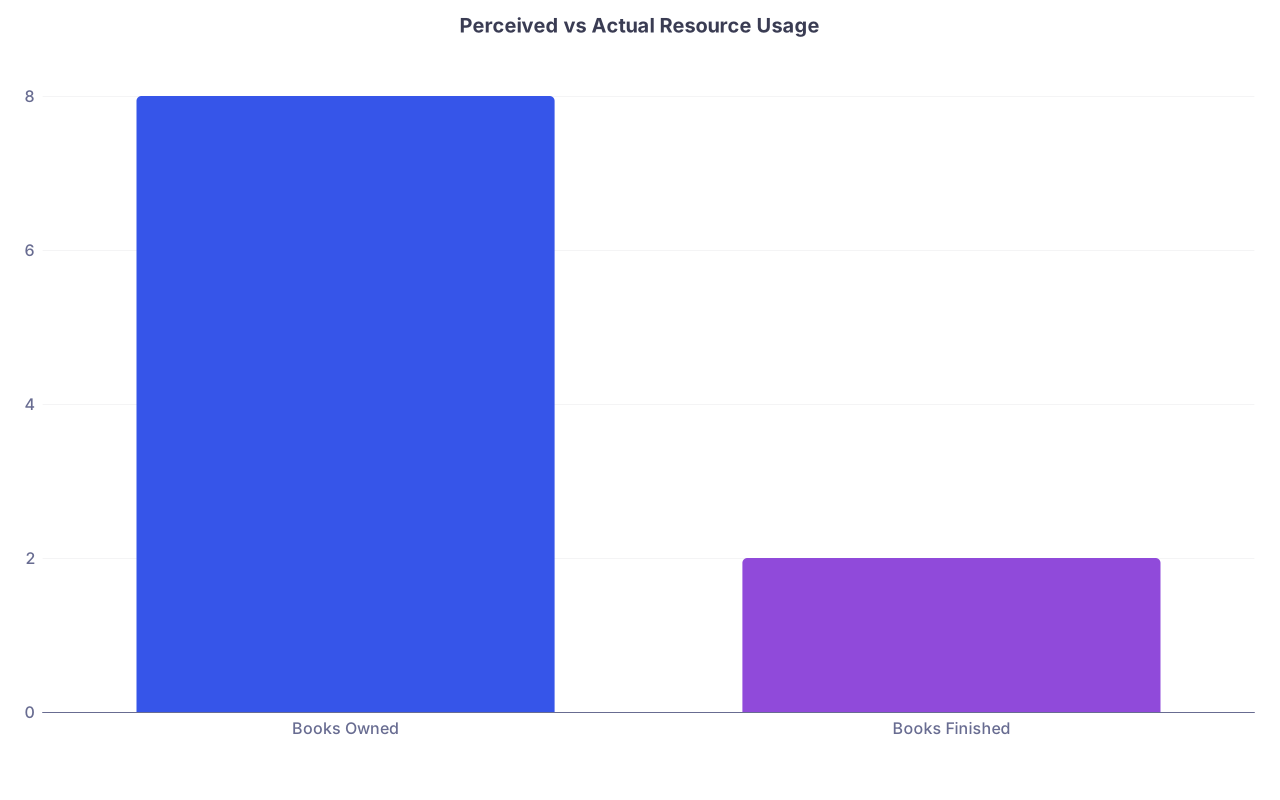
| Category | Value |
|---|---|
| Books Owned | 8 |
| Books Finished | 2 |
How to protect your brain when people start flexing resources
Let me give you a simple mental script, because you will keep seeing this.
When you see someone with a mountain of resources, mentally say:
“That’s their strategy. Mine is depth over chaos. Their stack doesn’t change what’s on my exam.”
And if they start the humble‑brag:
- “I’m using like five different books right now.”
You’re allowed to respond with something like:
- “Nice. I actually do better sticking to one and really mastering it, so I’m just using X + questions.”
You don’t owe anyone proof that you’re doing “enough.” You owe yourself a plan that you can actually execute.
A practical plan: “I have less stuff, but I want to do more with it”
Instead of spiraling, you can turn this into an actual advantage.
Take what you already have and ask:
“How do I squeeze the maximum value out of this?”
For example, say you only have:
- One review book for the course
- A Qbank (or even just school-provided practice questions)
- Maybe a shared Anki deck or your own cards
Here’s how you can beat the person with five books:
Make one resource your spine
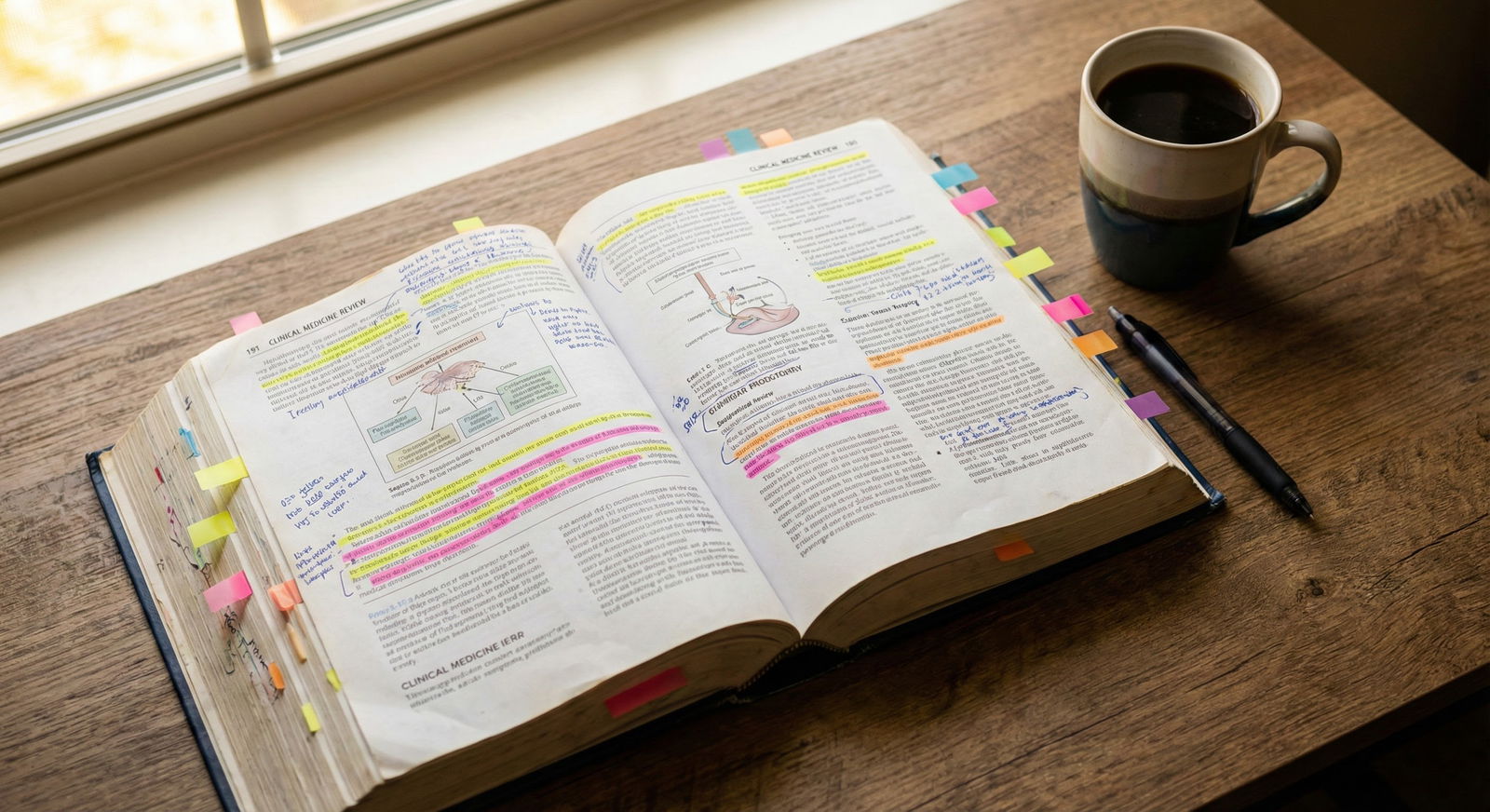
That review book? That’s your backbone. For each lecture or topic, find the matching section and read it with intention. Mark it up. Add questions in the margins. That book becomes your “single source of truth” for the basics.Marry content to questions
Don’t just passively read, then separately do questions. After you study a topic from your book, do a small block of questions on that topic. Use the explanations as bonus teaching, not as a separate “resource” you’re supposed to “cover.”Become ruthless about review
Every missed question is gold. Don’t just go “oh yeah, I knew that.” Write why you missed it:- Didn’t know the concept at all → go back to that section in your one book
- Misread the question → write what clue you ignored
- Knew it but couldn’t recall → maybe that belongs in your flashcards
Run full passes instead of lots of half‑passes
Finish the book once, even if it’s imperfect. Then circle back. Two complete, slightly messy passes beat six different resources each done 20%.
When it does make sense to add one more resource
Sometimes your anxiety has a point. Not always, but sometimes.
If:
- You literally have no access to NBME-style practice questions for a major exam
- Your current text is outdated or notoriously bad
- You’re consistently missing the same concept and your book really doesn’t explain it well
…then adding another resource can be reasonable. But do it like a surgeon, not like a kid in a candy store.
Ask:
- What exact gap am I trying to fix?
- What is the single best resource to plug that hole?
- Can I realistically use this before exam day?
And then decide: is this replacing something, or adding to it? If you add, you probably need to consciously drop something else. Time isn’t elastic.
| Situation | Add Resource? |
|---|---|
| No access to practice questions | Yes |
| Already have 1–2 Qbanks | Usually No |
| Single bad/outdated textbook | Yes |
| Just FOMO from classmates | No |
| Struggling with 1–2 topics only | Targeted Yes |
The deeper fear: “What if doing less means I’m choosing mediocrity?”
This is the part that really stings, right?
It’s not just: “They have more books.”
It’s: “If I don’t do what they’re doing, maybe I’m not serious enough. Maybe I’m choosing to be average.”
The medical education culture basically equates suffering and excess with virtue.
More resources. More hours. More everything.
But there’s a difference between:
- Doing the hard, boring, consistent work on a small number of high-yield things
and - Panic‑buying more stuff so you can feel like you’re “doing something” while your actual knowledge stays shallow
Choosing focused, sustainable work isn’t choosing mediocrity. It’s choosing not to light your brain on fire.

Quick gut-check: are you actually under-resourced or just scared?
Ask yourself, tonight, honestly:
If I magically received three more review books in the mail tomorrow:
- Would I actually have time to use them properly before my exam?
- Or would they just sit there and make me feel guilty?
If the honest answer is “they’d just stress me out,” then you don’t have a resource problem. You have an anxiety + comparison problem.
And that’s fixable. Not easy, but fixable.
FAQ (5 questions)
1. What if my classmates are using a famous resource (like UWorld or Pathoma) that I don’t have? Am I screwed?
No. Is it nice to have the big-name stuff? Yeah. Is it mandatory to pass or even do well? No. People have honored with:
- Only school-provided questions + one decent text
- Older or borrowed resources
If there’s a truly high-yield, widely recommended thing you’re missing and you can afford it and you have time to use it properly, consider it. But you’re not automatically doomed without the trendy brand names.
2. My school classmates all seem to have 2–3 Qbanks. Do I need more than one?
For almost everyone: one good Qbank used thoroughly > three half-finished ones. A second Qbank can help if you actually finish the first and still have time and mental energy. But using one deeply—timed blocks, full reviews, revisiting missed concepts—is already more than most people do.
3. I feel guilty using fewer resources, like I’m being lazy. How do I deal with that?
Doing less but doing it well is not laziness. Skimming seven books is lazier than mastering one. If guilt is your fuel, it’ll push you to constantly add more instead of actually learning. Try reframing: “I’m not doing less, I’m doing smarter—and I’m going to prove it by actually finishing what I started.”
4. How do I know if my single review book is “good enough” and not missing huge chunks of content?
Look at your practice questions and past exams. If the majority of what you miss is covered in your book but you just didn’t master it, the book is fine—you just need more reps. If you keep encountering entire topics that truly aren’t there or are clearly wrong/outdated, that’s when you might supplement with:
- Class notes
- A trusted online source
- Borrowed chapters from a friend’s book instead of buying a whole new one
5. Should I ask classmates what they’re using or just ignore everyone else’s resources completely?
Ask if you want info, but filter it hard. Treat resource recommendations like restaurant reviews: useful, but not gospel. If five people say, “This book helped a ton for this exact class or exam,” that’s worth listening to. But don’t turn every conversation into, “Maybe I should be doing what they’re doing too.” Learn what exists, pick your lane, and then stop constantly re-deciding.
Key points to keep in your head:
- Huge stacks of books look impressive and feel safe, but they don’t magically turn into higher scores. Depth beats volume.
- If you have one solid content source and one way to test yourself—and you actually use them—you’re not “behind,” you’re already in the game.
- Your classmates’ study pictures are not your problem. Your problem is what you do, repeatedly, with the resources already on your desk.