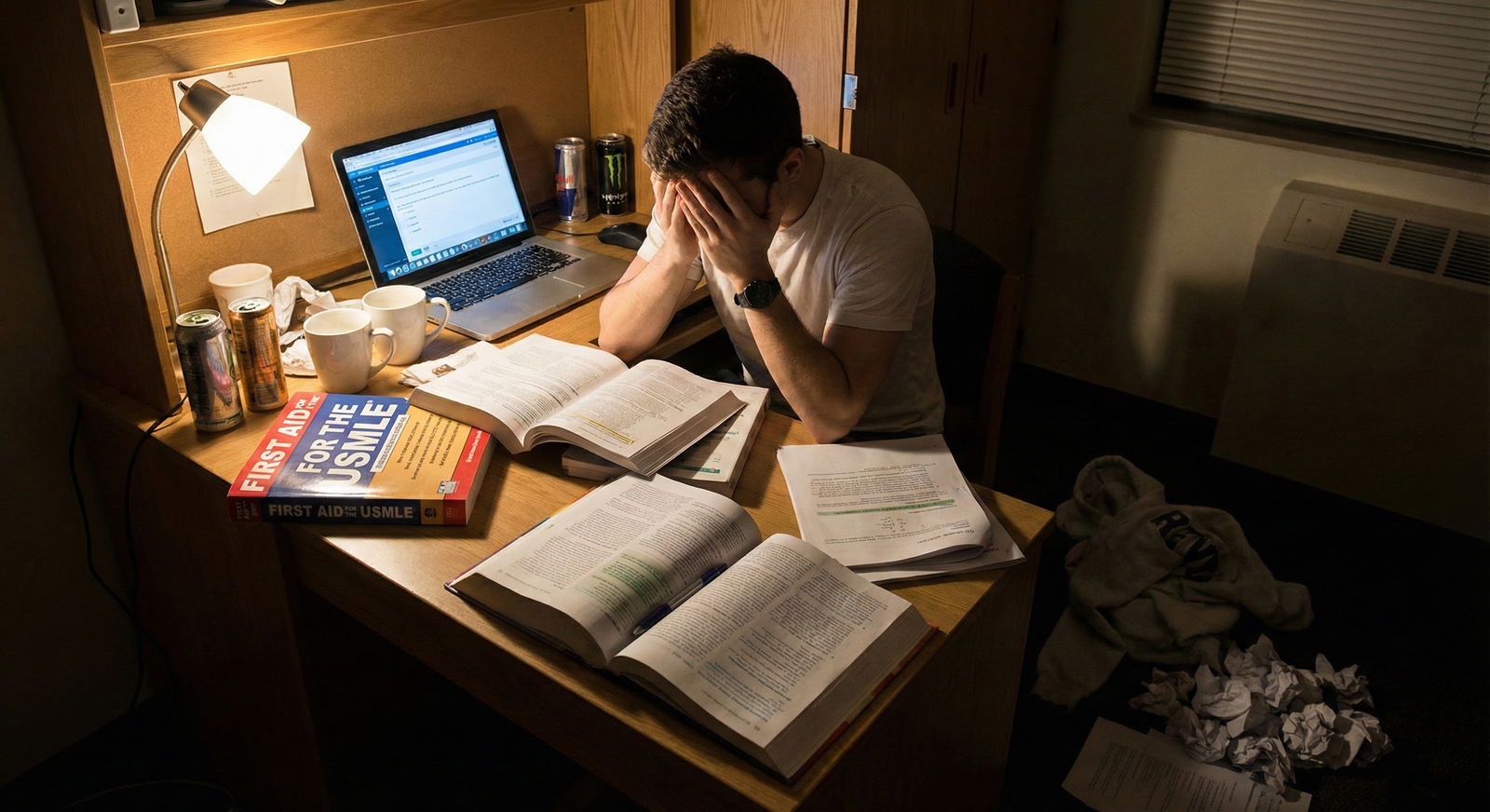
It’s 2:13 a.m. Your score report is still open on your laptop because you keep checking it like the numbers are going to magically change. You used all the “right” stuff—UWorld, AnKing, Pathoma, Sketchy, whatever everyone online swears by. And you still failed.
Now your brain is running on a loop:
“If these didn’t work, is everything a lie? Are there any resources I can trust? Or is there something just…wrong with me?”
Let’s walk through this without sugarcoating it. Because you’re not crazy for feeling betrayed by these tools. And no, failing doesn’t mean you’re broken or doomed.
First: It Wasn’t “The Resources Or You” – That’s The Wrong Question
You’re probably stuck in one of these mental scripts:
- “I failed because I picked the wrong resources.”
- “I failed because I’m not smart enough even with the right resources.”
- “Maybe boards are just random and nothing actually matters.”
All of those are oversimplified. And honestly, they’re dangerous because they make you feel powerless.
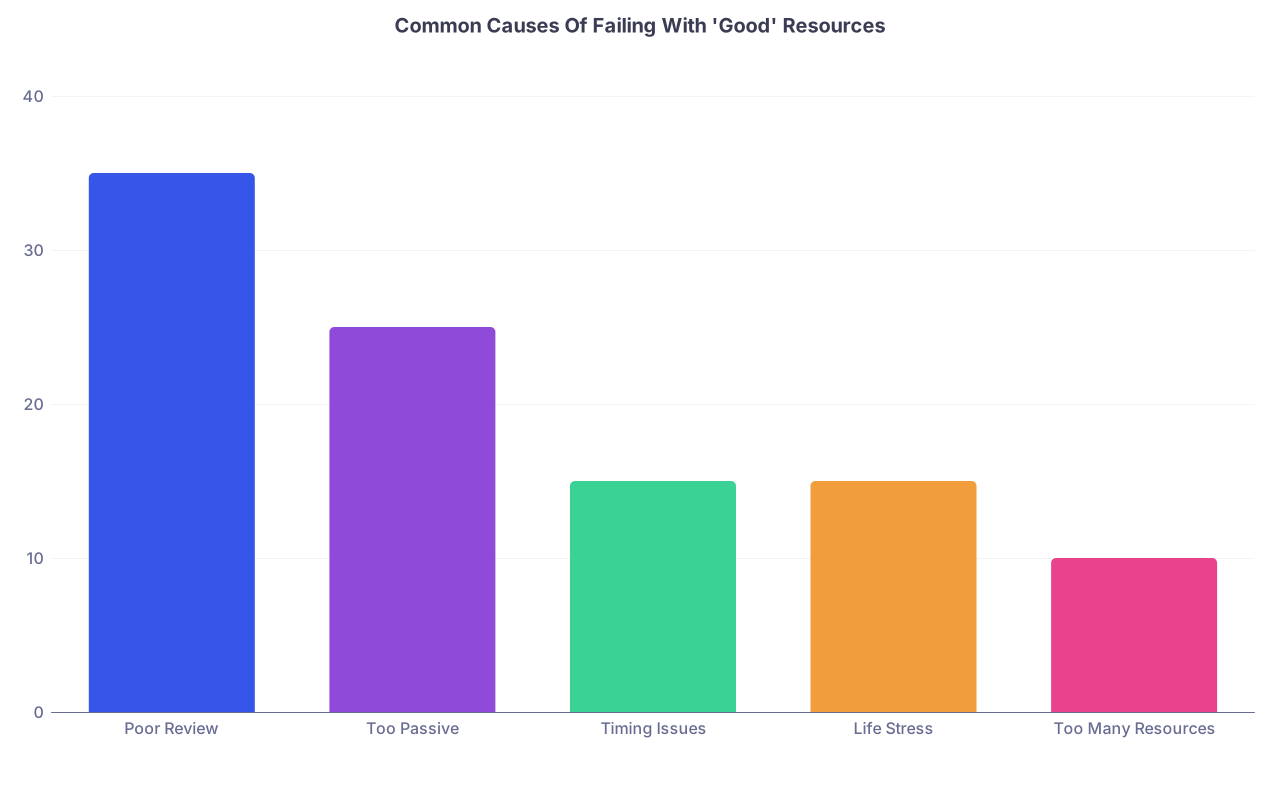
Here’s what’s usually going on when someone fails despite using the big-name tools:
- They used the right tools in the wrong way.
- Their timeline or consistency was off (started too late, stopped too early).
- They never got feedback on how they were studying—so they just kept repeating the same broken process.
- Life happened (illness, family stuff, mental health), and they tried to power through like nothing was wrong.
- They had gaps from preclinical years that no resource can magically patch in 6 weeks.
I’ve seen people fail using “the perfect stack” and then pass comfortably on their retake using 90% of the same tools, but with a very different process.
So yes, there are tools you can trust. But you can’t trust any of them as magic. You use them like instruments, not like autopilot.
Popular Resources: What They Actually Do (And Don’t Do)
Let’s be brutally honest about the “standard” stuff.

| Resource Type | What It's Good For | What It's Bad At |
|---|---|---|
| Qbanks (UWorld, etc.) | Testing reasoning, patterns | Teaching from scratch |
| Anki/Flashcards | Retention, details | Initial understanding, context |
| Video Series | Big-picture, explanations | Cramming, fast review |
| Review Books | Consolidation, structure | Passive reading, no application |
| Question Review Tools | Error analysis, weak areas | Replacing qbanks or full-length practice |
Qbanks (UWorld, AMBOSS, etc.)
What they do well:
They train you to think like the exam. Pattern recognition. Clinical reasoning. Identifying traps.
Used properly, they’re the closest thing to the “real test.”
What they don’t do:
They’re not good at teaching you brand-new content from the ground up. If you haven’t really learned cardiac physiology, doing 1,500 questions about it won’t fix that. You’ll just keep seeing the same phrase: “This was answered incorrectly because…”
Where people go wrong:
- Treating qbanks as a content source instead of an assessment/practice tool.
- Doing questions without reviewing explanations in depth.
- Racing through to “finish the bank” as if completion = competence. It doesn’t.
Anki / Flashcards (AnKing, premade decks)
What they’re good at:
Burning details into your long-term memory. Lab values, mechanisms, small but testable facts. Spaced repetition is legit. I’m not arguing that.
What they’re terrible at:
- Teaching you first-pass understanding.
- Simulating how the exam thinks (no vignettes, no prioritization).
- Fixing bad reasoning. You can memorize “what,” not “why.”
Where people go wrong:
- Grinding 1,000+ cards/day without actually learning from them.
- Using premade decks that don’t match how they think, then blaming themselves.
- Letting Anki eat all their time so there’s nothing left for qbanks and practice exams.
Videos (Pathoma, Sketchy, Boards & Beyond, etc.)
What they’re good at:
Explanation, visuals, and giving structure. They’re great for “I kind of get this but it’s fuzzy” moments.
What they’re not:
- A primary study strategy two months before boards.
- Efficient when you’re passively watching on 1x and “taking notes” that you’ll never reread.
Where people go wrong:
- Binge-watching without active recall or questions afterward.
- Using videos as comfort when they feel behind (“at least I’m doing something”).
- Restarting whole series instead of targeting specific weak areas.
So no, the “popular resources” don’t suck. But they’re tools. You can absolutely fail boards with the “best” tools and pass with a similar or even smaller set if the way you use them changes.
How To Decide What You Can Actually Trust Now
Right now you don’t trust anything. Which makes sense: you did what you were “supposed” to and it didn’t work. So you’re thinking: “How do I know I’m not making the exact same mistakes again?”
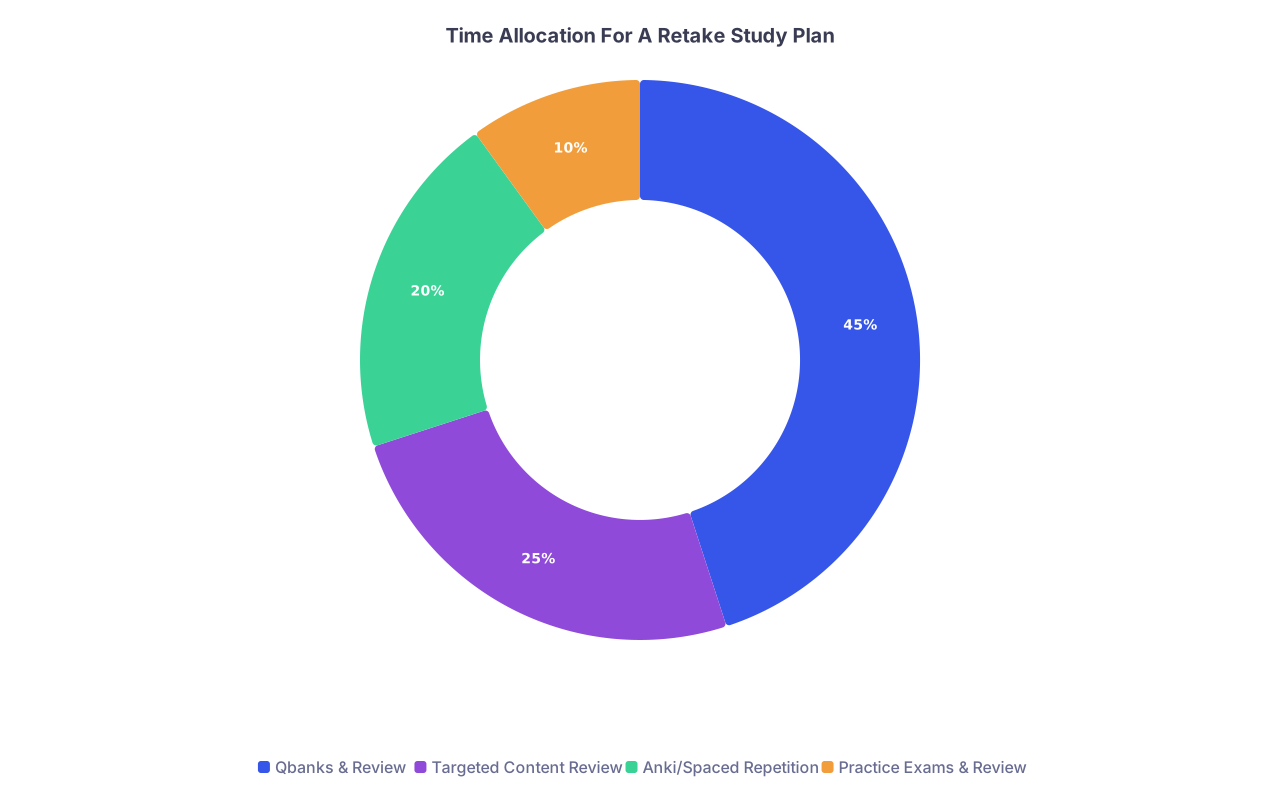
Here’s how I’d rebuild your toolset if I were sitting next to you, looking at your score report.
| Category | Value |
|---|---|
| Qbanks & Review | 45 |
| Targeted Content Review | 25 |
| Anki/Spaced Repetition | 20 |
| Practice Exams & Review | 10 |
1. Pick one primary qbank and actually commit to it
If you used UWorld before and rushed, half-reviewed, or didn’t finish it meaningfully, I’d still use UWorld for the retake. The exam didn’t change just because your score was bad.
If you truly did UWorld carefully, thoroughly, scored decently but still failed, consider:
- Resetting UWorld and using AMBOSS as a second pass or vice versa.
- Making your review twice as deep this time (every missed question becomes notes or cards, not “ugh whatever”).
What to trust:
You can trust that doing high-quality questions + deep review improves your score. That’s exam psychometrics, not vibes.
What not to trust:
Those “I did 5,000 questions and passed easily” posts. They never tell you how they reviewed, what their baseline was, or what their med school foundation looked like.
2. Use Anki as a scalpel, not a lifestyle
If Anki already burned you out, I wouldn’t scrap it completely. I’d just stop letting it dictate your day.
How to use it in a retake:
- Make your own cards from questions you miss or from weak topics.
- Cap reviews to a reasonable number so you don’t sacrifice qbank and practice exam time.
- Use premade decks only for high-yield gaps, not as your entire spine.
You can trust spaced repetition to keep info in your brain.
You cannot trust 20,000-card decks to magically make you a good test-taker.
3. Content review: targeted, not “start over from scratch”
The panic move is: “I need to re-learn everything.” So you restart all of Pathoma, all of Sketchy, all of Boards & Beyond.
That’s how you end up 4 weeks into a 6–8 week dedicated and you’ve done like…200 questions total.
Smarter (and yes, harsher) approach:
- Use your score report + qbank stats to find your worst systems/topics.
- Pick one main content source (e.g., Pathoma for path, B&B or AMBOSS articles for others).
- Dive deep on your bottom 3–5 systems, not all 10 at once.
You can trust good content resources to clarify and organize.
You cannot trust them to raise your score alone if you’re not applying anything.
4. Practice exams: uncomfortable but absolutely necessary
You might be terrified of full-lengths now. Failing once makes every predictor exam feel like another possible confirmation that you’re “not good enough.”
Do them anyway.
Bare minimum for a retake plan:
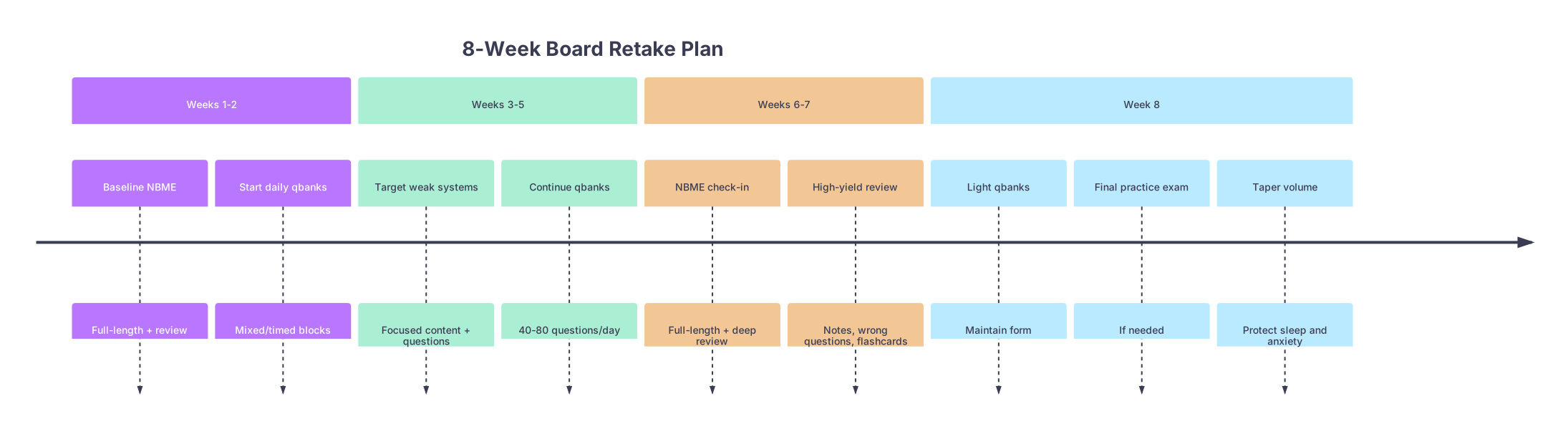
- 1 NBME early-ish to see baseline and weaknesses.
- 1–2 more NBMEs midway and near the end.
- Maybe the official practice test if your exam has one.
Then actually autopsy them. Figure out patterns: timing problems, certain systems, question misreads, anxiety spikes halfway through blocks.
| Period | Event |
|---|---|
| Weeks 1-2 - Baseline NBME | Full-length + review |
| Weeks 1-2 - Start daily qbanks | Mixed/timed blocks |
| Weeks 3-5 - Target weak systems | Focused content + questions |
| Weeks 3-5 - Continue qbanks | 40-80 questions/day |
| Weeks 6-7 - NBME check-in | Full-length + deep review |
| Weeks 6-7 - High-yield review | Notes, wrong questions, flashcards |
| Week 8 - Light qbanks | Maintain form |
| Week 8 - Final practice exam | If needed |
| Week 8 - Taper volume | Protect sleep and anxiety |
You can trust NBMEs/practice exams more than random online chatter about “I felt like I failed but got a 250.”
You cannot trust your feelings during practice tests as objective data. Anxiety makes everything feel worse than it is.
The Part Everyone Avoids: Studying Style, Not Just Study Stuff
You probably already know your resource list. That’s not the actual monster under the bed.
The real questions:
- Do you read stems too fast and change right answers to wrong ones when you overthink?
- Do you freeze when you see something unfamiliar and mentally give up on the question?
- Do you panic if you don’t know the answer in 10 seconds, instead of calmly problem-solving?
- Do you reread explanations or just skim and move on to feel “productive”?
You can use “perfect resources” and still fail if:
- You never track what types of questions you consistently miss (calculation vs. conceptual vs. memorize-y facts).
- You treat every wrong question like a random event instead of data.
- You’re studying 10–12 hours/day but spending 8 of those in a fog of anxiety and fake studying.
Sometimes the tool you actually need isn’t new content or a fancy qbank. It’s:
- A tutor or coach for 3–5 sessions to dissect your approach.
- An academic support office at your school actually going through your pattern with you.
- Therapy or medication adjustment if your anxiety or depression is killing your concentration.
You’re not weak for needing that. You’re practical.
So…Are There Any Tools You Can Actually Trust?
Short answer: Yes. But not in the way you probably want.
Trust these things:
- A high-quality qbank + honest review will expose your weaknesses and gradually improve your reasoning.
- Spaced repetition (flashcards you actually understand) will keep details in your head.
- 2–4 well-chosen content sources are enough; more is usually just distraction.
- Your practice exam trends matter more than your worst single day.
Don’t trust:
- Any resource that says “all you need is this.”
- Any plan that leaves you doing mostly passive stuff in the final month.
- Reddit flex posts with insane scores and minimal context.
- The belief that failing once = permanent label.
| Category | Value |
|---|---|
| Poor Review | 35 |
| Too Passive | 25 |
| Timing Issues | 15 |
| Life Stress | 15 |
| Too Many Resources | 10 |
A Simple, Brutally Honest Reset Plan
If you need something concrete to hold onto, here’s a skeleton. You’d adjust details with your advisor, but the structure holds.
- Get your score report and actually analyze it. Circle your bottom 3–4 systems.
- Choose:
- 1 main qbank
- 1–2 main content sources
- Anki/flashcards only for missed questions + fragile topics
- For 6–8 weeks:
- Daily: timed qbank blocks (mixed or system-based), review each question in detail
- Rotate your weak systems with targeted content review and applied questions
- Flashcards only from your errors and notes
- Every 2–3 weeks: 1 practice exam, full autopsy afterward.
- Weekly: 30–60 minutes planning the next week based on your data (not your fear).
Is this guaranteed? No. Anyone selling “guaranteed” is lying to you. But is this a plan you can trust far more than “just do more” with the same chaotic approach? Yes.
FAQ (Exactly 5 Questions)
1. I used UWorld and failed. Should I ditch it completely for my retake?
Not automatically. If your problem was shallow review (skimming explanations, not tracking patterns, rushing to finish), UWorld itself isn’t the issue—your process was. I’d first fix how you use it: fewer questions/day, deeper review, notes or cards for every miss or guess. If you truly maxed it out properly and still bombed, then consider adding or switching to AMBOSS or another bank, but don’t just chase “new” for the sake of it.
2. I feel like Anki failed me. Is it even worth keeping?
Anki didn’t fail you; using it as your whole strategy probably did. Twenty thousand premade cards don’t make you a good test taker. For a retake, I’d strip it down: only cards you make yourself from questions you missed or topics you keep forgetting. That way, Anki becomes a maintenance tool, not a black hole. If it triggers your anxiety massively, you can even pause premade decks entirely and just do small, focused, personal decks.
3. Do I need a tutor now that I’ve failed once?
Not automatically, but strongly consider it if: 1) you genuinely don’t know why you failed, 2) your school support is weak or generic, or 3) your practice test scores don’t match how hard you’re studying. A good tutor doesn’t just reteach content—they pick apart your test-taking behavior. Even 3–4 targeted sessions can save you weeks of wandering blindly with expensive resources.
4. How many different resources should I be using for a retake?
Fewer than you think. For most people: 1 primary qbank, 1–2 content resources, 1 method for spaced repetition (like Anki or written notes turned to cards), plus practice exams. That’s it. Stacking Sketchy + Pathoma + B&B + two qbanks + three decks + random PDFs is how you stay busy and stay stuck. Depth beats variety. Always.
5. I’m terrified I’ll fail again even if I change my plan. How do I deal with that?
You’re not going to logic your way out of that fear. It’s there, and it’s loud. What you can do is build a plan that gives you real data and control: practice exams at set intervals, honest qbank stats, clear weak-area targets. Pair that with actual support—an advisor, tutor, therapist, trusted classmate. The fear doesn’t disappear, but it stops running the show when your daily actions are driven by a structured plan instead of panic.
Key points to walk away with:
- Popular resources aren’t scams—but they don’t rescue you from a broken process.
- You can trust: a good qbank, spaced repetition, targeted content, and honest practice exams more than social media noise.
- Failing once doesn’t mean you’re incapable; it means your system needs a serious rebuild, not just “more of the same.”