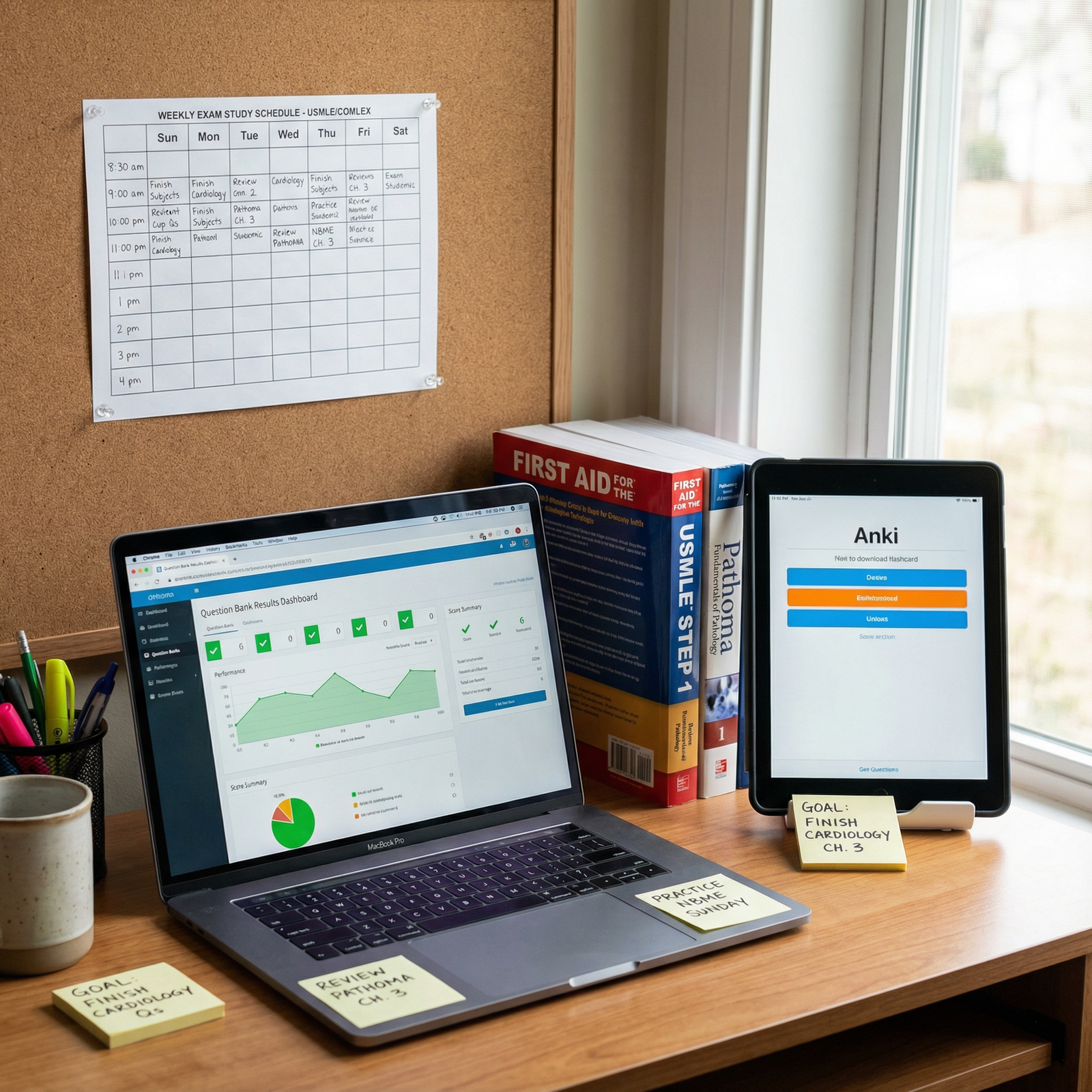
You just finished another NBME or UWorld self‑assessment. The score pops up. It is low. Again.
Your stomach drops. You do the math in your head: “If this is anywhere near my real score, I am in trouble.” You start guessing: Maybe I need another Qbank. Maybe I need a different review book. Maybe I should restart that video series from the beginning.
Stop.
You do not need more random resources. You need an audit. A systematic teardown of what you are using, how you are using it, and what is actually giving you points on test day.
This is that audit.
Step 1: Freeze Your Resource Shopping
First rule: no new purchases for 7–14 days.
When scores are low, people panic‑buy:
- Second or third Qbank
- Another video subscription
- Extra flashcard decks
- “High-yield” crash courses one week before the exam
This almost always makes things worse. You spread your attention thinner, you do not finish anything, and your cognitive load spikes.
For now:
- Use only what you already have.
- Commit to auditing before adding anything new.
- Write this somewhere visible: “The problem is how I use resources, not how many I own.”
You are going to treat your prep like a clinical case:
- Symptoms: low practice scores
- Differential: bad resource mix vs bad process vs poor retention vs timing issues
- Workup: structured audit
- Plan: targeted interventions, not shotgun therapy
Step 2: Map Your Current Resource Ecosystem
You cannot fix what you have not fully defined.
Grab paper or a doc and build a complete resource map. Category by category.
Use this template and fill it in honestly:
| Category | Primary Resource | Time/Week (hrs) | Completion % |
|---|---|---|---|
| Qbank | UWorld | 10 | 35% |
| Content Review | Boards & Beyond | 6 | 50% |
| Flashcards | AnKing Anki Deck | 8 | Mature 30% |
| Question Review | Self-made Notes | 3 | N/A |
| Assessments | NBME + UWSA | 1 (every 2 wks) | 3 taken |
If you want to be thorough, also note:
- How you use each resource (e.g., “Timed random blocks in UWorld, 40 Qs/day”).
- Where you use it (library, home, commute).
- When you use it (morning vs night).
You should end up with something like:
- Qbanks: UWorld + AMBOSS (but “I only really use UWorld”)
- Video: Pathoma + Boards & Beyond (Bb used rarely)
- Books/PDF: First Aid, Sketchy printed notes
- Flashcards: AnKing + 200 self-made cards
- Practice tests: NBMEs 25, 27, 29, UWSA1
Already, patterns start to appear:
- Too many resources, all half-finished.
- Or one Qbank overused, zero structured content review.
- Or lots of passive video, almost no active recall.
Keep this map. You will come back to it.
Step 3: Dissect Your Practice Test Autopsy-Style
Now we stop hand‑waving and look at data.
Pick your most recent full‑length (NBME, UWSA, COMSAE, etc.). You are going to perform an autopsy on it. No ego.
3.1 Pull Out the Hard Numbers
You want:
- Total score (and predicted board score if available).
- Performance by subject (e.g., cardio, renal).
- Performance by discipline (pharm, path, phys, micro).
- Percent correct in first half vs second half of exam (to detect fatigue).
If your platform offers a visual breakdown, use it. If not, you can chart your own.
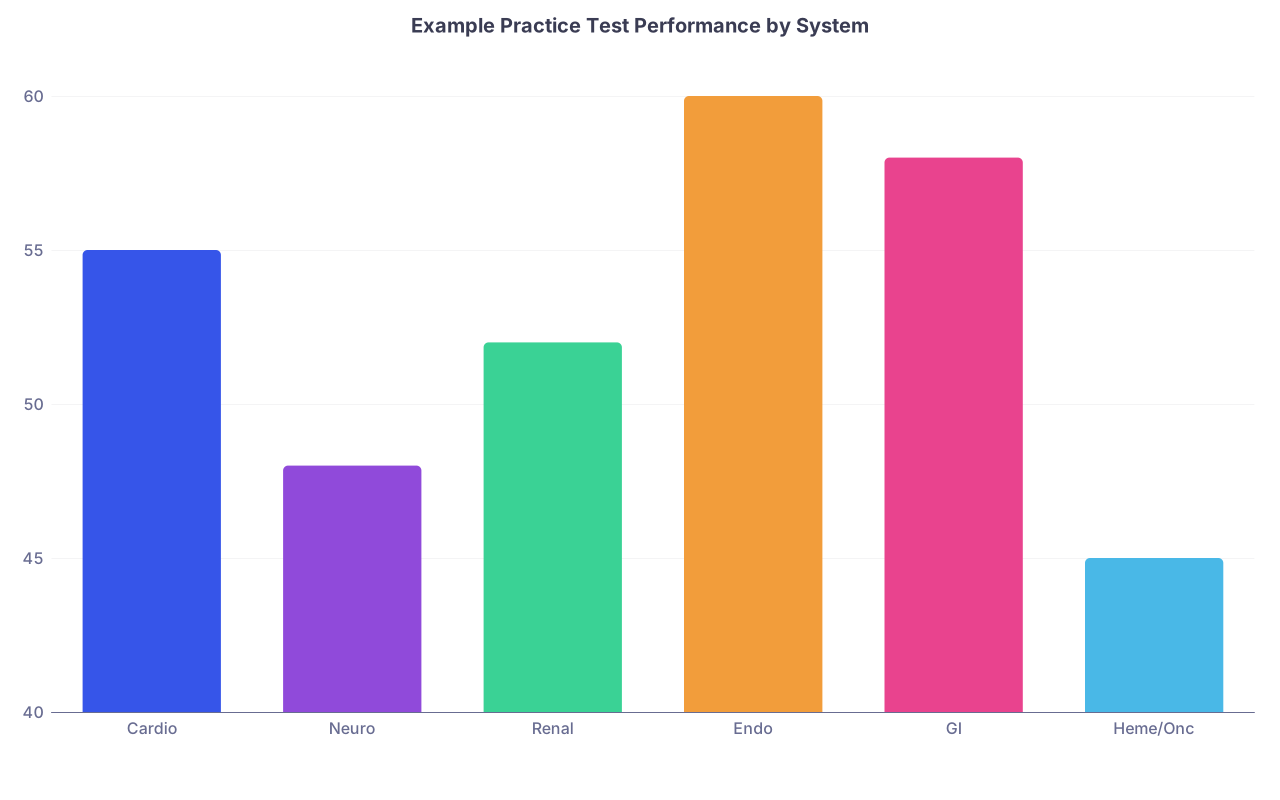
| Category | Value |
|---|---|
| Cardio | 55 |
| Neuro | 48 |
| Renal | 52 |
| Endo | 60 |
| GI | 58 |
| Heme/Onc | 45 |
The obvious problem: cardio and heme/onc here are weak. But keep going; content weaknesses are only half the story.
3.2 Categorize Every Wrong Question
Yes, this is tedious. Yes, it works.
For each incorrect question, assign it two tags:
Content vs Process
- Content gap – You did not know the fact / never learned topic.
- Partial knowledge – You recognized some elements but could not connect them.
- Process error – You knew enough, but misread, rushed, or fell for a distractor.
Error Type
- Misread question stem
- Misread answer choice
- Changed right answer to wrong
- Time pressure / random guess
- Overthinking / second‑guessing
- Calculation error
- Recall failure (you had learned it but blanked)
- Truly unfamiliar (never seen this concept before)
Do this for at least 40–60 wrong questions. You do not need 300 to see patterns. A sample is enough.
You should end up with something like:
- 30% pure content gaps
- 20% partial knowledge (missing one link in the chain)
- 25% misreading / rushing
- 15% second‑guessing
- 10% genuine “no idea, never seen this”
From this, you can make a very clear conclusion:
If more than ~40% of your errors are process‑related, then swapping resources will not help much. You need to fix how you take tests, how you read stems, and how you manage time.
If more than ~60–70% are true content gaps in specific systems, you have a coverage problem. Probably your resource system is incomplete, or your review process is broken.
Step 4: Link Errors Back to Resources
Now you connect three things:
- Where you are weak (test breakdown).
- What type of error it is (content vs process).
- Which resource is supposed to be covering that domain.
Example:
- You missed multiple nephrotic vs nephritic syndrome questions.
- Error type: partial knowledge (“I knew it was kidney but mixed up patterns”).
- Resource coverage: You watched Pathoma renal once, did UWorld renal once, and you have 60 unsuspended renal Anki cards that you keep “burying for later.”
Conclusion: Renal is “technically covered” by your resources but you have not locked it in:
- You need a reinforcement strategy, not a new resource.
Another example:
- Heme/Onc pharm questions destroyed you.
- Error type: truly unfamiliar drugs.
- Resource coverage: You never actually studied heme/onc pharm explicitly, you hoped UWorld would expose you to enough questions.
Conclusion: You are missing a primary pharm resource or a structured pass through pharm chapters. Relying on questions alone is failing you.
This is the real value of a resource audit. You stop blaming “UWorld is too hard” and instead identify:
- Broken coverage: topic not systematically learned anywhere.
- Broken retention: topic seen but not reinforced.
- Broken transfer: you can recite it in Anki but cannot apply it to vignettes.
Step 5: Grade Each Resource by Function
Every resource should have a job. If it does not, cut it.
Here are the core functions:
Primary Content Learning
- Videos (Boards & Beyond, Pathoma, Sketchy)
- Text (First Aid, class notes, review books)
Application / Question Practice
- Qbanks (UWorld, AMBOSS, Rx)
- Practice tests (NBME, UWSA, free 120, COMSAE, etc.)
Memory Reinforcement
- Flashcards (AnKing, self-made)
- Rapid review sheets, one‑pagers
- Short drill sessions
Strategy / Meta-Skills
- Test‑taking books or lectures
- Tutor feedback
- Post‑test analytics
Assign each resource to one main function. One.
Example:
- UWorld: Application
- AMBOSS: Secondary application + on-demand explanations
- Pathoma: Primary pathology learning
- First Aid: Consolidation / reference, not first‑pass learning
- AnKing: Memory reinforcement
- NBME: Assessment and calibration
Now ask: do you have:
- At least one solid primary content resource?
- ONE main Qbank (not three poorly used ones)?
- A consistent reinforcement tool?
- At least one method to work on your test‑taking strategy?
If you have three content resources partially completed, you are wasting time. Finish one. Use others only to patch specific gaps.
Step 6: Identify the Real Failure Mode
By this point, you should be able to classify your problem into one main bucket:
Coverage problem – You literally have not learned key material.
- Signs: Huge blind spots by system; many “never seen this” errors.
- Fix: Tighten your core content plan; stop hopping resources.
Retention problem – You have “done” the material but cannot recall it consistently.
- Signs: “I know I studied this but I just blanked”; lots of partial knowledge errors.
- Fix: Overhaul your spaced repetition and review system.
Application / test‑taking problem
- Signs: Misreading, changing answers from right to wrong, running out of time.
- Fix: Tactical changes in how you read stems, eliminate wrong answers, and pace yourself.
Execution / discipline problem
- Signs: Inconsistent daily work, skipping review, not finishing blocks, multitasking during study.
- Fix: Schedule and environment changes, not more resources.
Most students blame the wrong bucket. A classic example: someone with obvious reading speed and misinterpretation issues buys yet another video subscription instead of practicing timed blocks with deliberate review.
Be honest which bucket is dominant. You might have all four, but one is usually responsible for most of the damage.
Step 7: Rebuild Your Resource Plan, Tightly
Now you design a lean, purpose‑built system for the next 4–6 weeks.
7.1 Set Hard Limits
- Primary Qbank: Choose one (usually UWorld). Use any others only as targeted practice after finishing the main one or for specific weak topics.
- Primary video/reading series: Choose one for each domain (e.g., Pathoma for path, one main board review series).
- Primary reinforcement: Anki or structured notes. Not both at full scale.
If it is not primary or clearly supporting a documented weakness, it goes on the “maybe later” pile.
7.2 Attach Resources to Problems
Example final setup:
Problem: Weak in neuroanatomy content
- Resource plan:
- Boards & Beyond neuroanatomy videos (1× speed, targeted only to listed weak topics)
- UWorld neuro blocks (10 Q/day)
- Create 3–5 high‑yield cards per missed concept
- Resource plan:
Problem: Misreading stems and rushing decisions
- Resource plan:
- 1 timed 20‑question block daily where you must verbalize your reasoning for each question during review
- 2–3 days per week of “slow blocks” (untimed) focusing on reading every word and summarizing the question in 1 sentence before looking at answers
- Resource plan:
Problem: Weak pharm retention
- Resource plan:
- Dedicated 30 min/day pharm Anki
- Weekly 40‑question pharma‑focused Qbank block
- Resource plan:
You align each problem → with a resource → and a concrete protocol.
Step 8: Build a Daily Protocol (Not Just a To‑Do List)
You do not just want “Do 40 UWorld, 2 hrs Anki, 1 hour video.” That is vague.
You want protocols. For example:
Question Block Protocol (Timed, 40 Q):
- Sit at a desk. No phone near you.
- Do 40 questions, timed, random, exam interface if possible.
- During the block:
- Read the last line of the question first.
- Then read the stem once, no rereading unless absolutely necessary.
- Force yourself to pick an answer; mark only truly uncertain questions.
- During review:
- For every question (right or wrong), write:
- Why the correct answer is correct (1–2 bullet points).
- Why each of the 2–3 closest distractors is wrong.
- Tag error type if you missed it (from Step 3).
- For every question (right or wrong), write:
Anki Protocol (45–60 minutes):
- No new cards until reviews are under control (daily due < 250, for example).
- For each missed card:
- Ask: Is this card garbage? Too long? Too vague?
- Edit or delete bad cards. Do not keep junk.
- Every time you see a concept you missed on questions, add a minimal note card:
- One fact. One question. No paragraphs.
Content Review Protocol (1–2 hours):
- Start with your weakness list from your last practice test.
- Pick one system (e.g., renal) and one subtopic (e.g., glomerular disease).
- Watch / read with intent to answer questions, not just to “finish chapter”:
- Pause and quiz yourself every few minutes.
- Write 3 new questions or summary sentences per segment.
This is what changes outcomes. Not which YouTube channel you use.
Step 9: Install a Weekly Audit Ritual
Your system will drift. It always does. The only way to stop the drift is a recurring audit.
Once a week (same day, same time), do this:
Look at the numbers
- Total questions done this week
- Percent correct this week vs last
- Systems most frequently missed
- Anki reviews completed vs overdue
Evaluate each resource
- Is this resource clearly moving my scores?
- Is it eating time that could be better spent elsewhere?
Re‑prioritize
- Pick 2–3 focus areas for next week (e.g., cardio path, test‑taking speed).
- Map specific resources and protocols to those areas.
Plan the next practice test
- You should have a full‑length at least every 2–3 weeks in the active prep phase.
- Define what success looks like (e.g., +5 points or improvement in specific system performance).
To make it concrete, outline your week visually.

| Step | Description |
|---|---|
| Step 1 | Take Practice Test or Qbank Blocks |
| Step 2 | Collect Data & Error Types |
| Step 3 | Identify Top 3 Weak Areas |
| Step 4 | Assign Specific Resources & Protocols |
| Step 5 | Execute Daily Plan |
| Step 6 | Weekly Audit Session |
The loop is the point. You do not fix this once. You iterate.
Step 10: When (and How) to Add or Change Resources
Sometimes, your audit will show a true gap that your current tools cannot cover. Fine. Then you add—but with rules.
You can justify a new resource if:
- There is a clearly defined gap (e.g., you have no structured pharm resource, and your pharm performance is abysmal).
- You know exactly how you will integrate it (where in your schedule, what it replaces, what problem it solves).
- You can finish the key parts in the time you have.
Bad reasons to add a resource:
- “Everyone on Reddit is using it.”
- “I feel behind; maybe this crash course will save me.”
- “I am bored with my current stuff.”
When you do add something, treat it like a medication:
- Indication: what problem it is for
- Dose: how many hours / sections per week
- Duration: how long you will use it before reevaluating
- Adverse effects: what you must stop doing to make room
If you cannot answer those, you are not adding a resource—you are collecting it.
A Quick Reality Check
If your practice scores are low right now, one of these statements is almost certainly true:
- You are spreading yourself thin over too many resources.
- You are not reviewing questions deeply; you are just counting them.
- You are doing passive tasks (watching, reading) far more than active tasks (recall, questions).
- You refuse to admit that test‑taking itself is a skill you need to practice deliberately.
Auditing your resources systematically forces you to confront all of that. It is uncomfortable. It is also exactly how people jump 10–20+ points over a few weeks to months.
FAQ (Exactly 2 Questions)
Q1: My practice test scores are low across every system. Does that mean all my resources are bad?
No. Global low scores usually point to process and execution, not terrible materials. If you are missing easy questions, misreading stems, running out of time, or getting distracted while studying, you could have excellent resources and still score poorly. Before you throw out UWorld or AnKing, fix:
- Your daily schedule (no multitasking, defined blocks of work).
- Your question‑review protocol (every miss analyzed and tagged).
- Your test‑taking habits (timed blocks, pacing, summarizing questions).
Only after you have tightened these should you consider adding or changing core resources.
Q2: How often should I take full‑length practice tests while I am fixing my resource system?
For most medical students, every 2–3 weeks is a good interval once you are within 6–8 weeks of your exam. That is frequent enough to see trends but not so frequent that you spend all your time testing and no time fixing. Between tests, run the audit loop:
- Use the last test to identify 2–3 priority weaknesses.
- Adjust resources and daily protocols specifically toward those.
- Use the next test to see if those specific areas improved.
If scores are completely unstable or very low, you might delay the next full‑length until you have had at least 10–14 days of focused, structured work based on your audit.
Do one concrete thing now: open your last practice test report and tag the first 20 wrong questions as “content gap,” “partial knowledge,” or “process error.” Once you see those proportions, you will know whether your main problem is what you study—or how you are using the resources you already have.