
The biggest waste of money in medical school is not rent or coffee. It is over-buying study resources you’ll barely touch.
If you’re on a tight budget, you cannot afford the “maybe I’ll use this later” approach. You need a lean, intentional resource set that punches above its weight. One that’s minimal on your shelf and maximal on your scores.
Let’s build that.
Step 1: Get Real About Your Situation
You’re not a fictional “average med student.” You have a specific setup. So first, define it.
Here’s what I need you to answer honestly (even if just to yourself):
- What year are you? (M1, M2, clinical, Step prep, shelf-heavy rotation?)
- How much can you actually spend this semester on resources? Give yourself a real number. $0, $50, $200 – whatever it is, write it down.
- What does your school already give you for free? (This is where people leave money on the table.)
- How do you actually learn? Videos? Questions? Reading? Writing your own notes?
If you do not know your budget and what you already have, you’ll get played by every “limited time discount” and “everyone in my class is buying X” hype.
Open your school portal and check what’s included in your tuition. Many schools now provide at least some combo of:
- Anki decks (school-made or curated premade)
- Question banks (AMBOSS, UWorld, or school-specific banks)
- Online video/text platforms (Boards & Beyond, Pathoma, Sketchy, etc.)
- Anatomy resources (Complete Anatomy, Acland, etc.)
Write down exactly what is free to you. That’s your base layer.
Step 2: Understand What Actually Matters for Scores
Scores don’t come from owning resources. They come from doing reps with the right types of tools:
- Active recall (questions, flashcards)
- Spaced repetition (cards, repeated exposure)
- High-yield core content (concise explanations, not 900-page textbooks)
- Practice in exam format (NBME-style questions for Step/shelves)
On a tight budget, you prioritize tools that give you those four things. Everything else is cosmetic.
Here’s the brutal hierarchy for exam success:
| Resource Type | Impact on Scores | Typical Cost Level |
|---|---|---|
| Question banks | Very High | High |
| Anki (good deck) | Very High | Low / Free |
| Concise video/text | High | Medium |
| Full textbooks | Low–Medium | Medium–High |
| Pretty note apps | Low | Low–Medium |
If your budget is limited, your money goes first into:
- Questions
- A lean high-yield content source (or two, max)
Everything else must justify its existence.
Step 3: Build the Core Minimalist Setup (Preclinical)
Let’s assume you’re preclinical (M1–M2) and on a tight budget. Your target: pass your school exams comfortably and set a solid base for Step 1/Level 1.
Absolute Non-Negotiables (That Can Be Free)
You do not need six decks, 40 add-ons, and a YouTube deep dive into “optimal Anki aesthetics.”
You need:
- The Anki app (desktop is free; mobile is a one-time cost you can skip at first if needed).
- One mature, well-regarded deck that aligns with your exam (e.g., AnKing, Lightyear, school-specific deck).
- A daily habit: Reviews first, new cards second.
- Old Exams / School-Specific Material
If your school provides:
- Old exams
- Topic lists
- Learning objectives
Use them ruthlessly. This is targeted intel. It tells you what your faculty actually test, not what random YouTubers say is “high yield.”
- Free Question Sources Early On
Before you sink money into big qbanks, use:
- School question banks
- Free NBME sample questions
- Free practice questions from AMBOSS/UWorld trials
- Osmosis / Lecturio sample questions if you have trial access
It’s not as good as a full qbank, but it builds the habit: you learn through questions, not scrolling slides.
If You Have $0–$50
Here’s your minimalist but effective setup:
- Anki (desktop) + free premade deck.
- YouTube and free sites for concept explanations:
- Ninja Nerd, Armando Hasudungan, Osmosis public videos, Med School Tutors blogs, Radiopaedia for imaging basics, etc.
- Library access to:
- BRS Physiology
- Rapid Review Pathology or similar high-yield review texts
(Borrow, don’t buy if possible.)
- Your school’s old exams and slides.
How to make this actually work:
- For each lecture block, use your school’s objectives as your syllabus.
- For each objective, if you do not understand it from your slides, search targeted on YouTube or in a short review text.
- Find or create Anki cards that hit those objectives.
- Do questions at the end of each topic from free sources or self-made cases.
Notice what’s missing: subscription platforms. At this budget, they’re luxury items.
If You Have $50–$200 (Total, For the Year)
You can now add one or two paid resources—but slowly and intentionally.
Here’s how I’d rank additions:
Used or Shared Copy of a Concise Review Book
Examples:- BRS Physiology
- Pathoma physical book (if buying online video access is too pricey)
- Costanzo Physiology (if you like text) Do not buy full Robbins to “maybe read it.” You will not.
One Budget-Friendly Video Platform (If You Truly Learn Best from Video)
Only if:- You’ve confirmed you’re not actually a reader, and
- You commit to using it as your primary content tool, not a side toy.
Negotiate:
- Share accounts legally where allowed (check TOS; don’t be dumb).
- Buy shorter access periods (e.g., 3 months before exams, not a full year if you won’t use it).
What you still probably don’t buy yet:
- Big dollar qbank (UWorld, AMBOSS) for early M1 unless your school exams are hardcore. Save that money for Step prep when it matters more.
Step 4: Minimalist Setup for Step 1 / Level 1 on a Budget
This is where fear makes people overspend. Don’t.
Your Step 1 resource stack does not need to be a skyscraper. It should look more like a one-story house with a sturdy foundation:
Core: One Qbank + One Core Content Set + Anki
If you can swing it, your money should go here:
UWorld or AMBOSS (not both unless money is truly no object)
Do one well. Aim to finish:- 60–80% of questions well reviewed > 100% rushed and shallow.
One High-Yield Overview Resource
Historically: First Aid + Pathoma. Now often:- Boards & Beyond (if you already like it)
- Pathoma for path specifically
- Sketchy for micro/pharm (if that’s how your brain works)
You do not need:
- Two full video series covering the same content.
- Three different pharm memory systems.
- Both full First Aid and full B&B and full Sketchy and a 1,000-page path text.
Don’t try to simultaneously run multiple huge decks. Pick one main deck (e.g., AnKing Step 1) and suspend aggressively. Un-suspend cards topic-by-topic as you study that content.
Budget Tier Breakdown
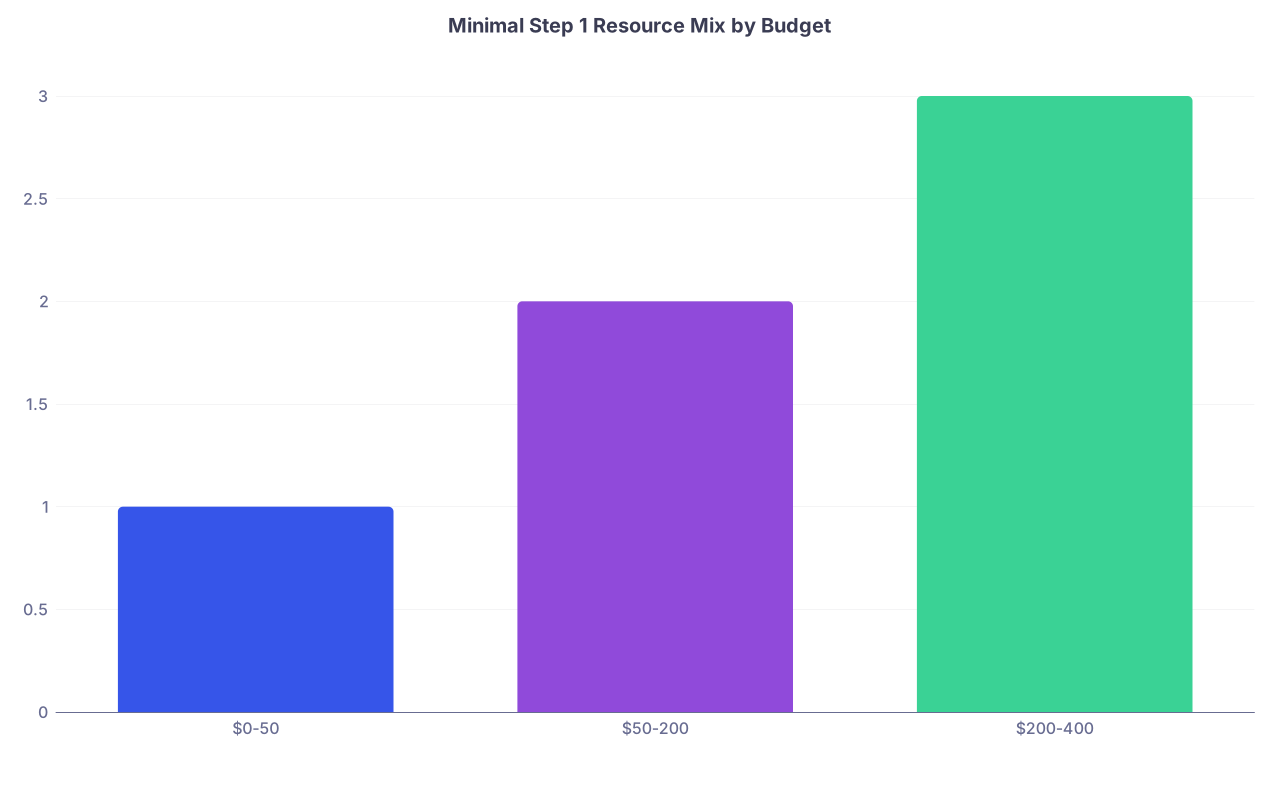
| Category | Value |
|---|---|
| $0-50 | 1 |
| $50-200 | 2 |
| $200-400 | 3 |
Interpretation:
- $0–$50: You rely on:
- Free NBME sample questions
- School-provided qbanks/resources
- Anki + First Aid via library
- $50–$200: You buy:
- A used First Aid or Pathoma book
- Maybe a 1–3 month qbank subscription timed for dedicated
- $200–$400: You likely can afford:
- Full qbank subscription for dedicated
- One major structured resource (FA, B&B, or Pathoma+Sketchy combo)
If you have to pick only one big purchase for Step 1 and you already got some things free from school, I would almost always spend on qbank over video.
Questions expose your blind spots. Videos comfort your anxiety.
Step 5: Minimalist Setup for Clinical Years and Shelf Exams
Different battlefield now. On rotations, you’ve got:
- Less control of your time
- More mental fatigue from actual patient care
- Less tolerance for long, slow explanations
So your resource set should get even tighter.
For shelf exams, the gold-standard minimalist combo for most students is:
- One primary qbank targeted to the rotation (UWorld/AMBOSS shelf blocks)
- One short text or resource:
- Step-Up to Medicine (for IM)
- Case Files (for several rotations)
- OnlineMedEd videos + notes (if your school provides them)
Plus:
- Anki only for truly high-yield lists (criteria, scoring systems, classic presentations). Many students go lighter on Anki here because time on qbank is higher ROI.
Example: Internal Medicine Shelf on a Budget
Say you have basically no extra money left.
Here’s what you do:
- Use:
- Your existing Step qbank’s IM questions (if still active).
- NBME practice exams only if you can afford 1–2 or your school buys them.
- Free guidelines/UpToDate through hospital access for concepts you repeatedly miss (do this while at the hospital computer if you don’t have a personal subscription).
- Borrow:
- Step-Up to Medicine or Case Files: Internal Medicine from upperclassmen or library.
Your daily rhythm:
- Clinical day → come home → 20–40 IM questions in timed, random blocks.
- Review carefully. For each missed question:
- One or two short notes in your personal notebook or digital doc.
- If something recurs, make 1–2 Anki cards—not 20.
You do not need four separate shelf-focused resources fighting for your time.
Step 6: Free and “Almost-Free” Resources You’re Probably Ignoring
Students on tight budgets often underestimate how much quality is available for free or nearly free if you’re selective.
Here’s the shortlist that’s actually worth your time:
YouTube Channels
Ninja Nerd, OnlineMedEd (partial), Armando Hasudungan, Strong Medicine, Dr. Najeeb (select videos), Osmosis public content.Podcasts
IM boards/shelf oriented content, quick review shows, case-based teaching. Great for commutes.Professional/Clinical Sites
Radiopaedia (imaging), DermNet (derm pictures), CDC/WHO for ID/preventive.School and Hospital Access
Many hospitals give you UpToDate, AccessMedicine, or similar for free. That’s hundreds of dollars of content you’re already paying for indirectly.Peer-Sharing (Done Smartly)
Ask upperclassmen:- “If you had to prep for this exam again with only 2 resources, which ones?”
Then see which are: - Available used
- In the library
- Part of student organizations’ shared drives (where allowed)
- “If you had to prep for this exam again with only 2 resources, which ones?”
Step 7: Cut Ruthlessly – What You Should Not Do
Minimalist does not just mean “fewer resources.” It means actively saying no to seductive junk.
Here’s what I’ve seen tank more study plans than any “low IQ moment”:
Buying a gorgeous textbook set you won’t read.
If a text is not:- Concise
- Directly supporting your exams
- Already proven helpful to you
Then do not buy it. Borrow first.
Running three qbanks at once.
UWorld + AMBOSS + Kaplan “just in case” is a fantastic way to:- Half-finish all three
- Fully master none
Subscription-hopping.
One month here, two months there, “maybe I’ll need this” platform. You end up paying full price for half-use.Letting FOMO drive spending.
Someone will always have more stuff. Some people cope with anxiety by buying resources. That’s their wallet, not yours.
When you feel the itch to buy a new resource, ask:
- What specific problem will this solve?
- What will I stop using to make room for it?
- Can I test something similar for free first?
If you cannot answer all three, you’re about to waste money.
Step 8: How to Actually Use a Minimalist Resource Set
Minimalist fails if you collect fewer resources but still use them chaotically. You need a clean execution plan.
Simple Weekly Structure (Preclinical or Dedicated)
Let’s say your core:
- Anki
- One main content source (B&B/Pathoma/First Aid)
- One qbank
Your week might look like:
Daily
- Anki reviews first (non-negotiable)
- 1–2 hours of content (videos or book) tied to your curriculum or Step schedule
- 20–40 practice questions, review explanations
Weekly
- One pass through your school’s objectives and lecture notes to ensure alignment
- 1–2 hour block to fix your weak topics (based on missed q’s)
You don’t bounce: “a little Pathoma, then maybe Sketchy, then lecture slides, then Reddit, then…”
You pick a lane and drive.
Simple Weekly Structure (Clinical Shelf)
Core:
- One qbank
- One short text or note set
Your week:
- On duty days: 10–20 questions after work, review on the bus or before bed.
- Off days: 40–60 questions + 1–2 chapters of your chosen text or videos.
That’s it. You’re not building a 50-page OneNote template for each condition.
Step 9: Realistic Minimalist Examples by Budget
Let me give you a few actual sets so you can see how this looks in reality.
Preclinical – Bare-Bones (Almost $0)
- Anki (AnKing deck, selective un-suspending)
- Lectures + learning objectives
- Old exams from school
- YouTube for gaps
- Library: BRS Physiology, Rapid Review Pathology
Execution: Content from lectures/library → related Anki cards → free questions → old exams.
Step 1 – Moderate Budget (~$250 Total)
- UWorld 90-day subscription
- Used copy of First Aid (recent edition)
- AnKing Step 1 deck (free)
- Pathoma via shared book or short subscription if possible
Execution:
6–8 weeks dedicated:
- Morning: UWorld blocks + review.
- Afternoon: First Aid/Pathoma for systems you’re actively testing.
- Evening: Anki reviews + light First Aid read.
Clinical – Tight Budget but Qbank Already Paid For
Assume you still have UWorld or AMBOSS access covering clerkship year.
- Use that qbank’s shelf sections
- Borrow Case Files for each rotation
- Use hospital UpToDate access for tricky topics
- Make micro Anki decks only for must-remember lists (criteria, dosing, scores)
Execution:
Clinical day → questions + quick Case Files chapter.
Pre-shelf week → crank question volume and NBME-style practice.
Step 10: Your System for Deciding “Do I Buy This?”
Before you pay for any new resource, run it through this filter:
- Does it cover material I’m currently responsible for (this block, this exam, this year)?
- Does it clearly improve one of the “big four”:
- Active recall
- Spaced repetition
- High-yield explanation
- Exam-format practice
- Can I realistically use it at least 3–4 hours per week?
- What will I stop using to make room for it?
- Can I test a similar alternative for free first?
If you cannot answer those questions clearly, don’t buy it. Simple.

| Step | Description |
|---|---|
| Step 1 | See New Resource |
| Step 2 | Do Not Buy |
| Step 3 | Use Existing Better |
| Step 4 | Buy & Drop One Old Tool |
| Step 5 | Solves Clear Problem? |
| Step 6 | Already Have Similar? |
| Step 7 | Will Use Weekly? |
The whole point of a minimalist resource set is not aesthetic. It’s psychological.
Fewer tools. Clearer priorities. Less guilt from unused subscriptions. More time actually doing the hard reps that move your scores.
Do this right and you’re not the student with the prettiest bookshelf. You’re the one who quietly crushes exams with an ugly stack of three things that are dog-eared and worn.
Today’s next step is simple:
Open a blank page and list every study resource you currently “own” or have access to. Then, circle 3–5 that you’ve actually used in the last 7 days and that truly help your learning. Everything else? Put it on a “pause” list for 1 month. Commit to studying only from your circled set and see how much lighter and more effective your exam prep feels.