
Most ADHD med students don’t fail because they’re not smart enough. They fail because their study structure is built for neurotypical brains.
Let me be blunt: if you have ADHD and you’re using Q‑banks and books the “normal” way—long blocks, endless reading, ‘review all incorrects’—you’re playing on hard mode.
This is fixable.
You don’t need “more discipline.” You need a system that assumes:
- Your focus will drop.
- You will get bored.
- You will click away if something feels too hard or too vague.
- Time will disappear unless it’s contained.
So here’s how to structure Q‑banks and books so your brain can actually work with you instead of against you.
Step 1: Stop Studying Like Everyone Else
Most people are told:
- Do 40–80 questions in one block
- Read every explanation thoroughly
- Then “review content gaps” in a textbook
If you have ADHD, this is what actually happens:
- By question 12 you’re doom‑scrolling.
- By explanation 8 you’re skimming.
- “Review content gaps” becomes 3 hours of unfocused reading and 0 retention.
So we flip it.
Your goals become:
- Short, repeatable Q‑bank structures
- Tight loops between questions → targeted reading → brief recall
- Pre‑decided rules so you’re not constantly “deciding what to do”
Think of it as writing a protocol for your future distracted self.
Step 2: Build ADHD‑Friendly Question Blocks
You need smaller, sharper, more frequent blocks. Not marathons.
Your default “micro‑block” structure
Use this as your standard unit of studying:
- 10–12 questions
- Tutor mode OR timed‑tutor (if available)
- One topic/system at a time, especially early on
- Hard cap: 25–30 minutes for questions, 30 minutes for review
Then you stack these micro‑blocks with short breaks between them instead of one huge block.
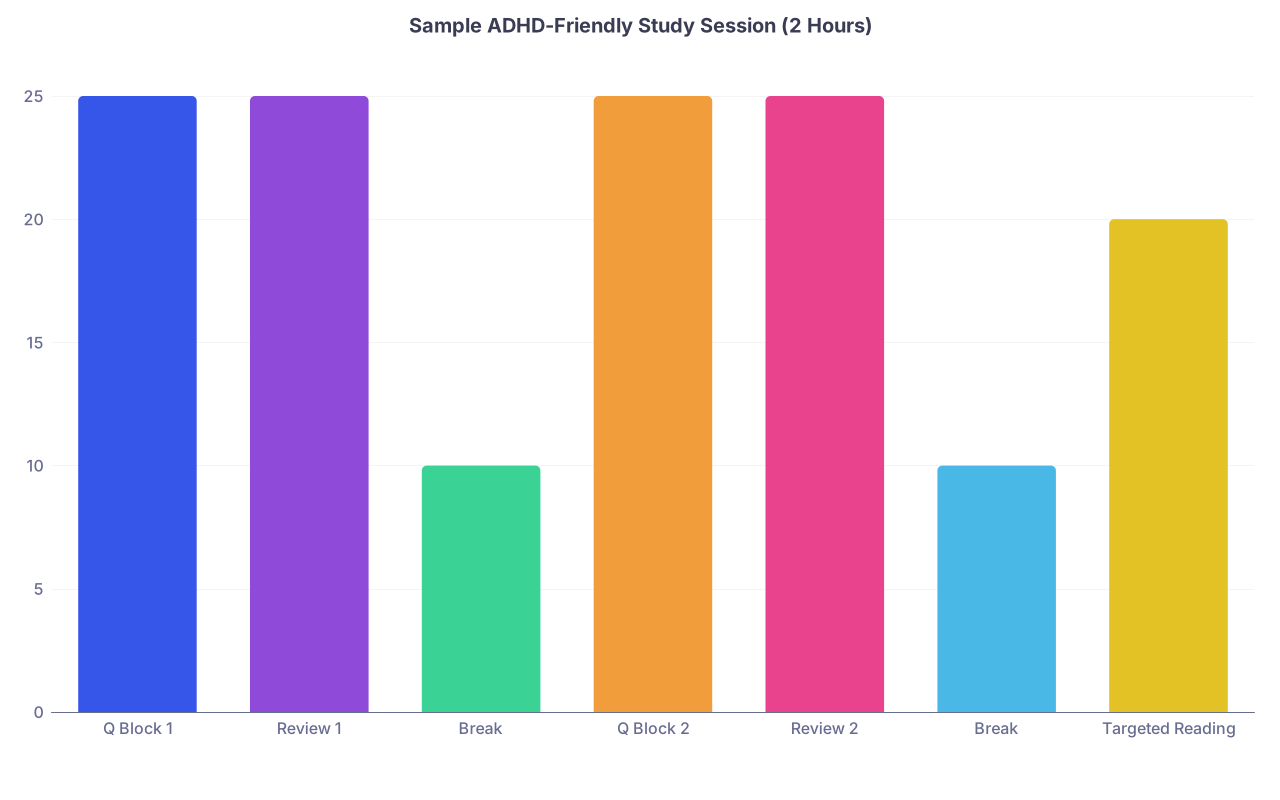
| Category | Value |
|---|---|
| Q Block 1 | 25 |
| Review 1 | 25 |
| Break | 10 |
| Q Block 2 | 25 |
| Review 2 | 25 |
| Break | 10 |
| Targeted Reading | 20 |
Notice: nothing here is over 30 minutes except maybe the last reading chunk. That’s on purpose.
How to pick number of questions per block
Use this heuristic:
| Focus Level Today | Questions per Block | Notes |
|---|---|---|
| Exhausted / fried | 6–8 | Just keep the habit alive |
| Average day | 10–12 | Default setting |
| High-focus day | 15–20 | Only if truly locked in |
Do not “push through” on bad days with huge blocks. Consistent small blocks beat rare heroic efforts.
Step 3: Fix How You Review Questions
ADHD brains drown in open‑ended tasks. “Review questions” is uselessly vague. You need a review script.
Here’s a 4‑step review protocol that actually works.
For every missed or “lucky guess” question:
Name the failure type (5–10 seconds)
- Didn’t know content
- Misread question
- Knew but couldn’t retrieve
- Changed from right → wrong
- Time / panic
Extract the rule (20–40 seconds)
Ask: “What’s the single take‑home that would get future questions right?”
Write a one‑liner in your notes/Anki/doc:- Bad: “Read about nephritic vs nephrotic”
- Good: “Nephritic = hematuria + HTN + RBC casts; nephrotic = protein >3.5 + edema + hyperlipidemia”
Tag if it needs book review (5 seconds) Create 3 mental buckets:
- “Tiny fix” – explanation alone is enough
- “Medium concept” – 1–2 paragraphs in a review book
- “Big hole” – needs a dedicated short reading session (e.g., cardio phys, acid–base, immunology basics)
Optional: one quick “would I get this now?” mental re‑answer (10 seconds)
No, you do not need to rewrite every question. That’s overkill.
You’re aiming for brutal efficiency. Explanation → rule → move on.
Step 4: Lock In a Q‑Bank Daily Structure
Here’s a concrete 3‑hour structure you can use during heavy exam prep (Step 1, Step 2 CK, shelf exams).

| Step | Description |
|---|---|
| Step 1 | Start Session |
| Step 2 | Q Block 1 (10-12 Qs) |
| Step 3 | Review Block 1 (rules + tags) |
| Step 4 | Short Break 5-10 min |
| Step 5 | Q Block 2 (10-12 Qs) |
| Step 6 | Review Block 2 |
| Step 7 | Break 10-15 min |
| Step 8 | Targeted Reading 20-30 min |
| Step 9 | Optional Q Block 3 or Stop |
More concrete schedule:
Hour 1
- 10–12 questions (system‑focused) – 25 min
- Review using 4‑step protocol – 25 min
- 10‑minute break
Hour 2
- 10–12 questions (mixed or same system) – 25 min
- Review – 25 min
- 10‑minute break
Hour 3
- Targeted reading from book(s) only on tagged topics – 20–30 min
- Optional 6–8 question mini‑block on what you just read – 20–25 min
That’s 26–32 focused questions with structured review. For an ADHD brain, that’s far more valuable than 60 half‑reviewed questions and YouTube in between.
Step 5: Use Books as Tools, Not Black Holes
The worst thing you can do with ADHD: sit down with First Aid, B&B, or a big textbook and “study cardio.”
You won’t. You’ll swim.
Books should plug into your Q‑bank work like this:
- Q‑bank exposes holes.
- You write down exactly which holes.
- You open book only to those sections.
- You stop reading once you can answer a self‑written question correctly.
How to set up your “content rescue” system
Use either:
- One digital doc (Notion, Google Doc, OneNote), or
- A physical “Q‑bank → Book” notebook
Create sections by system: Cardio, Pulm, GI, Neuro, etc.
Every time you tag a “Medium” or “Big” content gap, dump it here as a bullet with a pointer:
- “Cardio – pericarditis vs MI chest pain — UWorld ID 4637 — read in First Aid cardio”
- “Renal – type 1 vs type 2 RTA – B&B Renal 3 video + notes”
Then, during your Hour 3 targeted reading, you don’t ask “What do I study?” You simply start at the top of this list.
Step 6: Micro‑Reading Rules for ADHD
When you do open a book, you need rules, or 40 minutes disappear into a 6‑page tangent.
Here’s a structure that works:
- Set a timer for 10–15 minutes. This is a sprint, not a sit‑down.
- For the topic you tagged, do this:
- Skim headings and bolded terms first (30–60 seconds).
- Read only until you can:
- Define the key term in your own words, and
- Answer a single self‑made board‑style prompt.
Example:
Tagged gap: “Hypercalcemia causes and basic workup”
Book: First Aid endocrine section
Your sprint:
- Skim: primary hyperparathyroidism, malignancy, granulomatous disease, thiazides, etc.
- Self‑prompt: “55‑year‑old with stones, bones, groans, psychiatric overtones. What labs distinguish primary hyperPTH from malignancy?”
- Read until you can answer: “Primary hyperPTH → ↑PTH, ↑Ca, ↓P, ↑ALP. Malignancy → ↓PTH, ↑Ca.”
Stop. Close the book. Write that quick rule in your doc or card system. Move on.

Step 7: Build Question → Book → Recall Loops
ADHD brains learn best in short loops with clear edges.
Your loop for each “big” gap looks like this:
- Miss question on topic X
- Label gap + write 1–2 line rule from explanation
- Later that day or next day: 10–15 minute book sprint on topic X
- Immediately write:
- 1 question in your own words
- 1–3 line answer
- Optionally convert into Anki or a simple “question doc” to re‑hit later
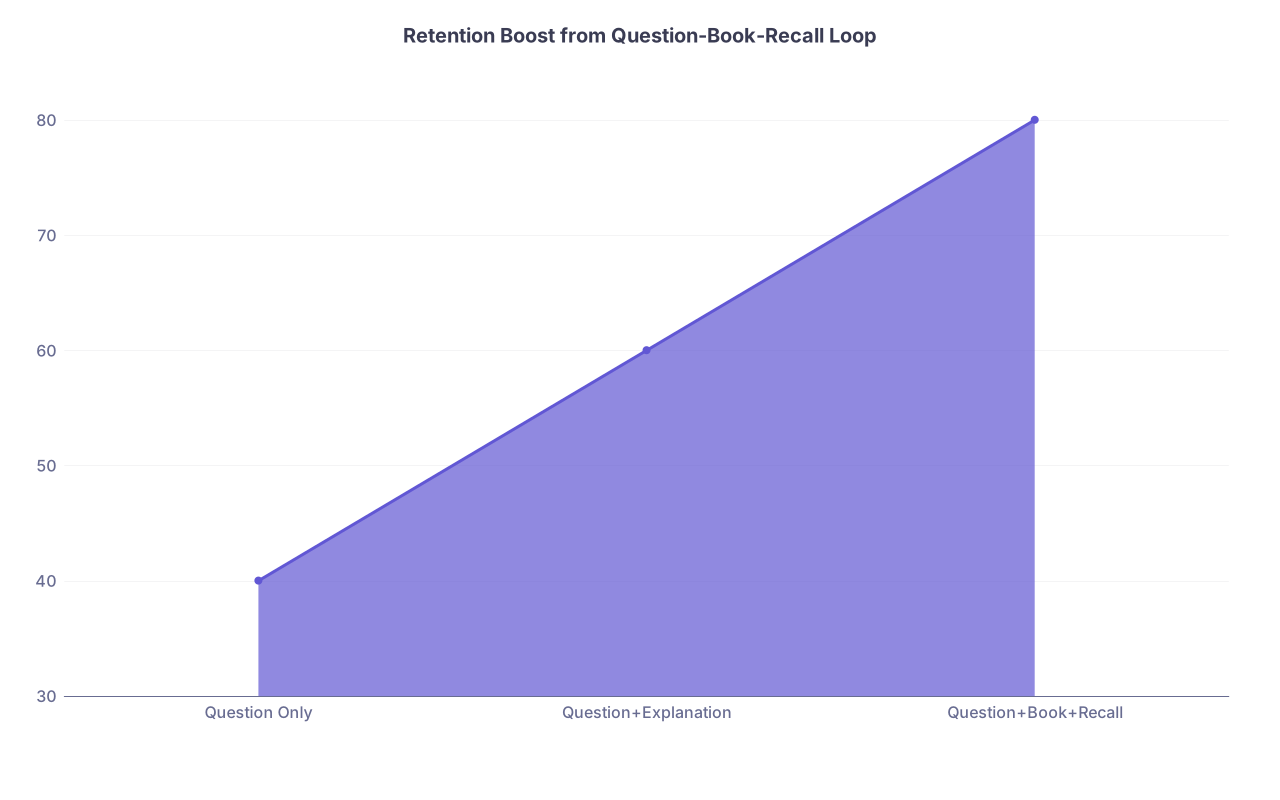
| Category | Value |
|---|---|
| Question Only | 40 |
| Question+Explanation | 60 |
| Question+Book+Recall | 80 |
(Those numbers aren’t exact data; they’re to illustrate the jump. The pattern is real: active recall after targeted reading massively increases retention, especially in ADHD.)
Step 8: Match Study Structure to Your ADHD Pattern
Not all ADHD looks the same. You need to be honest about your flavor.
If you’re a “hyperfocus then crash” type
Use that to your advantage on Q‑banks, not YouTube.
- Schedule one 90–120 minute “deep work” block per day as sacred.
- In that block, stack:
- Q Block 1 (12–15 Qs)
- Review
- Short break (5 min walk)
- Q Block 2 (12–15 Qs)
- Review
- Save less cognitively demanding stuff (organization, flashcards, admin) for later when your brain is trash.
If you’re a “constant micro‑distraction” type
You need harder environment constraints:
- Phone in another room. Not just silent—physically away.
- Website blocker during Q blocks (Freedom, Cold Turkey, LeechBlock).
- Full screen your Q‑bank.
- Use only one notebook/tab for notes. Fragmented notes = doom.

If you lose track of time completely
Every block gets:
- A start time written on paper
- A visible countdown timer (not just on your phone lock screen)
You’re not “weak” for needing external structure. You’re realistic.
Step 9: Special Rules for Different Exam Phases
Your structure should shift as exams change.
Pre‑clinicals (course exams + early boards prep)
Focus:
- 50–75% Q‑bank / practice questions closely tied to course content
- 25–50% book / lecture reinforcement
Structure:
- 1–2 Q‑blocks on current course material per day
- Finish with 20–30 minutes reading only on what you missed
- Do not let passive lecture re‑watching eat your whole day
Dedicated Step 1 / Step 2 / COMLEX Level 1/2
Focus:
- 70–85% questions, 15–30% targeted reading
Target ranges (for ADHD, these are effective targets, not guilt‑inducing ones):
| Phase | Target Questions | Comment |
|---|---|---|
| Light pre-clinical prep | 10–20/day | 1–2 micro-blocks |
| Heavy pre-clinical block | 20–30/day | 2–3 blocks + review |
| Dedicated Step/Level | 30–50/day | 3–4 blocks, no marathon |
You’ll hear classmates brag about “120 questions a day.” Many of them are skimming explanations, half‑guessing, and retaining very little. Do not copy their insecurity.
You want processed questions, not just completed ones.
Clerkships and Shelf Exams
Here the problem is usually time + fatigue, especially with ADHD.
Concrete plan:
- On lighter days: 10–15 questions after work + quick review
- On post‑call/exhausted days: 6–8 questions or flashcard review only (habit maintenance)
- Weekend: 2–3 blocks of 10–12 questions + book sprints on your biggest misses
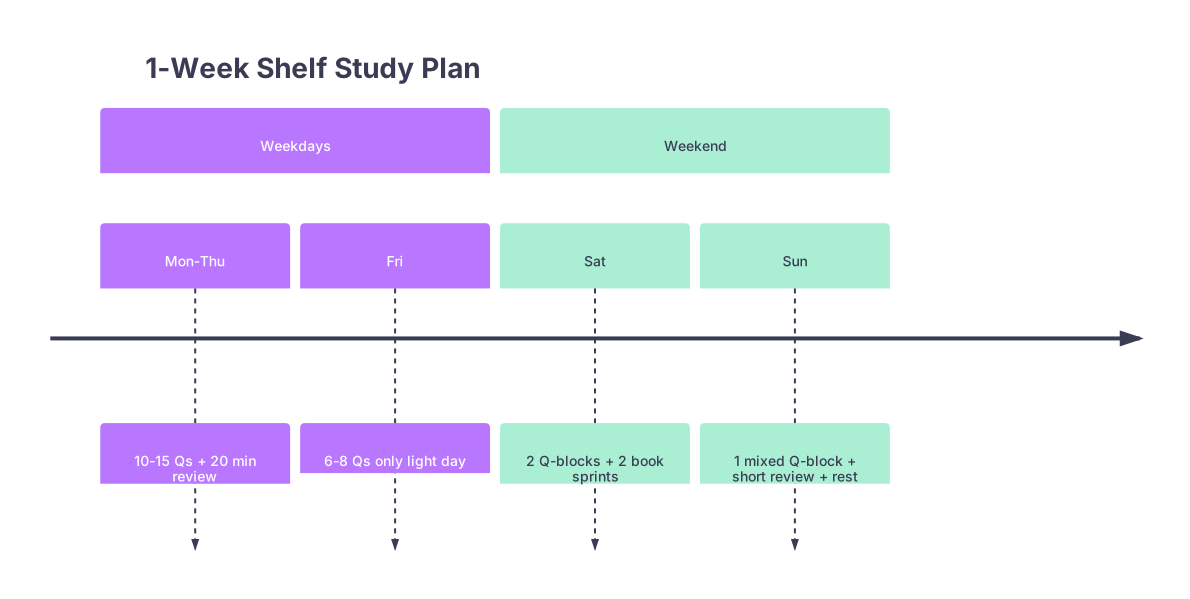
| Period | Event |
|---|---|
| Weekdays - Mon-Thu | 10-15 Qs + 20 min review |
| Weekdays - Fri | 6-8 Qs only light day |
| Weekend - Sat | 2 Q-blocks + 2 book sprints |
| Weekend - Sun | 1 mixed Q-block + short review + rest |
Step 10: Concrete Tools That Pair Well with ADHD
You don’t need 12 apps. You need a few that actually lower friction.
Good pairings:
- Q‑banks: UWorld, AMBOSS, Kaplan, Rosh (for some shelves). Use only one as your “main” at a time to reduce decision fatigue.
- Capture tool:
- Google Doc titled “Q → Book Gaps”
- Or a single OneNote section
- Or a small physical notebook dedicated only to this
- Timer:
- Pomodoro app, or even just your phone + a cheap visual timer on your desk
- Focus blocker:
- Freedom / Cold Turkey / LeechBlock during Q blocks

FAQs
1. Should I finish all explanations, even for questions I got right?
No. That’s ADHD suicide. For correct questions:
- Scan the explanation quickly for:
- Alternative answer justifications
- Classic “twists” on this concept
- If you truly knew it cold, move on in under 30–45 seconds.
- Only slow down if:
- You guessed
- You were between two answers
- You learned something new in the explanation
Your default should be: deep dive on misses, skim on solid wins.
2. Is it okay to do questions in tutor mode if I have ADHD?
Yes—and in many cases, it’s better early on.
Use tutor mode when:
- You’re still building foundations
- You’re easily discouraged by long blocks of red Xs
- You want to link question → correction → book in a tight loop
Add timed blocks later for test‑taking stamina. But do not sacrifice learning just to mimic exam conditions from day one. Build accuracy and understanding first, then layer on pressure.
3. I feel guilty when I only do 20–30 questions and other people do 60+. Am I falling behind?
Not if:
- You’re actually reviewing your questions with structure
- You’re closing gaps with targeted book sprints
- You’re consistent 5–6 days a week
I’ve watched plenty of ADHD students crush boards and shelves on 30 excellent questions a day while their peers burned out on 80 sloppy ones.
You’re not graded on question volume. You’re graded on exam performance. Optimize for that, not for bragging rights.
Key points to walk away with:
- Use short, structured Q‑blocks and a fixed review protocol; no more marathon, unstructured sessions.
- Let questions drive your reading: only open books to fix specific, tagged gaps, in 10–15 minute sprints.
- Build tight loops: question → explanation → rule → brief reading → recall. That’s how an ADHD brain actually learns and remembers.