
The way most students try to handle a remediation and boards at the same time is a recipe for failure.
They try to “do everything.” You do not have that luxury. You have to choose what to be bad at on purpose.
This is about ruthless resource prioritization when you’re remediating a course and prepping for Step/Level at the same time. Not ideal. But survivable—if you treat this like damage control, not perfectionism.
Step 1: Get Brutally Clear on What Actually Matters This Block
You’re juggling two masters:
- The remediated course (pass/fail, immediate threat to promotion or graduation)
- The board exam (big long-term gatekeeper, but with a flexible date window in many cases)
Let’s cut through the noise.
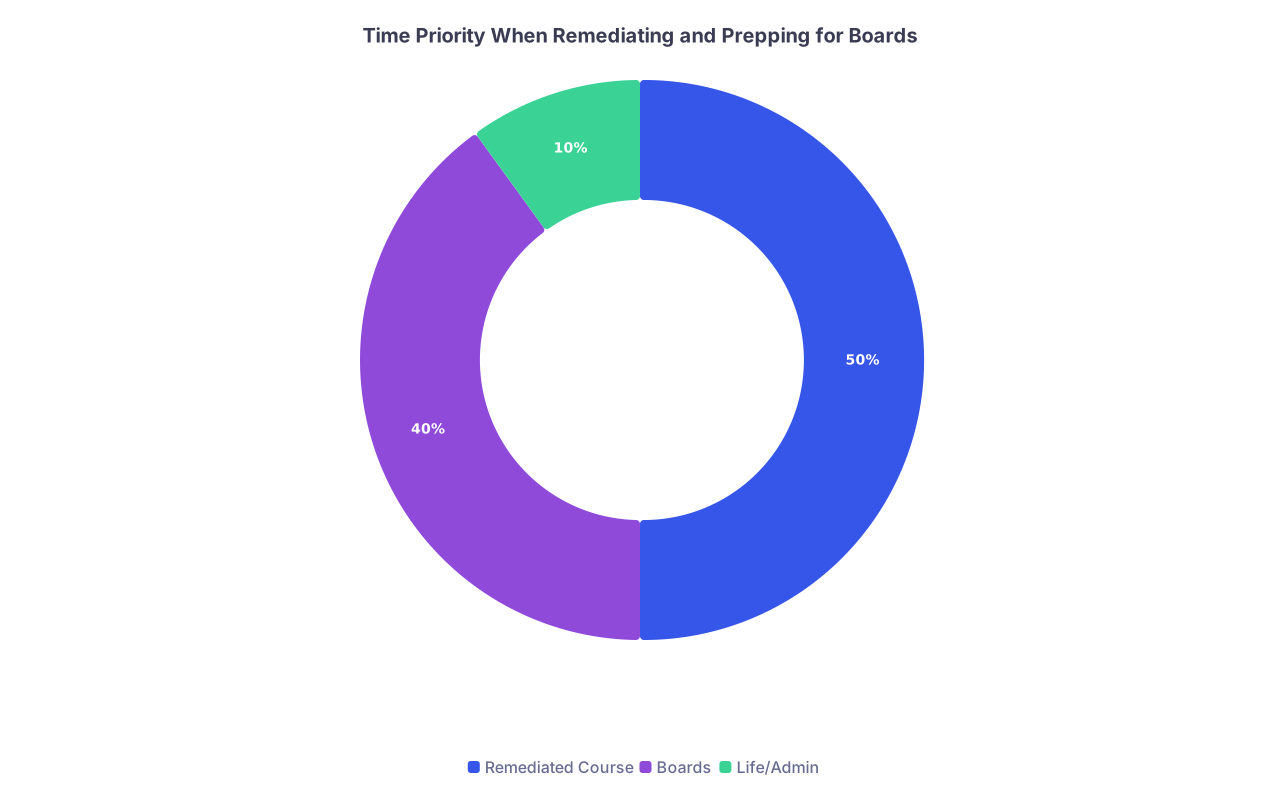
| Category | Value |
|---|---|
| Remediated Course | 50 |
| Boards | 40 |
| Life/Admin | 10 |
If you are in active remediation (meaning: there is an upcoming exam/OSCE/assignment that determines if you pass the course), the short-term hierarchy is:
- Passing the remediated course
- Not completely tanking your boards prep
- Everything else
I’ve watched people do the opposite—protecting their perfect Anki streak while barely touching the remediation material—and then failing the course. That’s how you end up explaining to a promotions committee why you failed twice, with a decent Step score in your back pocket that suddenly means a lot less.
So first, you clarify your non-negotiables for the next 4–8 weeks:
- “I must pass the remediation exam on [date].”
- “I must maintain at least X questions/day for boards so I don’t lose ground.”
- “I will accept that some board resources will sit untouched and that’s fine.”
Now, let’s build around that.
Step 2: Strip Your Resource List Down to Bare Minimum
You can’t run the full med student resource circus when you’re remediating. If your current setup looks like:
- UWorld
- Amboss
- Anki (3 decks)
- Sketchy
- Boards & Beyond
- Pathoma
- Lecturio / Firecracker / Osmosis
- School recordings
- Course PDF notes
- Random PDFs from seniors
…you’re done before you start.
You get one primary question bank, one primary “content spine,” and the course materials. Everything else is optional seasoning—only added if the core is under control.
For Boards, pick:
- Qbank:
- USMLE: Usually UWorld as primary. Amboss if you already started there and it’s working.
- COMLEX-only: TrueLearn or UWorld + COMLEX-specific Qbank.
- Content spine (pick ONE):
- First Aid
- Boards & Beyond videos
- Pathoma (for path-heavy review)
Not all three. Not in this phase. You’re in survival mode.
For the Remediated Course, you focus on:
- Official learning objectives
- Past exams (if allowed)
- Faculty slides / syllabus
- Any blueprint your school gives (“50% from lectures 1–6, 30% from cases, 20% from required readings”)
If there’s a conflict between “what UWorld emphasizes” and “what your course director emphasized 15 times in lecture,” you study what will be tested now: the course.
Step 3: Map a Realistic Weekly Plan — Not a Fantasy One
Most students wildly overestimate how much time they actually have once life, fatigue, and school nonsense hit.
So you start with your real hours.
Let’s say:
- 7 days/week
- 16 awake hours/day
- Subtract: commuting, meals, basic chores, admin, “my brain is mush” time → call that 5–6 hours/day
- You realistically have 8–10 usable study hours on good days, maybe 6–7 on bad days
You divide usable hours into:
- ~60% → remediation course
- ~40% → boards
That ratio might shift as the remediation exam gets closer (80/20 the last 5–7 days before your exam).
Here’s a simple weekly structure in table form that won’t kill you:
| Time Block | Focus |
|---|---|
| 8–11 am | Remediated course |
| 11–12 pm | Boards Qbank (20–30 questions) |
| 1–3 pm | Course (weak topics / assignments) |
| 3–4 pm | Boards review (qbank review, Anki) |
| 7–9 pm (optional) | Either: finish course tasks OR light board content (video/FA) |
Key points:
- Boards work happens daily, but in small, consistent chunks.
- Remediation gets the best brain time—morning, not 10 pm when you’re fried.
- Night blocks are flexible: if you’re cooked, you drop to maintenance mode (review only, no new content).
Step 4: Decide Exactly What to Do Each Day With Boards Resources
This is where people get lost. “Study for boards” means nothing. You need numbers.
You define your minimum viable board plan:
Questions:
- 20–40 questions per day, max. Not 80.
- Timed, random (ideally), but if your foundation is weak you can use system-based for a bit.
- You review every question, right or wrong, and tag anything related to your remediated course for extra attention.
Content:
- 30–60 minutes per day tied directly to:
- Topics you missed in Qbank
- Topics overlapping with the remediated course
- Use FA/B&B/Pathoma. Not all three.
- 30–60 minutes per day tied directly to:
Spaced repetition (if you’re already doing Anki):
- Cap reviews: e.g., max 250 reviews/day.
- Suspend low-yield or non-tested decks for now. Purposefully.
You’re not “optimizing” boards right now. You’re staying in shape so you don’t have to start from zero once remediation is over.
Step 5: Treat the Remediated Course Like a Board Subject, Not a Random Silo
Here’s the move that actually helps you long-term: you integrate remediation into your boards prep instead of treating it like a separate planet.
Example: You’re remediating Renal Physiology.
What you do:
Go through the course objectives and line them up with:
- The Renal chapter in First Aid
- UWorld questions tagged “Renal”
- Pathoma renal videos
For each big topic (RTA types, nephrotic vs nephritic, AKI, acid-base), you:
- Learn it well enough to pass your school’s exam
- Do 5–10 questions on that concept from your Qbank
- Add or unsuspend only targeted cards in Anki (not the whole deck)
Now your remediation time is also boards time. You’re double-dipping.
If you’re remediating something dumb like a “seminar” or lecture attendance-based course with minimal overlap with boards (yes, they exist), you don’t integrate. You minimize:
- Figure out exactly what passes the course: paper, quiz, OSCE station.
- Do only what moves that needle. No perfectionism, no extras.
Step 6: Decide What You’re Willing to Let Go Of (On Purpose)
You cannot keep your old “ideal” study life. Some things need to go on the chopping block.
Here’s what I usually tell people to put on pause when they’re in this situation:
- Secondary Qbank (Amboss if UWorld is primary, or vice versa)
- Watching full lecture recordings “just in case”
- Extra board videos that aren’t directly tied to your weak topics
- Obsessive Anki streak perfection (missing a day won’t kill your score; failing a course might)
You might also temporarily accept:
- Lower daily card counts
- Using premade Anki decks selectively, not in full
- Not reading every single required article line-by-line for your course if your exam is primarily from slides
Think triage. You treat what is life-threatening first, not every paper cut.
Step 7: If Your Board Exam Date Is Soon, You Need a Conversation
If your board exam is:
- Less than 4–6 weeks away
- And you’re remediating something substantial (like an entire systems course or major block)
You probably shouldn’t be stoic and silent. You should talk.
Talk to:
- Your academic advisor
- Student affairs
- A trusted faculty member (ideally someone who actually passes decisions on these things)
Be explicit:
- “I’m remediating [course]. The remediation exam is on [date]. My Step/Level is scheduled for [date]. I’m worried that doing both will compromise both my performance and my mental health. What are my options for adjusting my exam date without looking flaky?”
I’ve seen a lot of students assume “rescheduling looks bad.” It doesn’t—if you pass on your first attempt and your score is solid. A delayed exam with a good score is fine. A rushed exam with a mediocre or failed score is not.
If you can move the test by 4–8 weeks and buy yourself clean, remediation-free time to ramp up your Qbank volume after you pass the course? Do it.
Step 8: Concrete Daily Execution Plan (What This Actually Looks Like)
Let me walk you through a single real-world day during this kind of crunch.
You’re remediating Cardiology. Exam in 3 weeks. Boards in 2 months. You’re behind. Here’s the day:
7:30–8:00 – Wake, breakfast, zero phone scrolling while eating. Quick review of your written plan for the day.
8:00–10:30 – Remediated Course Deep Work
- Re-watch or re-study 2–3 key cardiology lectures (like arrhythmias and heart failure).
- Create a 1–2 page condensed outline from the slides (not an encyclopedia, just “what the exam loves”).
- For each major concept, star what you know is also high-yield for boards (STEMI vs NSTEMI, murmurs, etc.).
10:30–11:30 – Boards Qbank (20–25 Questions)
- Block: 20–25 cardiology-heavy questions if your foundation is weak; otherwise random.
- Timed.
- Quick break after.
11:30–12:15 – Review Those Questions
- For every question:
- Write a one-liner takeaway in a running document or notebook.
- Tag overlaps with your remediated course.
12:15–1:00 – Lunch / mental reset
1:00–3:30 – Course-Specific Practice
- Past exams / practice questions from your course if available.
- Drill your weak areas from the morning (e.g., valvular lesions).
- Make mini “cheat sheets” for things you always mix up (like which murmurs get louder with inspiration vs expiration).
3:30–4:15 – Boards Content Review (Tie-in)
- 30–45 minutes: Pathoma cardio chapter or B&B cardio video.
- Skim the First Aid cardio pages and mark things that match what you saw in qbank and course.
4:15–6:30 – Break, life tasks, short walk, food
6:30–8:00 – Light Work / Flex Block
- If course stuff feels shaky: spend it on more course questions or revisiting confusing lectures.
- If course is solid that day:
- Do another 10–15 boards questions OR
- Do Anki targeted to cardio and your worst systems.
8:00–10:00 – Wind down
- Light reading if you want (But not grinding more qbank when your brain is dead. That’s how you learn wrong patterns.)
Do this 5–6 days a week with one true low-intensity day (maybe just 10 questions + Anki + 1–2 hours course review) so you don’t burn out.
Step 9: Watch For the Two Failure Modes
Most people in your position crash in one of two ways.
Failure Mode 1: “All Boards, I’ll Wing the Course”
Symptoms:
- 60–80 question blocks daily
- Tons of boards videos
- “I’ll catch up on remediation next week”
- Suddenly it’s next week and you’re two weeks out from the course exam with a shaky grasp of the material
Outcome: You might get a decent Step/Level score. You might also pick up a course failure or repeat remediation and now you have a pattern. Promotions committees care about patterns.
Failure Mode 2: “All Course, Boards Can Wait”
Symptoms:
- Zero or near-zero questions for 1–2 months
- “I’ll crush the course, then ramp boards like crazy later”
- You forget all your old content, your test endurance drops, and ramping up takes longer than you think
Outcome: You pass the course, but when remediation ends you’re basically starting boards studying from scratch with less time and more stress.
The path you want is the middle:
- High priority → Remediated course
- Low but non-zero floor → Boards
That’s it. Not glamorous. But it works.
Step 10: Mental Framing So You Don’t Spiral
You’re going to have days where both sides feel like they’re going poorly. That doesn’t mean the plan is wrong. It means you’re human and under pressure.
Couple anchors:
- This is temporary. You’re not living like this for a year. This is a 4–8 week crunch.
- Perfection is not the goal. Adequate is.
- Adequate = pass the course.
- Adequate = maintain some question momentum for boards.
- Failing the course again is worse than pushing your board exam back 4–8 weeks.
One more thing: if your school has academic support and you’re not using it because you’re embarrassed, get over that. The students who survive messes like this are rarely the ones who tried to white-knuckle it alone.
A Quick Visual: Your Next 6 Weeks
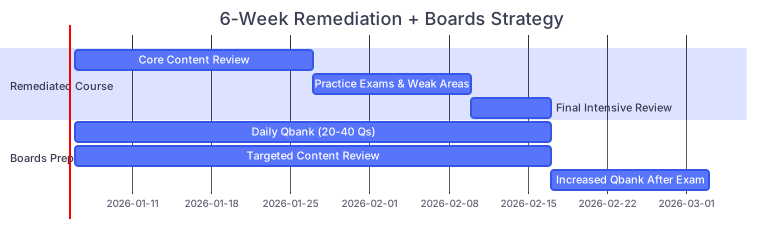
| Task | Details |
|---|---|
| Remediated Course: Core Content Review | a1, 2026-01-06, 3w |
| Remediated Course: Practice Exams & Weak Areas | a2, after a1, 2w |
| Remediated Course: Final Intensive Review | a3, after a2, 1w |
| Boards Prep: Daily Qbank (20-40 Qs) | b1, 2026-01-06, 6w |
| Boards Prep: Targeted Content Review | b2, 2026-01-06, 6w |
| Boards Prep: Increased Qbank After Exam | b3, after a3, 2w |
The idea: steady boards presence, variable course intensity—with a spike in course work near your remediation exam, then a spike in boards work after.
What To Do Tonight
You don’t need more theory. You need a plan on paper.
Here’s your next, concrete move:
Right now, grab a sheet of paper (or open a doc) and:
- Write the date of your remediation exam and your board exam.
- List every resource you’re currently “planning” to use.
- Cross out at least half of them for the next month. Circle:
- ONE boards qbank
- ONE primary content resource
- Your course slides/objectives
- Build a 2-day micro-schedule with:
- Exact times for: course work, qbank, q-review, and content review
- Specific targets: “25 renal questions,” “Lecture 3–4,” “Pathoma Renal Ch. 1–2”
Then follow that plan for just 2 days. Not forever. Just 2 days.
At the end of day 2, adjust—but don’t add more resources. Just tweak hours and proportions.
Open your calendar and block tomorrow’s study blocks now, with labels: “Remediation,” “Boards Qs,” and “Boards Review.” Put them in like appointments you’re not allowed to miss.