You are two weeks out from a big exam. Your practice questions are fine for cardio, renal, pharm. Then you hit biostats and ethics. Your percent correct falls off a cliff. You keep mixing up sensitivity vs PPV, and every ethics question feels like “all of the above are reasonable.” You are not dumb. You are under-resourced and unfocused in exactly two domains that happen to be heavily testable.
Let me fix that.
This is a targeted resource stack and a study protocol for people who are specifically weak in:
- Biostatistics / epidemiology
- Ethics / professionalism / legal-ish questions
Not vague “do more questions” advice. A concrete, stepwise plan that you can plug into a 1–3 week window and actually move your scores.
1. What You’re Up Against (And Why You’re Struggling)
You are failing biostats and ethics for a few predictable reasons.
Biostats: Why it feels like quicksand
Common patterns I see:
- You “kind of” know definitions but cannot use them in a question stem.
- You memorize formulas the night before, then they evaporate under pressure.
- You avoid calculation questions, so you never build fluency.
- You never tied concepts to visual patterns (2×2 tables, graphs, etc.).
Biostats is not hard math. It is:
- Pattern recognition with 2×2 tables
- Understanding what a test actually tells you
- Knowing which number moves when prevalence changes
Once the patterns lock in, the questions recycle.
Ethics: Why everything sounds reasonable
Ethics questions feel slippery because:
- You read them like opinion questions, not rules-based questions.
- You do not actually know the named principles (beneficence, autonomy, etc.) beyond buzzwords.
- You are fuzzy on legal anchors: capacity vs competence, informed consent requirements, confidentiality exceptions.
Most ethics items on exams are not asking “what is nice?” They are asking “what matches the guideline / rule?”
So we will build:
- A tight concept spine (what you must know cold).
- A lean but high-yield resource stack (not fifteen books).
- A drill protocol that forces application, not rereading.
2. Core Concept Spine: What You Must Know Cold
Before resources, define the minimum viable knowledge you will hold in your head without notes.
Biostats – Non-negotiable Concepts
If you cannot explain each of these out loud to yourself, you are not done:
Test characteristics
- Sensitivity / specificity
- PPV / NPV
- How prevalence affects PPV/NPV (but not sensitivity/specificity)
2×2 table relationships
- True positive, false positive, true negative, false negative
- Where each fraction comes from
- Risk vs odds vs probability
Ratios and differences
- Relative risk (RR)
- Odds ratio (OR)
- Absolute risk reduction (ARR)
- Relative risk reduction (RRR)
- Number needed to treat / harm (NNT / NNH)
Study designs
- Cross-sectional vs cohort vs case-control vs RCT vs meta-analysis
- What each can and cannot infer (incidence, prevalence, causality)
- Classic biases tied to each design (recall bias, selection bias, etc.)
Common errors and biases
- Confounding vs effect modification
- Lead-time bias, length bias
- Selection bias, recall bias, measurement bias
Basic statistics
- Mean, median, mode and how they shift with skew
- Standard deviation and 68–95–99.7 rule
- Confidence intervals: what “95% CI” actually implies
- Types I & II error, power, p-values
That is it. That list covers the majority of real exam biostats content.
Ethics – Non-negotiable Concepts
Ethics is even more list-driven:
4 core principles
- Autonomy
- Beneficence
- Nonmaleficence
- Justice
Capacity and consent
- Capacity vs legal competence
- Conditions for valid informed consent
- Situations where you treat without consent (emergency, etc.)
Confidentiality
- Standard rule: do not disclose
- Exceptions: duty to warn, reportable diseases, abuse, risk to others
- Minors: when you maintain confidentiality vs when you must inform parents
End-of-life and advance directives
- DNR vs DNI vs “comfort care”
- Living will vs durable power of attorney
- Surrogate decision-making hierarchy
Professionalism
- Boundaries with patients (gifts, social media, relationships)
- Impaired colleagues and duty to report
- Conflicts of interest and industry influence
Legal-ish basics
- Negligence elements (duty, breach, causation, damages)
- Battery vs assault in medical context (e.g., operating without consent)
- Documentation and disclosure duties after error
Once you can attach question stems to these buckets quickly, the “guessing” feeling goes away.
3. The Resource Stack That Actually Works
You do not need a 500-page stats text. You need concise explainer + targeted questions + quick-review tools.
Here is the stack I recommend, assuming US-style board exams (Step, shelf, NBME-style school exams). Adapt the concept to your region.
| Need | Primary Resource | Backup / Add-on |
|---|---|---|
| Concept explanations | Boards & Beyond videos | OnlineMedEd biostats/ethics |
| Question practice (boards) | UWorld / AMBOSS | NBME practice exams |
| Rapid formulas & rules | Anki (pre-made decks) | Personal 1-page sheets |
| Outline-style review | First Aid relevant chapters | Sketchy slides (for some) |
1. Explanations
Biostats
Boards & Beyond – Biostatistics/Epidemiology videos
- Clear, stepped explanations.
- Walks through 2×2 tables and formulas repeatedly.
- You stop each video and re-build the example yourself. If you are just watching, you are wasting time.
Alternative: OnlineMedEd or similar short biostats modules if you prefer a different style.
Ethics
Boards & Beyond – Behavioral Science / Ethics
- Clean, board-style framing.
- Good at mapping principles to patient scenarios.
Guideline PDF from your exam board or school
- Many schools or national boards publish a short “professionalism/ethics” document. That document is often closer to the question-writers’ brains than any video.
2. Question Banks
This is where you actually fix the problem.
- UWorld / AMBOSS question blocks filtered to:
- “Biostatistics & Epidemiology”
- “Ethics / Patient Safety / Professionalism”
- Do timed, random blocks once you know basics. Earlier on, you can do untimed and system-tagged.
Pay more attention to explanations than whether you got it right.
3. Rapid-Review Tools
You need fast repetition on small pieces.
- Anki
- Use a curated deck:
- For USMLE style: AnKing or equivalent, filtered to “Biostats”, “Epidemiology”, “Ethics”.
- If decks overwhelm you, build your own:
- 1 card per formula / principle / exception rule.
- Use a curated deck:
- 1-page cheat sheets
- One page for biostats formulas and patterns.
- One page for ethics rules and exceptions.
- You should be able to redraw each page from memory in 5–7 minutes.
4. A 10-Day Biostats Fix Protocol
Assume you have 10–14 days and an existing study schedule. You are going to carve out 60–90 minutes per day just for biostats.
If you have less time, compress but keep the structure.

| Step | Description |
|---|---|
| Step 1 | Watch focused video |
| Step 2 | Rebuild examples |
| Step 3 | Do 10-15 targeted questions |
| Step 4 | Create/Review flashcards |
| Step 5 | Weekly mixed practice block |
Days 1–2: Foundations + Tables
Watch / rewatch:
- Sensitivity, specificity, PPV, NPV, likelihood ratios.
- 2×2 tables construction.
Active note:
- Draw a blank 2×2 table.
- Fill in true/false positives/negatives from verbal descriptions.
- Derive each formula from the table, do not copy.
Practice:
- 15–20 UWorld/AMBOSS questions only on:
- Sens/Spec
- Predictive values
- Basic screening test changes with prevalence
- 15–20 UWorld/AMBOSS questions only on:
End of day drill (10 minutes):
- Close notes.
- Draw a 2×2 table from scratch.
- Write all formulas around it.
- Explain out loud what happens to PPV/NPV when prevalence increases.
Days 3–4: Ratios and Risk
Watch / review:
- Relative risk, odds ratio.
- ARR, RRR, NNT/NNH.
Concept linking:
- Compare:
- Cohort → relative risk (prospective incidence).
- Case-control → odds ratio (retrospective).
- Compare:
Practice:
- 15–20 questions focused on:
- RR vs OR interpretation (what does RR=2.0 mean in words?).
- Absolute vs relative risk reductions.
- NNT calculations.
- 15–20 questions focused on:
Drill:
- Create 4–5 quick scenarios yourself:
- Example: “10% event in control vs 5% in treatment. What are ARR, RRR, NNT?”
- Answer without notes. Then check.
- Create 4–5 quick scenarios yourself:
Days 5–6: Study Designs and Biases
Watch / review:
- Study design overview.
- Common biases and how to mitigate them.
Create a mapping chart:
- Rows: cross-sectional, cohort, case-control, RCT, meta-analysis
- Columns: direction (pro/retro), measures (incidence, prevalence, RR, OR), main use, core limitation.
Practice:
- 15–20 questions:
- Identify design from description.
- Identify the bias from scenario.
- Choose best method to reduce bias.
- 15–20 questions:
Drill:
- Take each bias (recall, selection, lead-time, length, etc.).
- Write:
- 1-sentence definition.
- 1-sentence example.
- 1 mitigation strategy.
Days 7–8: Basic Stats and Interpretation
Watch / review:
- Normal distributions, SD, confidence intervals.
- Type I/II errors, power, p-values.
Visualize:
- Draw the bell curve with:
- Mean, ±1 SD, ±2 SD, ±3 SD labeled with 68–95–99.7.
- Sketch right-skewed and left-skewed distributions and how mean/median shift.
- Draw the bell curve with:
Practice:
- 15–20 questions:
- Interpreting CIs (does it cross 1? Does it include 0?).
- Understanding p-values scenarios (especially misinterpretations).
- Sample size, power relationships.
- 15–20 questions:
Drill:
- Flashcard: “Power increases with _____” (effect size, sample size, alpha).
- Flashcard: “Type I error is…” “Type II error is…”
Days 9–10: Mixed Reinforcement
Do a mixed block:
- 20–30 questions from all biostats subtopics.
- Timed, exam-style.
Post-block review:
- For every miss, categorize:
- Concept error (did not know).
- Sloppy formula/error (knew but mis-applied).
- Reading error (misread the question).
- Fix differently:
- Concept → rewatch or re-note that subtopic.
- Sloppy → add a “check step” to your process.
- Reading → underline question stem ask every time.
- For every miss, categorize:
Final drill:
- Recreate your entire 1-page biostats formula sheet from memory.
- Any gap = you are not done.
5. A 7-Day Ethics & Professionalism Fix Protocol
Ethics can move faster because there is less calculation and more rules.
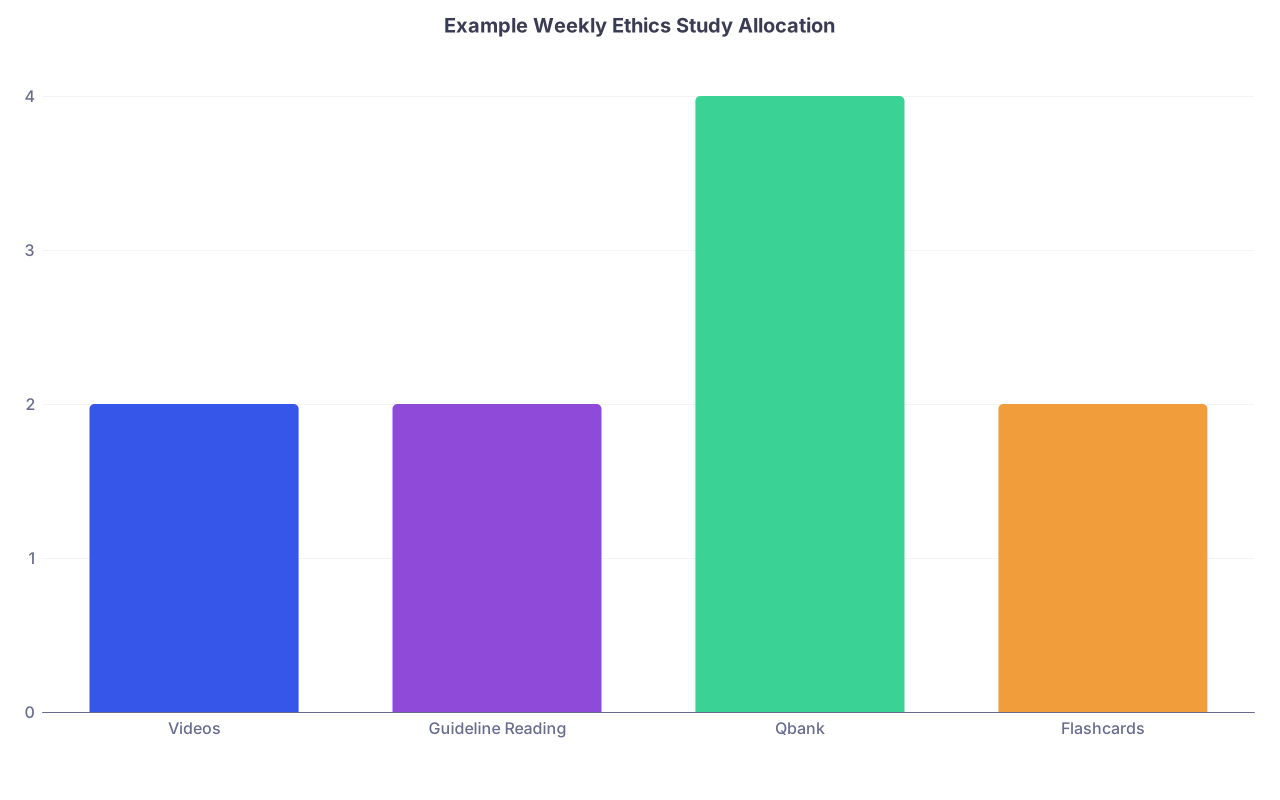
| Category | Value |
|---|---|
| Videos | 2 |
| Guideline Reading | 2 |
| Qbank | 4 |
| Flashcards | 2 |
Day 1: Core Principles and Framework
Watch / review:
- General ethics overview.
- 4 principles: autonomy, beneficence, nonmaleficence, justice.
Build your decision framework:
- When you face an ethics stem, you will:
- Identify the domain: consent, confidentiality, end-of-life, professionalism, etc.
- Identify the principle: autonomy vs beneficence vs nonmaleficence vs justice.
- Apply the rule associated with that domain (e.g., “if patient has capacity, respect their decision even if you disagree”).
- When you face an ethics stem, you will:
Practice:
- 10–15 ethics questions focused on:
- Choosing the “most ethical next step.”
- Mapping each question back to the principle.
- 10–15 ethics questions focused on:
Day 2: Capacity, Consent, and Minors
Read / watch:
- Capacity vs legal competence.
- Required elements of informed consent.
- Exceptions (emergencies, therapeutic privilege, etc.).
- Minors: when they can consent (e.g., pregnancy, STI, substance use in some jurisdictions) vs when parents are needed.
Create a “Consent Rules” sheet:
- Who can consent.
- Who cannot consent.
- Concrete examples:
- Intoxicated adult.
- Psychotic patient.
- 16-year-old requesting OCPs.
- Unconscious patient in ED.
Practice:
- 15–20 questions only on consent/minors scenarios.
- After each, write the “rule” that explains the answer in 1 sentence.
Day 3: Confidentiality and Exceptions
Review:
- Default: protect confidentiality.
- Clear exceptions:
- Imminent harm to self or others (duty to warn).
- Reportable diseases (depends on region but concept is the same).
- Suspected child/elder abuse.
- Impaired drivers or pilots in some settings.
Table of exceptions:
- Column 1: Situation.
- Column 2: You must / may / must not break confidentiality.
- Column 3: Whom you notify (authorities, family, etc.).
Practice:
- 15–20 questions on confidentiality, abuse, duty to warn.
- Drill: For each exception, say out loud: “Here I must break confidentiality because…”
Day 4: End-of-Life, Directives, and Surrogates
Review:
- DNR/DNI vs general treatment limitations.
- Living will vs durable power of attorney for healthcare.
- Surrogate decision hierarchies when no directives exist.
- Comfort care, palliative vs curative intent.
Practical mapping:
- Scenario: Patient with living will refusing intubation, but family demanding “everything.” Whose wishes control? (The patient.)
- Scenario: No documentation, patient comatose, estranged family – who decides?
Practice:
- 15–20 end-of-life / code status questions.
- After each, note which document or surrogate rule controlled the decision.
Day 5: Professionalism and Boundaries
Review:
- Physician–patient boundaries:
- No romantic relationships with current patients.
- Caution / usually avoid with former patients.
- Gifts from patients and from industry.
- Impaired colleagues: duty to report, not cover up.
- Social media behavior.
- Physician–patient boundaries:
Make a yes/no list:
- “Is this acceptable?”
- Small thank-you gift from patient: usually yes (with limits).
- Expensive vacation from pharma: no.
- Friending patients on social media: no.
- Having a beer with residents: yes, depending on context.
- “Is this acceptable?”
Practice:
- 15–20 professionalism questions.
- Force yourself to articulate which rule the wrong option violates.
Day 6–7: Mixed Questions and Rules Drill
Mixed ethics block:
- 20–30 ethics questions from all domains.
- Timed, exam style.
Post-block analysis:
- For each incorrect:
- Identify the domain (consent, confidentiality, etc.).
- Write the specific rule you missed.
- Turn misses into flashcards.
- For each incorrect:
End-of-week drill:
- From memory, write:
- 4 core principles + 1-line definition each.
- Full capacity/consent exceptions list.
- All confidentiality exceptions.
- Basic hierarchy of surrogates and directives.
- From memory, write:
If you can write that cleanly, you can answer most ethics questions.
6. Integration: Making Biostats and Ethics Stick Long-Term
You do not want to re-learn this for every exam. So you build light maintenance.
Weekly Maintenance Protocol
After your intensive period:
Once per week:
- 10 mixed biostats questions.
- 10 ethics/professionalism questions.
- Quick glance (5 minutes) at your 1-page biostats and 1-page ethics sheets.
Anki:
- Keep reviews small and consistent.
- Suspend overly detailed or low-yield cards that slow you down.
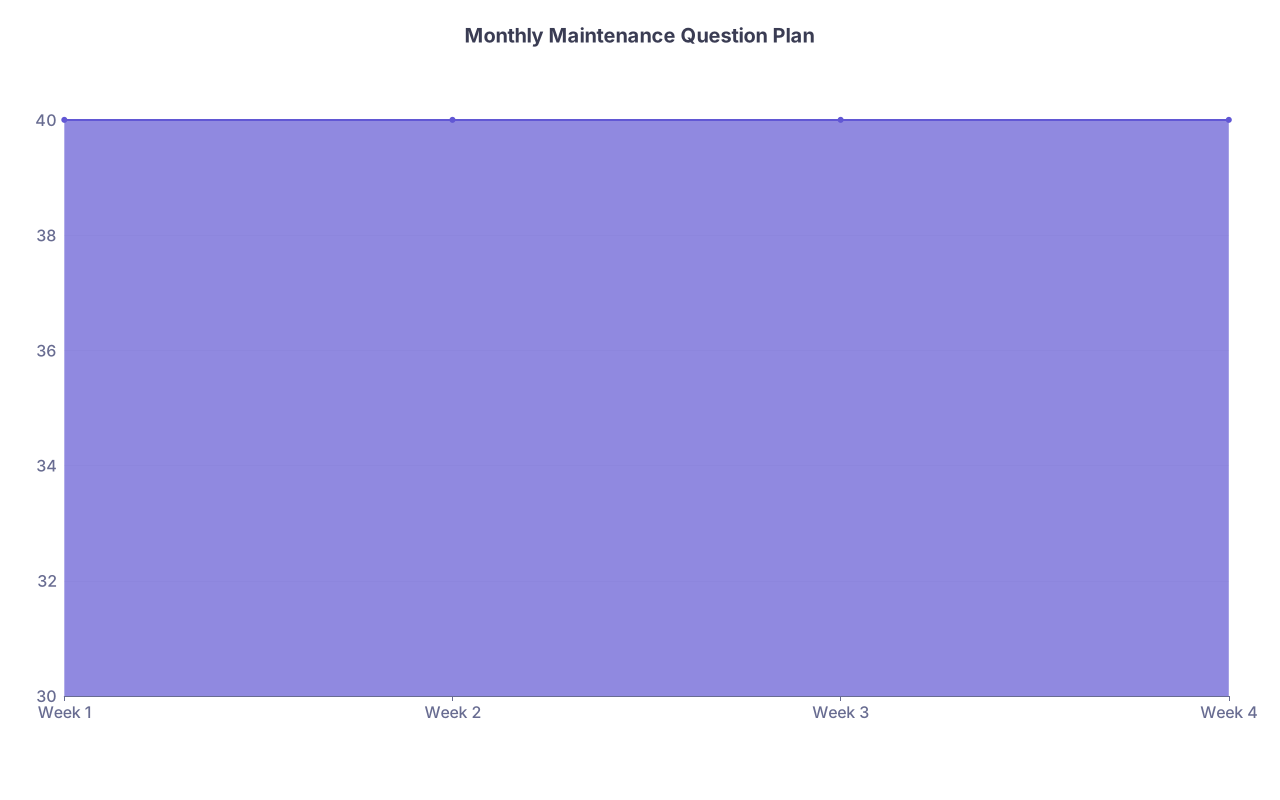
| Category | Value |
|---|---|
| Week 1 | 40 |
| Week 2 | 40 |
| Week 3 | 40 |
| Week 4 | 40 |
On the Week Before Any Big Exam
- Do one full mixed block (20–40 questions) with:
- 50% biostats/epi.
- 50% ethics/professionalism.
- Recreate your 1-page sheets from memory.
- Watch 1–2 speeded videos as a “concept refresh,” not first exposure.
7. Common Mistakes That Keep Scores Low
You can do everything above and still sabotage yourself with bad habits.
Passive watching
- Watching videos like Netflix with zero pausing, zero writing.
- Fix: Pause every few minutes, re-derive the formula or concept yourself.
Never touching calculations
- Skipping any question that needs math because it “takes too long.”
- Fix: For a week, force yourself to attempt every calculation. Speed comes after understanding.
Not reading the stem ask
- Misreading “Which of the following study designs…” as “Which of the following biases…”
- Fix: Underline the actual question each time before looking at the options.
-
- Watching three different biostats series, reading a text, using 4 decks.
- Fix: One main explainer + one Qbank + your notes. That is enough.
Treating ethics as “common sense”
- It is not. It is rule-based. Common sense from your culture/family can be flatly wrong for exam writers.
- Fix: Anchor decisions on explicit rules you have written down, not vibes.
FAQs
1. I am less than a week from my exam. What is the bare minimum I should do for biostats and ethics?
Two days: watch fast biostats/ethics review videos at 1.5x, pausing to take skeletal notes. Two days: 20–30 targeted questions per day for biostats and ethics each, carefully reviewed. Daily: redraw a half-page summary of formulas and core ethics rules from memory. You are not becoming an expert in 5 days; you are eliminating catastrophic gaps.
2. My Qbank performance in biostats is stuck around 40–50%. Should I abandon it and read more?
No. That score means you are exactly where learning happens. Stay in the Qbank, but slow down. Do smaller sets (10–15 questions), and spend more time in explanations than in answering. Then, immediately summarize each new concept into one sentence or one mini-table in your notes. Reading more without application will not move the needle.
3. How do I know when I am “good enough” at biostats and ethics for my exam?
Three signals: (1) You can build a 2×2 table and write all main formulas from memory. (2) You can explain 4 core ethics principles, capacity/consent rules, and confidentiality exceptions without notes. (3) On mixed Qbank blocks, your biostats/ethics questions are at least in line with, or slightly above, your overall percentage. When those three are true, you are no longer weak in this area—you are average to strong, which is all you need.
Key points to walk away with:
- Biostats and ethics are rule- and pattern-based domains. Once you lock patterns and rules, scores jump fast.
- One clean resource stack plus a 7–10 day focused protocol beats a scattered year of half-attention.
- Long-term, light weekly maintenance (small Qbank sets + 1-page sheet review) prevents you from ever feeling this unprepared again.