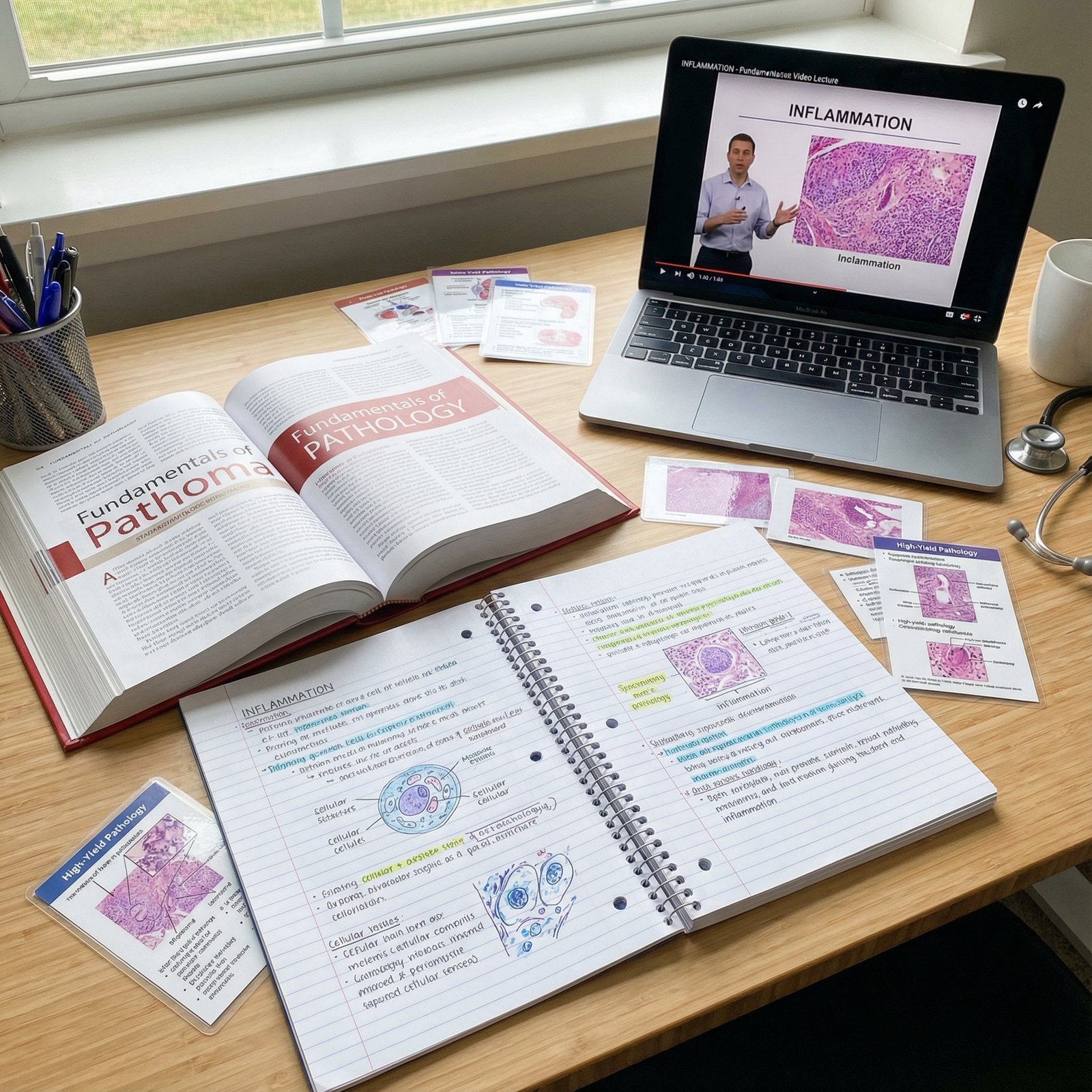
The way most students collect board prep books is wrong. You are not “being thorough.” You are building a hoarder’s nest that kills your focus and your score.
You do not have a content problem. You have a triage problem.
Let me show you exactly how to fix it.
Step 1: Admit the Real Problem (It Is Not Lack of Resources)
You probably recognize this pattern:
- You bought (or “acquired”) UWorld, AMBOSS, Anki, Boards & Beyond, Pathoma, maybe Sketchy, maybe a big review book (First Aid, Step-Up, etc.).
- Every upperclassman told you a different “must use” resource.
- Your bookshelf and hard drive look impressive.
- Your plan? Vague. Something like: “I’ll use all of them and see what works.”
That is how smart people fail these exams.
Too many resources create three problems:
Fragmented attention
You keep switching: book → video → cards → questions. Nothing sticks. You feel busy but learn shallowly.False productivity
Staring at a huge stack of books feels like you are serious. But serious is measured in:- Mastered questions
- Recall under pressure
- Not hours spent highlighting 700 pages.
No mastery loop
Board prep requires:- Learn → Test → Review → Repeat
When resources are scattered, that loop breaks. You “learn” the same anemia chapter in three different books, but rarely test it deeply.
- Learn → Test → Review → Repeat
So the fix is not “more discipline” or “more hours.”
The fix is ruthless simplification and a triage protocol.
Step 2: Perform a Hard Inventory and Categorize
You cannot triage what you have not clearly seen.
Take 20 minutes. Pull everything out. Physical books, PDFs, subscriptions.
Make a simple list on paper or in a note, then categorize like this:
1. Primary learning resources
- Examples:
- Boards & Beyond
- Pathoma
- Sketchy
- Big review texts (First Aid, Step-Up, etc.)
2. Question banks (Qbanks)
- UWorld
- AMBOSS
- USMLE-Rx
- NBME practice exams (forms)
3. Spaced repetition / flashcards
- Anki decks (Zanki, AnKing, Lightyear, your own)
4. Extras / “nice-to-haves”
- Specialty-specific books (e.g., cardiology review manual)
- Extra review books (e.g., Rapid Review Pathology when you already have Pathoma)
- Extra video subscriptions you barely touch
Now you have a full map. Good.
Next step: brutally honest decisions.
Step 3: Decide Your “One Primary” in Each Category
You cannot run three primary resources in the same lane. That is how you burn out.
Your goal: choose one main resource in each category, plus at most one backup where needed.
3.1 Selecting your primary Qbank
Non-negotiable: you need one workhorse Qbank that you aim to finish.
For USMLE/COMLEX style exams the hierarchy is painfully clear from real experience:
| Exam Phase | Primary Qbank | Optional Secondary |
|---|---|---|
| Step 1 / Level 1 | UWorld | AMBOSS |
| Step 2 / Level 2 | UWorld | AMBOSS |
| Shelf Exams | UWorld | AMBOSS or NBME |
If you own three Qbanks, here is the protocol:
- Pick UWorld as primary unless you have a strong, explicit reason not to.
- Use AMBOSS as:
- A targeted backup for weak topics only.
- Not as another full Qbank to “get through if I have time” (you will not).
- Ignore others unless your school forces you.
If you are mid-way through another Qbank (say 30–40% done) and have not touched UWorld yet:
- Switch to UWorld now.
- Use the old one only for occasional extra practice in weak areas.
Do not overcomplicate this. Completed UWorld > partially completed everything.
3.2 Selecting your primary content resource
You need one main structured content source that gives you the “big picture” and fills gaps when questions expose them.
Pick based on how your brain actually works, not what your class group chat worships:
- If you like video + concise notes:
- Boards & Beyond + First Aid
- Pathoma for pathology
- If you like reading + self-notes:
- First Aid or Step-Up as backbone
- Supplement with short topic videos as needed
- If you are a visual mnemonic person:
- Sketchy for micro/pharm
- Pathoma for path
- Still need a short text backbone (First Aid or similar).
Key rule: one backbone. Everything else supports it.
Example final choice:
- Backbone: First Aid
- Pathology: Pathoma
- Micro/Pharm: Sketchy
- Questions: UWorld
Everything else? Optional and probably dispensable.
3.3 Selecting your primary spaced repetition method
If you are not using spaced repetition, you are playing the exam on “hard mode”.
If you are using five different decks, you are playing it on “impossible mode”.
Your options:
- Deck-based (AnKing, Zanki variants):
- High yield, but time-consuming.
- Works best when started early in M1/M2.
- Custom cards only:
- Great once you have a strong base and know your weak spots.
- Hybrid:
- Use a big premade deck but aggressively suspend / delete what you do not need.
Pick one:
- If you are >6 months from the exam:
- Use a large curated deck (AnKing or school-specific) as primary.
- If you are 2–4 months out:
- Focus on making targeted cards from missed UWorld questions and weak topics.
- If you are <2 months out:
- Ruthless: keep only cards tagged to:
- UWorld incorrects
- NBME misses
- High-yield topics you repeatedly forget
- Ruthless: keep only cards tagged to:
Stop adding three new decks every 2 weeks. That is procrastination disguised as enthusiasm.
Step 4: Triage Your Existing Books: Keep, Downgrade, or Kill
Now we make actual cuts.
Use this 3-level triage system:
Tier 1 – Core
- Must be used regularly.
- Directly tied to your daily schedule.
- Example: UWorld, AnKing, Pathoma.
Tier 2 – Targeted Backup
- Only used for specific weak topics.
- Example: AMBOSS articles, an organ-system review book, a pharm flashcard set.
-
- Aspirational stuff you “might get to.”
- Old PDFs you never open.
- Extra review books duplicating what you already have.
Your move:
- Everything in Tier 3: put in a box, in a closet, or digitally in an “Archive” folder. Out of sight.
- Everything in Tier 2: put on a separate shelf or folder labeled “Targeted Only”.
- Leave only your Tier 1 tools in your workspace and bookmarks.
Yes, physically moving the books matters. Visual clutter = mental clutter. I have seen anxiety drop in 10 minutes just by clearing the desk to 3 items.
Step 5: Build a Simple Daily Workflow (The Real Triage Plan)
Resources do not score points. Processes do.
Your daily board-study workflow should have 4 components. In roughly this order:
- Spaced repetition review (Anki or equivalent)
- Fresh Qbank blocks
- Review of missed questions
- Targeted content refresh for weak areas
Let me give you a concrete daily plan for a dedicated study period (~8–10 hours/day).
Example daily schedule (dedicated period)
08:00–09:00 – Spaced repetition
- Review due Anki cards (cap it at 60 minutes).
- If you have 900 cards due, that is not a badge of honor. That is a problem to fix (we will address this).
09:00–11:00 – Qbank Block #1
- 40 questions, timed, mixed.
- No pausing for long reading in the middle. Simulate exam conditions.
11:00–12:30 – Review Block #1
- For each question:
- Mark:
- Correct + confident
- Correct + guessed
- Incorrect
- Write 1–3 bullet notes for incorrect / guessed:
- What concept?
- Why you missed it?
- Micro-fact to remember?
- Mark:
- For each question:
Lunch break (actually step away)
13:30–15:30 – Qbank Block #2
- Another 40 questions.
15:30–17:00 – Review Block #2
17:00–18:00 – Targeted content / flashcards
- Use Pathoma/First Aid/AMBOSS for:
- Topics that burned you today.
- Patterns of weakness: e.g., renal, biochem, stats.
- Use Pathoma/First Aid/AMBOSS for:
Everything else is “nice if extra time” after 18:00. You will rarely have that extra time.
Step 6: What To Do With All Those Extra Books You Feel Guilty About
You probably have:
- A giant pharm review book
- A “high-yield” rapid review book
- A second full Step review text
- Extra specialty question books
Here is the blunt truth:
If your primary Qbank is not finished and your NBME score is not yet where it needs to be, those extra books give you less return than one more serious pass at your main tools.
Reframe them:
- They are not “wasted.” They were tuition in learning what you actually use.
- You can repurpose them only in these scenarios:
- During clerkships as reference for tricky patients.
- For targeted remediation after you have clear weak areas.
Action:
Pick 1–2 extras that might actually be useful long term. Box the rest. Resist the urge to “just keep them handy.”
Step 7: Fix the “Too Many Anki Cards” Disaster
Anki deserves its own triage plan. It is one of the biggest sources of overwhelm.
Here is the protocol:
7.1 If your review load is insane (500–1000+ due daily)
You must aggressively cut.
Suspend low-yield tags / decks
- If using AnKing/Zanki:
- Turn off low-yield tags that classmates or online guides commonly recommend suspending.
- Focus on:
- UWorld-tagged cards
- Systems you are currently studying
- High-yield path and pharm
- If using AnKing/Zanki:
Delete or suspend “never seen” subdecks
- If you will not reasonably reach them before your exam, stop pretending.
Cap daily new cards
- If you are in dedicated: 0–20 new cards/day from premade decks.
- New cards from your own UWorld notes are higher priority.
7.2 Make Anki serve UWorld, not the other way around
Rule: Every incorrect UWorld question that exposes a true knowledge gap → 1–2 good Anki cards.
- Focus on:
- Concepts you did not understand.
- Facts you keep forgetting.
Not:
- Obscure trivia or one-off zebras that likely will not appear again.
This way, your flashcards become a laser-focused record of your real weaknesses, not a random encyclopedia.
Step 8: Use Data, Not Feelings, To Adjust Resources
You will be tempted to add new prep books when you feel stuck.
Do not trust that urge.
Instead, use three data points:
Qbank performance trends
- 7-day rolling average of UWorld % correct.
- If it is rising or stable in the 60s–70s, you are likely on track.
- If it is stuck in the 40s–50s and you are >50% through the bank, then you consider changing something.
NBME practice exams
- These are your gold standard.
- If your NBME scores keep rising with your current resource set, do not change it.
Error pattern categories
- Are your misses:
- Because you never learned the concept? (content gap)
- Because you read too fast / misinterpreted the question? (test-taking problem)
- Because you forgot a detail you once knew? (retention / Anki problem)
- Are your misses:
Only match resource changes to the true problem:
- Content gaps → consider more focused content review in that area (Pathoma/AMBOSS), not an entirely new book.
- Test-taking problem → work on:
- Slowing down
- Systematic reading
- Practicing under timed conditions
- Retention problem → clean up Anki, improve your review discipline.
Step 9: Dedicated vs Non-Dedicated: Adjusting the Triage
The triage plan is the same idea in both, but the balance shifts.
During pre-clinical / non-dedicated
You must juggle school exams plus boards.
Your priorities:
- Keep up with school content (you still need to pass).
- Tie school topics to board-style questions as early as possible.
- Use a single Anki deck closely linked to your curriculum.
Practical weekly outline:
- Use your school’s schedule as the skeleton.
- For each new lecture block:
- Watch corresponding Boards & Beyond / Pathoma segment (if you use them).
- Do 10–20 related Qbank questions/day instead of saving everything for later.
- Keep total Qbank use modest but consistent.
No, you should not be doing 120 UWorld questions a day in M2 if your school exams are crashing.
During dedicated
School is (mostly) out of the way. Boards become the top priority.
Shift to:
- 60–80 UWorld questions daily, full focus.
- Aggressive review.
- Tight Anki / content loop around mistakes.
- Practice full-length NBME exams on a schedule (every 1–2 weeks).
Use a simple timeline visualization to keep your sanity:
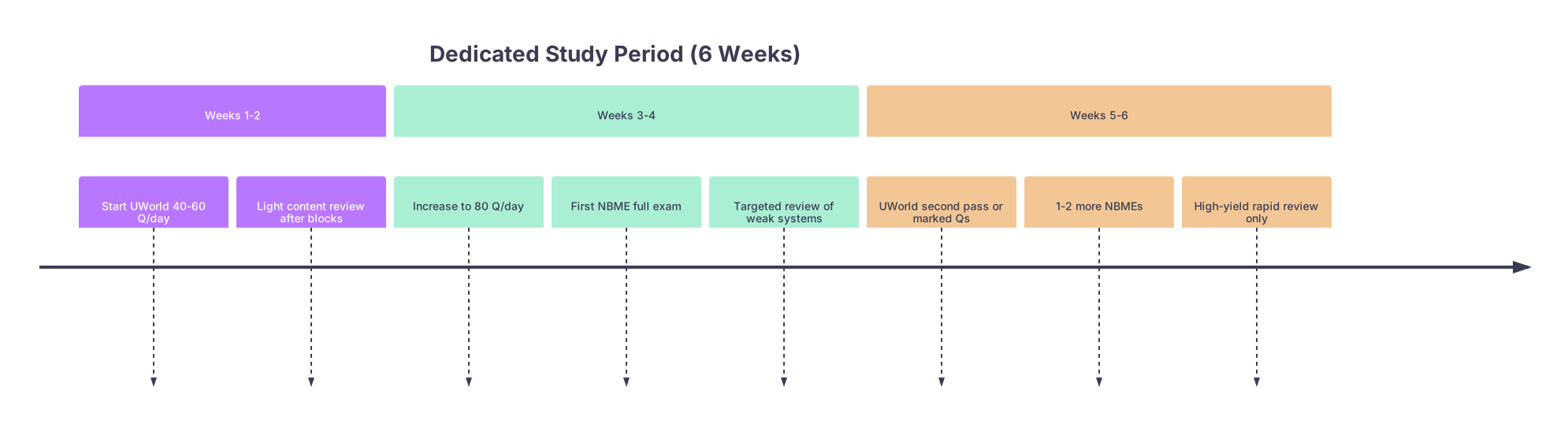
You do not need three new books at week 4. You need honest NBME feedback and tighter focus.
Step 10: A Quick Comparison: “Resource Hoarding” vs “Triage Plan”
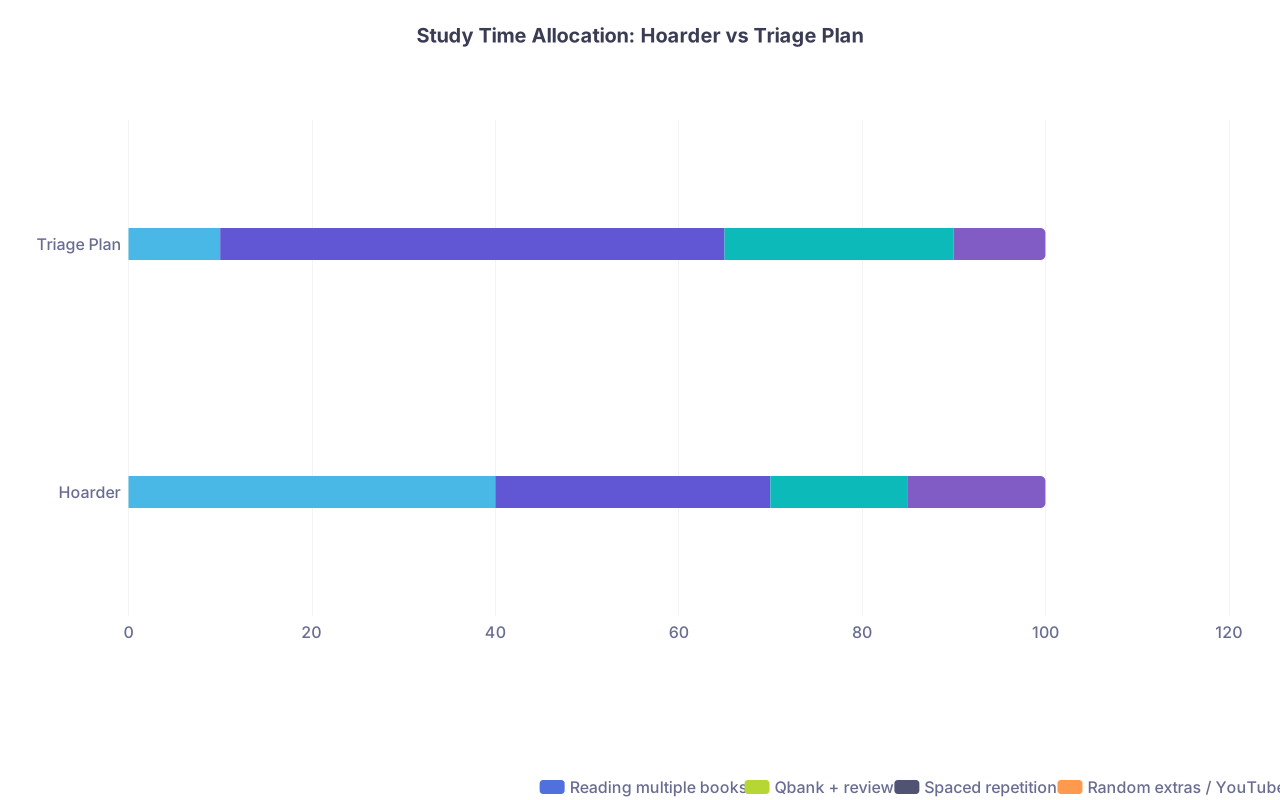
| Category | Reading multiple books | Qbank + review | Spaced repetition | Random extras / YouTube |
|---|---|---|---|---|
| Hoarder | 40 | 30 | 15 | 15 |
| Triage Plan | 10 | 55 | 25 | 10 |
The “Hoarder” feels busy but spends most time passively reading.
The “Triage Plan” forces active work where scores are actually made: questions and recall.
Step 11: How To Handle FOMO From Friends’ Resources
Someone in your class will always be using:
- A new Qbank
- A new “high-yield” PDF
- A new video series
- Some magical secret Reddit resource
Your brain will whisper: “You’re falling behind if you don’t add this.”
Do this instead:
- Ask them:
- “Have your NBME scores actually gone up since using it? By how much?”
- If their answer is vague (“I just feel better”), ignore it.
- If there is a concrete benefit, still apply this rule:
- Only add a new resource if:
- You can clearly state what it will replace, not what it will add on top.
- It solves a specific, demonstrated problem (e.g., you keep missing cardio path, so you add 1 week of focused Pathoma cardio chapters).
- Only add a new resource if:
You are not collecting Pokémon cards. You are building a minimal, lethal toolkit.
Quick Rescue Plan If You Are Already Deep In Overwhelm
If your exam is in 6–8 weeks and your situation looks like:
- UWorld: 20% done
- AMBOSS: barely started
- 3 half-used review books
- Anki: 1000+ due daily
Do this today:
Pick:
- Primary Qbank: UWorld
- Primary content: Pathoma + First Aid (or your equivalents)
- Primary spaced repetition: your own cards + a trimmed Anki deck
Slash Anki due load
- Suspend whole low-yield sections and decks.
- Accept that you will not see every card.
Make a realistic UWorld completion plan
- Daily target: total remaining questions / realistic days available.
Schedule NBMEs
- Every 1–2 weeks.
- Use results to shift focus, not to panic.
Put all other books in a literal box
- Keep only:
- UWorld
- Main content source
- Anki
- Keep only:
You will feel a drop in anxiety within 48 hours when your brain sees a smaller battlefield.
FAQ (Exactly 2 Questions)
Q1: I feel guilty ignoring expensive books I bought. Should I still box them away?
Yes. You are not running a museum. You are passing an exam. The only metric that matters now is: “Does this resource directly help my score in the next 4–8 weeks?” Money already spent is a sunk cost. If a book is not part of your tight daily workflow, it is a distraction. Box it, label it “post-exam,” and revisit later if you really want to.
Q2: Is it ever smart to fully use two Qbanks before the exam?
Sometimes, but not as often as people think. If you start early, finish UWorld with careful review, and still have 4–8 weeks plus solid NBME scores, a targeted run through AMBOSS or another bank can help with exposure. The mistake is trying to rush through two full Qbanks without deep review of either. If you have not carefully reviewed every missed and guessed UWorld question, you do not “earn the right” to start a second bank yet.
Open your study space right now. Pull every board prep book and resource into one pile. Then choose your Tier 1 tools and physically remove the rest from your desk. Your triage plan starts the second you clear that surface.