If you are burning out on long review books, the problem is not you. The problem is the resource–workflow mismatch.
Let me be blunt: trying to brute-force 700‑page review tomes on top of full‑time rotations is a losing strategy for most medical students. I have watched excellent students sink their scores and their mental health because they clung to the idea that “real studying” means reading everything.
You need a short‑form resource strategy. Not as a compromise. As the main plan.
Here is how to build it, step by step, without tanking your scores.
1. Why Long Review Books Are Burning You Out
You are not lazy. You are trying to do an impossible volume of low‑yield work.
Long review books (think 600+ pages of dense text) fail most students for three reasons:
They do not match how the exams test you.
Exams test:- Pattern recognition
- Application in vignettes
- Rapid recall of key facts
Long books train: - Slow reading
- Passive recognition
- False sense of mastery (“yeah this looks familiar”)
They chew time you do not have.
Example I have seen multiple times:- Goal: Read all of “Big Internal Medicine Review Book X” in 6 weeks
- Actual: After 3 weeks, they are on page 120, already behind on UWorld, stressed, and starting to hate medicine
They create a psychological death spiral.
- You fall behind on reading →
- You feel guilty →
- You avoid the book because it reminds you of failure →
- You do less active learning (Qbank, Anki) →
- Scores stagnate or drop → more guilt
If you see yourself in that pattern, stop trying to “push through.” The method is broken, not your discipline.
2. The Short-Form Resource Toolbox (What Actually Works)
Short‑form does not mean “less rigorous.” It means compressed, test‑aligned, and repeatable.
Here are the core categories you should be using.
| Tool Type | Primary Use | Best For |
|---|---|---|
| Qbanks | Application, gaps | NBME/COMLEX style |
| Flashcards (Anki) | Rapid recall, spaced | Facts, details |
| Rapid review PDFs | Structure, big pic | Last 2–4 weeks |
| Video shorts | Conceptual clarity | Hard topics |
| One-page sheets | Last-minute review | Algorithms, lists |
2.1 Qbanks: Your Main Engine
If you are not building your study plan around high‑quality questions, you are doing this backwards.
You want:
- UWorld (Step/Level 1 & 2, shelf prep)
- Amboss (also excellent, good for explanations and quick hits)
- NBME-style practice exams where available
How to think about Qbanks:
- 50–80% of your study time should be questions + review
- Long book reading is optional. Question review is not.
2.2 Flashcards: Your Retention Backbone
Anki (or similar) is how you keep what you learn from vanishing after three days.
Use:
- Pre‑made decks aligned with your exam phase (e.g., AnKing, Lightyear, Brosencephalon for Step 1–style content; clinical decks for Step 2/shelves)
- A small, curated personal deck for:
- The “weird” things you keep missing in Qbanks
- Institutional quirks (local protocols, attendings’ favorite pimp questions)
Daily non‑negotiable:
- Do your reviews. Even if you do nothing else that day, keep the spaced repetition engine running.
2.3 Rapid Review PDFs / Short Notes
These are compact notes or PDF summaries (20–100 pages) focused on:
- Algorithms
- Classic presentations
- High-yield tables
Use them:
- At the start of a block to orient yourself
- In the last 1–2 weeks to polish and compress
They should not replace questions and flashcards. They reinforce them.
2.4 Short Videos and Concept Clips
Not 1‑hour lectures. Short targeted bursts:
- Pathoma‑style concept explanations
- Boards & Beyond single videos for weak areas
- Sketchy/other memory aids for micro/pharm
You are allowed to watch longer videos if they are efficient, but be clear:
Video is supplemental, not your main strategy for high‑stakes exams.
3. Build a Short-Form Study System (Not Just Resources)
Switching to short‑form tools without a system is just a different flavor of chaos.
You need a daily structure that:
- Minimizes startup friction
- Guarantees repetition
- Keeps you in contact with questions almost every day
Here is a practical blueprint.
3.1 The 3-Block Study Day
Think in blocks, not hours. That is how you actually execute when you are tired from rotations.
Block 1 – Spaced Repetition (30–60 min)
- Anki reviews only
- No new cards until reviews are done
- Phone in another room, browser closed
Block 2 – Primary Qbank (1–2 hours)
- 20–40 questions in timed, random (or block-specific early on) mode
- Thorough review of each question:
- Why is the right answer right?
- Why are the wrong answers wrong?
- What concept is this really testing?
Block 3 – Targeted Patch Work (30–90 min)
Based on what you missed in Block 2:
- Short video on a weak topic
- Read 2–4 pages in a short-note PDF
- Create 3–5 personal Anki cards for recurring errors
If you are on a brutal call month, you might only get Block 1 and a half‑block of Qbank. That is fine. The structure holds.

| Step | Description |
|---|---|
| Step 1 | Start Day |
| Step 2 | Block 1: Anki Reviews |
| Step 3 | Block 2: Qbank Set 20-40 Qs |
| Step 4 | Block 3: Short Video / Notes |
| Step 5 | Create 3-5 New Cards |
| Step 6 | End Study Day |
| Step 7 | Identify Weak Areas |
3.2 Weekly Rhythm: Short-Form Planning
Once a week, 15–20 minutes. No more.
Look at:
- Qbank performance by system/topic
- Which tags/subjects are red or weak
Choose:
- 2–3 priority topics for the week (e.g., renal phys, OB hemorrhage, cardiac murmurs)
Plan:
- For each priority: 1–2 short videos + a few pages of a rapid review PDF
- 1 mini self‑test day (e.g., 40–80 question mixed block simulating exam conditions)
You are no longer chasing “finish the book.” You are chasing “close gaps in measured weaknesses.”
4. Replace Long-Form with Smart Short-Form (By Exam Phase)
Long review books are not always useless. They are often just misused. Let me show you exactly what to swap in at each phase.
4.1 Pre‑Clinical (Systems Blocks, Before Step 1)
You do not need to pre‑read 50 pages before each lecture. Waste of time.
Use this instead:
During each system block (e.g., cardio):
- 60–90 minutes Qbank per day aligned to that system
- Daily Anki (class deck + Step-aligned deck)
- Short concept videos for lectures that make no sense or are poorly taught
Long review book use:
- 5–10 pages per day max, only if it genuinely clarifies weak topics
- No guilt if you drop it altogether and your Qbank/Anki performance is solid
For Step 1‑type prep:
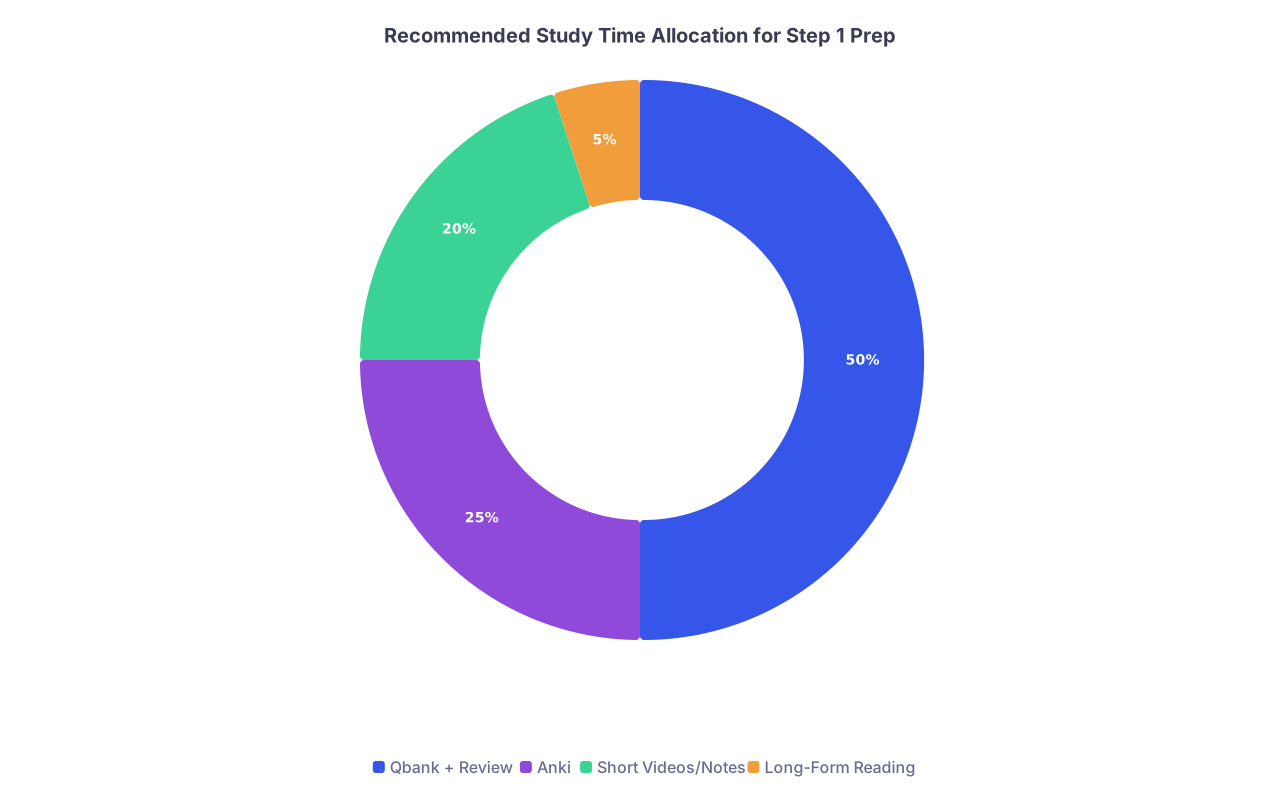
| Category | Value |
|---|---|
| Qbank + Review | 50 |
| Anki | 25 |
| Short Videos/Notes | 20 |
| Long-Form Reading | 5 |
If your reading time is >15–20%, you are likely over‑reading and under‑practicing.
4.2 Clinical Rotations + Shelf Exams
This is where long books destroy people. I have seen students try to read 30 pages a night on Internal Medicine while on wards. They last three days.
A workable rotation strategy:
Daily (post‑call adjusted):
- 30–45 minutes Anki focused on:
- Rotation‑specific deck
- Personal cards from shelf Qbank questions
- 20–40 Qbank questions (UWorld/Amboss) focused on:
- Rotation topic (e.g., IM for IM, Surgery Qbank for surgery)
2–3 times per week:
- 20–30 minutes of short notes or rapid review PDF for that rotation:
- E.g., read about “chest pain workup,” “GI bleed,” “pneumonia management,” not 50 pages of random conditions
Last 7–10 days before the shelf:
- Shift slightly:
- More mixed Qbank sets
- More rapid review PDF / high-yield sheets
- Less new video content
Concrete example:
- Internal Medicine shelf:
- Main Qbank: UWorld IM section 100–150 questions/week
- Supplement: Amboss IM blocks, focusing on questions with NBME vibes
- Short notes: 20–40 pages of rapid IM summary twice each week
4.3 Dedicated Step 1 / Step 2 CK Prep
This is when people feel tempted to “finally read everything.” Huge mistake.
You want a question‑anchored schedule.
Standard full‑time dedicated (8–10 weeks) for Step 2 CK, adapted for short‑form:
Daily:
- 60–80 Qbank questions (UWorld)
- Full review of all questions
- 2–3 short targeted videos or PDF sections for weak spots
- 45–60 minutes Anki
Twice weekly:
- 1 mixed, timed block that feels like the real exam (40 Qs + short break)
Every 1–2 weeks:
- NBME or practice exam
- Turn missed concepts into a small set of high‑yield flashcards or notes
Where long review books fit:
- They usually do not. If you use them, it should be:
- Targeted: look up 1–2 topics when UWorld + Amboss + short videos are not enough
- Brief: 5–10 minute reading bursts only
5. Converting Long-Form into Short-Form (Without Starting Over)
Let us say you already own a huge book (or two) and feel guilty not using them. Fine. You can cannibalize them instead of reading them.
Here is how.
5.1 Use Books as Reference, Not Curriculum
Rule:
- You are not allowed to read more than 2–3 pages in a row.
- You open the book for a specific question that came up in:
- A Qbank explanation
- Clinic/rounds
- A missed NBME topic
Workflow:
Do questions.
For topics you still do not understand after Qbank + a short video:
- Open the book to that specific section
- Read only until you can explain the concept to yourself
- Close the book
Convert what you learned into:
- 2–5 flashcards
- A 3–5 line note in your rapid review doc
5.2 Strip Books for High-Yield Tables and Algorithms
Many long books have gold buried in them:
- Diagnostic algorithms
- Management flowcharts
- Summary tables of drug side effects, murmurs, rashes
What you do:
- Flip through with a pen and sticky tabs one afternoon
- Mark only:
- Algorithms
- Tables
- “Classic presentation” boxes
Then:
- Photograph or scan those pages
- Turn them into:
- One‑page PDFs
- Short cards
- “Look at this on the bus” images on your phone
You have now extracted the 10% that matters and ditched the fluff.
6. Managing Burnout While Staying High-Yield
Burnout is not just emotional; it is structural. If your study system is unsustainable, your brain will revolt. Short-form strategy is partly about energy conservation.
Here is how to make this survivable.
6.1 Set Hard Limits, Not Vague Goals
Do this instead of “I will study as much as I can”:
- Daily Qbank cap:
- Example: 40 questions on heavy rotation days, 80 on lighter days
- Max screen time for videos:
- Example: no more than 60 minutes of videos/day
- Max total study time on post‑call days:
- Example: 60–90 minutes focused, then stop
Less guilt. More consistency.
6.2 Use Micro-Units of Study
You do not need 3‑hour blocks. You need repeatable micro‑units:
- 10 minutes: Do 5 Anki cards + review 1 simple concept
- 20 minutes: 5 Qbank questions + quick review
- 30 minutes: 10–15 Qbank questions
Build your day around stacking micro‑units:
- On the bus → 10 min of Anki
- Waiting for sign‑out → 5 flashcards
- Between cases → 3–5 Qbank Qs on your phone
Consistency beats heroics.
6.3 Non-Study Rules That Protect Performance
Harsh truth: if you try to study 14 hours a day for weeks, your recall will drop even if your hours look impressive.
Minimum non‑negotiables:
- Sleep: 6–7 hours most nights; if you dip below 5 two nights in a row, the next day is a light study day.
- Movement: 10–20 minute walk or brief workout at least 4 days/week. No debate.
- Off-switch: at least 30–60 minutes daily of non‑med activity (friends, shows, hobbies, anything that is not “optimize my life” content).
Short‑form study only works if your brain is not fried. You are not a productivity robot; you are an oxygen‑dependent mammal.
7. Sample Short-Form Study Plans You Can Copy
Let me give you concrete examples. Steal them. Modify later.
7.1 Light Rotation (e.g., Psych, Outpatient FM)
Goal: Step 2 CK prep + shelf
- 45 min: Anki reviews (rotation + Step deck)
- 90 min: UWorld CK, 40 Qs timed, mixed IM/FM/psych
- 30–45 min: Review weak topics via short videos/notes
- 15 min: Create 3–5 personal Anki cards
Total: ~3 hours. Split into morning + evening if needed.
7.2 Heavy Rotation (e.g., Surgery, IM Wards, ICU)
Goal: Survive + not fall behind
- 25–35 min: Anki (non‑negotiable)
- 45–60 min: 20–30 Qbank questions (rotation‑specific) with quick review
- 15 min: One short video or algorithm reading from rapid review PDF
Total: 90 minutes on a typical day. On true post‑call: only Anki + 10 easy questions.
7.3 Dedicated 8-Week Step 2 CK Example
Mon–Sat:
- 60 min: Anki
- 3 × 40‑question blocks UWorld (120 total) with review
- 45–60 min: Short videos / Amboss articles on top 2–3 weak areas
Sunday:
- Morning: NBME / practice test or 2 long mixed blocks
- Afternoon: Light review + rest
You can drop to 2 blocks/day (80 Qs) if your review is very thorough and you are scoring solidly.
8. How to Know If Your Short-Form Strategy Is Working
You do not need to guess. Track.
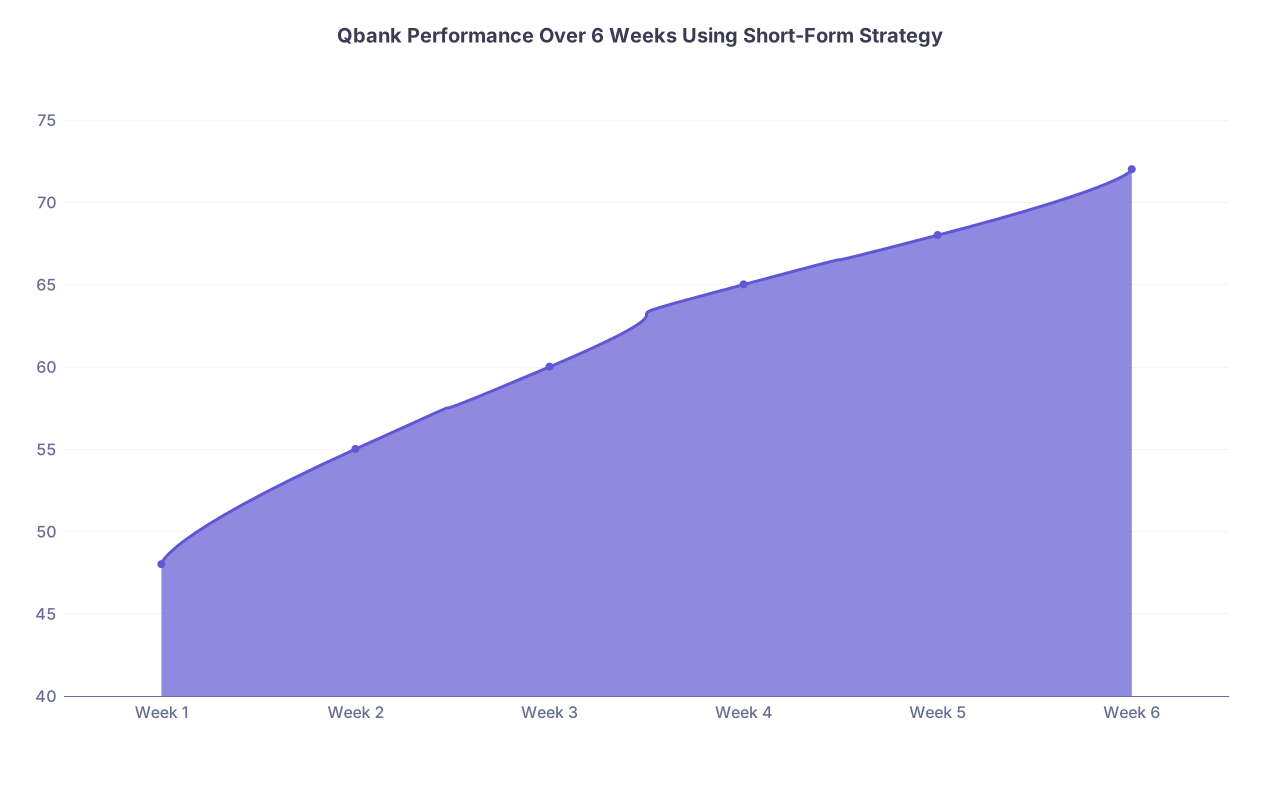
| Category | Value |
|---|---|
| Week 1 | 48 |
| Week 2 | 55 |
| Week 3 | 60 |
| Week 4 | 65 |
| Week 5 | 68 |
| Week 6 | 72 |
You are on track if:
- Qbank percentages trend upward over 3–4 weeks (even slowly)
- You feel less dread sitting down to study
- You can list your top 3 weak topics at any time without thinking
- Practice exams stabilize or rise, not swing wildly
Red flags that you are still doing it wrong:
- You are “reviewing content” for hours but doing <20 questions/day
- You keep restarting books or videos from the beginning
- You feel perpetually behind on reading and rarely finish Qbank blocks
If that is you, cut your long‑form resources by 80–90% for 3 weeks and watch what happens to your performance.
9. Stop Worshipping Long Books
Let me end the myth clearly.
Long review books are not inherently superior or “more serious.” They are tools. Often blunt ones. Exams reward:
- Retrieval
- Pattern recognition
- Applied reasoning
Short‑form resources—Qbanks, flashcards, targeted notes—map directly onto those skills.
You do not get extra points because you “worked harder” by reading 500 pages. The score report does not care how much guilt and misery you sprinkled on top of your studying.
If you are burned out by long review books, that is your brain sending a performance warning, not a character indictment.
Key points to walk away with:
- Long review books are optional. A question‑centered, flashcard‑supported, short‑note strategy is not just “good enough”; it is usually better.
- Build a simple, repeatable daily structure: Anki → Qbank → targeted patching. On busy days, shrink it; do not abandon it.
- Use long books as surgical reference tools and table/algorithm donors, not as cover‑to‑cover projects. Your time and energy are too expensive to waste.