
If your shelf scores are stuck, the problem is not that you are “bad at exams.” The problem is that you are using your question banks wrong.
I have watched plenty of smart students grind thousands of questions and barely move their percentile. Same pattern every time: random blocks, lazy review, and zero strategy for how different Qbanks fit together. Then they panic, buy a third Qbank, and get even more lost.
You can fix this. But you have to stop thinking “more questions” and start thinking “smarter structure.”
This is a stepwise upgrade of how you use question banks when your NBME shelf scores have plateaued. Not vibes. Not motivational quotes. A concrete protocol.
Step 1: Diagnose Why You Actually Plateaued
Before you throw money at new resources, you need a working diagnosis. Treat this like a patient.
1. Run a 3-point reality check
Pull up your last 2–3 shelves (or practice NBMEs) and answer three questions:
Are your scores:
- Consistently in the same range (e.g., 65–70 raw NBME, same percentile)?
- Slightly dropping as rotations get busier?
- Completely random (swinging wildly by 10+ points)?
Where are you missing?
- Content gaps? You read an explanation and realize, “I never knew that.”
- Application errors? You knew the fact but mis-applied or fell for a distractor.
- Time or fatigue? Rushing at the end, careless mistakes on things you truly know.
Which systems or question types are bleeding points?
- Systemic (e.g., endocrine always low).
- Competency-based (e.g., ethics, biostats, management questions).
- Question style (long vignettes, multi-step calculations, vague outpatient questions).
If you cannot answer these clearly, you are not plateaued. You are flying blind.
2. Use data from your Qbanks, not feelings
Most students say “I’m bad at neuro” without checking their neuro performance.
Go into your Qbank stats and look at:
- Performance by:
- System (e.g., cardio, GI, neuro).
- Topic (e.g., acid-base, arrhythmias, anemia).
- Question type (if available: ethics, stats, communication).
Identify:
- 2–3 weakest systems.
- 1–2 weakest cross-cutting skills (e.g., interpreting EKGs, ABGs, imaging, statistics).
Those are not annoyances. Those are score leaks.
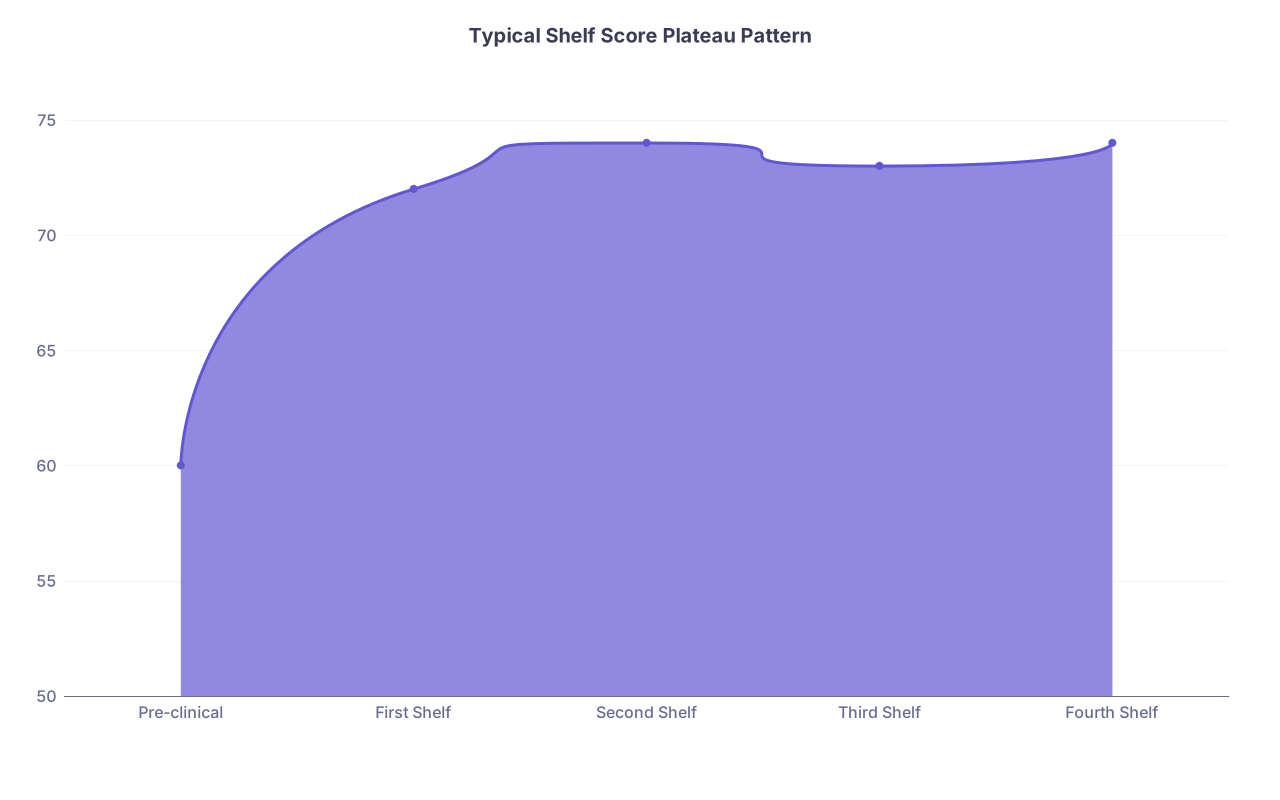
| Category | Value |
|---|---|
| Pre-clinical | 60 |
| First Shelf | 72 |
| Second Shelf | 74 |
| Third Shelf | 73 |
| Fourth Shelf | 74 |
What this usually shows: a quick jump when you start Qbanks, then a flat line. That flat line is your signal: technique and structure, not raw effort, are now limiting you.
Step 2: Assign Each Question Bank a Specific Job
Stop treating all question banks as the same. They are tools. Different tools, different jobs.
Here is the basic division of labor I push most students toward:
| Qbank / Source | Primary Role | Best For |
|---|---|---|
| UWorld (core) | Gold-standard clinical reasoning | First-pass learning + structured review |
| AMBOSS | Depth + explanations + quick reference | Targeted remediation, hard questions |
| NBME Forms | Exam blueprint + scoring reality | Calibration, timing, gaps near test |
| Shelf-specific Qbank (onlineMedEd, Rosh, etc.) | Volume + pattern exposure | Extra reps in weak areas |
| Local/hospital question sets | Idiosyncratic emphasis | Matching your institution’s style |
If you try to use everything for everything, you dilute your effort.
How to choose your “core” and “supporting” banks
Choose one core Qbank per shelf.
- For IM, Surgery, Peds, OB/GYN, Psych: this is almost always UWorld.
- For Family or Neurology shelves, you may need to augment earlier with AMBOSS or a niche bank, but you still want one anchor resource.
Limit yourself to one secondary bank at a time.
- If your plateau is from content gaps: secondary bank = AMBOSS.
- If your plateau is from test anxiety or pattern blindness: secondary bank = NBME forms and a focused high-yield bank.
- But do not run three full banks half-heartedly. That is how you learn nothing deeply.
Respect NBME as its own category.
- NBME forms are not a “Qbank.” They are a reality check.
- You use them strategically around week 3–4 and week 5–6 of a rotation, not as daily grind.
If you are already mid-rotation with UWorld 40% complete and AMBOSS 10% tapped randomly, you do not throw that out. You reassign roles starting now.
Step 3: Upgrade How You Do Question Blocks (Immediately)
If your blocks look like:
- 10 random questions while half-distracted.
- Skim explanations.
- Tell yourself “I’ll remember that.”
- Repeat…
…then your plateau is deserved. You are not actually training; you are just sampling.
Here is the upgrade protocol for daily question work.
1. Daily block structure
On weekdays:
- 1 timed block of 20 questions (mixed, shelf-specific) from your core Qbank.
- 1–2 shorter focus blocks of 10–15 questions on a weak system or topic.
On lighter days:
- 1 timed block of 40 questions from core Qbank.
- 1 targeted block of 10–15 from your secondary bank on a specific weakness.
Total daily:
- 30–55 high-quality questions with full review.
- Not 80 rushed, half-reviewed questions.
2. Make each block mimic the exam
For your core timed block:
- Mode: Timed, mixed, tutor off.
- No phone, no notes, no pausing every 3 questions.
- Sit like you would on exam day.
You are training your brain to:
- Endure 60–80 vignettes.
- Read once and commit.
- Guess and move, not obsess over a single killer question.
If your timing is awful, you can start with:
- Timed, but allow yourself to stop every 10 questions to briefly regroup. But keep the time constraint real.
3. Change how you review questions (where most students waste time)
The review protocol needs to be brutal and focused.
For every missed question (and honestly, most guessed-right questions too):
Label the error type in 5 seconds:
- Knowledge gap.
- Misread question.
- Poor test-taking (ignored key phrase, changed correct answer to wrong).
- Reasoning gap (knew facts but could not connect them).
Extract the “exam-learning unit,” not the whole textbook.
- One question → 1–3 key points you should be able to recall on a new vignette.
- Example (IM, chest pain question):
- Unstable angina vs NSTEMI: troponins normal vs elevated.
- First step in suspected ACS: aspirin + EKG within 10 minutes.
- Do not send home atypical chest pain in high-risk patient.
Write it where you will see it again.
- Dedicated notebook.
- Digital doc.
- Flashcard (Anki or similar) only if you will actually review them.
- The point: no “mental notes.” You will forget.
Spend extra time on patterns, not zebras.
- If you miss 3 nearly identical questions on DKA vs HHS, that deserves a 20–30 minute focused mini-review with 5–10 more practice questions.
- The one random question on a rare vasculitis? Learn a simple rule, move on. Do not build your study plan around board-exam trivia.
Under no circumstances should your review just be:
- Read the explanation once.
- Shrug.
- “Got it now.”
That is how you end up missing the same concept in slightly different wording on test day.
Step 4: Use Multiple Qbanks in a Stepwise, Not Chaotic, Way
You do not use every Qbank at full power from day 1. That is inefficient. Here is how to phase them.
1. Weeks 1–2 of a rotation: Core Qbank dominance
Your goals:
- Learn the blueprint of common presentations.
- Build basic reasoning patterns.
Your structure:
- 80–90% of questions from your core Qbank (usually UWorld).
- Blocks mostly by system early in week 1, then quickly move to mixed by week 2.
Secondary bank:
- Use ONLY for targeted reading or 5–10 extra questions on a topic you completely bombed.
Example:
- You miss 4/5 nephrotic vs nephritic questions.
- You then do 5–10 AMBOSS questions on glomerular disease and read the article.
2. Weeks 3–4: Introduce structured support from a second Qbank
By week 3:
- You should be 50–70% through your core Qbank for that shelf.
- You now know your weaknesses with some precision.
Now:
- 60–70% of questions from core Qbank.
- 30–40% from secondary bank, but only in weak systems or competencies.
Use AMBOSS (or similar) for:
- Hard questions that stretch your reasoning.
- Detailed explanations with quick content review.
- Short, focused article reads when you notice a recurring miss.
Use a shelf-focused bank (Rosh, PreTest, etc.) for:
- Extra volume in high-yield areas you keep missing.
- Rapid-fire pattern exposure (especially in Psych, Peds, OB/GYN where “classic” presentations repeat).
3. Weeks 5–6 (and beyond if a long rotation): NBME + fine-tuning
Here, quantity stops being your main lever. Precision matters more.
Protocols:
- Take an NBME practice exam 10–14 days before the shelf.
- Analyze it ruthlessly:
- What systems underperformed compared to your Qbank stats?
- Which question styles hurt you? (management decisions, ethics, long multi-step problems).
Then:
- 40–50% of questions from core Qbank (clean-up pass, focusing on incorrects or weaker systems).
- 50–60% from secondary sources, strictly targeted:
- If ethics/biostats tanked: hammer those specific sections in AMBOSS or a stat/ethics-focused resource.
- If OB emergencies crushed you: built a 3–4 day “OB emergencies bootcamp” of only shoulder dystocia, eclampsia, hemorrhage, fetal distress questions.
Last 5–7 days:
- 1 more NBME form if available.
- 20–40 mixed questions daily, but more emphasis on reviewing prior errors and “must know” patterns than discovering new rare facts.
You are sculpting now, not pouring more concrete.
Step 5: Build a Simple Error-Tracking System That Actually Affects Your Plan
Most students either track nothing, or track everything in a way they never use. Both are useless.
You want a lean system that forces you to change behavior.
The 3-column error log
You can do this on paper or a spreadsheet. Columns:
Question/Topic
- Short label: “DKA management,” “NSTEMI vs unstable angina,” “preeclampsia severe features.”
Error Type
- Knowledge gap.
- Misread.
- Reasoning flaw.
- Decision-making (e.g., you know the diagnosis but chose wrong next step).
Action Taken
- “Read AMBOSS DKA article; made 3 flashcards.”
- “Practiced 10 more questions on ACS from AMBOSS.”
- “Wrote rule: for severe preeclampsia ≥34 weeks → deliver.”
Then once or twice a week, look at your log and ask:
- What is repeating?
- Where am I not following through on actions?
That drives which Qbank sections to hit next.
Step 6: Fix Timing, Fatigue, and Test-Taking – Not Just Content
A shelf plateau is often less about knowledge and more about logistics under pressure.
1. Train your timing explicitly
If you consistently run out of time:
- Start with:
- 20 questions in 30 minutes (1.5 minutes per question).
- Gradually tighten to 20 questions in 25 minutes.
- Practice:
- Quickly eliminating 2 options and choosing between 2, instead of hunting for “perfect certainty.”
If you finish too early with lots of errors:
- Force yourself to:
- Pause 3 seconds before every answer choice click.
- Re-read the last line of the question stem and ask: “What exact question am I answering?”
2. Recognize and fix your “panic patterns”
Common ones I see:
- Switching answers from right to wrong at a high rate.
- Overvaluing rare diagnoses early in the block.
- Getting emotionally stuck on a single confusing question.
Countermeasures:
Limiting answer changes: allow changes only if:
- You misread the question initially.
- You recall a specific rule you forgot before.
Writing a simple triage rule on your scratch paper for exam day:
- If still completely unsure after 60–75 seconds → pick best guess, flag, move on.
- You will get more benefit from finishing the block than from wrestling with 1 monster vignette.
Step 7: Match Your Qbank Use to the Specific Shelf
Not all shelves respond to the same Qbank strategy.
Internal Medicine
- Core: UWorld medicine questions as non-negotiable.
- Secondary: AMBOSS for depth (renal, heme/onc, infectious disease) and guidelines.
- Special focus:
- Long-vignette endurance.
- Multisystem integration (CHF + CKD + diabetes patient).
Surgery
- Core: UWorld surgery and IM cards/pulm/GI sections (surgery shelf is >50% medicine).
- Secondary: Shelf-specific surgery banks for trauma, postop complications, and acute abdomen patterns.
- Special focus:
- “Next best step” for unstable vs stable patients.
- Pre- and post-op management questions.
Pediatrics
- Core: UWorld peds.
- Secondary: AMBOSS or Rosh for high-yield pediatric-specific presentations.
- Special focus:
- Growth and development milestones.
- Vaccine schedules, congenital heart disease, pediatric rashes.
OB/GYN
- Core: UWorld OB/GYN.
- Secondary: AMBOSS or specialty qbank for labor curves, fetal heart tracings, pregnancy complications.
- Special focus:
- Algorithmic thinking (when to induce, when to C-section, when to observe).
- Prenatal screening and management sequencing.
Psychiatry
- Core: UWorld psych.
- Secondary: Shelf-specific banks to expose you to repetitive patterns of major disorders.
- Special focus:
- Drug side effects and “best next step” in management.
- Differentiating similar diagnoses by time course and severity.
Family Medicine, Neuro, and others will often require a broader sweep of IM + specialty questions. Again: decide which Qbank is core, then plug gaps with a second.
Step 8: Weekly “Audit and Adjust” – The Piece Almost Nobody Does
Your plan on day 1 of a rotation is always wrong by week 3. That is normal. What is not normal is refusing to adjust.
Once per week, do a 15–20 minute audit:
Numbers:
- How many questions did you actually do?
- What % were from core vs secondary qbank?
- How many full timed blocks did you complete?
Performance:
- Are your block scores trending up, down, or flat?
- Which systems are no longer weak?
- Which new weaknesses emerged?
Adjustments:
- Drop any resource you are not really using. Yes, even if you paid for it.
- Reassign time:
- If NBME practice shows OB is your worst section in IM → dedicate 2–3 days to OB/OB-related questions next week.
- Schedule NBME practice tests, not “when I feel ready,” but on calendar.
This is how grown-ups study. You run a feedback loop, not a hope loop.
Example: Putting It All Together for a 6-Week IM Rotation
Just to make this concrete, here is what a realistic structure might look like.
Weeks 1–2
- Goal: Build core pattern recognition.
- Qbanks:
- UWorld IM as core.
- AMBOSS only for supplemental explanations.
Daily:
- 20 timed mixed UWorld questions.
- 10–15 UWorld questions targeting one system (e.g., cardiology).
Weeks 3–4
- Goal: Identify and patch weak areas.
- Add AMBOSS as a structured secondary.
Daily:
- 20 timed mixed UWorld questions.
- 10–15 AMBOSS questions in one weak system (e.g., nephrology) or topic (e.g., acid-base).
- Error log review 2x/week.
NBME:
- Take one practice NBME end of week 3 or early week 4.

| Step | Description |
|---|---|
| Step 1 | Week 1-2: Core Qbank Focus |
| Step 2 | Week 3: Add Secondary Qbank |
| Step 3 | Week 4: First NBME + Targeted Remediation |
| Step 4 | Week 5: Mixed Qs + Weak Areas Bootcamp |
| Step 5 | Week 6: Second NBME + Light Polishing |
Weeks 5–6
- Goal: Refine, not expand.
Daily:
- 20–30 mixed questions (UWorld + AMBOSS).
- 10–15 targeted questions only in the areas NBME flagged as weak.
- Spend serious time reviewing past missed questions and your error log.
NBME:
- Second practice exam 5–7 days before the real shelf.
- Final week = minimal new content, maximum consolidation.
When You Actually Need a New Qbank (and When You Do Not)
There are times a new Qbank is the right move:
You should consider adding or switching if:
- You have completed 80–100% of your core Qbank for that shelf, reviewed it reasonably well, and are still stuck.
- Your Qbank style is very different from NBME style and your practice NBMEs are lagging behind.
- Your current bank has poor coverage in a specific area (e.g., OB emergencies, outpatient pediatrics).
You should not reflexively add a new Qbank if:
- You have done only 30–40% of your core Qbank.
- Your NBMEs show huge gaps in basics (e.g., misdiagnosing common diseases).
- You are not deeply reviewing the questions you already do.
In other words: if your current ship is leaking because you are drilling holes in it, switching to a new ship will not save you.
Two Tracking Tools That Turbocharge Everything
If you want two high-yield, low-friction habits that massively amplify your Qbank work, here they are:
The “Top 100” list.
- As you study, maintain a running list of the 100 highest-yield concepts you tend to miss.
- Quick phrases like:
- “Nephrotic vs nephritic: key differences.”
- “ACS: initial management pathway.”
- “Preeclampsia severe features – memorize criteria.”
- Review this list briefly every 2–3 days.
- This acts as your personal high-yield guide, not a generic one.
A visual progress chart.
- Track:
- Percent of core Qbank completed.
- Avg block % correct over time.
- Even a simple habit of plotting your last 10 block averages gives immediate feedback.
- Track:
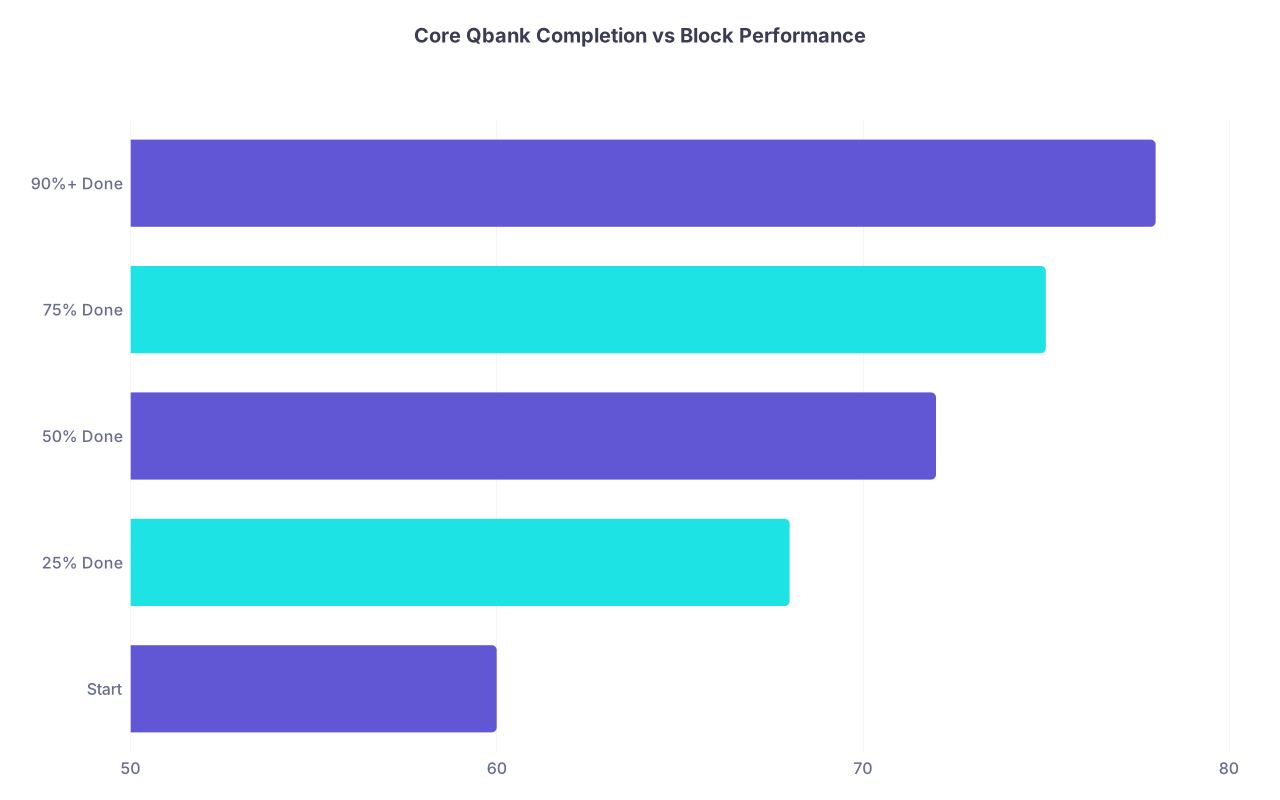
| Category | Value |
|---|---|
| Start | 60 |
| 25% Done | 68 |
| 50% Done | 72 |
| 75% Done | 75 |
| 90%+ Done | 78 |
You want to see that line bending up as completion rises. If it flattens or drops, that is your early alarm to adjust method, not just grind more.
The Short Version: How to Actually Break the Plateau
If you skimmed everything above, here is the distilled version:
Assign roles to your question banks.
- One core bank for each shelf.
- One secondary for targeted depth, not chaos.
- NBME forms for calibration, not daily drilling.
Upgrade your daily blocks and review.
- Timed, mixed core blocks.
- Ruthless error classification and targeted follow-up.
- Fewer questions, higher-quality review beats blind volume.
Run a weekly feedback loop.
- Check Qbank stats and NBME results.
- Adjust which topics and banks you emphasize.
- Drop dead weight; double down on what works.
Your shelves will not jump just because you suffer more. They jump when your effort finally lines up with the exam’s structure and your actual weaknesses.
Do that with intention, and the plateau starts to crack.