
You do not need to restart UWorld to fix a bad first pass. You need to stop wasting questions and start squeezing value out of the ones you already burned.
I have watched too many students panic at 40–50% of the bank done, realize their “strategy” was random clicking and skimming explanations, then nuke everything and “start over.” They burn time, crush their confidence, and end up in the exact same hole six weeks later.
You are not restarting. You are rebuilding. Here is how.
Step 1: Diagnose Exactly What Went Wrong
Do not jump to solutions until you know the real problem. “UWorld isn’t working” is not a diagnosis. It is an excuse.
You are going to do a quick, brutal audit of how you have been using UWorld. Takes 30–45 minutes. Saves you weeks.
1.1 Run a Hard Reality Check
Ask yourself, and be specific:
- How many questions have you done so far (and in how many days/weeks)?
- What is your overall percentage correct?
- Are you doing:
- Timed random blocks?
- Timed tutor?
- Untimed / reading explanations first / gaming the system somehow?
- How do you handle explanations:
- Skim only the correct answer?
- Read every explanation but never write anything down?
- Copy explanations verbatim into Anki or a notebook (aka mindless transcription)?
- Do you review:
- Just wrongs?
- Wrongs + marked?
- Neither, because “no time”?
If you cannot answer those clearly, that’s problem #1: you are flying blind.
1.2 Look at Your Data, Not Your Feelings
Open UWorld performance stats. You are looking for patterns, not drama.
- Overall percentage:
- < 50%: content gaps + test-taking issues
- 50–60%: common, fixable with structure
60%: your process is inefficient but salvageable
- Subject breakdown:
- Any subject < 50% = red flag
- System breakdown:
- You want most systems at least in the low 50s by the mid-point of the bank
- Question mode used:
- If most blocks are untimed: your timing and exam realism are behind
- If all are tutor and you never switched to timed: you are delaying pain
Write your findings down in 2–3 bullet points. Example:
- “Doing 40–60 random/timed per day, 55% correct, barely reviewing explanations”
- “All in tutor mode, 65% correct, but slow and no second pass”
- “Systems based, but keep avoiding biostats and neuro; both are 45–48%”
You are going to fix that, not some generic “UWorld strategy.”
Step 2: Stop the Bleeding – Change How You Use Every New Block
You are not deleting your history. You are changing your process starting today.
Here is your non-negotiable structure for all new questions going forward.
2.1 How to Do a UWorld Block the Right Way
Block size: 40 questions (standard exam block). If your focus is shattered at 40, start with 20 but build to 40 over 1–2 weeks.
Mode:
- If you are > 6–8 weeks from exam:
- Use timed, random for at least half of your blocks
- You can keep some tutor/system blocks to fix weaknesses
- If you are < 6 weeks from exam:
- Switch to timed, random for almost everything
While answering questions:
- Read the stem once. Do not scroll up and down five times.
- Force yourself to predict the diagnosis or tested concept before checking answer choices.
- Pick an answer within 60–75 seconds for easier questions, 90–100 seconds for longer stems.
- If you are stuck between two choices, write down (short) why you chose what you chose. It will matter in review.
If you are regularly running out of time, it is a timing problem, not a knowledge problem. You fix that by more timed blocks, not by going back to untimed tutor mode forever.
Step 3: Fix Your Review Process – This Is Where You Were Inefficient
Most wasted UWorld passes die in the review phase. People either:
- Do zero review
- Or spend 3 hours per block copying every line of the explanation into notes they will never read
You are going to do fast, targeted, high-yield review. That is the core of salvaging your pass.
3.1 A 40-Question Block Should Not Take All Day
Target:
- 40 questions in timed mode: 60 minutes
- Review: 60–90 minutes
- Total: 2–2.5 hours
If you are at 4–5 hours per block, you are doing it wrong.
3.2 How to Review a Question in Under 3 Minutes
For each question (right or wrong):
- Skim the stem again quickly – remind yourself what was actually being asked.
- Check your reasoning, not just right/wrong:
- Why did you pick what you picked?
- Were you right for the right reason, or by guessing?
- Read the explanation for:
- Correct answer: understand the core tested concept
- Your wrong answer (if you missed it): Why is it wrong? What should have clued you away from it?
- Extract one learning point (sometimes two). Literally answer:
- “Next time I see a similar question, what do I want my brain to remember first?”
If you see a long UWorld explanation, your job is not to memorize the paragraph. Your job is to extract the one sentence that makes future questions easier.
Step 4: Build a Salvage System – Without Resetting the Bank
Here is where we actually fix the “I already wasted half my UWorld” problem.
You are going to turn your existing history into a second, smarter, high-yield pass.
4.1 Use Your Old Questions Instead of Deleting Them
You have three main tools:
- Incorrect questions
- Marked questions
- Low-performing subjects/systems identified in stats
You are going to mine these instead of pretending they did not happen.
4.2 The Core Framework: New + Old Blend
Going forward your question strategy should look like this (adjustable by time until exam):
| Time to Exam | New Questions (Random Timed) | Old Questions (Incorrect/Marked) | Total per Day |
|---|---|---|---|
| 8–12 weeks | 40–60 | 20–40 | 60–80 |
| 4–8 weeks | 40 | 40–60 | 80–100 |
| < 4 weeks | 40 | 60–80 | 100–120 |
You are not restarting. You are rebalancing.
Step 5: Structured Plan to Salvage Your First Pass
Let us walk through an actual protocol you can implement tomorrow.
Assume:
- You are 50% through UWorld
- Sitting around 52–58% correct
- 6–8 weeks from your exam
Here is the repair plan.
5.1 Step A: Reorganize Your Day
You are going to run your day in blocks, not chaos.
Sample day structure:
- Block 1: 40 new questions (random, timed) – 1 hour
Review – 1–1.5 hours - Block 2: 20–40 old incorrects (timed or tutor) – 45–60 minutes
Review – 45–60 minutes - Content / resource tie-ins: 1–2 hours using First Aid, Anki, Boards and Beyond, etc., focused on what UWorld exposed
Total: ~4–6 hours of serious work. Not TikTok “studying.”
5.2 Step B: Systematically Attack Incorrects
Go to UWorld → Create test → “Incorrect” questions.
You have two phases:
- Mass exposure phase (get through them)
- Mastery phase (clean up what still recurs)
Mass Exposure Phase
Goal: See and actively re-try every incorrect question at least once.
- Set blocks of 20–40 incorrects
- Mode: Timed or tutor, your choice (timed is better as you get closer to the exam)
- Do not obsess if you remember the question. Still work it out.
For each repeated question:
- If you get it right and know exactly why, skim explanation only long enough to confirm your understanding.
- If you get it wrong again or felt unsure:
- This question gets tagged in some way:
- Mark it in UWorld
- Or star it in your notes
- Or create a short Anki card from it
- Extract 1–2 bullet learning points
- This question gets tagged in some way:
By the end of this phase, you should have:
- Seen all prior incorrects once more
- A smaller subset of “repeat offenders” that you still struggle with
5.3 Step C: Build a Micro-Note / Anki System That Does Not Suck
Do not type the UWorld explanation into Anki. This is lazy and ineffective.
You want micro-cards or micro-notes, such as:
- “Pseudotumor cerebri – venous sinus stenosis, worsens with vitamin A, tetracyclines, obesity; treat with acetazolamide + weight loss”
- “MCC of spontaneous lobar hemorrhage in adults = cerebral amyloid angiopathy (beta-amyloid in vessel walls); think elderly with Alzheimer features”
Your rule:
If a concept has already burned you twice (two questions wrong, same idea), it gets:
- 1–2 flashcards, or
- 3–5 line bullet in a running Google Doc / OneNote
Review these every day for 20–30 minutes.
Step 6: Fix Specific Common Mistakes That Ruin UWorld Passes
Most inefficient passes come from a few predictable errors. Let us kill them one by one.
6.1 Problem: “I Do Too Few Questions Per Day”
You are doing 20–30 per day, feel “busy”, but never build momentum. That is not a serious Step prep pace once you are in dedicated.
Fix:
- Minimum 60 questions/day once you enter serious prep (usually after classes ease)
- Aim for 80–100/day if:
- You are < 8 weeks from exam
- Or you started late
- Keep blocks manageable. Two 40-question blocks are better than one 80-question block that wrecks your focus
If you are in full-time classes, fine: 40/day consistently + more on weekends. But stop kidding yourself that 15 random tutor questions in bed is a “UWorld day.”
6.2 Problem: “I Read Every Single Explanation in Excruciating Detail”
Analysis paralysis. You feel productive. You are not.
Fix:
- Cap yourself at 2–3 minutes per question on review, average
- Use a timer for a few days if you have to
- For questions you 100% understand, even if you got them wrong due to a dumb slip:
- Read the relevant paragraph, repair the error, move on
- For truly confusing questions:
- Allow up to 5 minutes
- But the output must be 1–3 lines of your own summary in notes or an Anki card
You are not writing a textbook. You are training your brain to recognize patterns faster.
6.3 Problem: “I Ignore My Statistics / Weak Areas”
Students always “feel” like they are bad at everything or nothing. Both are usually wrong.
Look at your UWorld stats:
- Pick the 2 weakest subjects and 2 weakest systems
- For the next 10 days:
- Guarantee at least 20–40 questions/day that pull from those weak zones:
- Create custom blocks: e.g., Subjects → Pharmacology, Biostatistics; Systems → Neuro, Endocrine
- After questions, open your primary resource (First Aid, Pathoma, Sketchy, etc.) to that exact topic and spend 20–30 minutes tightening the concept
- Guarantee at least 20–40 questions/day that pull from those weak zones:
You repeat this in cycles. Every 1–2 weeks, reassess weak areas and rotate.
, Neuro, Cardio, Renal](https://cdn.residencyadvisor.com/images/articles_svg/chart-example-subject-weakness-profile-from-uworld-7566.svg "Example Subject Weakness Profile from UWorld")
| Category | Value |
|---|---|
| Pathology | 62 |
| Pharmacology | 54 |
| [Biostats](https://residencyadvisor.com/resources/exam-prep-resources/weak-in-biostats-and-ethics-targeted-resource-stack-that-works) | 42 |
| Neuro | 48 |
| Cardio | 60 |
| Renal | 58 |
Above, Biostats and Neuro are the obvious target for corrective cycles.
6.4 Problem: “I’m Good on Content but Keep Missing Stupid Questions”
You do a question, know the topic, still get it wrong. Repeatedly. That is not a knowledge problem. That is a test-taking problem.
Common errors:
- Not reading the last line carefully
- Ignoring age / risk factors / small details in the stem
- Changing answers last minute with no good reason
Fix protocol (for the next 100–200 questions):
- Before revealing the answer, write down in very short form:
- Your answer
- Why (1 short phrase)
- When wrong, classify the cause:
- Misread question
- Ignored key word/clue
- Overthought / changed answer
- Did not know content at all
- Track tally marks in a notebook for each category.
After a few days you will know if your main enemy is:
- “Did not know it” (content)
- Or “missed the clue” (reading)
- Or “second-guessing” (anxiety / overthinking)
Each of those has a different fix. Most people lump them together and then never fix any of them.
Step 7: How to Use Other Resources to Patch Your UWorld Gaps
You cannot fix an inefficient UWorld pass by just “doing more UWorld.” Sometimes you need a short, direct hit of content to plug a gap.
Here is the hierarchy I recommend.

7.1 Use Videos Strategically, Not As Background Noise
You miss 3 vasculitis questions in one day?
- Watch Pathoma vasculitis section at 1.25–1.5x
- Immediately afterward: do 10–15 UWorld or other Qbank questions on vasculitis if available (or re-do some of your incorrects)
You constantly miss Neuroanatomy?
- Watch 1–2 targeted neuro videos (Boards and Beyond, etc.)
- Draw 1–2 schematics by hand (tracts, lesions with deficits)
- Then hit neuro UWorld blocks
The sequence matters:
Question → Identify gap → Resource → More questions.
Not: “Watch 6 hours of random videos and call it a day.”
7.2 Use Anki Intelligently
Anki is powerful. It is also a black hole for your time if you add junk.
Rules:
- Only make cards for:
- Concepts that have already cost you points (UWorld incorrects)
- High-yield fact clusters you keep forgetting (e.g., medication side effect profiles)
- Keep cards minimal:
- Front: Short question or cloze
- Back: 1–3 lines
Sample cloze from UWorld:
Idiopathic intracranial hypertension is associated with vitamin A excess, {{c1::tetracycline use}}, and obesity; first-line treatment is {{c2::acetazolamide}}.
15–25 minutes of Anki/day reviewing only these targeted cards is enough during intense question phases.
Step 8: What If You Are Very Close to the Exam?
Different rules apply if you are inside 3–4 weeks. You do not have time for a perfect rebuild. You need a triage plan.
8.1 Inside 4 Weeks: Priority Shift
Primary goal:
Maximize performance on probable exam content, not complete the entire bank “nicely.”
Here is what I recommend if your exam is in ~3–4 weeks and your UWorld pass was sloppy:
- Focus on high-yield systems / subjects first
- Cardio, Pulm, Renal, GI, Neuro, Endo, Heme/Onc, Infectious, Pharm, Biostats
- Mix:
- 40 new random timed / day
- 40–60 incorrects / day
- Aggressively cut low-yield review
- If a question is obscure, zero chance you will internalize it in 3 weeks, do not sink 10 minutes into the explanation
- Move on and make sure you nail the bread-and-butter questions

| Step | Description |
|---|---|
| Step 1 | Today: Audit UWorld Stats |
| Step 2 | Identify 2 weakest subjects + 2 weakest systems |
| Step 3 | Daily: 40 new random timed |
| Step 4 | Daily: 40-60 incorrects |
| Step 5 | Targeted review 60-90 min |
| Step 6 | Patch gaps with focused videos/FA |
| Step 7 | Weekly: Recheck stats and adjust focus |
Step 9: Example Schedules to Make This Concrete
Here are a few realistic weekly patterns depending on your stage.
9.1 Dedicated, 6–8 Weeks Out, Salvaging First Pass
Daily (5–6 days/week):
- 40 new random timed (1 hr) + review (1–1.5 hr)
- 20–40 incorrects (45–60 min) + review (45–60 min)
- 1–2 hours targeted content review (based on UWorld gaps)
- 20–30 minutes Anki / micro-notes
Total: ~5–6 hours of serious studying.
9.2 During M2 With Classes, 10–16 Weeks Out
You are not full dedicated yet.
Weekdays:
- 20–40 UWorld (timed or tutor) – 1 hour
- 45–60 minutes review
- Content mostly via lectures + boards resources
Weekends:
- 40–80 questions/day + review
- 1–2 hours resource work
Goal: Enter dedicated having already done 40–60% of UWorld properly, not burned.
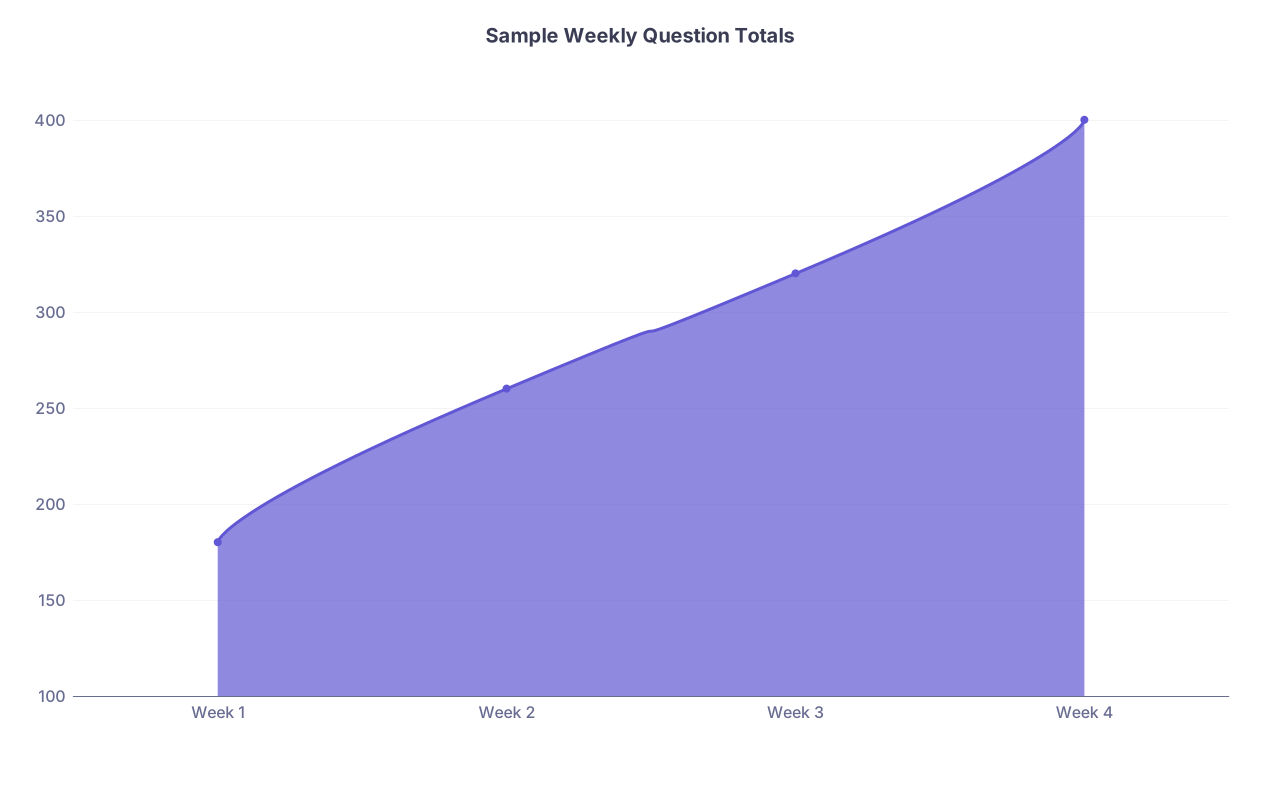
| Category | Value |
|---|---|
| Week 1 | 180 |
| Week 2 | 260 |
| Week 3 | 320 |
| Week 4 | 400 |
Aim to ramp up question volume, not stay flat.
Step 10: When Should You Actually Consider Resetting UWorld?
Very rarely. But there are a few legit cases:
- You did < 300–400 questions total, all untimed, clicked through explanations, and remember almost nothing. Essentially: you did not really start.
- Your interface is filled with mixed Qbank use from 2+ years ago, and you are basically a different student now.
Even then, I would usually:
- Finish the current pass using a fixed process (timed, good review)
- Then use incorrects + marked as my “second pass”
Resetting destroys valuable performance data. People love it because it feels like forgiveness. It is usually self-sabotage.
Final Check: How You Know Your Salvage Operation Is Working
Over 2–3 weeks, you should see:
- Your percentage on new random blocks creeping up by ~5–10 points
- Your confidence reading stems improving (less overwhelmed, more pattern recognition)
- Fewer “I have no idea” questions and more “it is between these two” decisions
- Your weakest areas (per UWorld stats) slowly closing the gap
If that is not happening, troubleshoot:
- Are you still reading explanations passively?
- Are you avoiding your weakest subjects?
- Are you doing too few questions per day?
- Are you turning mistakes into durable notes / Anki, or just “feeling bad and moving on”?
Be honest. Then adjust.
The 3 Things I Want You to Remember
- You do not need to restart UWorld. You need to change how you use it starting today and mine your incorrects like gold.
- Salvaging a bad pass hinges on efficient review and targeted follow-up: short, sharp extraction of key points, plus focused content review where you repeatedly fail.
- Track your data, not your anxiety. Use UWorld stats and block performance to guide what you do each week, and you can turn even a messy first half of the bank into a strong finish.