
Last fall, I watched a PD scroll through an applicant’s CV during our rank meeting. He stopped at the “Educational Resources” section, snorted, and said, “Ah yes, the ‘I did UWorld, therefore I am prepared’ crowd.” The room laughed, and then—this is the part no one tells you—he moved the file one column lower on the rank list.
Let me walk you through what really goes through their heads when your CV shows just one lonely Q-bank. Because it is not what your advisor in the student affairs office told you.
The Moment They See “Q-Bank: UWorld Only”
First thing: no PD is sitting there with a checklist saying “Must have 3+ Q-banks.” They are not that shallow. But they are pattern recognizers, and the Q-bank section—if you put one—is a tiny window into how you think and how you prepared.
Here’s the internal monologue I’ve heard versions of in real committees, word for word:
- “Only UWorld. Default path. Did they ever really self-audit or just follow the herd?”
- “No mention of NBME self-assessments? That always makes me nervous.”
- “One Q-bank usually means they did not push volume. That’s risky in this exam era.”
The dirty secret: your Q-bank list is less about which brand you used and more about what it signals about rigor, intentionality, and self-awareness. When you list only one, you’re sending signals—whether you mean to or not.
And yes, UWorld is the one most of you list. When a PD sees:
“USMLE Step 1 preparation: UWorld Q-bank (completed 100%, one full pass).”
they decode that much faster than you think.
Why PDs Even Care About Your Exam Prep
You’re thinking, “Why do they care what I clicked on in an app two years ago if I already passed Step 1 and did fine on Step 2?”
Because PDs have learned, the hard way, that your approach to exam prep is a proxy for your approach to residency work. Not the score. The approach.
- Q-bank strategy mirrors how you handle complexity and volume.
- Review methods mirror how you handle feedback.
- Resource selection mirrors how you make decisions under uncertainty.
In real meetings, this is how program directors use exam prep clues:
To explain an outlier:
High Step 2 with modest clinical evals? They’ll check how you studied: are you just a test-taking machine or did you learn to translate it to the wards?
Average Step 2 with “UWorld only” and weak shelf performance? They assume your strategy was shallow.To estimate teachability:
Students who explore multiple banks, self-assessments, and clearly tweak their strategy? They’re seen as coachable and reflective.To gauge resilience:
If there’s a misstep (failed Step, late success), PDs look for evidence of a changed strategy, not just “did UWorld again.”
Bottom line: they are not obsessed with how many banks you used. They are obsessed with what your choices say about how you’ll handle ICU nights, massive note loads, and boards during residency.
What “One Q-Bank” Actually Signals to PDs
Let me be blunt. When a PD sees only one Q-bank listed—especially for both Step 1 and Step 2—they don’t just see “simplicity.” They see one of a few stories.
Story 1: The Minimalist Who Got Lucky
This is the classic: only UWorld, one pass, and then a decent score. Some PD comments I’ve heard:
- “Fine. But did they learn how to self-diagnose their weaknesses or did UWorld just bail them out?”
- “We won’t know how they respond when UWorld isn’t enough—like in PGY-1 when they’re barely sleeping.”
If your score is strong (say Step 2 CK 250+), one Q-bank is usually forgiven. The performance itself buys you grace. But the internal bias is still there: “strong test-taker, unknown depth.”
Story 2: The Underprepared Grinder
Much more common:
- One Q-bank.
- One pass.
- Average or slightly below-average Step 2.
- Maybe a “took time off for Step” note somewhere.
The translation in the room is not kind:
- “They did the bare minimum that everyone on Reddit tells them to do.”
- “If that’s all they did and still landed at a 225–230, they probably didn’t know how to course-correct.”
This is where “one Q-bank” starts to hurt you. Not alone, but in context.
Story 3: The Overconfident, Under-Reflective Type
When the CV has a certain tone—honors in pre-clinicals, “self-directed learner” everywhere, but again: one bank, no explicit self-assessments—people start to connect dots.
I’ve seen PDs say things like:
- “They believe they’re high-yield incarnate. Those folks either thrive or crash.”
- “This reads like someone who never really tested their own blind spots until reality did it for them.”
It’s not fair, but committees are not fair. They are pattern-guessing machines under time pressure.
What PDs Like to See Around Your Q-Bank Use
Let’s get practical. If you insist on listing Q-banks—and many of you do—then do it in a way that actually buys you credibility.
PDs are looking for a story that shows evolution, intentionality, and data-driven adjustment. Not a “flex” about how early you started UWorld.
When they see something like:
“USMLE Step 2 CK: UWorld (completed 2x, annotated misses), AMBOSS (targeted weak areas based on NBME feedback), regular NBME self-assessments with progressive score improvement.”
that reads very differently from:
“UWorld Q-bank for Step 1 and Step 2 (completed).”
Same resource. Completely different signal.
To them, the first version says:
- This student monitored performance.
- They didn’t just click through; they used the wrong answers.
- They adjusted based on data (NBMEs, second Q-bank targeted use).
Now, I’m not telling you to lie or inflate. I’m telling you to understand the code PDs are reading when they see your resource line.
How Many Q-Banks PDs Actually Expect
Let me kill a myth.
No PD sits there saying, “If they didn’t use three Q-banks, pass.” That’s nonsense.
What they expect depends on the context: your scores, the exam era, and your narrative.
| Profile Type | Typical PD Reaction to 1 Q-Bank |
|---|---|
| Step 2 CK ≥ 250, solid shelves | Neutral to mildly positive |
| Step 2 CK 235–249, decent shelves | Neutral, look for strategy notes |
| Step 2 CK 220–234, mixed shelves | Concerned, question preparation |
| Any score + prior exam failure | Want to see expanded resources |
| Significant score *improvement* | Expect more than one resource |
So, what do they “like” to see?
- For strong scorers: even with one Q-bank, they want some hint you used self-assessments and actually reviewed.
- For average scorers: they want evidence you didn’t rely on one passive path.
- For red-flag scorers (fail, big jump, late pass): they expect to see that your second attempt involved a changed, intensified strategy. Often multiple banks, clear structure, tutor help, etc.
If you failed Step 1, then wrote in your CV that you “remediated with UWorld only,” it reads like you didn’t really re-engineer your approach. That packs more punch than you think.
The Hidden Red Flag: Q-Bank Flex Without Context
A big mistake students make is turning their resource list into some kind of humblebrag:
- “UWorld (100% complete, 1.5x, timed random).”
- “Completed 2,800+ questions.”
Without any mention of how you used those questions, that reads hollow to a lot of faculty. Remember, they’ve seen students do 5,000+ questions and still fail shelves because their review process was garbage.
What PDs privately roll their eyes at:
- Bragging about raw question numbers without:
- Any follow-up on error log, Anki use, or pattern tracking.
- Any indication that you adapted over time.
I’ve heard an associate PD say in a meeting:
“Everyone writes that they did 2,000–3,000 questions. So what? Show me that they learned from them.”
So if you insist on listing question counts, pair them with process: targeted review, repeated blocks in weak systems, NBME correlation. Otherwise, it looks like fluff.
How To List Only One Q-Bank Without Looking Superficial
Sometimes, you really did only use one bank. Maybe you were efficient. Maybe you were broke. Maybe you started clinicals late. Whatever the reason, you can still present that reality in a way that does not undermine you.
Here’s how you do it without sounding like you just followed the herd blindly.
1. Focus on Strategy, Not Brand
Bad:
“Used UWorld Q-bank for Step 2 CK.”
Better:
“Step 2 CK prep: UWorld Q-bank (1 full pass in timed, random mode; detailed review of missed questions with system-based tagging and second-pass of weak areas). NBME self-assessments used periodically to guide focus.”
Still one Q-bank. But now you sound like a person who actually studied, not a person who bought an app.
2. Tie It to Performance And Reflection
If your scores are good, tie your process to a learning mindset:
“Used UWorld as primary Q-bank for Step exams, incorporating daily question blocks with post-block reflection and pattern tracking. Adjusted study plan based on NBME feedback and shelf outcomes.”
You don’t have to invent a second Q-bank. You just have to prove you weren’t on autopilot.
3. If You Had a Weakness, Show Evolution
Let’s say Step 1 was pass-only, borderline, and Step 2 was much stronger. Listing one Q-bank with no narrative looks suspect. Instead:
“Transitioned from content-heavy, passive review for Step 1 to active, question-driven approach for Step 2 CK using UWorld as primary resource. Implemented structured error log and weekly performance reviews, resulting in significant score improvement.”
Same number of banks. Completely different story.
The Quiet Comparison PDs Make Between Applicants
You might think PDs don’t compare these details. They absolutely do—especially in competitive fields or at name-brand places.
Imagine two otherwise similar applicants:
Applicant A:
“USMLE Step 2 CK: 244. UWorld Q-bank completed.”
Applicant B:
“USMLE Step 2 CK: 241. Primary prep: UWorld Q-bank (1.5x, timed random, annotated errors). Supplemental: AMBOSS for targeted cardiology and ID practice based on NBME feedback. Regular NBME and UWSA self-assessments to validate readiness.”
I’ve watched committees lean toward Applicant B even with a slightly lower score because B sounds like a self-directed, evaluative learner. That matters more for residency than three extra scaled points.
Remember: the CV is not just telling them what you did. It’s revealing how you think.
The P/F Era Twist: Why Your Q-Bank Choices Matter More Now
Since Step 1 went pass/fail, PDs had to find other ways to separate “memorized First Aid” from “actually knows medicine.” So they look harder at:
- Shelf scores.
- Step 2 CK.
- Narrative comments from rotations.
- And quietly, how you talk about your prep.
I’ve sat in meetings where someone says:
“This school has grade inflation. Everyone ‘meets expectations.’ Look at their Step 2 and how they prepared. That usually tells you who actually did the work.”
If your school’s clinical eval language is vague and Step 1 is just “Pass,” little clues like your self-assessment use and prep structure start mattering more than before.
List one Q-bank plus a sophisticated process? You’re fine.
List one Q-bank with no evidence of self-assessment and a middling Step 2? They’ll assume you never switched out of undergrad test-taking mode.
When You Should NOT List Q-Banks At All
Here’s the part no one tells you: sometimes the smartest move is to leave Q-banks off entirely.
You should strongly consider skipping the resource list if:
- Your use was actually pretty superficial: one pass, rushed, no real review strategy.
- Your scores were not great and your resource section will just highlight that your approach wasn’t robust.
- You’re applying to a specialty and program that barely glances at that section and cares way more about research, letters, and clerkship performance (e.g., some IM or FM programs).
In those cases, focus the CV on:
- Objective scores (they’ll see those anyway).
- Any evidence of improvement over time.
- Your work ethic and adaptability on actual rotations.
Because yes, sometimes listing “UWorld only” just hands them more ammunition to question your preparation. If you cannot make it sound intentional and thoughtful, better to keep it off.
If You’re Still Early: How To Prep So Your Future CV Looks Strong
If you’re a first- or second-year reading this, you’re in the best position of all. You can build the story now instead of trying to rewrite it later.
Here’s how PDs like to see it play out:
- You start with one primary Q-bank (usually UWorld). Fine. That’s normal.
- You build a consistent review system: error logs, Anki or notes, tagging weak areas.
- You incorporate NBME or UWSA self-assessments at planned intervals and adapt based on them.
- If you hit a plateau or struggle, that’s when you layer in a second resource (AMBOSS, Kaplan, etc.) strategically—not as panic, but as a targeted supplement.
Later, when you’re building your CV, you can honestly write:
“Developed a question-based study framework using UWorld as a core resource, supplemented by AMBOSS for focused remediation in weaker systems identified by NBME self-assessments.”
That’s the kind of line that makes PDs think, “This one will do fine when we hand them MKSAP, UWorld for IM, or internal question sets during residency.”
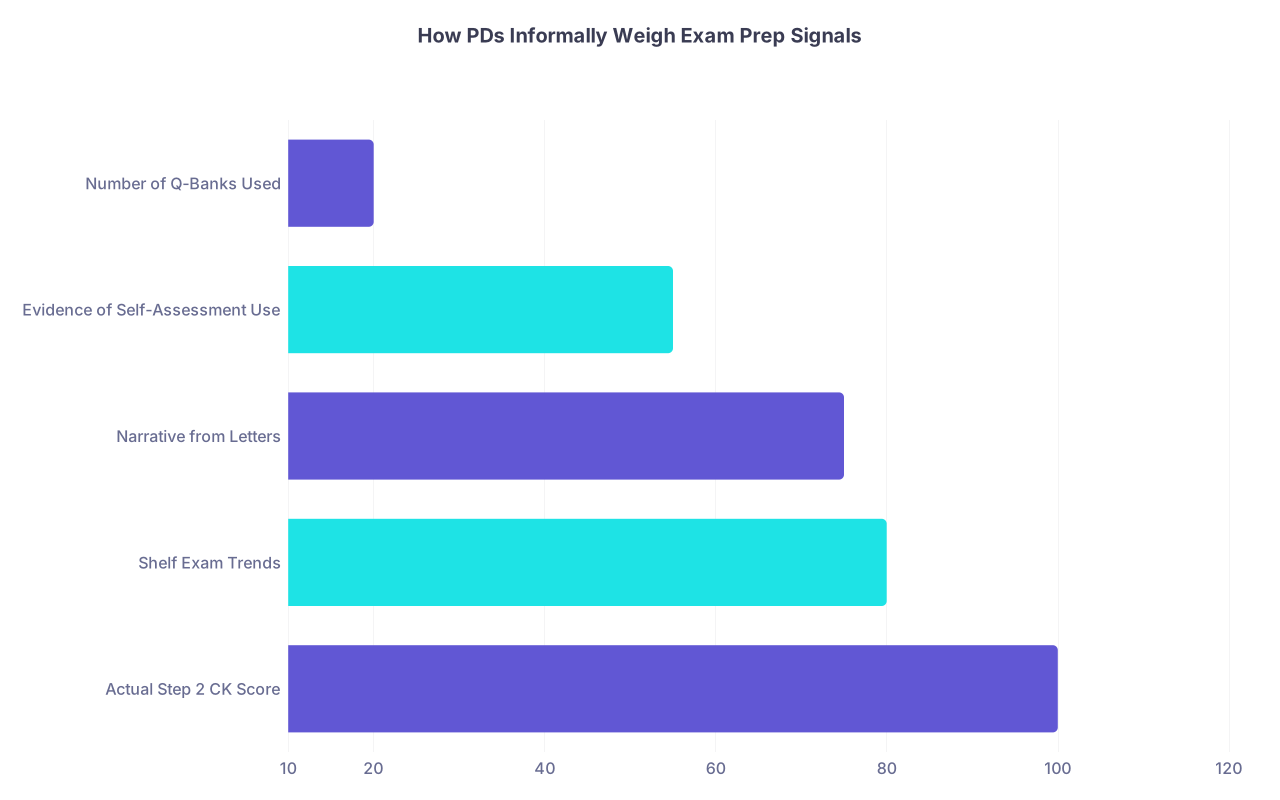
| Category | Value |
|---|---|
| Actual Step 2 CK Score | 100 |
| Shelf Exam Trends | 80 |
| Narrative from Letters | 75 |
| Evidence of Self-Assessment Use | 55 |
| Number of Q-Banks Used | 20 |
FAQ: What PDs Really Think About Your Q-Bank List
1. Should I list Q-banks at all, or just my scores?
If your approach was structured, reflective, and shows growth, list them briefly with your strategy. If your use was generic (“I did UWorld because everyone did”) and your scores are middling, you’re usually better off letting your score report and narrative speak for themselves. PDs do not require a resource list. It’s optional signaling—use it only if the signal is good.
2. Does it hurt me if I genuinely only used UWorld but scored very well?
No. If your Step 2 CK is strong (think mid-240s+ in most specialties, higher in the very competitive ones), one well-used Q-bank is more than enough. If you mention it at all, frame it around how you used it—timed, random, detailed review, self-assessments—rather than just name-dropping UWorld. The performance carries the weight; the narrative just reassures them you’re not a one-trick pony.
3. I failed Step 1, passed on second attempt with UWorld only. How do PDs read that?
Harshly, if you present it as “did UWorld again and passed.” What helps is showing that your approach changed: daily schedule, error logging, spaced review, faculty/tutor involvement, NBME tracking. If you really only changed effort but not method, do not overemphasize resources; focus on the broader remediation structure. PDs want to see that you didn’t just repeat the same superficial strategy.
4. Is using multiple Q-banks always better in PDs’ eyes?
Only if it reflects a smarter strategy, not panic-buying. Listing three Q-banks with mediocre scores and no explanation makes you look unfocused. One primary bank plus targeted, intentional use of a second (especially if tied to identified weak areas and eventual score improvement) reads very well. Quantity of banks never beats quality of process.
Years from now, nobody will care whether you used UWorld alone or stacked three different banks. What they will remember—your attendings, your PD, your co-residents—is whether you were the kind of person who thought critically about your own weaknesses and changed course when you needed to. The Q-bank line on your CV is just a faint shadow of that bigger truth. But people who’ve been doing this a long time know how to read shadows.