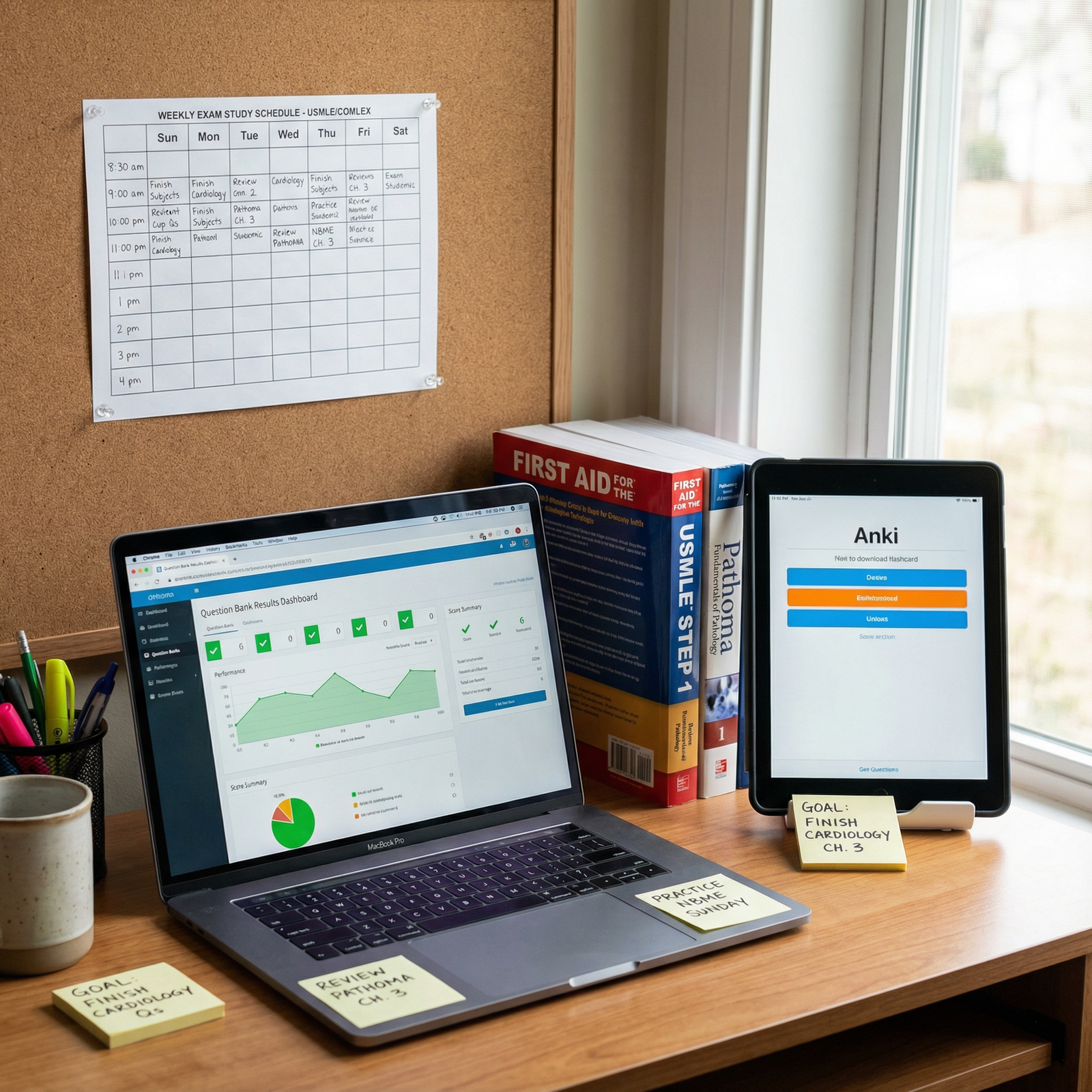
It’s 11:47 p.m. Your exam is six weeks away. On your desk: UWorld open on one monitor, Anki on the other, Boards & Beyond playing at 1.75x, First Aid half-covered by a random “Rapid Review” book you bought because a Reddit thread said it was “a must.” Your browser has 14 tabs: Sketchy, Pathoma, BRS Phys, random YouTube lectures, and a blog comparing “the BEST Step 1 resources ranked.”
You keep telling yourself: “I’ll pull the best from everything.”
You’re not optimizing. You’re sabotaging your recall.
Let me walk you through the mistakes I watch over and over, and how this “more is better” mindset quietly destroys your board exam performance.
The Core Problem: Your Brain Isn’t a Dropbox Folder
Everyone makes the same wrong assumption: If I see more versions of the same topic, I’ll remember it better.
That’s not what actually happens.
What happens is this: you build five half-finished mental models of the same concept—none of them strong enough to survive exam stress. You fragment your memory. You dilute your recall cues. Then on test day, you get that awful feeling: “I’ve seen this… somewhere… but I can’t pull it.”
That’s the signature of resource overload.
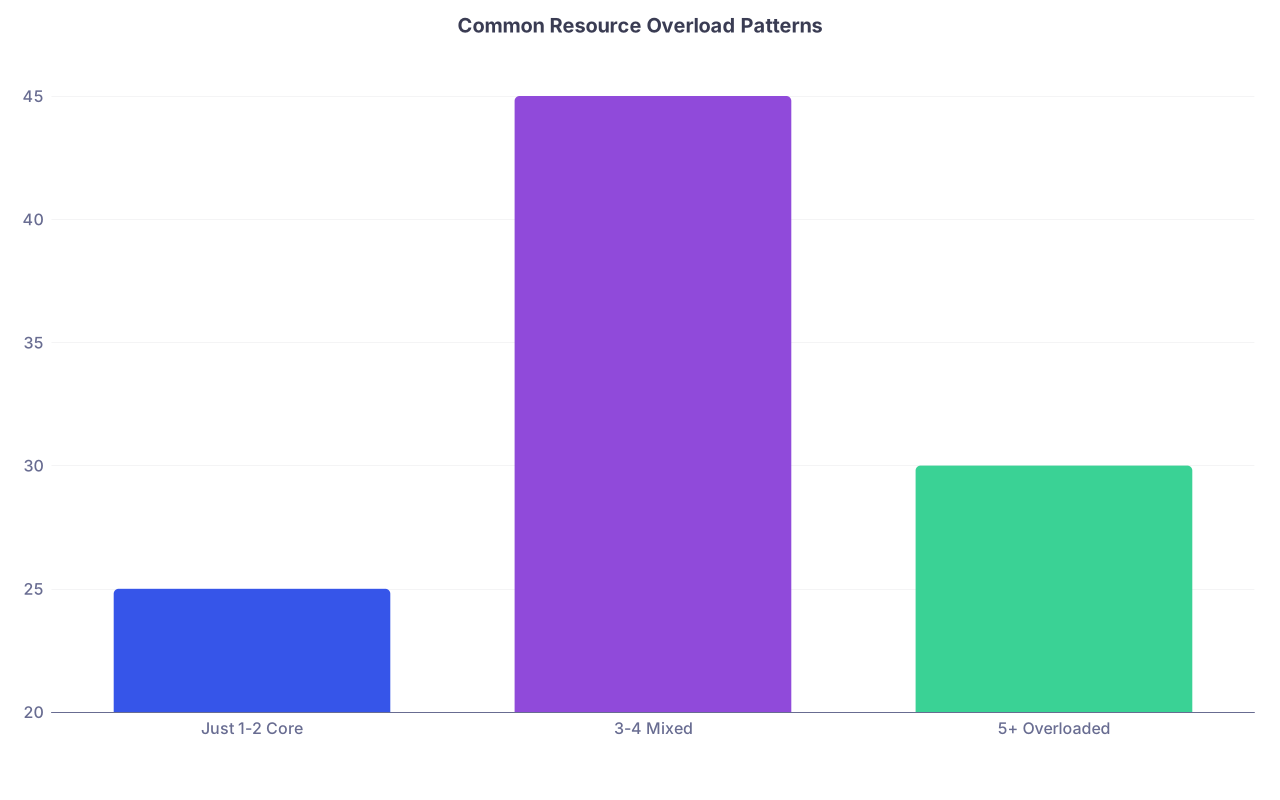
| Category | Value |
|---|---|
| Just 1-2 Core | 25 |
| 3-4 Mixed | 45 |
| 5+ Overloaded | 30 |
Here’s what too many resources actually do to your recall:
- Conflicting explanations = fuzzy concepts
- Different diagrams/terms = weak memory cues
- Repeated passive exposure = illusion of mastery
- No single “anchor” = nothing to fall back on when anxious
You think you’re reinforcing. You’re actually scrambling your retrieval paths.
Mistake #1: Layering “Just One More” Primary Resource
This is the most damaging pattern: using multiple primary resources for the same job.
Examples I’ve seen (too often):
- Pathoma + Robbins review reading + Boards & Beyond pathology full lectures
- Sketchy micro + random YouTube micro series + a full micro textbook
- UWorld + AMBOSS + Kaplan Qbank all done at 30–40% each
You’re doing triple the work for half the retention.

Here’s the rule nobody likes to hear:
For any major exam, you get:
- 1 main question bank (maybe 2 if you’re very far out and disciplined)
- 1 main content reference (could be FA/Boards & Beyond/Pathoma combo, or similar)
- 1 main spaced repetition system (Anki or well-made personal cards)
Everything else is optional garnish, not another main dish.
The mistake is thinking: “I’ll do most of UWorld, some of AMBOSS, a lot of Kaplan, a bit of NBME-style questions…”
The exam doesn’t reward “sampled widely.” It rewards “mastered deeply.”
On test day, you don’t need 3 slightly familiar ways to think about hyponatremia. You need one clear, automatic framework that fires instantly.
Avoid this: Starting a new major resource after you’re already halfway through another. When you feel that itch to jump to what your friend is using, stop. Ask: “Am I actually close to mastering what I already have?” If not, you’re just chasing novelty.
Mistake #2: Rewriting the Same Fact in Five Different Languages
You watch a Pathoma video on lung cancer. Then you read First Aid. Then you check Boards & Beyond because you “like his explanation better.” Then you add Anki cards. Then you screenshot a UWorld explanation to “review later.”
You’ve now created five separate, partially overlapping “files” in your brain. None are indexed well. None communicate with each other.
This is how you end up thinking:
- “Was it central vs peripheral I saw in Sketchy or in FA?”
- “Wait, which image was from UWorld and which from Pathoma?”
- “I remember a purple diagram… from where?”
The problem isn’t repetition. Repetition is good.
The problem is uncoordinated, unanchored repetition.
High-yield repetition looks like this:
- Same framework, revisited in different contexts
- Same terminology, reinforced with questions
- Same base notes, updated—not replicated elsewhere
What you’re doing instead:
- New notes in every resource
- New terminology each time
- New diagrams that don’t match anything
You’re not building depth. You’re repainting the same shaky wall with different colors.
Avoid this: Creating a separate set of “main notes” from each resource. Pick one home base: usually First Aid or your own master notes/Anki. Every time you learn something from another resource, it either:
- gets integrated into your existing structure
- or gets ignored because it’s redundant / too low-yield
But it does not get its own little independent island in your brain.
Mistake #3: Confusing Activity with Encoding
Here’s a pattern I’ve seen in multiple students who underperformed badly:
They proudly say:
“I went through Pathoma twice, B&B once, Sketchy micro/pharm, read FA twice, did 50% UWorld and like 40% AMBOSS.”
They are exhausted.
They are not ready.
Why? Because they optimized coverage, not encoding.
Encoding = turning something from “I recognize this” into “I can pull this from nothing, under stress, accurately.”
Too many resources push you into:
- Watching more
- Skimming more
- Re-reading more
Instead of:
- Solving more
- Reciting from memory
- Explaining in your own words

| Step | Description |
|---|---|
| Step 1 | Many Resources |
| Step 2 | Passive: watch/read |
| Step 3 | Illusion of mastery |
| Step 4 | Weak recall on exam |
| Step 5 | Few Core Resources |
| Step 6 | Active: questions/recall |
| Step 7 | Strong encoding |
| Step 8 | Reliable recall on exam |
Mixing too many resources is the fastest way to lull yourself into thinking: “I’ve seen everything.”
But seeing is worthless without retrieval.
Avoid this: Tracking your prep in hours watched or pages read. Track by:
- Questions completed and thoroughly reviewed
- Cards matured in spaced repetition
- Topics you can teach from scratch without looking
Mistake #4: Constantly Switching Because of Fear or FOMO
This one’s brutal because it feels rational at the time.
You start with UWorld. First block feels hard. You see a Reddit post: “Honestly AMBOSS is more representative now.” Panic. You buy AMBOSS. You do a few questions. Explanations feel long. Someone else: “Kaplan helped my fundamentals way more.” New panic. Another subscription.
Now you’re doing none of them properly.
Same with content:
- Week 1: “Pathoma is my bible”
- Week 2: “B&B covers more integrative physiology, I should switch”
- Week 3: “Everyone says Sketchy path is underrated, maybe I’ll pivot to that”
Translation: you’re outsourcing your confidence to anonymous strangers and loud classmates.
Here’s the ugly truth:
Every resource will feel “not quite right” right before you start to actually learn from it. That discomfort is exactly where your brain is being forced to adapt. If you flee to something new every time that happens, you never cross the line from confusion to clarity.
Avoid this: Mid-stream resource changes based on anecdotes. If you want to add or switch something, do it:
- With a clear reason (“I need better visuals for micro”)
- With clear limits (“I’ll use Sketchy only for micro, not as a full replacement”)
- At clear checkpoints (after NBME, not mid-week meltdown)
Mistake #5: No Defined Resource Hierarchy
Most students have a chaotic stack. No defined roles. Everything feels equally important, so everything gets half-attention.
You need a resource hierarchy. Something like:
| Level | Purpose | Example Resources |
|---|---|---|
| 1 | Core Qbank | UWorld (primary) |
| 2 | Core Content | First Aid + Pathoma |
| 3 | Supplement Clarify | Boards & Beyond topics |
| 4 | Visual Memory Boost | Sketchy micro/pharm only |
Notice what’s not happening here:
- You’re not doing two full Qbanks as equals
- You’re not watching complete lecture series from three platforms
- You’re not re-learning every single topic in four different styles
The hierarchy protects your time and your recall.
You know what gets done first. And what gets cut if time is tight.
Avoid this: Letting every new resource you buy creep up to “core” status. If you add something, demote something else.
Mistake #6: Ignoring How Recall Actually Works Under Stress
On exam day, your brain isn’t calm and thoughtful. It’s scanning.
It’s looking for:
- Familiar patterns
- Stable anchor concepts
- Strongly reinforced connections
When you’ve mixed too many resources:
- Hyponatremia = 3 different flowcharts in your head
- Renal tubular acidosis = one colored chart from FA, one from B&B, and some half-remembered slide from a random lecture
- Murmur changes = 4 different explanations with slightly different emphases
Nothing stands out as the real one. So your pattern recognition collapses into doubt.
Stress amplifies inconsistency.
If your mental image of a disease jumps between 5 different styles and diagrams, your retrieval time goes up. On a timed exam, that’s death.
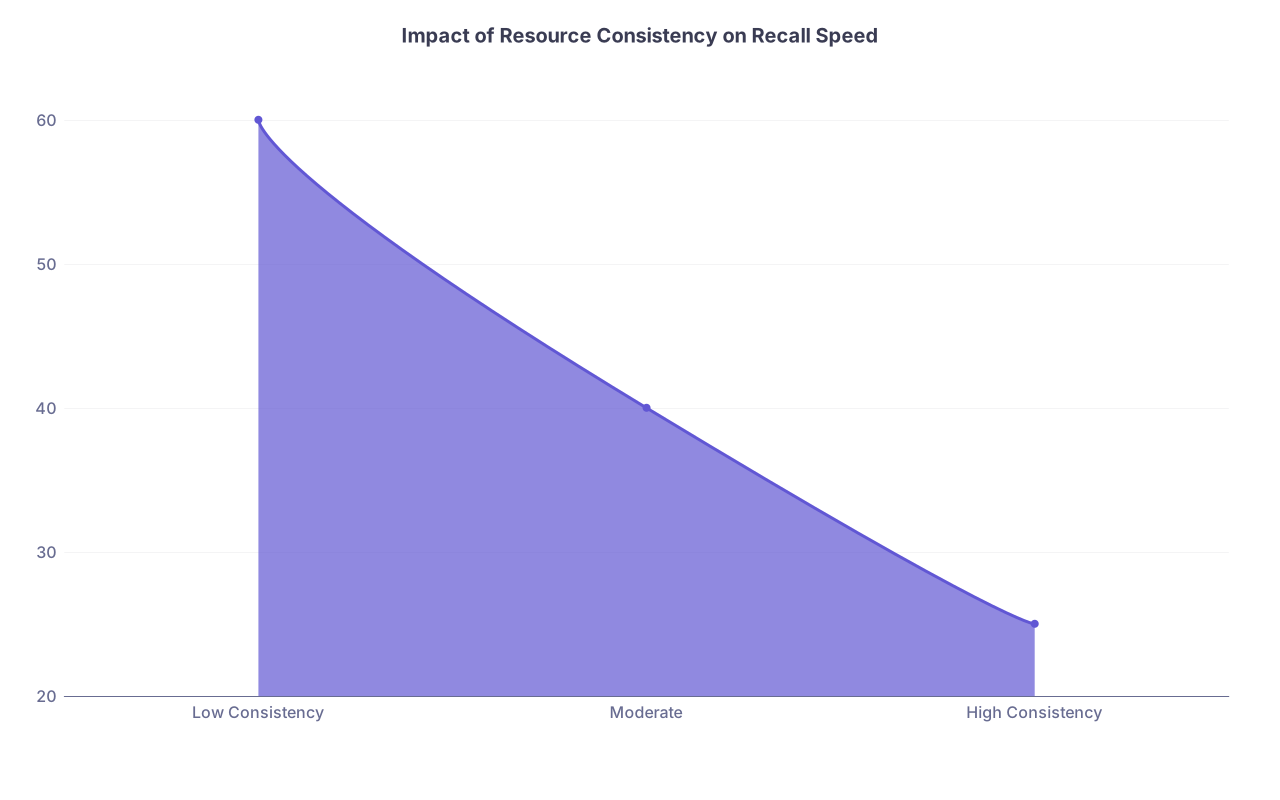
| Category | Value |
|---|---|
| Low Consistency | 60 |
| Moderate | 40 |
| High Consistency | 25 |
(Think of those numbers as “seconds per question spent just remembering the concept.” High consistency = faster recall.)
Avoid this: Wild swings in style and source for the same core topics in the last month. Late phase is for consolidating into one coherent mental model, not re-exposing yourself to new versions of the same information.
Mistake #7: Underestimating Cognitive Switching Costs
Every time you jump from:
- one platform UI to another
- one terminology set to another
- one visual style to another
…you’re paying a tax. Your working memory has to adapt to “how this one works” before you even get to the content.
Example I’ve watched in real time:
Student: “I’ll start the day with Anki, then do some UWorld, then switch to AMBOSS for variety, then a few hours of B&B, then maybe some FA page-flipping to wind down.”
That’s 4–5 context switches. Some of your mental energy is burned just on switching environments.
You want your brain’s “how to interact with this” to be automatic. That only happens when you stick with fewer tools long enough.
Avoid this: Daily schedules that bounce between 4–6 major platforms. Anchor your day around:
- 1 main Qbank block
- 1 main content/weakness review method
- 1 main spaced repetition block
That’s it. Everything else, if used, is peripheral.
A Safer Blueprint: Fewer Resources, More Recall
Here’s how to avoid sabotaging yourself while still using the tools you like.
Step 1: Pick Your Core Trio
Be ruthless:
Core Qbank
Usually UWorld. Maybe AMBOSS if you have a strong reason. But one of them is clearly primary.Core Content
Example: First Aid + Pathoma, or Boards & Beyond + FA, or similar pairing. Not three full systems.Core Review System
Anki (well-curated deck, not 12 random ones) or your own structured notes with frequent active recall.
Everything else gets downgraded to “supplemental only if needed.”
Step 2: Assign Specific Jobs to Each Supplement
You don’t “use Sketchy.” You use it for micro and pharm only.
You don’t “use AMBOSS.” You use it when UWorld explanation isn’t clear or for targeted article reading on weak topics.
Every resource should answer:
“I’m using this for X and not for Y.”
Vague usage = resource creep = overload.
Step 3: Lock the Plan After a Trial Period
Give yourself 1–2 weeks early in dedicated to test what fits your brain. After that, you freeze the main structure.
You can still tweak how you use things, but you stop adding big new resources “just in case.” You commit to depth rather than breadth.
Red Flags You’re Already Sabotaging Your Recall
If any of these sound like you, you’re in the danger zone:
- You can list 8–10 resources you “kind of” use
- You’ve started more than one Qbank and finished neither
- You keep restarting lecture series instead of finishing and reviewing questions
- Your notes live in 4 different places: FA margins, Notion, random Word docs, and card fields
- You feel vaguely familiar with everything but confident with almost nothing
That “I’ve seen this but can’t quite recall it cleanly” feeling? That’s the exact footprint of resource overload.
You don’t fix it with more exposure. You fix it with fewer anchors and repeated recall.
FAQs
1. Is it always wrong to use more than one Qbank?
Not always, but most students misuse them. If you’re 4–6 months out, you can do, say, Kaplan for fundamentals then UWorld closer to the exam. The mistake is doing 40% of three Qbanks instead of 100% of one with deep review. If your second Qbank is preventing you from doing multiple thoughtful passes through UWorld, it’s hurting you.
2. What if my school requires us to use a specific resource I don’t like?
Then you treat the required one as “supplemental,” unless it’s actually good for you. You can say: “School Qbank = extra practice, UWorld = my true core.” Or “Required lectures = background, Pathoma = core path.” The key is: you define what’s primary. Don’t let institutional checkboxes dictate your actual learning hierarchy.
3. How do I know if a resource should be cut?
Two tests. First: If you stopped using it today, would your main plan actually break, or would it mostly hurt your FOMO? Second: Are you consistently behind on your core tasks (Qbank, Anki, core content) while still finding time for this resource? If yes, it goes. Your weakest, least-targeted resource is almost always dead weight.
4. Is it okay to change resources if I truly hate one?
Yes—but do it like an adult, not in a panic. Set a decision point: “If after 2 weeks and 500 questions I still feel UWorld explanations are unusable, I’ll switch to AMBOSS as primary.” Then switch cleanly. Don’t keep the old one half-alive. The worst situation is you “kind of” use both and master neither.
5. How far from the exam should I stop adding new resources?
For most people, no major additions in the last 6–8 weeks. That phase is for consolidation, NBMEs, and targeted patching of weak spots using the resources you already know well. A new platform or lecture series at that point just fragments your mental model and steals time from high-yield recall practice.
Open your current study plan right now—spread your books, your subscriptions, your decks out in front of you. Circle your one core Qbank, one core content source, and one core review system. Everything else? Either assign it a narrow, specific role or cut it entirely. Then commit to that leaner setup for the next 3 weeks and watch how much cleaner your recall starts to feel.