
The way most MS2s use flashcards for Step 1 is not just inefficient. It is actively dangerous to their score.
I am not exaggerating. I have watched smart, motivated students tank their practice exams because they “did Anki every day,” but did it in exactly the wrong way. They hid behind decks, trusted green bars, and confused clicks with learning. Then wondered why their NBMEs stalled 20+ points below where they thought they “should” be.
This is what you are up against.
Flashcards are a tool. They can absolutely help you crush Step 1. But used the way many MS2s instinctively use them? They become a time sink, a source of false confidence, and a way to avoid the real work of understanding and applying.
Let’s walk through the mistakes that wreck people’s Step prep and how to avoid stepping into the same trap.
Mistake #1: Treating Flashcards as Your Primary Learning Source
This is the core error. Everything else builds on this.
Many MS2s do the following:
- Download a giant Anki deck (AnKing, Lightyear, Dope, etc.)
- Decide “I will just do these religiously”
- Assume that if they see “all the cards,” they will “know everything”
This is backward. Flashcards are for retention, not initial learning. If you are using cards to learn brand‑new material you never really understood from lectures, Boards & Beyond, or Pathoma, you are building a house on sand.
Here is what actually happens when flashcards become primary:
- You memorize patterns of words, not mechanisms or concepts.
- You get “good” at recognizing prompts you have seen, not solving novel problems.
- You start to believe you “know” topics because you did 500 reviews, but cannot explain anything out loud or apply it to a multi-step question.
Step 1 questions do not ask:
“What is the side effect of this drug?”
They ask:
“Patient on this drug with this comorbidity presents with these new findings—what is the mechanism of the complication?”
If you learned pharmacology through cards from day one and never internalized mechanisms, you will be exposed badly on exam day.
Avoid this:
Use flashcards after you understand the material from a primary resource. The sequence should look like:
- Learn →
- Clarify →
- Then encode into flashcards to keep it.
Not “open Anki and hope for osmosis.”
Mistake #2: Blindly Trusting Big Premade Decks
The worship of giant premade decks is out of control.
I have heard all of these:
- “I am behind in cardio but it is fine, AnKing covers it.”
- “I do 800 reviews a day, I am good for Step.”
- “I will just suspend what I don’t know, there are still like 25k cards left.”
This is how you end up 3 months before Step 1, sitting in a library thinking, “Why does every NBME feel like a different language?”
Premade decks are built from someone else’s brain, someone else’s curriculum, someone else’s timing. They:
- Do not match your school’s emphasis.
- Do not adjust to your weak spots.
- Do not filter for what is actually high yield for you right now.
You know what premade decks are absolutely excellent for?
Reinforcing specific, curated, high‑yield facts that you already decided matter after working through a real resource and QBank questions.
You know what they are terrible for?
- Mindlessly grinding card after card because “people on Reddit said to do it.”
- Assuming “if it’s in the deck, it must be important.”
- Letting them replace your own thinking.
If you are not ruthless about what you keep, suspend, or never start, the deck owns you. Not the other way around.
Avoid this:
- Use big decks as fact banks, not sacred texts.
- Unsuspend in small, intentional chunks that align with the system you are actually studying.
- Aggressively suspend cards that feel redundant, hyper‑niche, or verbose. You will not magically get bonus points for memorizing obscure enzyme names that show up in one question every 10 years.
Mistake #3: Overloading on “Mature” Cards and Burning Out
Here is a pattern I see over and over:
- Student feels behind.
- Student increases “new cards per day” to 60, 80, or more.
- Two months later, student is drowning in 700–1000 daily reviews and cannot keep up.
- Student starts “resetting” or “deleting” cards, or just stops opening Anki for days. Then panics.
This is not a time management problem. It is a design problem.
Spaced repetition only works if you can consistently review what is due. When your review load exceeds what you can handle on a bad day (post‑call, sick, family emergency), your whole system collapses.
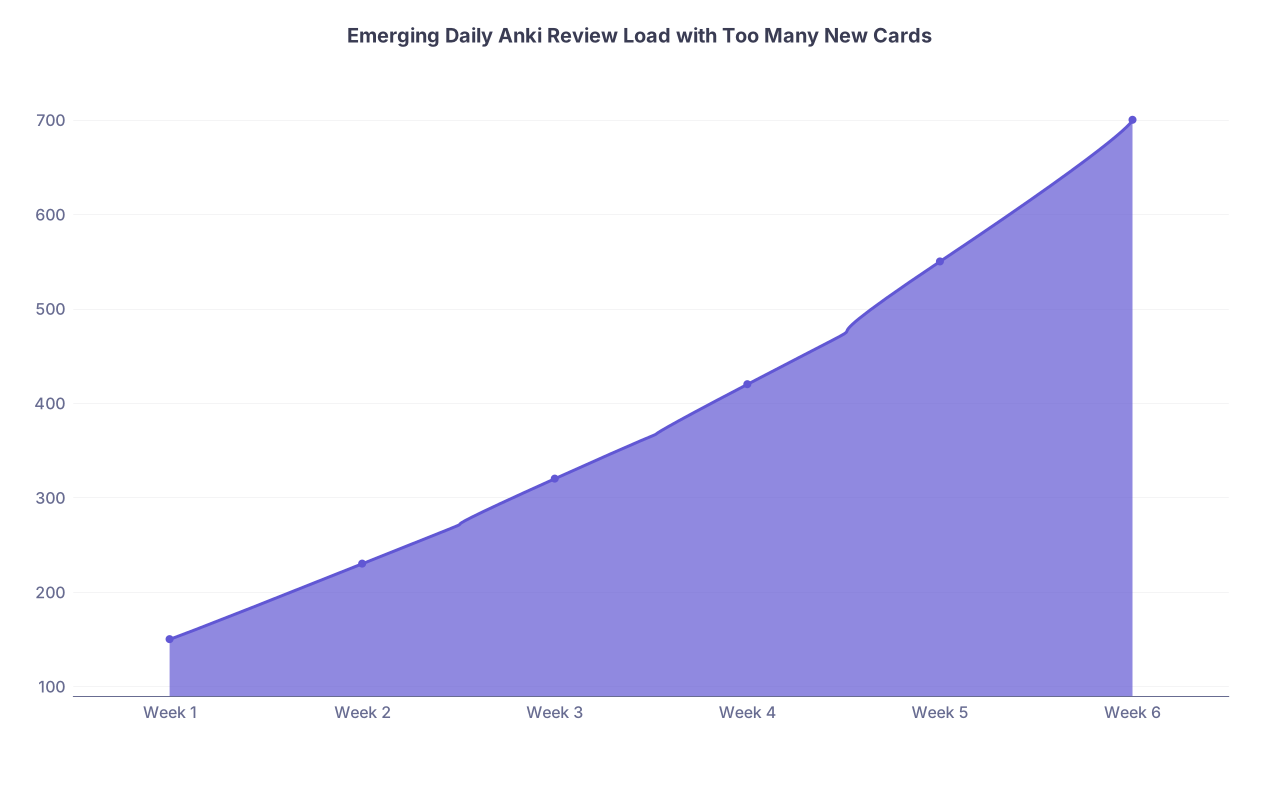
| Category | Value |
|---|---|
| Week 1 | 150 |
| Week 2 | 230 |
| Week 3 | 320 |
| Week 4 | 420 |
| Week 5 | 550 |
| Week 6 | 700 |
This is what happens when you treat Step prep like a macho endurance contest instead of a long, planned campaign.
Once your reviews spiral out of control:
- You start rushing through cards.
- You stop thinking in full sentences and start clicking reflexively.
- You mark things “Good” that you barely half‑recalled because you “need to get through this.”
Congratulations. You have turned a powerful learning tool into a gamified checkbox app.
Avoid this:
- Keep daily new cards at a level you can sustain for months, not days. For many MS2s, that is 20–40 new cards per day when you are also doing real studying and questions.
- If your reviews consistently exceed what you can handle well, cut new cards first. Do not sacrifice review quality to keep pushing new content.
- Protect your Anki system from becoming unmanageable, even if it means you cover fewer total cards. A smaller, stable deck you truly know beats a massive, chaotic deck you panic‑click through.
Mistake #4: Using Flashcards Without Questions
Relying on flashcards without doing serious QBank work is like training for a marathon by only doing calf raises.
I see students who:
- Do 1–2 blocks of UWorld per week “because they are saving it”
- Or worse, “saving UWorld for dedicated”
- But they do hundreds of cards daily, pat themselves on the back, and call it efficient.
Then their first NBME comes back 40–60 points lower than they expected. They are shocked. I am not.
Questions test:
- Multi‑step reasoning
- Prioritization between competing answer choices
- Integration of physiology, pathology, and pharmacology in one clinical stem
- Stamina and focus over long blocks
Flashcards do not.
Flashcards are recognition and recall of isolated facts in short bursts. Step 1 is complex, integrated, and long. If your brain has never been forced to link the flashes into a coherent picture, the test will destroy you.

Avoid this:
- Treat question banks as your central training ground, not an optional extra.
- Use flashcards to support and reinforce insights from questions, not replace them.
- After each UWorld block, convert your missed concepts into targeted cards, not generic trivia.
If you are an MS2 starting Step 1 review, a reasonable split once systems are basically covered: something like 60–70% time on questions and reviewing them; 30–40% on flashcards. The exact number is less important than the principle: questions first, cards follow.
Mistake #5: Making (or Using) Bad Card Types
Not all flashcards are created equal. Some are basically useless.
The most dangerous kinds I see daily:
Vague cloze deletions
“ACE inhibitors ↓ ______.”
↓ what? Blood pressure? Angiotensin II? Aldosterone? Afterload? All technically true. The card is teaching you nothing precise.Garbage “multi‑fact” cards
Front: “B12 deficiency”
Back: 10 lines of pathophys, causes, findings, labs, treatment.
You “pass” the card if you recall 2–3 of them. The rest rots.Cards that test your ability to remember the card
The wording on the front is so specific that you are memorizing the sentence, not the concept. In a different phrasing, you fail.Cards with clue words
Front: “MCC of pneumonia in alcoholics with currant jelly sputum?” You ignore the whole question and jump at “currant jelly = Klebsiella.” You did not learn pneumonia. You learned a puzzle cue.
This style of card breeds shallow recall and overconfidence. On real questions, the clues will not be arranged for your convenience.
Avoid this:
- Write cards that test one clear idea. Something like:
“Vitamin B12 deficiency – neurologic findings” → then list them. - Use specific prompts, not lazy ones.
- Break monster cards into 2–4 shorter, focused ones. More cards, smaller bite each.
If you are using a premade deck, you cannot rewrite every bad card. But you can:
- Suspend cards that feel unclear, overly long, or weirdly worded.
- Favor cards that match the way you think and the way resources present material.
- Make your own supplemental cards for concepts you keep missing in questions, with your own wording.
Mistake #6: Confusing “Seeing Cards” With “Learning Cards”
This is the quiet killer.
Anki addicts love streaks, heatmaps, and green progress bars. I have watched people race through 500+ cards in one sitting, hitting “Good” on auto‑pilot, just to “zero my reviews.” Then they proudly post: “All caught up!”
No. You are not. You just pushed buttons.
Learning requires:
- Effortful recall
- Honest self‑assessment
- Willingness to mark “Again” when you failed
What most stressed MS2s do instead:
- Half‑remember a term, think “yeah, that sounds familiar,” and hit “Good”
- Tell themselves they will get it next time
- Then mark similar cards “Good” again and again, because the pattern looks right, even if the underlying understanding is weak
On Step 1, there is no “Again” button. You do not get spaced repetition. You get one shot and 60 seconds.
Litmus test:
If you cannot explain the concept in the card out loud in a full sentence, or use it in a small made‑up clinical scenario, you have no business marking it “Good.”
Avoid this:
- Slow down on cards that relate to topics you keep missing in questions.
- Occasionally say the answer out loud or write a couple of key words on scrap paper.
- ruthlessly mark “Again” when you did not know it cold. Yes, your review count will increase. That is the point. Either you face the gap now or let Step expose it later.
Mistake #7: Using Flashcards Detached From Your Actual Weaknesses
Another common pattern: everything is “global,” nothing is targeted.
You:
- Do today’s random card reviews
- Unsuspend the next “recommended” subdeck
- Maybe add a few cards from a lecture or video
- But you never stop and ask: “What am I actually bad at right now?”
The result: you spend equal time on strengths and weaknesses. That is not efficient. That is lazy.
Step 1 punishes uneven preparation. If you are outstanding in micro but keep bombing renal phys, your total score will still be dragged down. Yet I have seen students continue grinding micro cards because “they are fun” while dodging the ugly subjects.

| Step | Description |
|---|---|
| Step 1 | Do QBank Block |
| Step 2 | Identify Missed Concepts |
| Step 3 | Review Resource/Notes |
| Step 4 | Create/Curate Flashcards |
| Step 5 | Daily Anki Reviews |
| Step 6 | Retest with New QBank Block |
This is the loop you want. Not “open Anki and see whatever shows up.”
Avoid this:
- After each NBME or UWorld assessment, list your worst topics (e.g., “renal phys,” “biostats,” “cardiomyopathies”).
- Make sure your next week of flashcard focus is heavily biased toward those areas.
- Suspend or ignore entire subtopics where you are already consistently strong on questions. You are not paid extra for making strong areas even better.
Flashcards should follow your weaknesses, not lead them.
Mistake #8: Letting Flashcards Replace Actual Rest
There is a quieter, more insidious danger: using flashcards as a way to avoid feeling guilty, even when your brain is shot.
I have seen students:
- Do cards late into the night every day “to keep the streak”
- Review casually while half‑asleep in bed
- Grind through reviews on post‑exam days instead of taking a real break
This is how burnout creeps in. Slowly, then suddenly.
Sleep‑deprived, emotionally exhausted students retain less from every card. They also make worse choices about what to mark “Good” or “Again.” You end up sabotaging both your mental health and your learning in the name of “discipline.”
You are not a machine. You are preparing for a high‑stakes exam that requires clear thinking and endurance. Showing up mentally wrecked but with a 365‑day Anki streak is not an achievement.
Avoid this:
- On truly bad days, protect review quality over quantity. Trim your load, do the highest‑yield sections only, or even skip a day and accept the backlog.
- Build at least one real off‑half‑day per week in long prep periods where you do no cards. Yes, no cards. Your brain will not erase glycolysis in 12 hours.
- Remember the actual metric that matters is your NBME and Step score. Not your Anki stats.
How to Use Flashcards Safely and Effectively for Step 1
Let me flip this from “don’t” to “do,” because you need a concrete alternative. Here is a safer, higher‑yield way to integrate flashcards into MS2 and Step 1 prep.
| Aspect | Safe, Effective Use | Dangerous Use Many MS2s Do |
|---|---|---|
| Role of Flashcards | Retain and reinforce known concepts | Primary learning method |
| Deck Type | Curated + targeted premade subsets | All‑in on huge premade deck |
| New Cards per Day | 20–40 sustainable | 60–100 until burnout |
| Question Banks | Central pillar of study | “For later” or minimal use |
| Card Quality | Focused, single‑concept, clear prompts | Vague, overstuffed, cue‑based |
A practical sequence for a typical MS2 system block:
Learn the content properly.
Watch Pathoma/Boards & Beyond / whatever your school or you prefer. Take minimal, focused notes. Actually understand mechanisms.Do questions early.
Start system‑specific QBank blocks even if you feel “not ready.” Your errors will show you what actually matters.Turn gaps into cards.
For every concept you miss or nearly miss on questions, either:- Tag/unsuspend high‑quality cards from a premade deck on that topic, or
- Make 1–3 of your own concise, targeted cards with wording that makes sense to you.
Review daily, but sustainably.
Keep review numbers in a range you can handle with attention. If your quality drops, your number is too high.Constantly align cards with weaknesses.
After each NBME, adjust your card focus. More renal if renal is weak. Less micro if you are already scoring high in it.Use cards as a support, not a badge of honor.
No one gives out medals for “Most Anki Reviews.” But Step 1 absolutely punishes people who confuse streaks with mastery.
FAQs
1. Do I have to use Anki or flashcards to do well on Step 1?
No. You have to remember facts. Flashcards are simply one of the best tools for retention if used correctly. If you have a different, consistent, evidence‑based way of reviewing (written questions, summary sheets, spaced review schedules) and your NBME scores are rising, you are fine. But if you are not using some structured system for spaced repetition, you are making Step 1 harder than it needs to be.
2. Is it a mistake to start premade decks during MS1 instead of MS2?
It is a mistake to start massive premade decks without controlling the daily load or tying them tightly to what you are actually learning. Starting early can be excellent if you: keep new cards modest, prioritize understanding lectures/resources first, and only unsuspend relevant cards. Starting early with 100+ new cards daily “to get through AnKing” is how people burn out before MS2 even starts.
3. How do I know if my flashcard use is actually working?
Ignore Anki stats and look at two things: practice test performance and explanation ability. If your NBME/UWorld percentiles are rising over weeks and you can explain key concepts out loud without a prompt, your flashcards are doing their job. If your reviews are high but your scores flatline or you freeze when asked to walk through mechanisms, you are making the classic mistake: confusing repetition with learning.
Key points:
Flashcards are for retention, not primary learning. Huge premade decks and massive review counts easily turn into traps that burn time and build false confidence. Anchor everything to real questions and your actual weaknesses, not to Anki streaks and Reddit folklore.