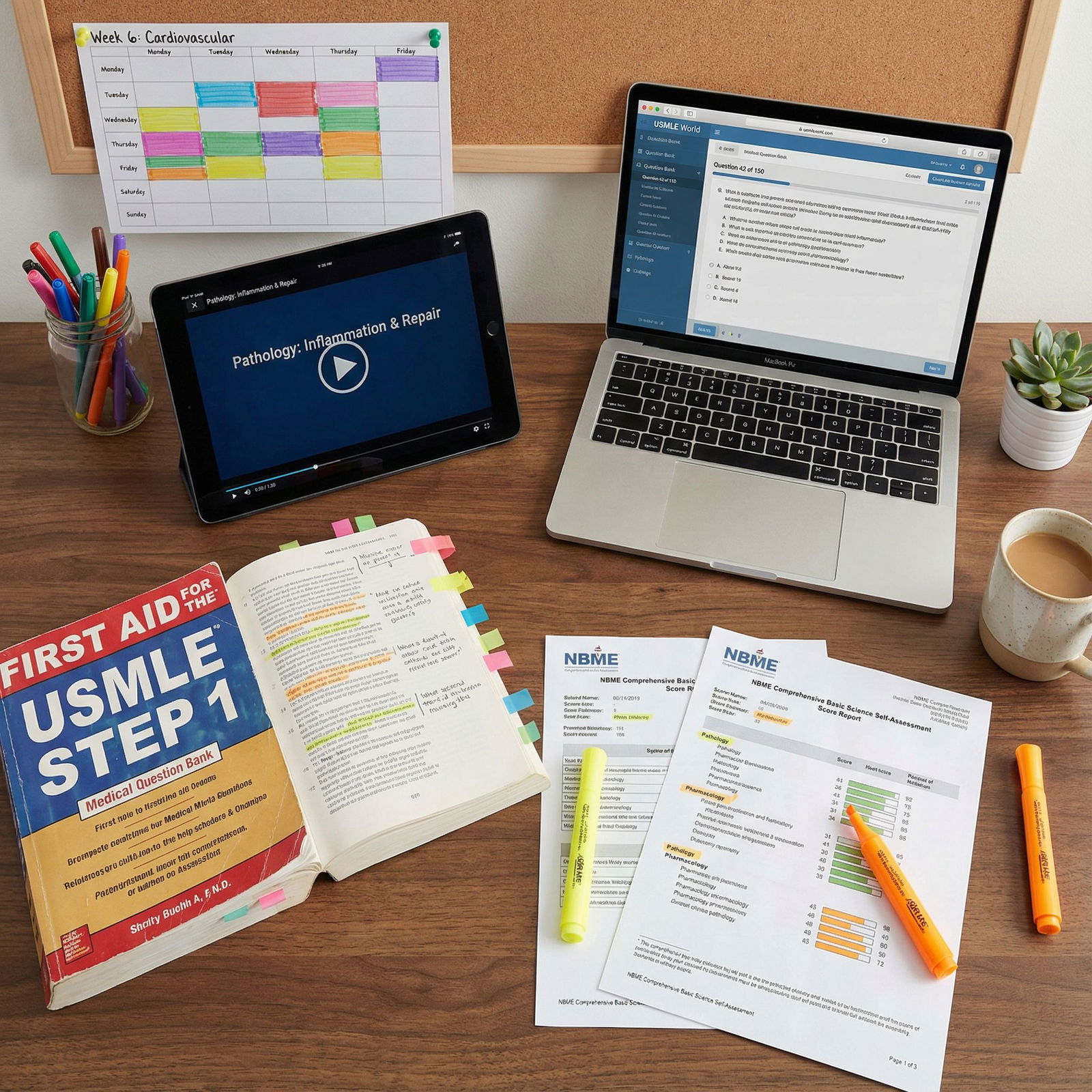
What if I told you that 30–50% of what you’re about to spend on USMLE prep books will quietly rot on your shelf… and do nothing for your score?
Let me be blunt: most students do not fail USMLE prep because they work too little. They fail because they scatter their effort across a mess of shiny, overhyped resources that look “impressive” on a bookshelf and terrible on a score report.
You’re being marketed to. Aggressively. And a lot of those “must-have” books are, at best, low-yield distractions. At worst, they actively replace what actually moves your score: active recall and questions.
Let’s kill some bad purchases before they happen.
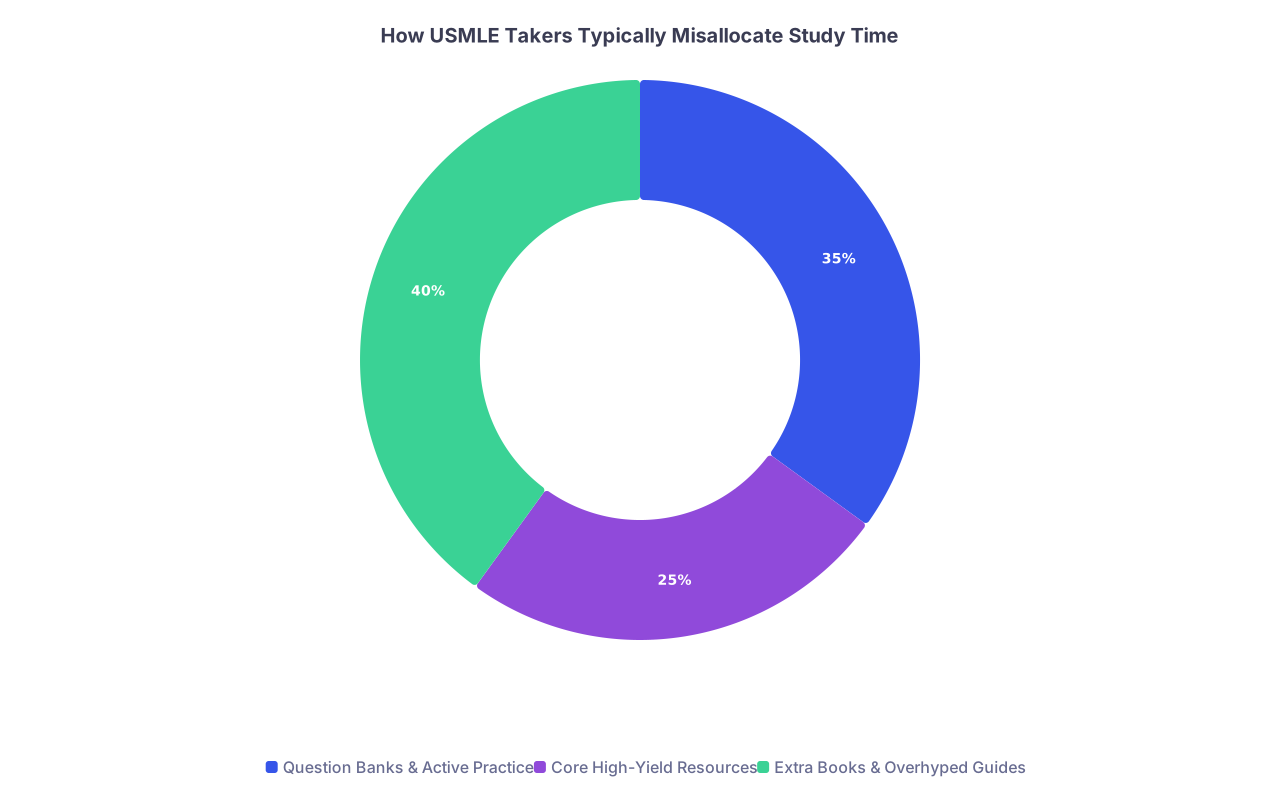
| Category | Value |
|---|---|
| Question Banks & Active Practice | 35 |
| Core High-Yield Resources | 25 |
| Extra Books & Overhyped Guides | 40 |
The Core Mistake: Treating Books Like a Security Blanket
You’re anxious. So you buy things.
“I’ll get First Aid, Pathoma, UWorld, B&B, that legendary physio book everyone mentions, that thick pharmacology review, an ethics book, a biostats book, maybe that new clinical mastery series—then I’ll be covered.”
No. You’ll be buried.
The mistake is simple but deadly:
- You equate more resources with more preparation
- You underestimate the time cost of each book
- You forget that USMLE = recall + application, not passive reading
The test doesn’t care how many books you own. It cares how many questions you’ve struggled through and how quickly and accurately you can pull concepts from memory.
So before you click “Place Order,” let’s call out specific types of USMLE books that are overhyped—and how they hurt you.
1. The Ultra-Detail “Encyclopedia” Textbooks Wearing a USMLE Sticker
You know these. Massive tomes labeled “USMLE Review” that are basically slightly condensed textbooks.
They often:
- Have 800–1000+ pages
- Read like a wall of text with minimal diagrams
- Include every obscure syndrome your attending ever pimped you on
- Slap “High Yield” on the cover in giant letters while doing the exact opposite
Why they’re a trap
They destroy your time budget
You don’t have time for another full textbook disguised as a review. During USMLE prep you’re fighting for every hour. A book that needs 100+ hours to read and almost zero hours to remember is a terrible trade.They encourage passive reading
You feel productive because you read 30 pages. But:- No spaced repetition
- No retrieval practice
- No real integration
You’re just scrolling words with your eyes.
They overlap heavily with better sources
You already have:- First Aid (or its equivalent)
- A path resource (Pathoma / B&B / etc.)
- UWorld with its detailed explanations
Those three alone can already overload you. Adding a 1,000-page “comprehensive review” is like adding a second engine to a car but never turning it on.
Red flags for this category
- “Comprehensive” + “All-in-One” + 900 pages
- Paragraph walls, minimal tables/figures
- Old-school layout, tiny font, no color distinction for high-yield points
- Promises like “Covers every topic in detail!” (that’s not a good thing for USMLE)
If you recognize a book as basically “another full textbook,” skip it.

2. Redundant Subject-Specific Books You Don’t Need
Some focused subject books are legitimately helpful if they’re tightly written and actually high-yield.
But many are not. They’re:
- Duplicating what UWorld + your core review already teach
- Adding huge time cost for tiny score gain
- Marketed with: “Essential for a 260+!” nonsense
Common offenders by type (not naming specific brands, you’ll recognize them)
Giant Pharmacology Review Books
Tempting because pharm feels weak. You think: “I’ll fix pharm by reading 600 pages.”Reality:
- You’ll memorize drug minutiae that never appears
- You’ll neglect questions where pharm is tested in context
- You’d get more improvement using:
- Flashcards (Anki decks like Zanki/AnKing)
- UWorld explanations
- Short, high-yield pharm summaries
Excessive Biochemistry/Molecular Books
Yes, biochem matters. No, you do not need a 400-page biochem review on top of your school course, Pathoma/B&B, and First Aid.I’ve watched students grind through detailed enzyme pathways that never show up, then miss a straightforward question about thiamine deficiency because they never did enough practice questions.
Ultra-Niche Microbiology Atlases
Gorgeous pictures. Absolutely overkill. You need:- Patterns
- Classic associations
- Clinical scenarios
Not photorealistic plates of bacteria.
How to catch a redundant book before buying
Ask yourself:
- Does this cover content that’s already in my primary resource + UWorld?
- Does it add a new way of understanding, or just more text?
- Can I see myself finishing this and doing question banks and reviewing?
If you can’t clearly answer “yes” to the last question, that book is going to die on your desk.
| Category | Usually High-Yield | Often Overhyped/Redundant |
|---|---|---|
| Core Review | First Aid-style main review | 800–1000 page “comprehensive” reviews |
| Pathology | Pathoma, B&B Path | Extra full-length pathology textbooks |
| Pharm | Anki decks, concise summaries | 500–700 page pharm “bibles” |
| Question Practice | UWorld, NBME forms | Random unsourced question books |
| Biostats/Ethics | Targeted short resources | Long, dense test-prep textbooks |
3. Old, Untargeted Question Books That Look “Serious”
This one hurts because it feels responsible. Thick paperbacks of “USMLE-style questions” stacked on your table like you’re grinding.
The problem:
- Many of these books are written by test-prep companies who aren’t tracking updated exam style like UWorld/NBME do.
- The explanations are thin, outdated, or flat-out wrong in how they frame concepts.
- Questions are often:
- Too easy
- Too gimmicky
- Not reflective of current exam vignettes
You end up training for an exam that doesn’t exist anymore.
Signs a question book isn’t worth it
- It’s not a major curated Qbank (UWorld, AMBOSS, etc.)
- People say “good for content review” but never “my scores went up”
- Explanations are 2–3 sentences and mostly restate the question
- No good tracking, no mixed blocks, no solid analytics
Your time is far better spent:
- Re-doing UWorld blocks
- Reviewing missed questions deeply
- Doing official NBME practice exams
That random 600-question paperback? That’s 600 questions you didn’t spend in a high-fidelity environment.
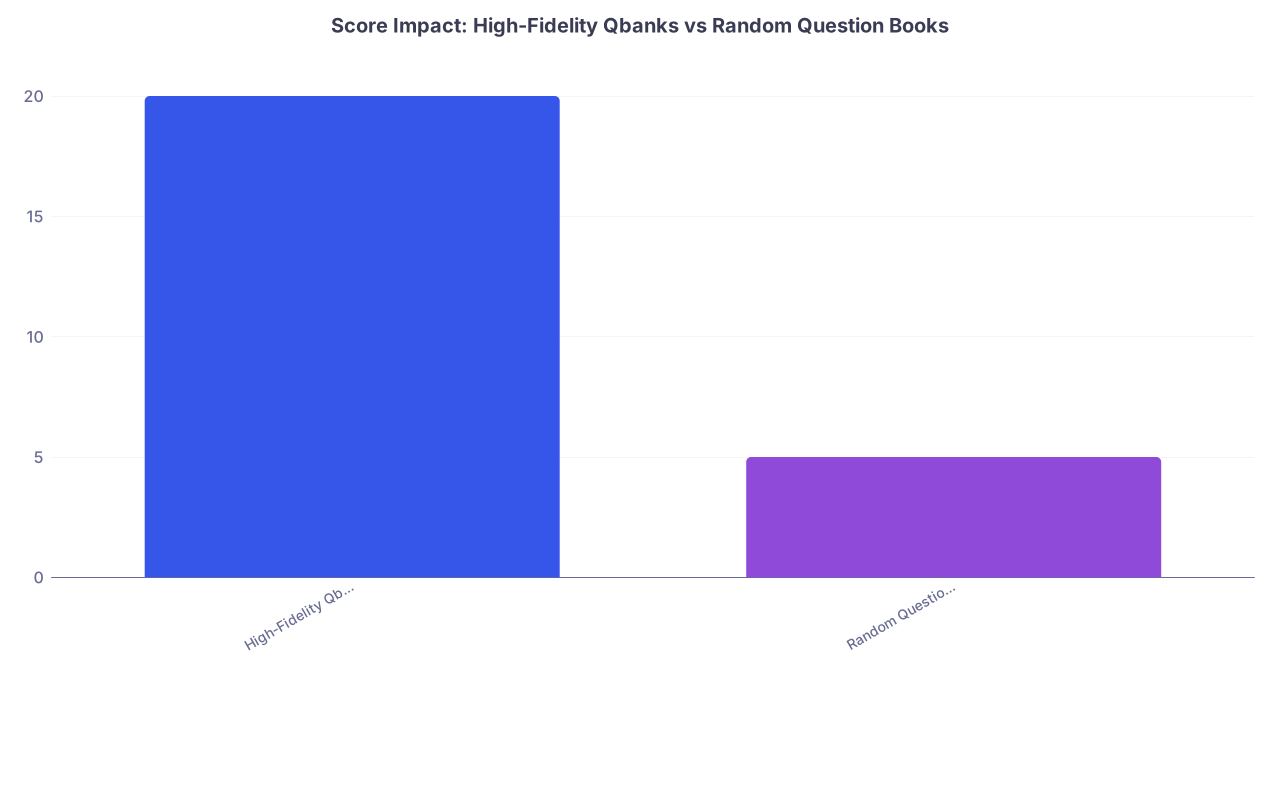
| Category | Value |
|---|---|
| High-Fidelity Qbanks | 20 |
| Random Question Paperbacks | 5 |
(Approximate average score gain potential with consistent use, not exact numbers—but the gap is real.)
4. “Strategy” and “Secrets” Books That Repackage Common Sense
You’ll see this especially for Step 1 and Step 2:
- “Top 100 Secrets for Crushing USMLE”
- “USMLE Step 1 Strategy Guide: Insider Tips”
- “The Only USMLE Book You’ll Ever Need”
These are almost always:
- Short on actual content
- Long on generic advice like:
- “Do lots of practice questions”
- “Focus on your weak areas”
- “Use active learning”
- Filled with personal study schedules that don’t match your situation
You do not need to pay $30–$50 for content that boils down to what any decent upperclassman could tell you over a 30-minute coffee.
Why these “strategy-only” books are overrated
They steal time from practice
Time reading strategy is time not spent testing your understanding, which is what the exam grades.They give a false sense of optimization
You feel like you’re “planning efficiently” while your knowledge base is unchanged.They rarely account for your actual constraints
- Your baseline score
- Your clinical schedule
- Your school’s calendar
If you want strategy:
- Ask recent high scorers from your school
- Read a short blog post or guide
- Use that guidance to structure real work: Qbanks + focused review
But don’t buy a whole book just for study tips.
5. Outdated Editions with Good Reviews (From Another Era of the Exam)
This one is sneaky.
You go on Reddit or SDN. People rave about a certain book. You find a cheap older edition on Amazon—maybe 2–4 editions behind.
You think you’re being smart and frugal.
You’re not. You’re setting yourself up to memorize:
- Old classification names
- Old guidelines
- Old “buzzwords” that exam writers have deliberately moved away from
USMLE evolves. Slowly but definitely. Explanations get more clinical, less buzzwordy. Preclinical minutiae get trimmed; reasoning and safety get emphasized.
Old editions don’t account for that shift.
When an older edition is a real problem
- Step format changed (like Step 1 going Pass/Fail) and the style of testing evolved
- Guidelines changed (HTN, lipids, sepsis, etc.)
- Content priorities shifted (more ethics, safety, systems-based practice, etc.)
If a resource is 6–10+ years behind, you’re training on the exam your senior residents took, not the one you’ll see.

| Step | Description |
|---|---|
| Step 1 | Considering a USMLE Book |
| Step 2 | Skip it |
| Step 3 | Consider Buying |
| Step 4 | Is it widely used AND recent? |
| Step 5 | Is it core or redundant? |
| Step 6 | Do I have time to finish it AND do Qbanks? |
6. The “Anecdotal Miracle” Book Everyone Mentions Once
You’ll hear:
- “This random immunology review changed everything for me.”
- “I used this one obscure path book and jumped 40 points.”
Here’s the ugly truth:
Most of these stories leave out context.
- The student’s baseline was already high
- They changed several things at once (schedule, qbanks, dedication)
- The book simply happened to be new during an upswing in effort
You can absolutely find edge-case resources that click for you. But they become dangerous when:
- You buy 3–4 of them “just in case”
- You replace proven resources with them
- You think you’ve found a shortcut
If one specific book consistently shows up across many sincere, detailed score reports by high scorers, fine—consider it. Otherwise, treat one-off miracle claims as what they usually are: survivorship bias plus nostalgia.
7. How to Build a Lean, High-Yield USMLE Book List (Without Underdoing It)
You’re not trying to be a minimalist monk. You’re trying not to drown.
Here’s a sane structure:
One primary content spine
- Step 1: First Aid–type book (or equivalent integrated resource)
- Step 2: A solid clinical review book or NBME/UWorld notes as your spine
One main path resource
- Pathoma, Boards & Beyond, etc.
Pick one. Not three.
- Pathoma, Boards & Beyond, etc.
One major Qbank (plus official exams)
- UWorld as non-negotiable for most people
- Supplement with NBME practice forms
Optional targeted add-ons (only if a clear weakness)
- A short, tightly written biostats/ethics booklet
- Anki decks for pharm/micro reinforcement
- Very brief, surgical strike style resources
That’s it. Anything else has to fight its way into your schedule by proving:
- You have the time
- It adds something truly new
- It doesn’t cannibalize Qbank and recall time
8. Red-Flag Checklist Before You Buy Anything
Run through this before you purchase another USMLE book:
Is this book >400 pages and not my primary review spine?
- If yes: probably a mistake.
Does this content already exist in UWorld + my main book?
- If yes: it’s redundant.
Did I hear about it from one person with a miracle story—or from consistent, detailed recommendations?
- One-off miracle: be suspicious.
Can I realistically finish this book AND do:
- Full UWorld
- Missed question review
- NBME practice tests
- A structured review period
If not: the book goes.
Am I buying this because I’m anxious, or because I’ve identified a specific, repeated weak area?
- “I’m scared” is not a good enough reason for another 600 pages.
You’re not under-resourced. You’re under-focused.
FAQs
1. Is it ever worth owning more than one big review book for Step 1?
Usually no. One main review spine is enough. When people buy two large review books, they end up half-finishing both, reinforcing nothing. If you must sample another, use it very surgically: a chapter or two to clarify a topic you truly don’t understand, then back to your primary source. But two full spines? That’s a classic score-killer.
2. What about using older hand-me-down USMLE books from friends to save money?
Hand-me-downs are fine for structure and general concepts, but be careful when they’re >5–6 years old or multiple editions behind. Use them as reference or for a quick skim, not as your primary, authoritative source. Combine them with current Qbanks and NBME exams so your understanding reflects the actual test you’ll take.
3. Are specialized books for biostats/ethics worth it?
They can be, but only if they’re short, focused, and widely respected. A 60–120 page concise guide or high-yield outline? Good. A 400-page treatise with dense paragraphs and replicated guidelines? Not worth it. You should be able to get most of what you need from a focused resource plus practice questions that include biostats/ethics items.
4. How do I know if my current book collection is already too big?
Quick test: write down every USMLE resource you own. Now honestly estimate how many hours each one would take to use properly (not just flipping). Add them up. If that total is more than your available study hours minus Qbank and NBME time, you’re overbooked. Start cutting: anything not core, not already in use, or clearly redundant gets boxed up or sold.
Open your USMLE study shelf (or Amazon cart) right now. Put each book through the red-flag checklist above—and physically remove or uncheck at least one that fails. One less dead-weight book today is dozens of hours saved before your exam.