
It’s six months before your exam. You’re staring at UWorld, Amboss, maybe Kaplan, and doing mental math: “There are 3,000+ questions here. Everyone online says ‘do UWorld twice.’ Another person did 10,000 questions. How many questions is actually enough for Step 1? And for Step 2 CK?”
Here’s the answer you’re looking for: there is a reasonable target range. More is not infinitely better. “Doing questions” is not a personality trait or a flex; it’s a tool. Use it correctly, hit the right volume, and move on.
I’ll break this into Step 1, Step 2 CK, and then how to adjust based on your level.
Short Answer: Target Ranges You Can Actually Use
Let me give you the numbers first, then explain the logic.
For Step 1 (now Pass/Fail)
Assuming a standard dedicated period and at least some prep before that:
- Core Q-bank (e.g., UWorld)
- Minimum: ~1,800–2,000 questions seriously done
- Strong target: 2,200–2,800 questions total
- Upper reasonable limit (for most people): ~3,500 questions
- Most students will finish UWorld once (about 2,000–2,400 questions depending on version) plus some supplemental blocks.
More important than the raw number:
You should finish at least 80–100% of a high‑quality bank with detailed review and reach consistent NBME-equivalent passing performance (and some buffer).
For Step 2 CK
Step 2 CK is more question-heavy by nature. You’re tested on management patterns, not obscure facts.
- Core Q-bank (UWorld Step 2)
- Minimum: ~2,200 questions seriously done
- Strong target: 2,400–3,200 questions total
- High but reasonable for top scorers: 3,500–4,000+ questions (UWorld plus a second bank like Amboss)
Again: it’s better to complete one bank well than to flail through 2 banks lazily.
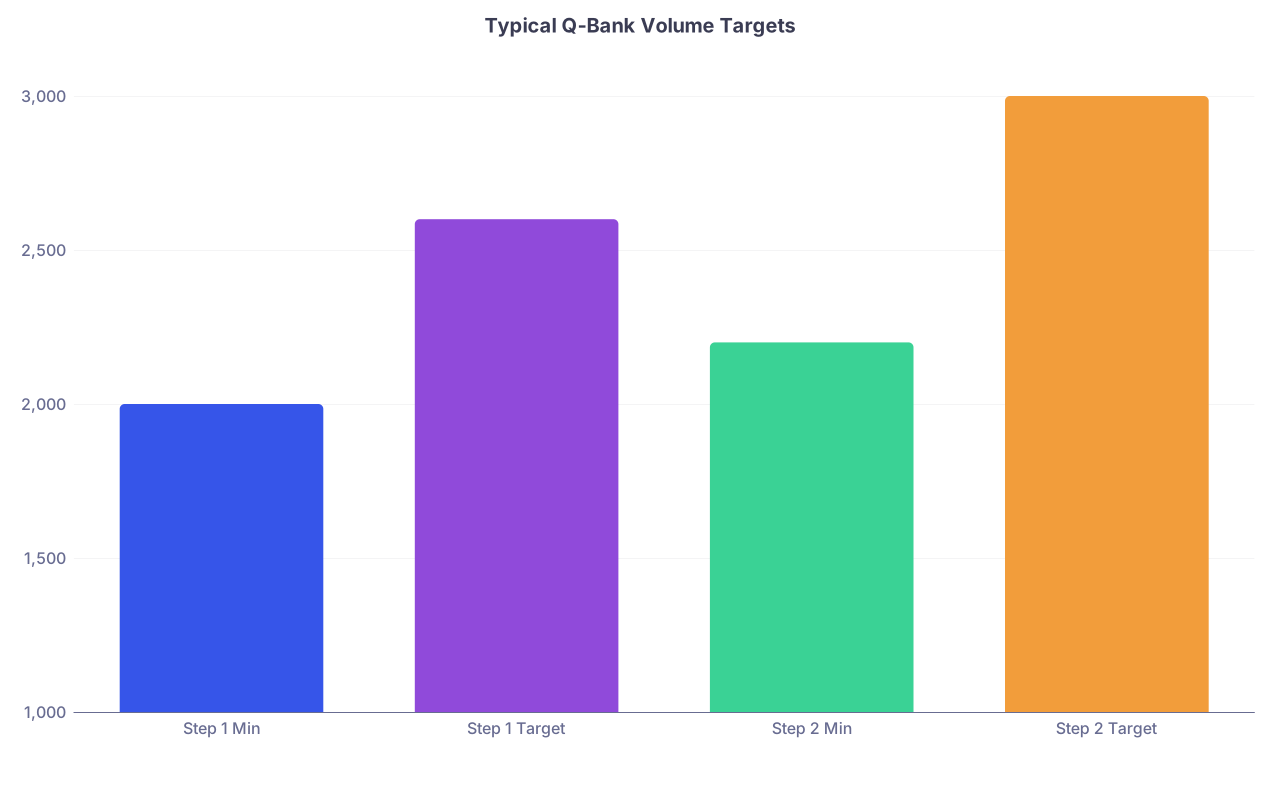
| Category | Value |
|---|---|
| Step 1 Min | 2000 |
| Step 1 Target | 2600 |
| Step 2 Min | 2200 |
| Step 2 Target | 3000 |
Why These Numbers Make Sense (and When They Don’t)
You’re not trying to win a Q-bank marathon. You’re trying to:
- See enough question patterns to recognize what test writers like.
- Solidify core content by retrieval practice.
- Learn how to think in USMLE language: what’s being asked, what’s irrelevant, what actually matters for diagnosis and management.
A typical student during dedicated:
- Can reasonably do 40–80 questions/day with real review.
- Over 6–8 dedicated weeks + some pre-dedicated questions, that comes out to roughly:
- Step 1: 2,000–3,000 total
- Step 2: 2,500–3,500 total
If someone claims they did 8,000+ questions with full review and slept… I don’t believe them. Or their “review” was glancing at explanations like a TikTok feed.
The ceiling effect is real: After a certain point, doing yet another similar hypertension question is less productive than pausing and really understanding the logic behind the last 10 you missed.
Step 1: How Many Questions Are Enough?
Step 1 is now pass/fail, which changes the calculus.
The goal is not to graze every obscure fact. It’s to avoid failing. And ideally, to lay a solid foundation for Step 2 CK.
Baseline Targets for Step 1
Here’s a reasonable structure for most students:
- Pre‑dedicated (during systems)
- 10–20 questions a few times per week per block
- Total: 500–1,000 questions before dedicated
- Dedicated (6–8 weeks)
- 40–80 questions/day, 5–6 days per week
- Total: 1,500–2,000+ questions
Add those together, and you land in the 2,000–2,800 range. That’s what I’d call “enough” for the majority aiming to pass with a margin.
Where do these come from? Usually:
- UWorld Step 1 as the main bank
- Maybe extra from Amboss, Kaplan, or your school’s bank if you finish early or feel weak in certain systems
Who Needs More for Step 1?
If any of these are true, bump up toward or beyond the upper range:
- Pre-clinical GPA is weak, you barely passed some courses
- NBME practice tests are hovering just at or below passing late in dedicated
- You started content review late and are compressing too much
In that case, I’d push you toward:
- Completing 100% of UWorld
- Then adding 500–1,000 supplemental questions focused on your weakest systems (e.g., neuro, renal, endocrine) or subjects (biostats, pharm).
Not 8,000 questions. But yes, breaking 3,000+ can be appropriate if your foundation is shaky.
Who Can Do Fewer for Step 1?
If you’re very strong:
- Consistently high NBME scores well above the pass line early
- Honors in most pre‑clin courses
- Strong question performance even on first pass
You might safely be okay with:
- ~1,800–2,200 total questions
- Provided you’re:
- Doing spaced repetition (Anki or similar)
- Hitting several NBMEs and passing them with room to spare
But I’d still prefer you finish at least 80–90% of a top-tier Q-bank. Skipping hundreds of questions “because you’re tired” is usually laziness disguised as strategy.

Step 2 CK: How Many Questions Are Enough?
Step 2 CK is more about clinical reasoning and management. You do not “memorize your way” through it; you pattern-match through lots of cases.
This inherently takes more questions.
Baseline Targets for Step 2 CK
Assuming you’re doing questions during clerkships (which you should):
- During clerkships (3rd year)
- Use UWorld or another bank subject-wise:
- Medicine: 400–600
- Surgery: 200–300
- OB/GYN: 200–300
- Pediatrics: 200–300
- Psych + Neuro + Misc: 200–300
- Total during the year: 1,200–1,800 questions
- Use UWorld or another bank subject-wise:
- Dedicated for Step 2 CK (4–6 weeks)
- 40–80 questions/day, 5–6 days/week
- Total: 1,200–1,800 questions
Grand total typical range: 2,400–3,200 questions. For many students, that’s a complete pass through UWorld plus some extras or second-pass timing-based work.
| Phase | Questions Range |
|---|---|
| During Clerkships | 1200–1800 |
| Dedicated Period | 1200–1800 |
| Overall Total | 2400–3200 |
When to Aim Higher for Step 2 CK
You should push to the 3,500–4,000+ range when:
- Your Step 1 prep was weak or you barely passed
- Clinical rotations did not give you much responsibility; you feel shaky on basic management
- Your early NBME/CCSA or UWSA scores are well below your target
In that setting, after finishing UWorld once:
- Add a second bank like Amboss or Kaplan, focusing on:
- Ambulatory medicine
- Obscure but testable management steps (next best step, long-term follow-up, contraindications)
Still, review matters more than raw count. I’d take 3,000 questions intensely reviewed over 5,000 skimmed any day.
Step 1 vs Step 2 CK: Why CK Often Needs More
Quick comparison:
- Step 1: heavy on concepts, mechanisms, buzzwords
- Step 2 CK: heavy on what do you do next?, nuance, guidelines
You simply do not internalize “next best step” without being burned by wrong choices repeatedly. This is why high scorers on CK almost always have done at least 100% of UWorld + some extras.
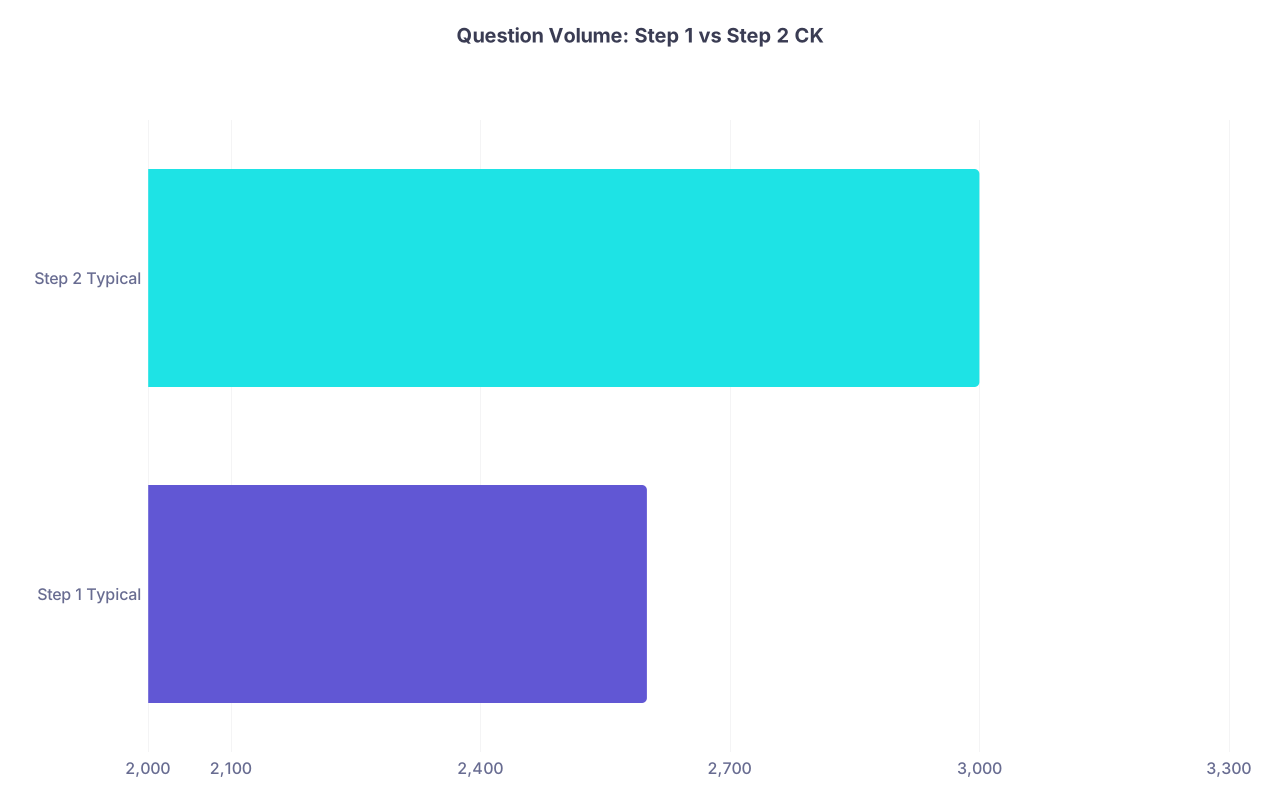
| Category | Value |
|---|---|
| Step 1 Typical | 2600 |
| Step 2 Typical | 3000 |
Quality vs Quantity: How to Make Each Question Count
If your approach to a missed question is: “Oh okay, the answer was C,” and then you move on… you can do 10,000 questions and still be mediocre.
Here’s the minimum effective way to handle Q-banks:
- Do questions timed or at least mixed for part of your prep
- Step 1: start with system-based, move toward mixed closer to exam
- Step 2 CK: much more mixed + timed throughout
- For every missed question (and most guessed-right questions), ask:
- Why specifically was my choice wrong?
- What heuristic would have led me to the right answer?
- What fact or pattern do I need to remember for next time?
- Capture high-yield misses somewhere:
- Anki cards
- A running Google Doc
- A notebook by system
If you are not extracting lessons from questions, then no number is “enough.” You’re just clicking.

Adjusting Question Volume by Performance Level
Instead of worshiping some magic number, anchor your plan to your practice test scores and how you feel doing questions.
Use NBMEs and UWSAs to Decide
Rough framework:
For Step 1
- If your NBME score is safely above the passing threshold (with 10–15+ points buffer), and you’ve done ~2,000+ questions well → you’re probably fine to maintain pace, not necessarily add massive question volume.
- If you’re near or below passing late in dedicated → increase question count + tighten review, don’t waste time on random resources.
For Step 2 CK
- If UWSA/NBME scores are near your goal range, and you’ve done most of UWorld → you can prioritize targeted weak areas over adding an entire second bank.
- If you’re >20 points below target → you likely need more questions and deeper review, not just re-reading notes.
Common Bad Advice About Question Numbers
Let me call out a few things that are plain wrong or overhyped.
“You have to do UWorld twice.”
No, you do not. For some people, a partial second pass is helpful. But doing the same questions you already know, again and again, is terrible return on time.“I did 8,000 questions and got a 260.”
Correlation isn’t causation. That person might have been strong regardless. Also, ask how many of those questions they actually reviewed in depth.“Amboss is better than UWorld, use that instead.”
UWorld is still the gold standard for both Step 1 and Step 2 CK. Amboss is a fantastic supplement, especially for explanations and targeted topics. But I would not skip UWorld to do Amboss only.“If you’re behind, just do more questions, skip review.”
Wrong. If you’re behind, you actually need better review, not less. Cutting review to squeeze in more raw items is how people spin their wheels and stay mediocre.

Putting It All Together: Practical Templates
Here are simple blueprints you can adapt.
If You’re 3–4 Months Out from Step 1
- Aim for 2,200–2,800 total questions
- Weekday plan:
- 40 questions/day (1 block) + 1.5–2 hours review
- Weekend:
- One NBME every 2–3 weeks
- Shorter review days or lighter question load
If You’re 3–4 Months Out from Step 2 CK
- Aim for 2,500–3,500 total questions
- During rotations:
- 10–20 questions/day relevant to your current clerkship
- During dedicated:
- 2 blocks/day (80 questions) + review most days
- One practice test (NBME/UWSA) every 1–2 weeks
If You’re Clearly Behind
- Do not fixate on a mythical question count. Instead:
- Prioritize finishing one main bank (UWorld)
- Push 60–80 questions/day, high-quality review, focus on why you miss things
- Cut lower-yield extras before cutting question review
FAQ (Exactly 5 Questions)
1. Do I really need to finish 100% of UWorld for Step 1 or Step 2 CK?
For most people, yes, or very close. Finishing 80–100% of a high-quality bank like UWorld with solid review strongly correlates with better outcomes. If you’re extremely strong and your NBMEs are excellent, missing 5–10% of low-yield blocks is not going to kill you. But “I did 40% of UWorld and felt fine” is usually famous last words.
2. Should I do a second full Q-bank after UWorld?
Only if you have time and a clear reason. For Step 1, a second full bank is often overkill unless your foundation is weak or you started UWorld bizarrely early. For Step 2 CK, adding 500–1,500 Amboss or Kaplan questions can be very useful once you’ve learned patterns from UWorld. But mindlessly grinding two full banks is not automatically better than one bank + focused review + practice exams.
3. Is it better to do more questions or reread my notes/First Aid?
Once you’re past the very early phase of studying, questions > passive reading almost every time. If you’re forced to choose, do questions and then use notes/First Aid/AMBOSS articles only to fill gaps revealed by your misses. Rereading First Aid cover-to-cover three times instead of doing questions is one of the most common Step regrets I’ve heard.
4. How much time should I spend reviewing each block of questions?
Plan on at least as much time reviewing as you spent doing the block. If a 40-question block takes 1 hour, budget 1–2 hours to review seriously. Fast review (30 minutes for 40 questions) is almost always fake productivity. If you constantly feel rushed in review, you’re probably doing too many questions per day.
5. What if my percentage in UWorld is low (like 45–55%)? Should I stop and relearn content first?
No. That percentage is normal for many students, especially early. Step scores correlate more with practice test performance than with raw Q-bank percentages. Keep doing questions, but slow down your volume slightly and deepen your review. Use every missed question as a content anchor: look up the concept once, write or tag it, and move on. Over time, your percentage should creep up. If your NBME scores remain low late in dedicated, that’s when you consider shifting time toward targeted content review.
Key points to walk away with:
- For Step 1, ~2,000–2,800 well-reviewed questions is enough for most; for Step 2 CK, ~2,400–3,200+ is a solid target.
- Finishing one high-quality bank with deep review beats bragging about raw question counts.
- Let practice tests and your performance, not Reddit flexes, tell you whether you need more questions or just better use of the ones you’re already doing.