
It’s 10:47 p.m. You’ve got UWorld open, AMBOSS bookmarked, a friend texting you about how “everyone” is doing both, and you’re sitting there asking the classic Step question:
Do I grind through one Q-bank twice, or split my time and do two different Q-banks once?
Let me be direct:
For most med students, especially for USMLE/COMLEX prep, the best plan is:
One high‑quality primary Q-bank done once, thoroughly and actively,
- optional targeted use of a second Q-bank (not full pass) if time and sanity allow.
But that doesn’t fully answer what you’re actually asking. So let’s break this down properly.
The Core Question: What Actually Raises Your Score?
You don’t get points for “number of questions completed.” You get points for:
- Recognizing patterns
- Avoiding the same mistakes again
- Translating knowledge into exam‑style thinking
- Managing timing and fatigue under test conditions
Question banks are just tools to train those skills.
Where people go wrong is thinking:
- “More questions = automatically higher score.”
- “Everybody else did 2 Q‑banks, so I have to.”
- “If I do UWorld twice, I’m guaranteed to crush Step.”
All wrong. I’ve watched people do 6,000+ questions and stay stuck in the same score band because they were just clicking through, not learning.
So the real decision isn’t “one Q-bank twice vs two once.”
It’s:
Are you using questions to learn, or to count?
Quick Answer Framework
Here’s the punchline in practical form.
| Situation / Profile | Best Primary Strategy |
|---|---|
| Strong foundation, 8–12 weeks | 1 top Q-bank once, very thorough |
| Weak base, long prep (4–6+ months) | 1 primary Q-bank once + targeted second |
| Short prep (<6 weeks) | 1 primary Q-bank once, no second Q-bank |
| Re-taker with same bank used poorly | New primary Q-bank once (don’t repeat) |
| High scorer aiming 250+ / >650 | 1 primary once + advanced blocks from second |
If you want one simple rule:
Do one Q‑bank well before you even think about a second.
One Q-Bank Twice: When It Helps, When It’s A Waste
Doing one bank twice can be useful. It’s just often misused.
When doing one Q-bank twice can help
It can be decent if:
- Your first pass was early and sloppy
(e.g., did scattered blocks during MS2, barely read explanations) - You’ve had a long gap and genuinely forgot most of it
- You’re specifically targeting pattern recognition and test‑taking skills late in prep
Then a second pass—focused on questions you missed or flagged—can tighten things up.
But notice the nuance:
I’m not saying “re-do every single question mindlessly.” I’m saying:
- Redo:
- Prior incorrects
- Prior guesses
- High‑yield concepts you still miss on NBMEs or COMSAEs
The big problems with two full passes
I’ve seen this plenty of times:
Student: “I did all of UWorld twice.”
Me: “Cool. What was your last NBME?”
Student: “226. I don’t get it.”
Three common reasons:
Memorization instead of thinking
On pass two, your brain goes: “Oh yeah, this is the Auer rods question, answer is acute promyelocytic leukemia.”
You feel smart. But you didn’t actually process the vignette or think through the differential. That doesn’t generalize to new questions.Terrible time trade-off
If you have limited weeks, spending them re‑doing known questions often gives less score gain than:- Doing fresh, high‑quality questions
- Fixing weak subjects from a review book/video
- Doing more practice exams and post‑test review
False confidence
You blast through pass 2 with 75–80% correct and think you’re ready. Then a new NBME smacks you with 60–65%.
Why? Because you trained on recall, not reasoning.
So, is “one Q-bank twice” always bad? No.
Is it overused and overrated? Yes.
Two Different Q-Banks Once: Variety vs Overload
Now the other side: “Should I use UWorld + AMBOSS? Or UWorld + Kaplan? Or boards & beyond Qs + something else?”
Two different Q‑banks can be excellent in some contexts.
Real advantages of a second Q-bank
You get:
Different question styles
UWorld is tightly written, boards‑style. AMBOSS sometimes goes deeper into pathophys and details. NBMEs feel blunt and trick‑free. Exposure to more styles can help.Better breadth
Some banks have stronger micro questions. Others hit ethics/hospital policy more. A second Q-bank fills gaps and weird corners.Extra reps in weak areas
You can hammer cardiology from Q-bank #2 if that’s your soft spot.
The trap with two Q-banks
Here’s how it often goes in reality:
- Plan: “I’ll do all of UWorld and all of AMBOSS before my test.”
- Reality:
- You sprint through UWorld, half‑reviewing explanations.
- You panic about finishing AMBOSS.
- You cut down on practice exams.
- You never really fix your recurring mistakes.
- You burn out 3–4 weeks before the actual exam.
End result? Tons of volume, mediocre learning.
The biggest mistake is this mindset:
“If I don’t finish both Q-banks, I’m behind.”
No. You’re behind if your NBME scores are flat and you still miss the same concepts.
What Actually Matters More Than “1 vs 2 Q-Banks”
You’re asking the wrong primary question. The real levers are:
1. How you use each question
Every question should give you one of these:
- A concept you truly didn’t know → learn it
- A concept you kind of knew → refine and solidify it
- A test‑taking pattern → recognize and label it (“oh, they’re hinting at SIADH here”)
If you’re:
- Skipping explanations
- Ignoring why each wrong answer is wrong
- Not writing down or Anki‑ing recurring misses
…it doesn’t matter if you did 2,000 or 7,000 questions.
2. Your timing and score trajectory
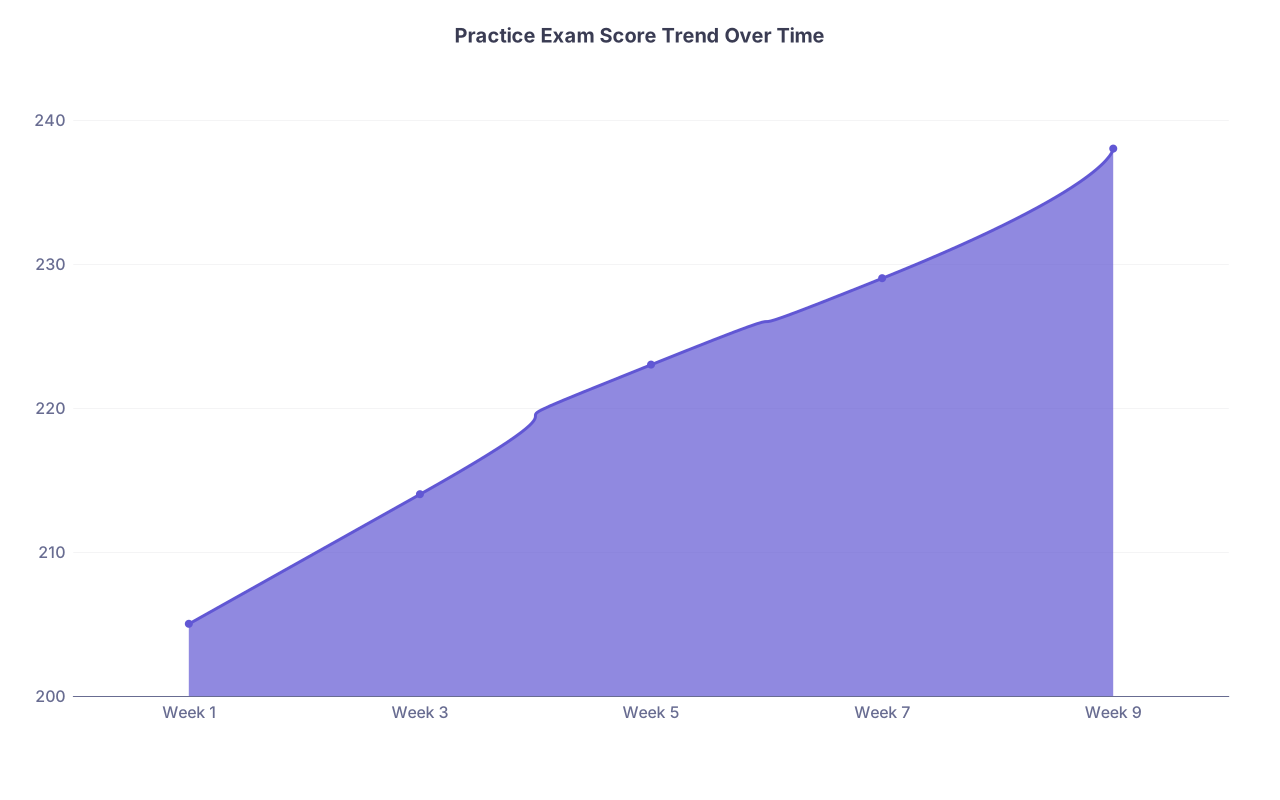
Use your practice exams (NBMEs, UWSA, COMSAE) as gospel:
| Category | Value |
|---|---|
| Week 1 | 205 |
| Week 3 | 214 |
| Week 5 | 223 |
| Week 7 | 229 |
| Week 9 | 238 |
- If your scores are rising: your current strategy is working → don’t randomly change it.
- If your scores plateau for 3+ weeks:
- Something is wrong in how you’re reviewing, not how many banks you have.
- That’s when targeted use of a second Q-bank for weak areas might help.
3. Your foundation
Blunt truth:
If your core knowledge is weak, no number of Q-banks will save you.
In that case, your time is better spent on:
- A structured resource (Boards & Beyond, Pathoma, Sketchy, etc.)
- Then one strong Q-bank slowly, with deep explanation review
- Only later, maybe adding a second Q-bank for extra practice
Concrete Recommendations by Scenario
Let’s go through actual realistic situations.
Scenario 1: Classic Step 2 prep, 8–10 weeks, average student
- Use UWorld as your primary. Do it once.
- 40–80 questions a day, random/timed or by system depending on phase.
- Review each block thoroughly. That’s where the learning is.
- Add:
- NBMEs/UWSAs on a schedule
- Maybe some targeted AMBOSS questions in weak areas if, and only if, you’re on pace with UWorld and not sacrificing practice exams.
Do not try to do full UWorld twice. That time is better spent:
- Fixing missed concepts
- Doing more practice tests
- Short focused sets from a secondary bank in problem areas
Scenario 2: Long runway (4–6+ months), aiming high score
This is one of the few places where two Q-banks can be used well.
Plan could look like:
- First 2–3 months:
- Primary Q-bank (e.g., AMBOSS) in tutor mode, system‑based
- Heavy focus on learning from explanations and reading linked library/citations.
- Next 2–3 months:
- Full pass of UWorld in random, timed blocks, exam‑style.
- Add NBMEs and UWSAs at smart intervals.
- Last 2–3 weeks:
- Redo incorrects/flagged from UWorld.
- Only redo specific high‑yield blocks you struggled with, not the entire Q-bank blindly.
Here, you’re not doing “one Q-bank twice” or “two Q-banks once” in a simplistic way. You’re staging them with different purposes:
First bank = learning. Second bank = performance training.
Scenario 3: Short prep time (<6 weeks)
You don’t have time for games.
- Pick one top-tier Q-bank. Usually UWorld.
- Do as much as you can in a high‑quality way.
- Heavy emphasis on:
- Timed blocks
- NBME/UWSA + serious review
- No second Q-bank. No full second pass. It’s a distraction.
Scenario 4: You already did one Q-bank poorly months ago
Example: you did most of AMBOSS during MS2, clicked through in tutor mode, half‑read explanations. Now real dedicated Step time is here.
Your best move is almost always:
- Switch to UWorld (or whichever you didn’t already ruin with memorization).
- Treat that as your true primary pass.
- You can go back and cherry‑pick tough AMBOSS questions/chapters later for weak spots.
Repeating the same bank you already half‑memorized is usually a mistake. You’ll get a fake sense of progress, not real gains.
A Practical Weekly Structure That Actually Works
Most students don’t need a fancy Notion board. They need a boring, repeatable rhythm.
Here’s a simple template that works better than almost anything:

| Step | Description |
|---|---|
| Step 1 | Pick primary Q-bank |
| Step 2 | Daily mixed blocks |
| Step 3 | Review explanations deeply |
| Step 4 | Track weak topics |
| Step 5 | Targeted review resources |
| Step 6 | Extra questions in weak areas |
| Step 7 | Weekly practice exam or half-exam |
| Step 8 | Adjust plan based on performance |
Roughly:
5 days:
- 40–80 Qs/day from your primary bank
- 2–3 hours reviewing explanations
- Short content review sessions built directly from your missed questions
1 day:
- NBME/UWSA/COMSAE or at least 2 timed blocks chained together
- Review the test and categorize misses
1 lighter/reset day:
- Clean up Anki/notes
- Maybe 10–20 targeted questions in weakest area
Where does the second Q-bank fit?
- Only after:
- You’ve made clear progress on your primary bank
- You’re using it surgically (e.g., “just cardio + renal on AMBOSS this week”)
When You Should Consider Re-Doing Questions
Re‑doing questions isn’t useless. It just has to be smart.
Re‑doing makes sense when:
- You’re 2–3 weeks out and want to:
- Re‑hit your weakest systems
- Re‑enforce patterns in your prior incorrects
- You notice you still miss:
- Biostats calculations
- Ethics/consent questions
- Certain bread‑and‑butter diagnoses
Use your primary bank’s “incorrects” or “marked” filter. Don’t re‑do all 3,000 questions in order. That’s lazy planning disguised as hard work.
Simple Decision Cheatsheet
If you’re still torn, this is the blunt rule set I use with students:
Haven’t finished one top‑tier Q-bank once, carefully?
→ Forget a second bank. Finish the first properly.Finished one Q-bank, but rushed explanations and your NBMEs are flat?
→ Fix your review process first. Then maybe add targeted second‑bank blocks in weak topics.Finished one Q-bank well, months left, scores rising, want to push from good to great?
→ Add a second Q-bank strategically (systems you’re weaker in, or timed random blocks to sharpen performance).Short on time or burned out?
→ One bank, one pass, quality over quantity. Practice exams > second bank.

FAQ: One Q-Bank Twice vs Two Q-Banks Once
1. If I have time, shouldn’t I always do two full Q-banks?
No. Extra questions are only useful if you’re actually learning from them. Once you’ve done one bank well and your scores are moving up, the marginal gain from fully finishing a second bank is smaller than people think. Often, targeted use of a second bank and more practice exams is better than mindlessly grinding through every question.
2. Is UWorld enough by itself for Step?
For a massive number of students, yes—if you:
- Do it once in a serious, thorough way
- Pair it with several NBMEs/UWSAs
- Actually learn from your mistakes and fill gaps with a primary content resource
Students get into trouble when they either don’t finish UWorld, or cannonball through it without review, then blame the resource.
3. Should I do tutor mode or timed mode on my first pass?
Early on, system‑based tutor mode is fine for building understanding, especially if your base is weak. But by the middle of your prep you should transition to timed blocks, ideally random, because Step/COMLEX is timed and random. You can use a second Q-bank later in timed mode if your first pass was mostly tutor‑based.
4. How many total questions should I aim for?
Stop chasing some magical “5,000 questions” number you saw on Reddit. A solid benchmark for many students is:
- 2,000–3,000 high‑quality questions done well
- Plus several full‑length practice exams
More than that is fine if you’re learning, but if you’re just chasing volume, you’re wasting time. I’d rather see 2,200 deeply reviewed than 4,500 half‑read.
5. I’m a re-taker. Should I redo the same Q-bank or switch?
If you already did a Q-bank and remember a lot of its stems/answers, switch your primary bank. Memorized questions hide real weaknesses. Use the new bank as your main grind, then later—if you really want—revisit incorrects from the old bank for reinforcement. But don’t lean on a fully repeated bank as your main strategy the second time around.
Key Takeaways:
- One high‑quality Q-bank done once, thoroughly, beats two rushed passes or two half‑baked banks.
- Use additional Q-banks and repeats surgically: for weak areas, pattern reinforcement, and performance tuning, not ego or question counts.
- Let your practice exams—not FOMO—decide if your current Q-bank strategy is actually working.