
What’s the one Step 2 CK resource you should build everything else around so you’re not juggling 7 half-finished books and 10 PDFs?
Let’s cut right to it.
If you want a single content “spine” for Step 2 CK, and you’re not an extreme outlier with bizarre learning preferences, the answer in 2025 is:
AMBOSS should be your spine.
Not UWorld.
Not OnlineMedEd (OME).
Not a random PDF your senior swore by.
UWorld is your question engine. AMBOSS is your content spine.
I’ll walk through exactly why, when I’d break that rule, and how to actually organize your studying around a single “spine” without losing your mind.
First: What Does a “Spine” Resource Actually Mean?
You don’t need 10 “primary resources.” You need one backbone, then everything else plugs into it.
Your spine resource should do three things:
Cover all high-yield Step 2 CK topics in a reasonably complete way
Not perfect. Not like a full IM textbook. But enough that if you learned just this plus lots of questions, you'd be fine.Be easy to search and cross-link
When UWorld hits you with “crescent sign” or “Lefort fractures,” you should have one place you instinctively go to look it up.Be structured well enough to review again near the end
You don’t want to “review UWorld” as your main content review. That’s pain. You want a spine that you can skim through system by system in the last 2–3 weeks.
That’s the point. You pick one spine. You marry it. Everything else is “questions and extras.”
Why AMBOSS Is The Best Single Spine for Step 2 CK
Here’s why I recommend AMBOSS as the central content resource for most students.
1. It’s Built Like a Digital Textbook, Not Just a Bank
UWorld explanations are fantastic, but they’re reactionary. You only see info tied to questions you’ve done.
AMBOSS has:
- Articles organized by disease, symptom, or topic
- Built-in algorithms and flowcharts
- Quick “Exam Essentials” summaries
- Integration between articles (you click through a thought process like you would in real life)
When you’re mid-block and miss a question on chronic mesenteric ischemia, you can literally jump into a clean, structured article on it. That’s what “spine” looks like.
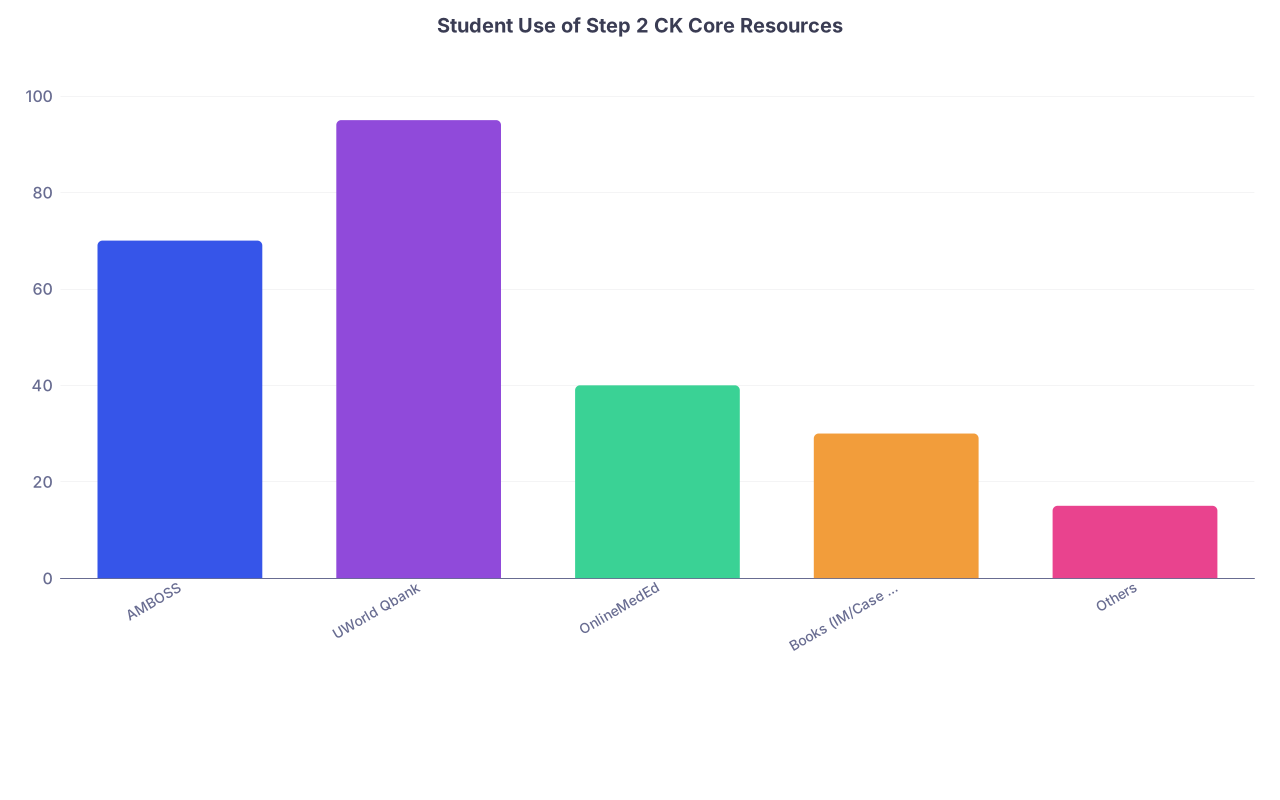
| Category | Value |
|---|---|
| AMBOSS | 70 |
| UWorld Qbank | 95 |
| OnlineMedEd | 40 |
| Books (IM/Case Files) | 30 |
| Others | 15 |
2. The Search + Highlight Tools Make It Actually Usable
The difference between owning a resource and using it daily is whether it’s searchable and fast.
AMBOSS gives you:
- A real search bar that actually works when you type “old person hip pain after fall”
- Hover-to-define and highlight features
- Cross-linking between articles, images, and tables
You’re trying to move fast, not do a literature review. AMBOSS plays nicely with that.
3. It Covers Breadth Without Drowning You
Step 2 CK is broad: medicine, surgery, OB, peds, psych, EM, ethics, biostats.
AMBOSS hits:
- Classic bread-and-butter topics (MI, pneumonia, preeclampsia, asthma)
- Less common but testable stuff (pseudotumor cerebri, strange rashes, tropical infections)
- Ethics/biostats/communications at a board-style level
Is it 1000% complete? No. Neither is anything else. But as a single spine, it’s the best compromise between depth and test-relevance.
4. It Integrates Well With Questions (Including Its Own Qbank)
Your workflow should look something like:
- Do UWorld blocks
- Mark things you guessed on or missed
- Look those topics up in AMBOSS and create short notes / Anki / screenshot
If you also use the AMBOSS Qbank (which is solid but still #2 to UWorld), that’s just extra practice that clicks back into the same article backbone.
Why Not UWorld As Your “Spine”?
Let me be very clear: UWorld is non-negotiable for Step 2 CK.
But it’s not your spine. It’s your gym.
Here’s the problem with trying to make UWorld your main content resource:
- Explanations are fragmented by question, not by topic
- There’s no clean, linear structure for “I want to systematically review all of cardiology”
- It’s terrible to rapidly skim for dedicated review
- You guess on something, read the explanation, then 3 weeks later you can’t remember where you saw that concept
Use UWorld for:
- Practice questions
- Learning patterns and test logic
- Identifying your weak spots
Then anchor those weak spots in AMBOSS (or whichever spine you choose).
Trying to “review UWorld” as if it’s a textbook is how people burn out and still feel lost.
Where Do Other Popular Resources Fit In?
Let’s be honest about the rest of the Step 2 CK zoo.

OnlineMedEd (OME)
Great for:
- Early M3 when you’re just trying to not drown on the wards
- People who learn strongly by video and story
Weak as a spine for pure Step 2 CK:
- Content is simplified by design
- Some topics are underdeveloped or not updated to NBME quirks
- Difficult to use as a last 2–3 week rapid review backbone
Use it as supplemental: watch a video on a topic you keep missing, then cement with AMBOSS/UWorld.
Step-Up to Medicine, Case Files, etc.
These are rotation weapons, not ideal single spines for CK.
They’re:
- Too detailed or too narrative
- Annoying to search on the fly
- Painful to integrate into a digital, Qbank-heavy workflow
If you love a specific book, fine. Use it early in third year. But for most students, it should not be the main CK backbone.
NBME/Free 120
These are assessment tools, that’s it. No content spine here.
How to Actually Use a Single Spine Without Wasting Time
Picking AMBOSS as your spine isn’t enough. You need a way to work it into your daily routine.
Here’s the model I’ve seen work over and over.
Step 1: Pick a Primary Structure (By System or Rotation)
Two common ways:
By rotation during M3
- On medicine: focus on cardio, pulm, renal, ID topics in AMBOSS that match your patients and UWorld blocks
- On OB: OB and Gyn in AMBOSS + matching UWorld sets
By system during dedicated
- Week 1–2: IM-heavy systems (cardio, pulm, renal, GI)
- Week 3: OB, peds
- Week 4: psych, neuro, EM, ethics/biostats
Doesn’t need to be fancy. But you need a path so that by the end, you’ve touched all the spine content at least once.
Step 2: Make UWorld the Driver, AMBOSS the Anchor
Daily plan, stripped down:
- 40–80 UWorld questions (timed, random or system-based depending on your phase)
- For each question you miss or guessed:
- Skim the explanation
- Immediately open the related AMBOSS article
- Read the Exam Essentials + key table/algorithm + one clinical image if relevant
- Capture 1–3 takeaways (Anki, notebook, screenshot folder – don’t overcomplicate)
That’s how you keep your spine alive and not just “a thing you meant to use.”
Step 3: Use AMBOSS for Active Review, Not Passive Reading
Don’t sit there “reading AMBOSS” like a novel. That’s how your brain checks out.
Better ways:
- Before a UWorld block on cardio, spend 10–15 minutes skimming AMBOSS’s main cardio summary or a few high-yield topics (ACS, HF, valve disease)
- After missing several nephrotic/nephritic questions, do a mini session:
- Open 2–3 related AMBOSS articles
- Force yourself to predict diagnostic steps and treatment before scrolling
- Compare the algorithm to how you tried to think during the questions
You’re training clinical reasoning plus recall, not just memorizing bullet points.
What If AMBOSS Just Doesn’t Click for Me?
Fair. Not everyone likes the same interface or style.
Here’s the honest hierarchy if AMBOSS really doesn’t work for you as a spine:
| Rank | Resource | Best Use Case |
|---|---|---|
| 1 | AMBOSS | Default digital spine for most people |
| 2 | OnlineMedEd + Notes | Strong video learners |
| 3 | Step-Up to Medicine | IM-heavy focus + strong readers |
| 4 | Combination PDFs | Very organized self-curated learners |
| 5 | “Just UWorld” | Only for ultra-efficient high scorers |
If you’re a video-first learner
You can make OME + your own condensed notes your spine, if:
- You actually take structured notes while watching
- You organize those notes by system/topic
- You revisit them multiple times before the exam
But you’re doing more work to build the spine yourself.
If you love textbooks
You can use Step-Up to Medicine (for IM-heavy content) plus supplemental OB/peds/psych resources as your spine, but:
- You must be disciplined about time
- You can’t read it cover-to-cover; you target high-yield chapters
- You accept that searching something quickly is more annoying
If you’re not sure which camp you’re in, you’re probably in the AMBOSS camp.
Common Mistakes Students Make With Step 2 CK Resources
I’ve watched a lot of people do this badly. Let’s avoid their mistakes.
Mistake 1: Trying to Have 3 “Spines”
UWorld, AMBOSS, OME, Step-Up, that Google Drive PDF, plus a Discord-recommended outline.
You end up:
- Half-finishing everything
- Having no single go-to reference when confused
- Feeling constantly behind
Pick one spine. Everything else is secondary.
Mistake 2: Confusing Familiarity With Mastery
You “watched all of OME” or “read most of AMBOSS cardio” and feel like you “covered it.”
Then you hit UWorld and get smoked on subtle second- or third-order thinking.
The exam tests application. Your spine helps, but questions and review of missed concepts are what convert content into score.
Mistake 3: Never Reviewing the Spine Near the End
In the last 2–3 weeks:
- You should absolutely still be doing questions
- But you should also be systematically skimming your spine resource
If AMBOSS is your spine, that might look like:
- Day: 40–80 UW questions
- Evening: 1–2 hours skimming 1–2 systems in AMBOSS, hitting the Exam Essentials of each relevant article and quickly reviewing algorithms
That final pass pulls everything together.
A Simple 4-Week Plan Using AMBOSS as Your Spine
Let’s be concrete. Assume:
- You have 4 dedicated weeks
- You’ve done some UWorld during M3, but not all
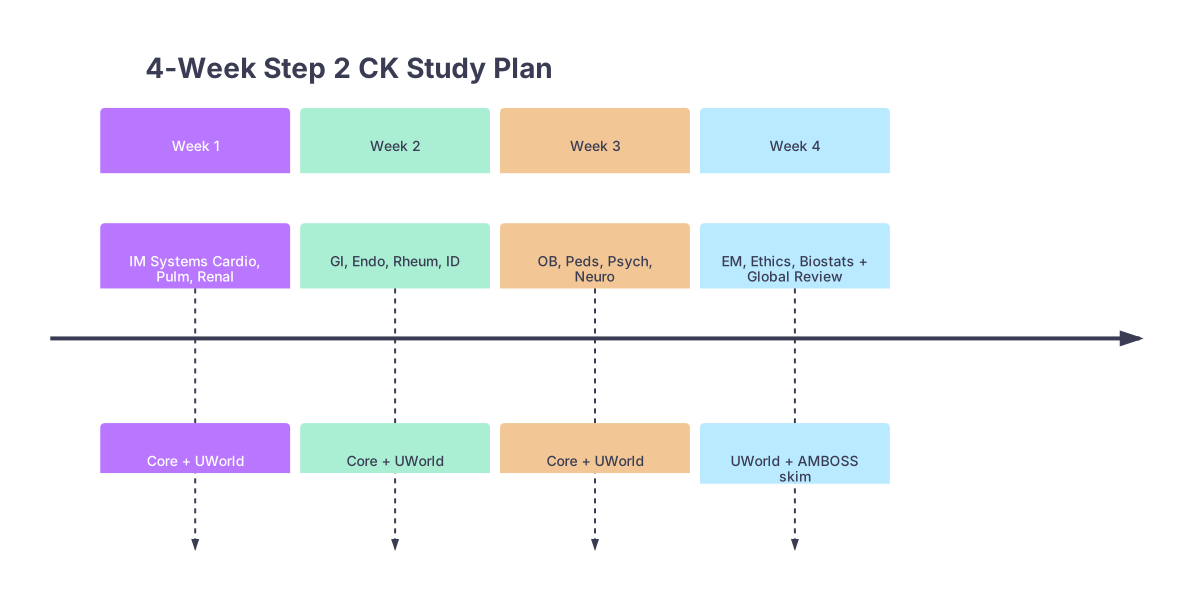
| Period | Event |
|---|---|
| Week 1 - IM Systems Cardio, Pulm, Renal | Core + UWorld |
| Week 2 - GI, Endo, Rheum, ID | Core + UWorld |
| Week 3 - OB, Peds, Psych, Neuro | Core + UWorld |
| Week 4 - EM, Ethics, Biostats + Global Review | UWorld + AMBOSS skim |
Rough daily flow:
- Morning: 40-question UWorld block (timed, random or system-based)
- Midday: Review block + targeted AMBOSS lookups
- Afternoon: Another 40-question block
- Evening: 60–90 minutes of AMBOSS spine work by system
Not perfect for everyone, but you get the idea: UWorld drives, AMBOSS organizes.
Quick Reality Check: Is One Spine Really Enough?
Yes—if you actually work it.
Here’s what high scorers usually have in common:
- One main content reference (most commonly AMBOSS now)
- Full pass (or near-full) of UWorld with serious review
- Some form of spaced repetition (Anki, concise notes, or AMBOSS highlights)
- A structured final 2–3 week review using that same spine
They’re not reading 5 different full resources. They’re recycling the same core structure over and over until it sticks.
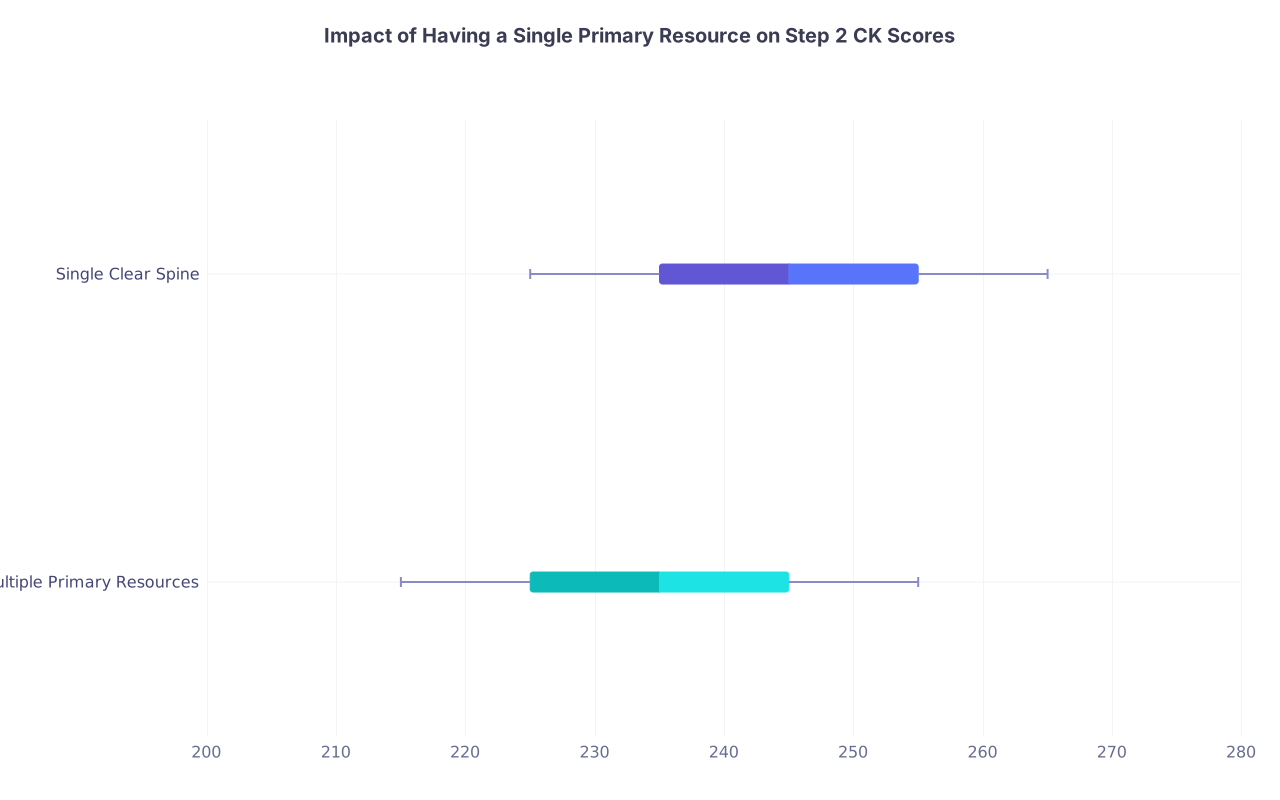
| Category | Min | Q1 | Median | Q3 | Max |
|---|---|---|---|---|---|
| Multiple Primary Resources | 215 | 225 | 235 | 245 | 255 |
| Single Clear Spine | 225 | 235 | 245 | 255 | 265 |
Scores don’t come from owning more PDFs. They come from depth and repetition anchored to a clear structure.
FAQs
1. If I can only afford one paid resource besides UWorld, should it be AMBOSS?
If we’re strictly talking content spine: yes, AMBOSS over anything else.
If you somehow had to choose between UWorld and AMBOSS, then UWorld wins. But between AMBOSS, OME premium, and some random review book? Take AMBOSS every time for Step 2 CK.
2. Can I use just UWorld and no spine at all?
You can. Some very strong test-takers do this and still crush the exam. But they’re usually:
- Already clinically sharp
- Very comfortable reading long explanations
- Good at mentally organizing scattered facts
For most students, skipping a spine leads to: “I’ve done 3000 questions and still feel like I have holes everywhere.”
3. How much AMBOSS should I realistically get through before my exam?
You don’t need 100% completion. Aim for:
- High-yield systems (cardio, pulm, renal, GI, ID, OB, peds, psych, neuro)
- Quick skim of EM/ethics/biostats/derm/ortho
If you hit the Exam Essentials and main algorithms for the big systems and tie them to UWorld questions, you’re in good shape.
4. When during third year should I start using my spine?
Best pattern:
- Early M3: Use your spine (AMBOSS or otherwise) to prep for each rotation and for shelf exams
- Late M3 / early M4: Turn that same spine into your formal Step 2 CK foundation during a dedicated block
The win is continuity: same structure all year → less chaos during dedicated.
5. How do I avoid getting lost doom-scrolling in AMBOSS?
Set rules:
- Never read an article “just because” without a trigger (missed question, upcoming shelf topic, or planned system review)
- Cap your read time: 5–10 minutes per topic max
- Focus on Exam Essentials, algorithms, and the parts directly related to a question you missed
If you catch yourself scrolling random unrelated topics, stop. Go back to questions.
Open your Step 2 CK study doc (or notes app) right now and write one sentence:
“My Step 2 CK content spine will be: ______.”
Fill in that blank, commit to it, and build everything else around that choice.