The idea that you absolutely must have separate resources for shelf exams and boards is exaggerated—and sometimes flat‑out wrong.
You can (and should) do at least 80–90% of your studying for both with the same core resources. The trick is how you use them and when you layer on rotation‑specific tools.
Let me walk you through what actually matters and where people waste time and money.
The Core Answer: One Main Stack, Targeted Add‑Ons
If you want the bottom line upfront:
You do not need two totally different study ecosystems for shelves vs Step 1/2. You need:
- One primary question bank stack
- One primary content/summary stack
- A few rotation‑specific add‑ons when needed
The students who burn out are the ones trying to juggle: UWorld + AMBOSS + OnlineMedEd + B&B + Anki + textbooks + random PDFs “for shelves only” + separate “boards‑only” stuff. Then they wonder why nothing sticks.
Here’s the reality:
- Shelf exams and USMLE Step 2 are testing almost the same clinical content
- Shelf exams are NBME‑style clinical vignettes → exactly like Step 2
- Differences are mostly:
- Depth vs breadth
- Timing: shelves hit during rotations, Step 2 after
- Emphasis: shelves lean harder into the rotation’s specialty
So no, you don’t need a completely separate universe of resources. You need to be strategic.
What Can Be Shared Between Shelves and Boards?
Let’s be specific. This is where most people are pleasantly surprised.
1. Question Banks: The Workhorse
For clinical years (shelves + Step 2):
- UWorld Step 2 CK
- AMBOSS Step 2 (optional but great if you can handle two)
You can use these for both:
- During each rotation:
- Do subject‑tagged questions (e.g., UWorld “Internal Medicine”, “Ob/Gyn”)
- Treat these as your shelf prep
- After clerkships:
- Reset and do mixed blocks for Step 2
- Same bank, different mode and strategy
For pre‑clinicals / Step 1:
- UWorld Step 1
- NBME practice exams
Those are also enough for school block exams + Step 1 if you supplement with lectures or a good board‑oriented content source.
You don’t need: three different Qbanks “just for variety”. That’s not variety; that’s dilution.
2. High‑Yield Content: Shared Backbone
The backbone you pick for boards will also carry you through shelves if you frame it correctly.
Examples that can do double duty:
- OnlineMedEd (OME) videos – excellent for:
- Building initial clinical framework for each rotation
- Later as a fast Step 2 review
- Boards & Beyond – great for:
- Building foundational understanding for Step 1
- Revisiting tricky systems ahead of Step 2
- Anki (good premade deck or your own)
- Same cards can reinforce both shelf/rotation content and boards fundamentals
The trick: don’t create totally separate “shelf decks” and “boards decks” and “school exam decks.” That’s how you drown. Have one main spaced‑repetition system and tag or filter it if you must, but don’t multiply systems.
3. NBME‑Style Practice Exams
These absolutely count for both:
- NBME subject exams = dress rehearsal for shelves
- NBME Comprehensive exams (CBSE, CCSE) = dress rehearsal for Steps
Same style. Same writers. Same trap answers.
You’re not “wasting” NBME practice if you’re thinking ahead to boards. You’re building pattern recognition and calibrating your brain to the real test style.
Where Separate Shelf Resources Actually Help
Now the more honest part: there are moments when you benefit from resources that are specifically tuned to a rotation’s shelf.
Here’s when you should seriously consider rotation‑specific add‑ons:
- The rotation is your weak area (e.g., Psych, Ob/Gyn, or Neuro for many people)
- Your school has a history of brutal shelves / below‑national averages
- You’re aiming for a competitive specialty and need strong shelf performance for honors
In those cases, the following can be worth it:
- Case Files series (good for: FM, IM, Ob/Gyn, Surgery, Peds, Psych)
- OnlineMedEd rotation‑specific playlists and notes
- Emma Holliday YouTube lectures for surgery and internal med
- Rapid Review style guides (e.g., De Virgilio for surgery, BRS Pediatrics for some)
But notice the pattern: these are rotation‑focused, not some alternate “boards universe.” They help you plug gaps in areas where the shelf goes deeper than you’ll need for Step 2’s broad sweep.
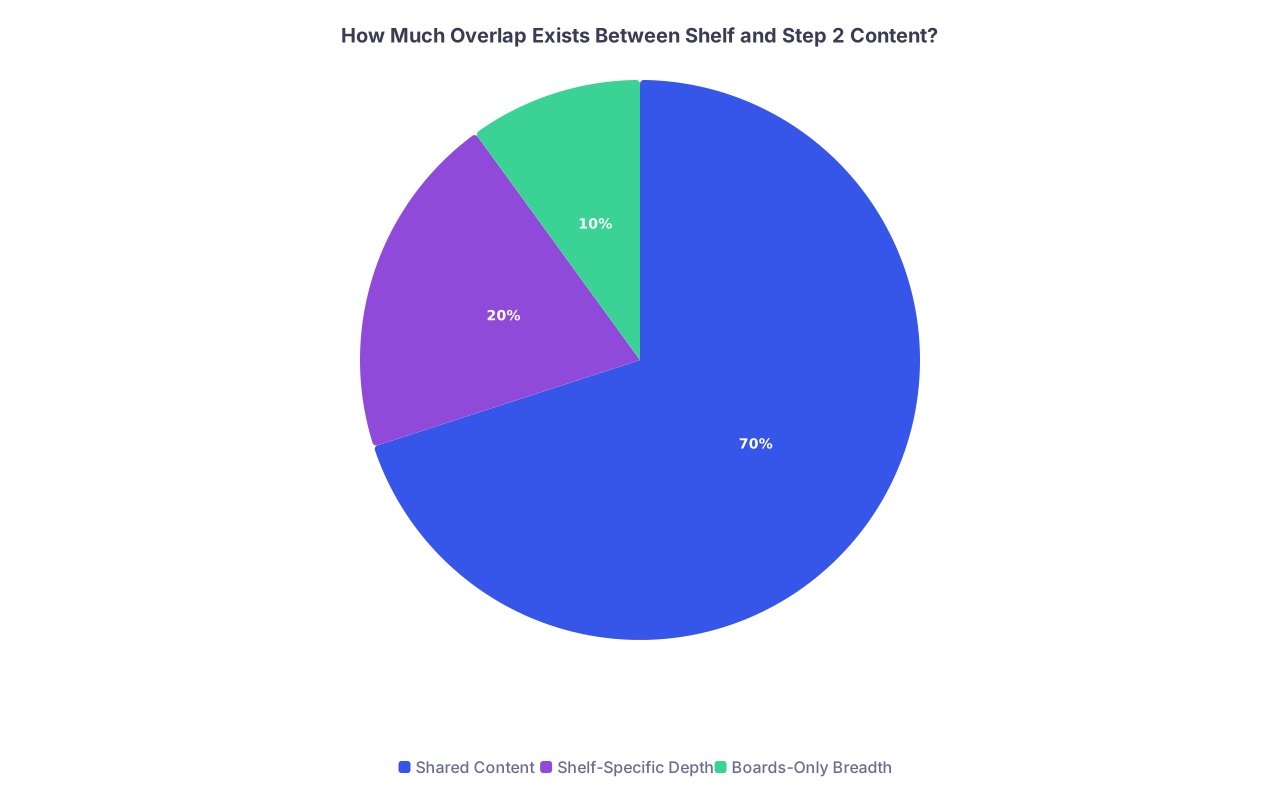
| Category | Value |
|---|---|
| Shared Content | 70 |
| Shelf-Specific Depth | 20 |
| Boards-Only Breadth | 10 |
Rough reality: about 70% is the same core content. Maybe 20% is shelf‑only deep dive (e.g., detailed ovarian tumor histology on Ob/Gyn shelf), and about 10% is Step‑only breadth or integrated content.
How to Build One System That Covers Both
You don’t need separate resources. You need a coherent plan. Here’s a simple, workable model.
During a Rotation (Shelf‑First, Boards‑Later Mindset)
Week 1–2:
- Watch OME or similar for that rotation
- Start UWorld questions limited to that subject
- Take notes in one place (digital or a single notebook) that you’ll later reuse for Step 2
Week 3–4:
- Ramp up questions to 40–80/day depending on schedule and stamina
- Rewatch weak topic videos on 1.5–2x speed
- Use Anki or targeted flashcards for things you keep missing
Week 5+ (for longer rotations):
- Add one practice NBME/subject exam
- Switch some blocks to timed, random within the subject
- Keep all your notes and error logs in the same structure you’ll use for Step 2 review
Result: You’re not doing “shelf prep” and “boards prep” as separate projects. You’re building your Step 2 foundation while sharpening for the shelf.
After Rotations (Boards Push)
For Step 2 CK:
- Reset or mark all UWorld questions as “unseen” if you did them by subject
- Do mixed blocks now – not subject‑segmented
- Use the very same notes you wrote during rotations, organized by:
- Cardiology
- Pulm
- Renal
- Ob
- Peds
- Psych
- Etc.
Your board prep becomes:
- The same Qbank, different style of usage
- The same video sources, but watched more quickly, filling gaps
- The same Anki content you’ve been maturing all year
No reinvention. Just consolidation.
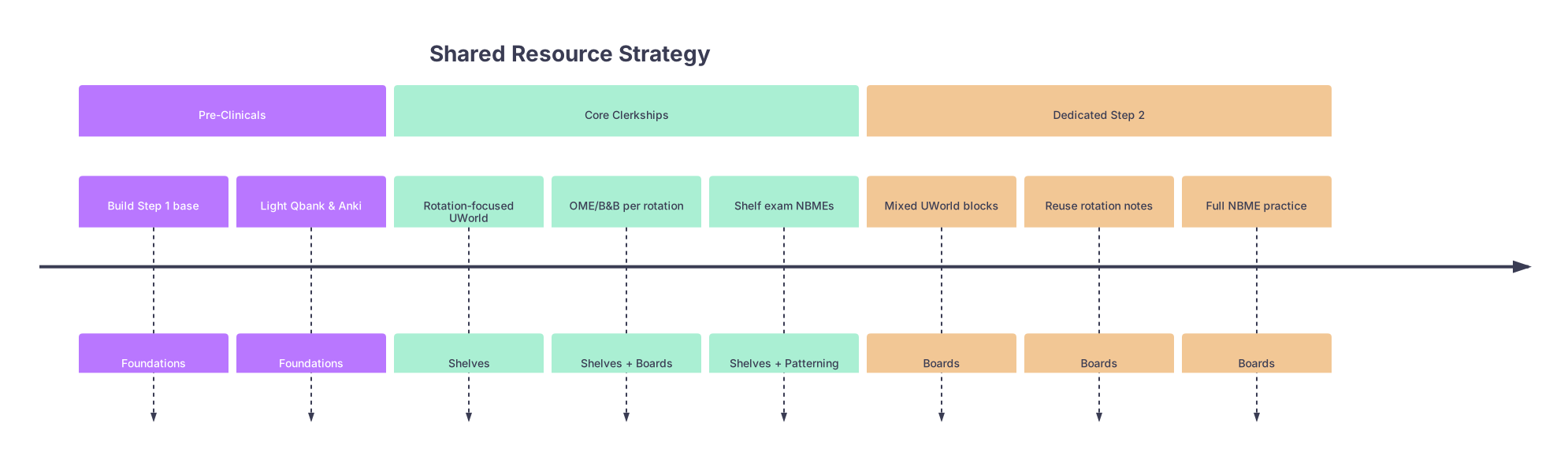
| Period | Event |
|---|---|
| Pre-Clinicals - Build Step 1 base | Foundations |
| Pre-Clinicals - Light Qbank & Anki | Foundations |
| Core Clerkships - Rotation-focused UWorld | Shelves |
| Core Clerkships - OME/B&B per rotation | Shelves + Boards |
| Core Clerkships - Shelf exam NBMEs | Shelves + Patterning |
| Dedicated Step 2 - Mixed UWorld blocks | Boards |
| Dedicated Step 2 - Reuse rotation notes | Boards |
| Dedicated Step 2 - Full NBME practice | Boards |
Common Bad Strategies You Should Avoid
I’ve watched plenty of students sabotage themselves with overcomplication. Here’s what doesn’t work well.
Two totally separate resource stacks
“These are my shelf resources. These are my Step 2 resources.”
Translation: You’re going to forget half of both.Switching resources every rotation
IM: UWorld + OME
Surgery: AMBOSS + De Virgilio only
Peds: Just Case Files, no Qbank
End result: zero continuity, shallow learning, and a Step 2 prep nightmare.Ignoring boards until ‘dedicated’
The fantasy: “I’ll just crush shelves with rotation‑only resources and worry about Step 2 later.”
Reality: You’ll hit dedicated and realize you never built a reusable framework.Too many Qbanks
UWorld + AMBOSS + Kaplan + random school bank “for shelves.”
You’re better off doing one bank deeply, reviewing every missed question, and mastering patterns.
How to Decide if You Personally Need Separate Shelf Resources
Not everyone needs extra shelf‑specific tools. Use this as a quick self‑check.
| Situation | Separate Shelf Resources? |
|---|---|
| Strong test taker, mid‑range school | Probably not necessary |
| Weak in a specific specialty | Yes, for that one rotation |
| School shelves below national avg | Yes, at least 1 focused book/video set |
| Gunning for very competitive specialty | Yes, to aim for honors across core rotations |
| Limited time, heavy service hours | Only 1 extra high‑yield resource max |
If you’re in the “probably not necessary” group, stick to:
- UWorld by subject
- One video series (OME/B&B)
- Your school’s required material
If you’re in the “yes” group, keep it lean: one shelf book or video series per rotation, not an entire parallel universe.
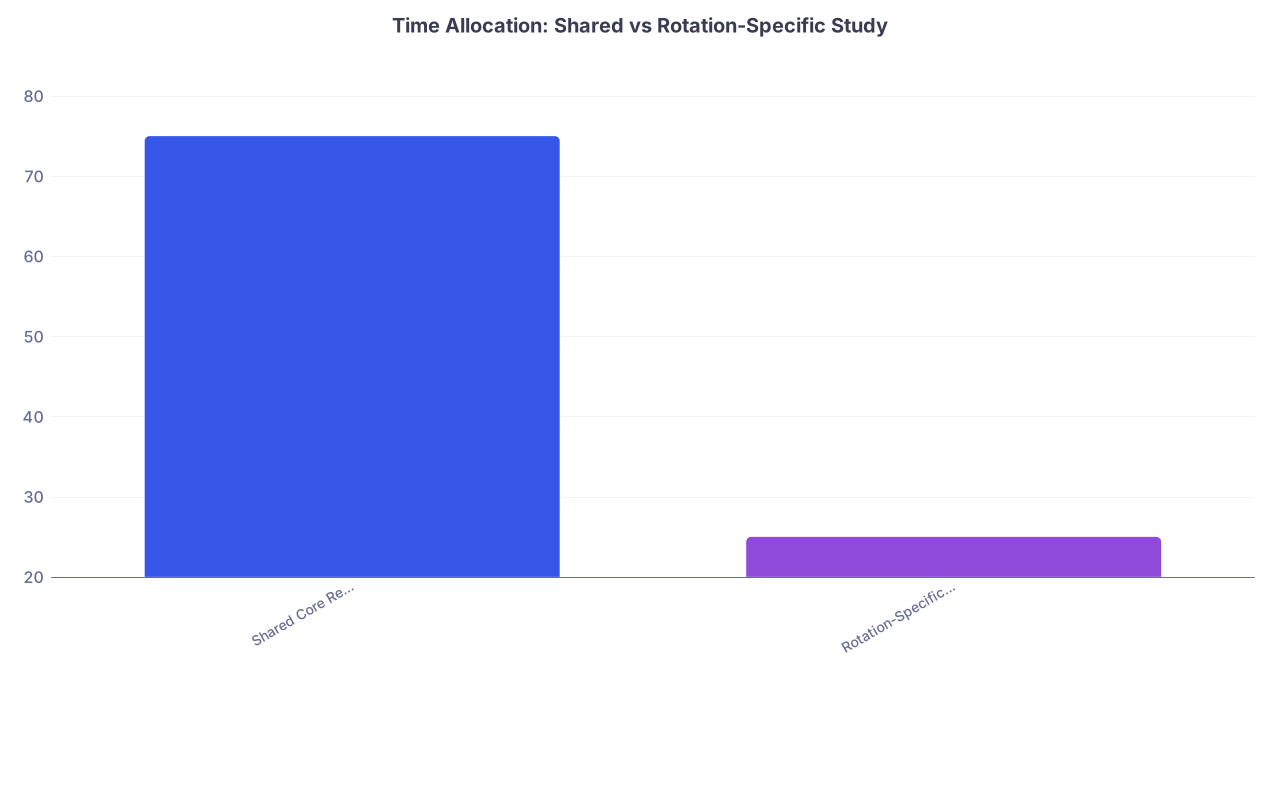
| Category | Value |
|---|---|
| Shared Core Resources | 75 |
| Rotation-Specific Add-ons | 25 |
A good heuristic: about 70–80% of your study time on shared, reusable resources; 20–30% on true shelf‑only deep dives where you need it.
Practical Examples by Rotation
To make this concrete, here’s how I’d structure things without building two ecosystems.
Internal Medicine (IM):
- Shared (shelf + Step 2):
- UWorld IM questions
- OME IM videos
- Optional IM shelf‑help:
- Emma Holliday IM video a week before the shelf
Surgery:
- Shared:
- UWorld Surgery + some IM questions (because the surgery shelf is secretly mostly IM)
- Shelf‑specific:
- De Virgilio or Pestana (pick one)
- Emma Holliday Surgery video
Pediatrics:
- Shared:
- UWorld Peds questions
- OME Peds
- Optional:
- Case Files Pediatrics for narrative‑style reinforcement
Same pattern for Psych, Ob/Gyn, FM. One Qbank. One general content core. One optional shelf‑focused helper.
When Boards Resources Truly Do Need to Be Distinct
There are a few exceptions where boards can require specific tools you don’t need for shelves:
- Biostats/Epi/ Ethics – Step 1/2 hit this harder than most shelves
- Multi‑system integration – weird crossover questions (OB + critical care + ethics) that shelves rarely emphasize
- Preclinical minutiae – enzyme pathways, rare diseases more for Step 1 than any shelf
For those, you may genuinely need:
- Dedicated biostats resource or UWorld biostats review
- A solid Step 1 review book or videos (for those still taking Step 1 numerically or who are weak on foundations)
But that’s not “separate for the sake of being separate.” That’s filling genuine content gaps that shelves won’t cover well.

FAQs
1. If I crush my shelves, will I automatically crush Step 2?
No. Strong shelf scores correlate with strong Step 2 scores, but only if you’re using shared resources and reviewing efficiently. If you learned each rotation in a silo (random notes, random PDFs, no Qbank continuity), you’ll still need a serious integration phase for Step 2.
2. Is it a mistake to start Step 2 prep during third year?
Not at all. Honestly, the opposite. The best Step 2 scores come from people who treated every rotation as Step 2 prep by:
- Using UWorld
- Watching clinical video series
- Keeping a reusable note system
You don’t need “dedicated Step 2” to start building that foundation.
3. Should I do a separate Qbank just for shelves?
Usually no. If you haven’t finished UWorld Step 2 CK, that should be priority #1. If you do have extra bandwidth and are already far into UWorld, then AMBOSS can be a nice supplement—but that’s a luxury, not a requirement.
4. Are textbooks worth it for shelves if they don't help boards much?
For most people, long textbooks are a poor tradeoff. Exceptions: a single concise text like De Virgilio (Surgery) or Case Files for a weak rotation can be worth it. But a 1,000‑page IM textbook just for shelves? Overkill and inefficient for both shelves and boards.
5. How early should I start using shared resources for both shelves and boards?
Ideally in late pre‑clinicals. Start with UWorld Step 1, Anki, and one main video source. Then in third year, transition into UWorld Step 2 and OME/B&B as your single backbone through every rotation. The earlier your system stabilizes, the smoother everything goes.
6. What if my school gives me their own question bank and says it's ‘for shelves’?
Use it after you’re consistently doing UWorld or AMBOSS. School‑made or vendor‑provided banks are often lower quality than UWorld. Treat them as bonus practice and exposure to your school’s style, not your primary learning tool.
Key takeaways:
You don’t need two separate empires of resources. Build one solid, reusable system centered on a high‑quality Qbank and a concise content source, then add small, rotation‑specific tools when you truly need more depth. Your shelves and your boards scores will both be better for it.