
The idea that you should “save” question banks for dedicated is wrong for most students.
If you want a single clear answer: you should start Q-banks in MS1—early, on purpose, and in a structured way—but not like you’re already in dedicated. The mistake is not “starting early.” The mistake is “burning through questions blindly.”
Let me break this down so you can stop second-guessing and actually plan.
The Core Answer: When Should You Start Q-Banks?
You should start some form of USMLE-style Q-bank use in the second half of MS1, aligned with your systems courses, and ramp slowly.
If you’re very strong academically and have excellent test-taking skills, you might delay to early MS2 and be fine. If you’re average, anxious, or historically a slower test-taker, waiting until dedicated to begin Q-banks is a terrible idea. You’ll be learning the question format at the exact moment you’re supposed to be consolidating knowledge.
Here’s the real rule:
- Use board-style questions early as a learning tool
- Reserve a substantial chunk of questions (especially from UWorld) for your true Step 1 prep
So yes, start. But start smart.
What Early Q-Bank Use Actually Does For You
People argue about this endlessly, but they usually miss the practical effects. Here’s what early, proper Q-bank use gives you:
You learn how NBME-style questions are written
That weird phrasing. The “which of the following is the most likely…” pattern. The distractors that are almost but not quite right. You do not want to be decoding that for the first time 6 weeks before your exam.You train your brain to think in mechanisms, not trivia
Lectures often push you toward memorizing: lists of causes, drug names, pathways. Good Q-banks force:
“What’s the mechanism here?”
“What’s the next best step in management?”
That shift is half the battle for Step 1/Step 2 style exams.You expose weak areas way earlier
You think you know renal physiology. Then you do 10 questions and get 7 wrong. Perfect. Now you know what to fix when there’s still time—months, not days—before your exam.You normalize getting things wrong
Early on, I watched students absolutely panic the first time they saw a 40–50% correct block during dedicated because they’d never touched board-style questions before. The ones who had been doing small amounts all year just shrugged and adjusted. Huge mental advantage.
What early Q-bank use is not for:
- Flexing big percentages
- Finishing UWorld as a badge of honor
- Grinding 80 questions a day in MS1
That’s how you burn out and waste your best resource.
The Real Risk: “Using Up” UWorld Too Early
This is the one legitimate concern. It goes like this:
“If I start UWorld in MS1, won’t I run out before dedicated?”
Yes—if you treat MS1 like a mini-dedicated. No—if you’re intentional.
Here’s a simple, safe framework.
| Phase | Typical Daily Questions | Goal with UWorld |
|---|---|---|
| Late MS1 | 10–15 on some days | Light exposure; do not rely only on UWorld |
| MS2 (pre-dedicated) | 20–30 on most days | Build foundation, identify gaps, still leave 40–60% of questions unused |
| Dedicated | 60–80 most days | Heavy, exam-focused use; second pass or unused blocks plus incorrects |
You don’t need 100% of UWorld to be fresh for dedicated. A mix of:
- Unused questions
- Incorrects
- Timed mixed blocks with both fresh + old material
…works extremely well. Doing zero Q-bank exposure until dedicated is much worse than re-seeing a fraction of questions.
If you’re paranoid about “using up” UWorld, there’s an obvious move: do not start with UWorld in MS1.
Use other banks first.
How to Structure Q-Banks Across MS1 and MS2
Let me give you a practical model instead of vague “start early” talk.
Step 1: Use a “lighter” bank in MS1
For most students:
- Use AMBOSS, Kaplan, or USMLE-Rx during MS1 and early MS2
- Save UWorld for late MS2 + dedicated, with light, targeted sampling earlier if you want
These other banks are still very useful for learning patterns and content. They’re just not the primary weapon most people want to lean on for final dedicated prep.
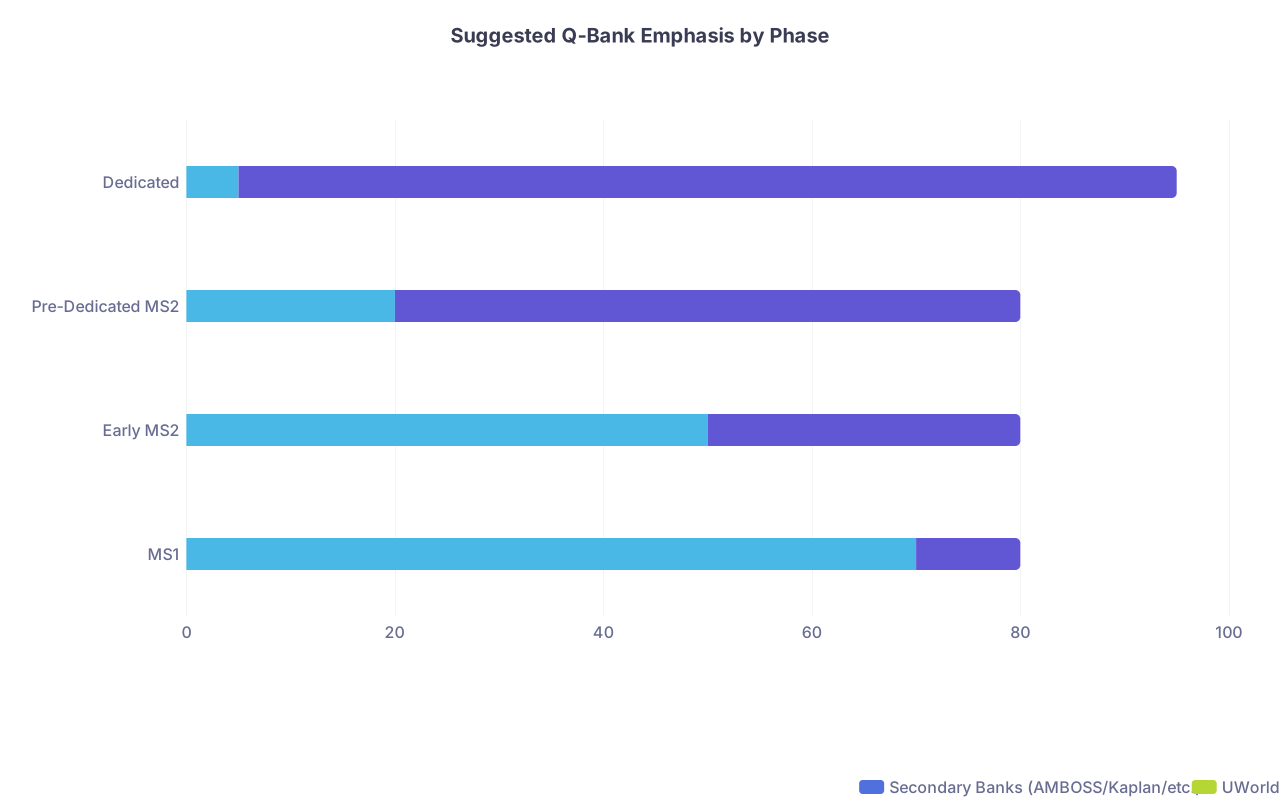
| Category | Secondary Banks (AMBOSS/Kaplan/etc.) | UWorld |
|---|---|---|
| MS1 | 70 | 10 |
| Early MS2 | 50 | 30 |
| Pre-Dedicated MS2 | 20 | 60 |
| Dedicated | 5 | 90 |
The numbers are illustrative, not strict. The point is: shift weight toward UWorld as you approach the exam.
Step 2: Align questions with your curriculum
Doing random cardiology questions while your school is teaching musculoskeletal? Bad idea for most of MS1. Your foundation isn’t there yet.
Better pattern in MS1:
- When you finish a system (say, cardio), do:
- 5–10 board-style questions at a time
- In tutor mode
- Subject/systems-specific
Your goal: see how the Step-style exams ask about the same content you just learned in lecture.
Step 3: Ramp the challenge level over time
Timeline that works for many students:
Fall MS1:
Focus: adjust to med school.
Q-banks: optional very light use (0–5 questions here and there), mostly for the highly motivated or those repeating a year.Spring MS1:
Start with 10–15 questions a few times per week on the systems you’re in. Use them to guide Anki/notes review.MS2 pre-dedicated:
Move toward 20–40 questions most days (more on weekends if you prefer). Start mixing systems. Transition from tutor mode / subject-specific to more timed, mixed blocks.Dedicated:
Now you’re living in 60–80 questions/day territory (sometimes more, sometimes less depending on your schedule and stamina), mostly UWorld, mostly timed and mixed.
Is this rigid? No. But it gives you a scaffold instead of hand-wavy “do some questions.”
Common Student Profiles: What You Should Actually Do
Let me give you direct recommendations by type, because not everyone reading this is the same.
If you’re an MS1 struggling with your courses
You do not need 40 UWorld questions a day. You need to pass and actually understand the basics.
Do this:
- Focus mainly on your school exams and core resources (Boards & Beyond/Sketchy/Pathoma, etc.)
- Add in 5–10 bank questions 2–3x/week after you’ve covered a topic
Example: After you study heart failure, do 5–10 heart failure questions to test your understanding. - Use explanations as a teaching tool. Read them slowly, compare to your notes, and fix gaps.
Your priority: build solid concepts and get used to the style, without overwhelming yourself.
If you’re doing well in class and thinking long-term
You’re the person who can safely lean earlier into Q-banks.
- Start consistent system-based questions by mid MS1
- By MS2, you should be regularly doing timed blocks, mixed topics, and using explanations to refine, not just to learn from scratch
- You can sample UWorld earlier, but I’d still keep the majority untouched until MS2 and dedicated
You’re not “overachieving” here. You’re giving yourself normal exposure over a long period instead of panic exposure in 6 weeks.
If your school is pass/fail and low stress on exams
Here’s the trap: students at these schools sometimes ignore questions until it’s almost too late.
If that’s you:
- Treat board prep as its own course, not something that “will happen later”
- Start with a secondary bank plus maybe some NBME-style practice from school or CBSEs if offered
- Use blocks as your primary self-assessment tool and trust the data, not your vague sense of “I know this”
How Many Questions Is “Too Early” To Do?
People ask this like there’s a magic cut-off. There isn’t. But there is dumb usage.
Red flags that you’re misusing Q-banks in MS1:
- You’re doing 40+ questions most days while still in your first year
- You’re re-doing the same questions over and over purely to increase your percentage
- You’re rushing explanations or skipping them completely “to save time”
- Your school coursework is suffering while your Q-bank streak looks great
Reasonable early use:
- 5–15 questions a few times per week in MS1, maybe up to 20–25 occasionally when you’ve finished a big system
- Adding more in MS2 as your content base grows
- Shifting from “learning” mode to “performance” mode gradually as Step gets closer
How to Read and Learn from Q-Bank Explanations (This Matters More Than Timing)
Starting early is useless if you learn nothing from what you’re doing. The score on each early block is almost irrelevant. What matters is what you do after you click “End Block.”
Here’s a high-yield review routine:
For every question you got wrong (and a few you got right for the wrong reason), ask:
- Did I not know the content?
- Did I misread or rush?
- Did I fall for a distractor because my reasoning chain was off?
In the explanation, focus on:
- Why the correct answer is correct
- Why your answer is wrong
- Why at least 1–2 tempting distractors are wrong
Take tiny notes:
- One sentence per key point
- Or add one or two Anki cards for real gaps
Do not turn every explanation into a page of notes you never see again.
When people “burn through” Q-banks and say they didn’t help, this is usually what happened: they chased percentages, ignored their thought process, and never actually fixed their errors.
When Waiting Until Dedicated Makes Sense (Rare, But Real)
There are a few situations where I’d be fine with you starting Q-banks closer to dedicated:
- You’re in a very accelerated program with a short pre-clinical period, and dedicated starts not long after MS1/MS2 content ends.
- You have a serious personal/health crisis in MS1 and bandwidth is limited. In that case, pass your courses, stabilize your life, then layer in Q-banks once you’re functional again.
- You’re repeating pre-clinicals and already did a ton of Q-bank work the first time around. Here, re-timing your resources matters more, and you may want to be selective.
Even then, I’d still try to get some exposure earlier. But you’re the exception, not the rule.
Quick Decision Guide: Start Now or Wait?
Use this simple flow:

| Step | Description |
|---|---|
| Step 1 | MS1 Student |
| Step 2 | Focus on coursework; add 5-10 Qs 2-3x/week max |
| Step 3 | Optional very light bank use |
| Step 4 | Start system-based Qs 10-15 a few times/week |
| Step 5 | 20-40 Qs most days, ramping over time |
| Step 6 | Passing courses comfortably? |
| Step 7 | Late MS1 or MS2? |
If you’re reading this during late MS1 or MS2 and have done zero board-style questions, you’re behind. Not doomed—but behind. Start now.
Bottom Line
You should not be “saving” all Q-banks for dedicated. That’s outdated, anxiety-driven advice.
Use Q-banks early as a learning tool in small, controlled doses. Protect UWorld by:
- Starting with other banks in MS1
- Aligning questions with your curriculum
- Ramping volume thoughtfully as Step approaches
Today’s action item:
Open whatever Q-bank you have access to. Pick the system you just finished in class. Do 10 questions in tutor mode and spend more time on the explanations than the questions themselves. Then decide—based on how that felt—what a sustainable weekly question target is for you right now.
FAQ (Exactly 7 Questions)
1. If I start Q-banks in MS1, will my scores tank and demotivate me?
Your percentages will probably be low at first. That’s fine. Early Q-bank use is about exposure and feedback, not performance. If you treat every low score like a personal failure, you’ll avoid the very tool that would help you improve. The healthier mindset: “What did this block just teach me about my weak spots?”
2. Should I start with UWorld or another Q-bank in MS1?
For most students, start with a “secondary” bank (AMBOSS, Kaplan, USMLE-Rx) in MS1. This preserves the bulk of UWorld for MS2 and dedicated, when you’re closer to the actual exam. You can sample a few UWorld blocks earlier if you want to see its style, but do not rely on it as your main MS1 resource.
3. How many Q-bank questions per day is reasonable in MS1?
A very workable target is 10–15 questions a few days per week during systems blocks, in tutor mode, aligned with what you’re learning. You do not need daily blocks in MS1, and you definitely do not need 40+ questions a day at that point.
4. Should I always use tutor mode early on, or start with timed mode?
In MS1, tutor mode is usually better. You’re learning content and style simultaneously, and immediate feedback helps. As you move into MS2, start mixing in timed blocks, especially as you get closer to dedicated. By dedicated, the majority should be timed and mixed to simulate the real exam.
5. Is it bad to re-do questions I’ve already seen?
No. But re-dos should be part of your strategy, not the whole thing. Re-doing incorrects is useful for reinforcing learning and cleaning up weak spots. Just don’t trick yourself by obsessively repeating questions for a higher percentage while avoiding fresh, harder material.
6. How do I balance Q-banks with Anki and lectures?
Use lectures/boards resources for initial exposure, Anki for spaced repetition, and Q-banks for application and assessment. The timing: learn → review → test. If you have to cut something when overwhelmed, cut quantity of Anki or lecture extras before you cut all question practice. Questions are what your exam ultimately measures.
7. What if my classmates aren’t doing Q-banks yet—am I overdoing it?
Probably not, as long as your volume is reasonable and your coursework isn’t suffering. Many students delay Q-banks because they’re uncomfortable seeing low scores, not because it’s a smart strategy. You’re not “overachieving” by doing 10–15 questions a few times a week in MS1; you’re building familiarity that will make dedicated far less miserable.