
Practice Exam Score Drop After Adding a New Q-Bank: Should I Panic?
What if that score drop after starting a new Q-bank isn’t a blip… but the “real you” finally being exposed?
That’s the kind of thought that shows up at 1:47 a.m. after a practice NBME goes 12 points lower than your last one, right after you proudly bought that second Q-bank because “everyone says it’s high yield.”
You add a new resource to get better. Your score tanks. And your brain immediately goes:
- “Did I just ruin my trajectory?”
- “Was my previous improvement fake?”
- “Is this what I actually deserve on test day?”
Let’s walk through this without sugarcoating it, but also without letting your anxiety drive the car off a cliff.
What Usually Happens When You Add a New Q-Bank
You know that feeling when you switch from UWorld to, say, Amboss or Kaplan, and suddenly every question feels like it came from a different planet?
You’re not imagining that.
Most of the time, when scores drop after adding a new Q-bank, a few things are going on at once:
Different style, same brain.
The questions aren’t written like what you’re used to. New wording. Different emphasis. Less hand-holding. So your pattern-recognition is off. Not your knowledge. Your test-taking autopilot just doesn’t recognize the cues yet.You moved into harder territory.
People often add a second Q-bank when:- They’ve nearly finished their first one
- Scores are going up
- They want to “push it”
Translation: you just told the universe, “Give me something harder.” And it did.
You’re seeing blind spots, not getting dumber.
A new Q-bank will hit your weak areas from angles your first bank didn’t. That feels like backsliding, but really it’s just exposing what was always there. You’re not losing knowledge; you’re losing the illusion that everything was fine.Your brain is tired and over-tracked.
New q-bank = new interface, new question stems, possibly more detailed explanations. You’re now doing:- More questions
- More review time
- Likely with the same (or less) sleep
Cognitive fatigue absolutely kills practice scores.
So no, a drop after adding a new Q-bank does not automatically mean your real score is plummeting.
But it also isn’t something to ignore.
Let me show you what I mean with numbers.
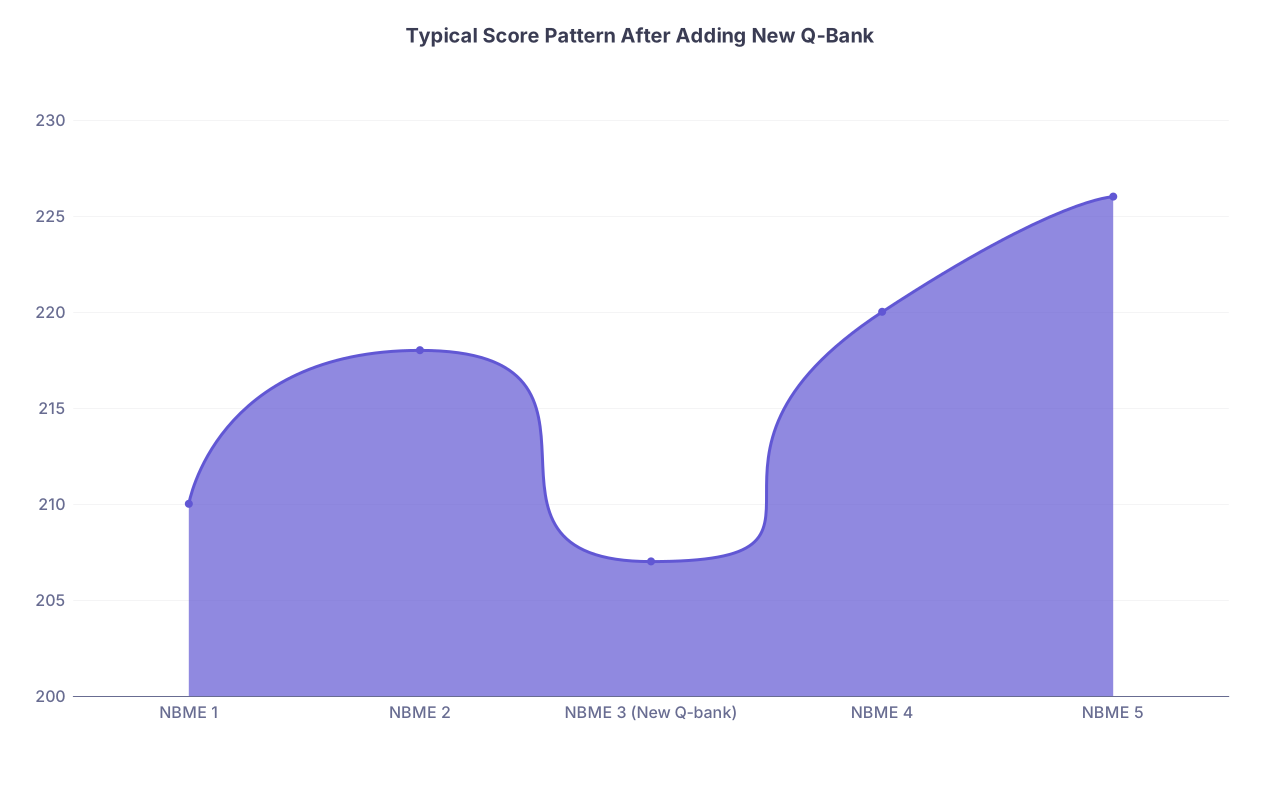
| Category | Value |
|---|---|
| NBME 1 | 210 |
| NBME 2 | 218 |
| NBME 3 (New Q-bank) | 207 |
| NBME 4 | 220 |
| NBME 5 | 226 |
That middle dip? That’s what freaks people out. They only see: “I dropped.” They don’t notice: “I then climbed above where I was.”
How To Tell If the Drop Is a Temporary Dip or a Real Problem
You’re not crazy to be worried. Sometimes a score drop does mean something is off. The trick is figuring out which kind of drop you’re dealing with.
Step 1: Compare like with like
Don’t compare:
- UWorld % to Amboss %
- Percent-correct to an NBME 3-digit
- Untimed/tutor blocks to timed exam scores
That’s apples to oranges.
What does matter:
- NBME vs NBME
- UWorld self-assessment vs UWorld self-assessment
- Same test format, at least 10–14 days apart
If your NBME 28 was 225, you added a new Q-bank, and NBME 30 is 213, yeah—your anxiety gets a voice at that point. But it still doesn’t get the final say.
Step 2: Look at where you dropped, not just how much
Open the performance breakdown. Really look. Patterns usually jump out.
Common red flags vs fake-outs:
| Pattern | Likely Meaning |
|---|---|
| Big drop in **multiple** systems & disciplines | Fatigue / off-day / test-taking shift |
| Drop isolated to **one system** (e.g., cardio) | You’ve hit a weak content area |
| Sudden tank in **timing** (lots of blanks/guesses at end) | Pace problem, not knowledge collapse |
| Normal timing but worse accuracy across the board | Overwhelm, anxiety, or very different question style |
| Drop happened on **first exam after new Q-bank** | Adjustment effect, often temporary |
If your new Q-bank is hammering you with long, convoluted stems and your NBME drop is mostly in questions where you ran out of time? That tells a story: this is a pacing and stamina issue, not a “you don’t know anything” issue.
Step 3: Ask the ugly question
“Did my behavior change?”
As in:
- Sleeping less?
- Cramming new resources?
- Doing huge question blocks then barely reviewing?
- Constantly switching between Q-banks like a hobby?
If you suddenly doubled your daily question volume, added Anki, added a new q-bank, and started sleeping 5 hours a night—your brain isn’t failing you. You’re frying it.
What a New Q-Bank Actually Does to Your Brain (Good and Bad)
When you add something like Amboss, Kaplan, or USMLE-Rx on top of UWorld, you’ve basically told your brain: “Hey, I want you to learn how to read another dialect of the same exam language.”
Short-term: chaos.
Long-term: higher fluency and adaptability.

It tends to affect you in a few predictable ways:
You stop coasting on pattern recognition.
If you were subconsciously recognizing UWorld “templates” (“oh, this is that question where they want SIADH”), a new Q-bank rips that crutch away. That feels bad. But it ultimately makes you better at the real exam, which doesn’t copy-paste UWorld questions.Your weaknesses are re-labeled, not created.
Maybe UWorld wasn’t hitting neuro enough. Suddenly your new Q-bank is 30% neuro, and you’re getting destroyed. That doesn’t mean you got worse. It means you finally got honest feedback: neuro was always soft.Cognitive load spikes.
New interface, new phrasing styles, often more dense explanations. Your brain is burning more energy per question. That means fewer high-quality hours before you hit the “I’m reading words but not absorbing them” wall.
This is why your first 1–2 practice tests after adding a Q-bank are often not representative of your final potential.
They’re snapshots of a brain in adaptation mode.
What To Do in the 1–2 Weeks After You See a Score Drop
This is the part where people either stabilize and climb… or spiral.
Here’s the calm, boring, effective way to respond.
1. Stop adding more new stuff
You already added a Q-bank, your brain is adapting, and now you want to add:
- New YouTube channels
- New Anki decks
- Another review book
No. Absolutely not.
For at least 10–14 days:
- Keep your resource list fixed
- Focus on getting good at what you already have
- Resist the urge to “fix” the problem by hoarding more material
More resources ≠ more points. It usually equals more fragmentation.
2. Use the new Q-bank strategically, not as a flex
Don’t just bang out 80 random questions a day because your friend is doing 160.
For a bit:
- Do smaller blocks (e.g., 20–30 questions)
- Keep them timed but not necessarily “exam length”
- Pick system-specific blocks that match your NBME weaknesses
Then review like it’s your job:
- For every wrong answer:
- Why did I miss it? (content, misread, timing, second-guessing?)
- Is this a one-off weird question or a pattern?
- What’s the 1–2 sentence distilled “take-home” I’d want on test day?

| Step | Description |
|---|---|
| Step 1 | Score Drop After New Q-bank |
| Step 2 | Check Section Breakdown |
| Step 3 | Ignore Direct Comparison |
| Step 4 | Identify 2-3 Weak Areas |
| Step 5 | Targeted Q-bank Blocks |
| Step 6 | Thorough Review & Notes |
| Step 7 | Short Content Refresh |
| Step 8 | Next Practice Exam in 10-14 Days |
| Step 9 | Same Test Type? |
3. Account for fatigue like it’s a real variable (because it is)
If your last practice exam:
- Was at night
- After a full day of questions
- On 5 hours of sleep
Then the result is contaminated. You didn’t just test your knowledge. You tested your physical and mental exhaustion.
Before your next exam:
- Sleep like it’s the exam for 2 nights before
- Light review the day before, not 8 hours of questions
- Quick warm-up (5–10 questions) the morning of, then test
You want your next score to reflect your best realistic test-day state, not your “I hate everything” state.
When You Actually Should Worry (And Change Something)
I’m not going to lie to you: sometimes a drop is a warning, not a fluke.
You should pay serious attention if:
- You’ve had 2–3 consecutive drops on comparable exams (e.g., NBME → NBME → NBME), not just one.
- You aren’t sleeping, aren’t exercising at all, and are living entirely on caffeine and panic.
- Your breakdown shows global decline, not just a couple of weak systems.
- You’ve massively over-committed: 2 Q-banks, plus Zanki, plus full-time classes, plus research, etc.
At that point, the answer is not, “Panic.” It’s, “Scale back and prioritize.”
Here’s a rough sanity check:
| Setup | Risk Level |
|---|---|
| 1 Q-bank + light Anki + class | Low |
| 1 Q-bank + boards Anki + some videos | Moderate |
| 2 Q-banks + full Anki + classes | High |
| 2 Q-banks + full Anki + research + work | Extreme |
If you’re in the high/extreme zones, your drop might be your brain waving a white flag.
How Long Until Scores “Recover” After Adding a New Q-Bank?
You’re probably wondering: “Okay, but how long until I stop sucking?”
From what I’ve seen:
First 3–7 days:
You feel slower. Score percentages on new Q-bank look lower than your main one. Confidence dips.7–14 days:
You start recognizing patterns in the new Q-bank. Review becomes more efficient. Your timing improves.10–21 days:
Your next standardized practice exam (NBME, UWSA, etc.) finally reflects the benefits of the extra exposure—if you haven’t burned yourself out or added more chaos.
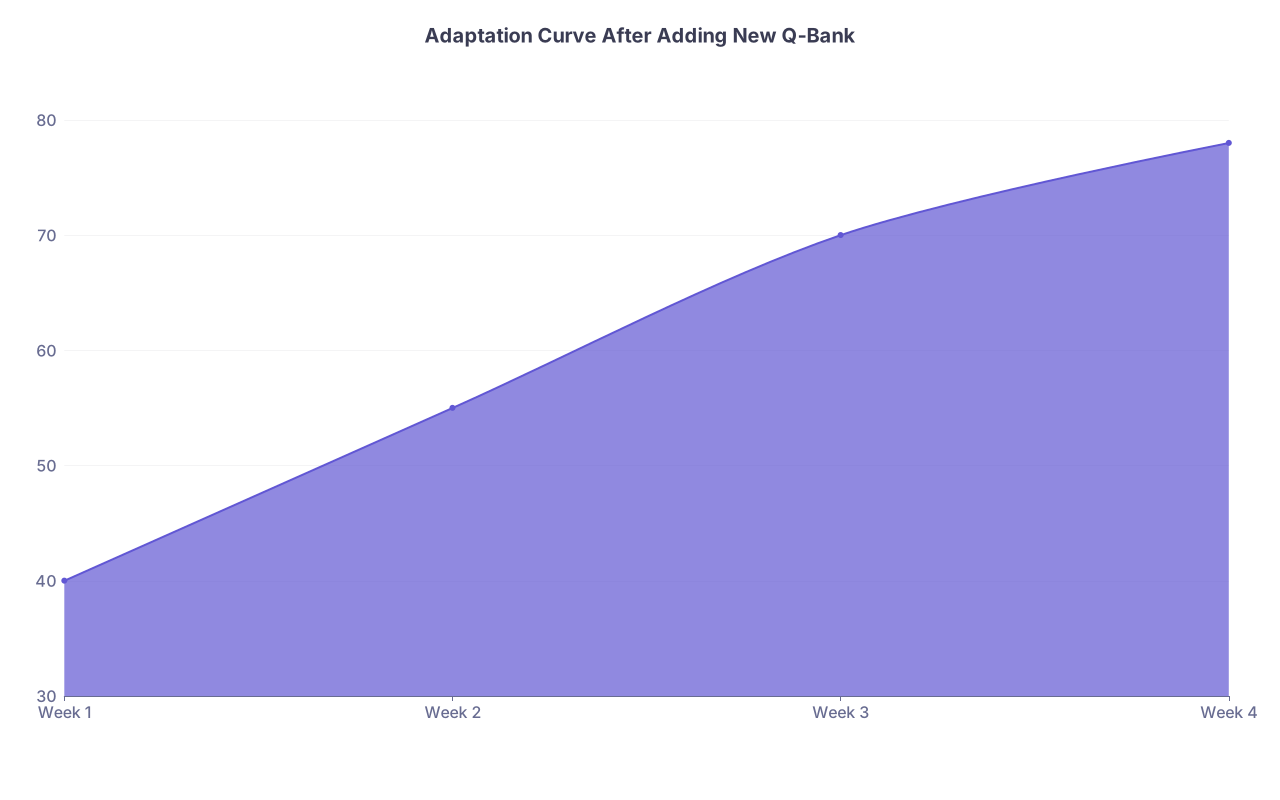
| Category | Value |
|---|---|
| Week 1 | 40 |
| Week 2 | 55 |
| Week 3 | 70 |
| Week 4 | 78 |
That early plateau and dip is normal. The trick is not to overreact in week 1 and blow up your whole plan.
A Quiet Reality No One Likes to Admit
A lot of “score drops after new Q-bank” are really this:
You were getting artificially high numbers from:
- Repeating question styles
- Reviewing explanations so much you basically memorized stems
- Doing untimed or tutor mode blocks
Then a new Q-bank came in and removed your training wheels.
It feels like losing ground. It’s actually losing the safety net.
If you can push through that discomfort—without adding 10 new resources or cutting sleep to 4 hours—you usually end up with stronger, more durable test performance.

Quick Checklist: Should I Panic?
Run through this in your head:
- Was the drop on the same type of exam (NBME vs NBME)?
- Have I had more than one drop in a row?
- Did I change too many things at once (resources, schedule, sleep)?
- Is my breakdown showing a few specific problem areas, or everything?
- Have I actually given myself 10–14 days to adjust to the new Q-bank?
If:
- It’s your first drop
- Right after adding a new Q-bank
- With obvious fatigue, schedule, or timing issues
Then no—you shouldn’t panic. You should stabilize, simplify, and give your brain time to adapt.

FAQ (Exactly 6 Questions)
1. My NBME dropped by 8–12 points right after I started a new Q-bank. Is that within the “normal” range?
Yes, that kind of drop is very common in the short term, especially if:
- It was your first NBME after changing your routine
- You were more tired than usual
- You crammed a ton of new questions in the 2–3 days before the exam
Is it ideal? No. Does it mean you’re doomed? Also no. What matters is what happens over the next 1–3 weeks with a stable plan.
2. Should I stop the new Q-bank since my scores dropped?
Not automatically. Stopping every time something feels bad is how you end up resource-hopping for months and never really mastering anything.
You should consider pausing or scaling back if:
- You’re doing so many questions you can’t review properly
- You’ve clearly overcommitted (2 Q-banks + full Anki + full-time classes)
- You feel mentally wrecked every day
But if the main issue is just, “This feels harder and my ego is bruised,” that’s not a great reason to quit.
3. How many Q-banks do I actually need?
For most people: one good Q-bank done well, plus maybe a second one used selectively, is enough.
Examples:
- Primary: UWorld, Secondary: Amboss for extra practice or weak systems
- Primary: Amboss, Secondary: UWSAs + NBMEs for exam-style practice
Doing 3+ full Q-banks is usually overkill unless your timeline is very long and your stress tolerance is abnormally high (which, let’s be honest, it probably isn’t right now).
4. My percentage correct in the new Q-bank is way lower than in my old one. Does that mean I’m regressing?
Not necessarily. Different Q-banks have different difficulty levels and user populations.
What matters more:
- Are you learning from the questions you miss?
- Are your standardized scores (NBME/UWSA) stabilizing or improving after a couple of weeks?
A lower percent in a harder Q-bank can still translate to progress on real exams. Percent-correct across different platforms is a terrible thing to obsess over.
5. How often should I take practice NBMEs after a score drop?
If you just dropped:
- Give yourself about 10–14 days before the next full NBME, unless your test date is very close.
- Use that time to:
- Target your weak areas with the Q-bank
- Fix timing issues
- Normalize your sleep and daily routine
Taking NBMEs every 3–4 days because you’re anxious usually just burns forms and amplifies noise, not signal.
6. What if my real exam is close and I just had a big score drop?
Then you need brutal honesty and a quick strategic decision:
- If you’re within striking distance of your goal (e.g., 3–5 points off) and this was your first drop after a clear fatigue/overload week—stabilize, rest more, keep going.
- If you’re far from your target or near/below the pass line on multiple forms, and the drop is part of a downward trend, you should seriously talk to your advisor about postponing, if that’s allowed.
Don’t let pride force you into an exam you’re not ready for. At the same time, don’t let a single bad test after a big change convince you that all your previous progress was fake.
Key points to walk away with:
- A score drop right after adding a new Q-bank is usually a temporary adaptation dip, not proof that you’ve fallen apart.
- Don’t “fix” a drop by adding more resources. Stabilize your plan, protect your sleep, and target your weak areas.
- Judge your trajectory based on patterns over a few weeks, not one bad exam taken in the middle of chaos.