
Common Shelf Exam Resource Errors That Blow Easy Honor Scores
It’s 6:45 a.m. on the medicine service. You’re post‑call, brain fried, and you check your phone “just once” before rounds. NBME score report dropped. You needed a 78 for honors. You got a 76. You didn’t miss honors because you’re dumb. You missed it because you made two or three avoidable resource mistakes that quietly bled points all month.
Shelf exams are predictable. The big trap is not the content, it’s the way students use (and misuse) the standard resources. I’ve watched very smart people turn sure‑thing honors into “high pass by 1 point” because they copied someone else’s plan, drowned in question banks, or trusted Reddit more than their own brain.
Let’s walk through the landmines.
Mistake #1: Treating Every Shelf Like Step 1 (and Drowning in Resources)
On day one of your rotation, you panic‑buy:
- UWorld for that specialty
- AMBOSS
- A primary review book
- Two “high‑yield” PDFs
- An Anki deck someone swore “got them 90+ on every shelf”
You just turned a 4–8 week rotation into a resource circus.
Here’s the problem: shelf exams are time‑limited. Clinical rotations are exhausting. You cannot use everything well. When you try, you use everything badly.
How this blows your score
- You scatter your attention across too many tools and never master any of them.
- You spend weeks “collecting resources” instead of doing questions.
- You end the rotation with:
- 40% of UWorld done
- 25% of AMBOSS done
- 10 unfinished PDFs
- And a shelf score that reflects half‑baked prep.
I’ve seen this exact pattern on surgery and medicine over and over. The student with 3 partially completed qbanks almost always loses to the student who annihilated one.
What to do instead
Pick a primary and a secondary resource. That’s it.
- Primary = one question bank (UWorld or AMBOSS, not both as “primary”)
- Secondary = either:
- A concise text (e.g., Case Files, Deja Review, Online MedEd notes), or
- Targeted Anki / flashcards
If you’re thinking: “But my classmate used UWorld + AMBOSS + PreTest and honored everything…”
Maybe. Or maybe they finished one and dabbled in the rest and you only heard the bragging, not the reality. Do not build your plan on someone else’s survivor bias.
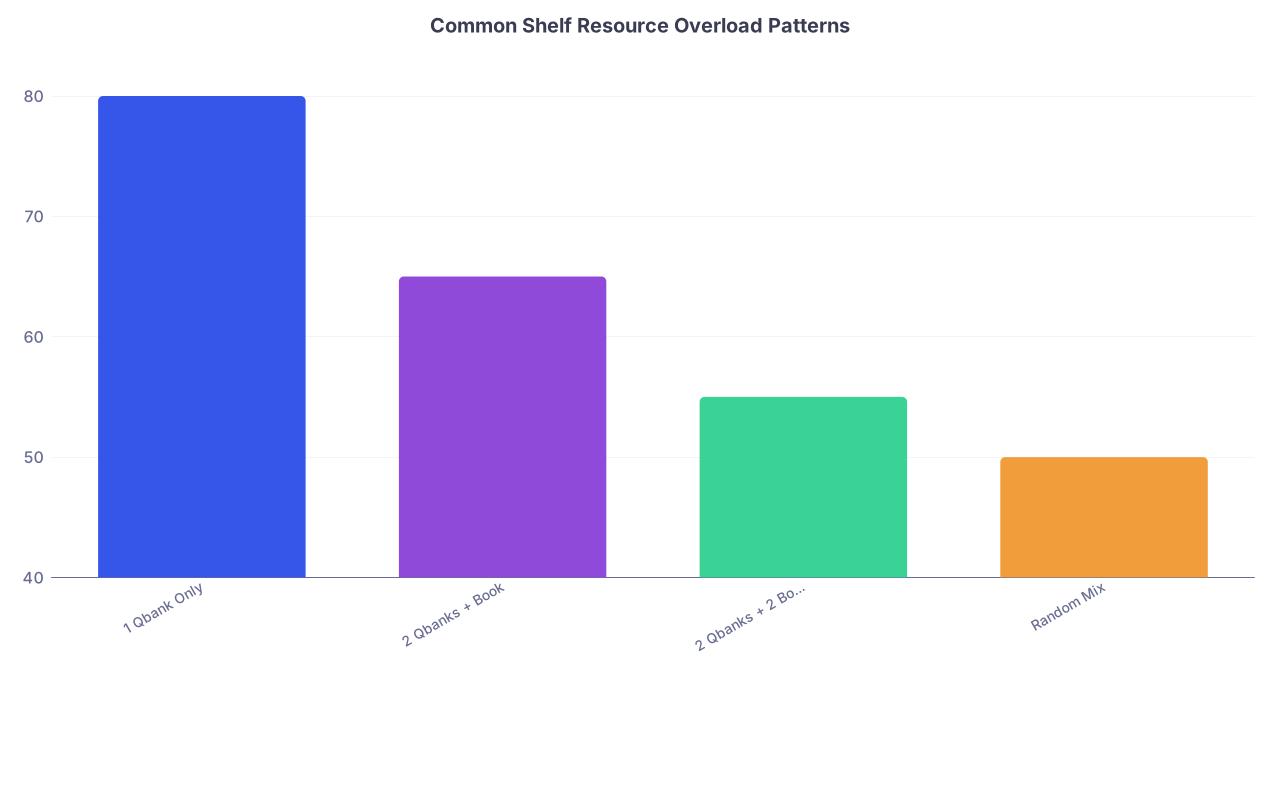
| Category | Value |
|---|---|
| 1 Qbank Only | 80 |
| 2 Qbanks + Book | 65 |
| 2 Qbanks + 2 Books | 55 |
| Random Mix | 50 |
(Values represent approximate average NBME percentiles I’ve seen patterns produce in real cohorts. The trend matters, not the exact numbers.)
Mistake #2: Ignoring the Rotation Calendar (Poor Timing Kills Honors)
Another classic: you “study hard” but use the calendar backwards.
Weeks 1–2:
You’re exhausted, trying to figure out where the bathroom is on the unit, so you do 5–10 questions a day and watch a few videos “to build foundation.”
Weeks 3–4:
You realize the shelf is close. Now you try to do 80–100 questions a day on top of call, notes, and sign‑out. You’re not reviewing explanations deeply because you’re panicking. Just smashing “next.”
This is how you end up “finishing the qbank” but not absorbing it. You did the reps when you were too tired and too stressed to actually learn.
The real timing mistake
You underestimate how mentally dead you’ll be later in the rotation. You assume “I’ll ramp up later” when that’s exactly when you’ll be most burned out.
On a 6‑week rotation, a sane curve looks like:
- Week 1: low‑moderate number of questions, but real focus on reviewing explanations
- Weeks 2–4: peak question volume
- Weeks 5–6: correcting weak spots, NBME practice, and targeted review (not heroic catch‑up)
What most people do is flip that: lazy start, desperate finish. Honors dies in that pattern.
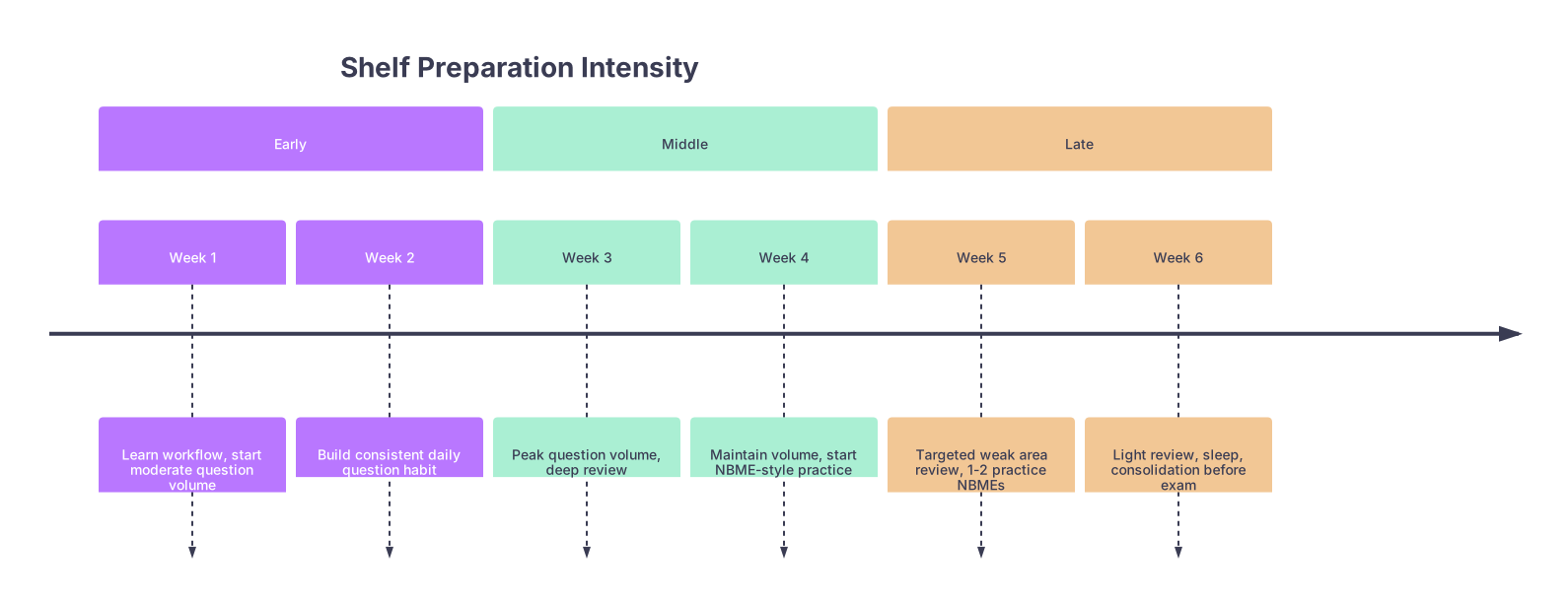
| Period | Event |
|---|---|
| Early - Week 1 | Learn workflow, start moderate question volume |
| Early - Week 2 | Build consistent daily question habit |
| Middle - Week 3 | Peak question volume, deep review |
| Middle - Week 4 | Maintain volume, start NBME-style practice |
| Late - Week 5 | Targeted weak area review, 1-2 practice NBMEs |
| Late - Week 6 | Light review, sleep, consolidation before exam |
Mistake #3: Using Question Banks Like Flashcards (Instead of Training)
A lot of students think, “If I complete all the questions, I’ll honor.” That’s wrong. It’s how you use the qbank that matters.
Here’s the most common error: speed over depth.
You do 40 surgery questions. Get 60% correct. You feel bad. So you move on quickly to the next block to “redeem” yourself instead of sitting with the mistakes and tearing them apart.
This is the mistake:
- Treating questions like a score generator
- Instead of a diagnostic tool to expose and fix gaps
Red flags you’re misusing your qbank
- You remember your “percentage correct” but not the key teaching points from yesterday’s block.
- You review explanations on your phone while half‑listening to sign‑out.
- You skip reading explanations for questions you got right.
- You never write down or flashcard tricky concepts.
The shelf isn’t testing whether you saw that exact vignette before. It’s testing the mental pattern underneath it. If you don’t slow down to extract the pattern, you’re just doing expensive busywork.
Better way to do questions
For each block:
- Do questions in timed mode regularly (you need pacing practice).
- After the block:
- For every question (right or wrong), identify:
“What was the one sentence or finding that clinched the diagnosis/management?” - For wrong ones, add:
- Why was each wrong answer wrong?
(Not every single time, but for topics you keep messing up.)
- Why was each wrong answer wrong?
- For every question (right or wrong), identify:
- Make a short record of repeat offenders:
- e.g., “Aortic stenosis vs hypertrophic cardiomyopathy murmur changes with maneuvers”
- “How to distinguish bronchiolitis vs asthma in kids”
You don’t need a beautiful system. You need a scrappy, used one.
Mistake #4: Blindly Copying Other People’s Resource Lists
You’re on Pediatrics. A classmate says: “You have to use UWorld, AMBOSS, PreTest, BRS Peds, and that 400‑card Anki deck. That’s how everyone honors.”
No, that’s how they studied. With their learning style. Their schedule. Their baseline knowledge. Their call burden. Their life.
You copy their plan exactly. Two weeks later:
- You’re behind on UWorld.
- You’ve opened your Anki deck three times.
- You feel guilty because you’re “not doing enough.”
- You’re not actually learning better; you’re just more anxious.
Copy‑pasting someone else’s resource overload is one of the fastest ways to sabotage an otherwise solid rotation.
Signs you’re falling into this trap
- You switch primary resources mid‑rotation because of something you read on Reddit.
- You constantly feel like you’re “behind” but you can’t articulate on what.
- You’ve bought resources you’ve barely logged into.
Everyone throws around “this is high‑yield” like candy. Ask yourself:
- High‑yield for whom?
- High‑yield compared to what?
- High‑yield if you’re starting when?
For a student with strong Step 1 background, a lean plan (UWorld + one short text) might be perfect. For someone who barely passed pre‑clinical, they might genuinely need extra content review. But “extra” still has to fit in 4–8 weeks of real life.
How to build your resource stack
- Start by looking honestly at:
- Your baseline (Are you generally strong/average/weak clinically?)
- Your schedule (Heavy call? Clinic days? Home at 8 p.m. vs 5 p.m.?)
- Pick:
- 1 primary qbank
- 1 secondary content source (book, video series, or notes)
- Then commit. Mid‑rotation is not the time to panic‑swap your primary resource.
| Plan Type | Components |
|---|---|
| Lean (Good) | 1 qbank + 1 concise text or notes |
| Moderate (OK) | 1 qbank + 1 text + light Anki |
| Overloaded | 2 qbanks + 2+ texts + big Anki deck |
| Delusional | “All of the above” + videos for every topic |
Mistake #5: Ignoring NBME-Style Practice Until the End (or Completely)
Another destroyer of easy honors: never actually seeing NBME‑style questions until it’s too late to adjust.
UWorld/AMBOSS are fantastic. They are also not the shelf.
Typical pattern:
- You grind UWorld all rotation.
- You never touch an NBME or school‑provided practice exam until 3–4 days before.
- You get crushed by the style:
- Shorter vignettes
- Sometimes oddly worded
- Awkward answer choices
- You don’t have enough time to adapt.
Your brain needs exposure to format, not just content. The test is a skill, not just a memory check.
Minimum safe practice
If NBME forms or school practice exams exist for that shelf:
- Do at least 1 full practice NBME 7–10 days before the real thing.
- Review it like a qbank block:
- Identify patterns of misses (e.g., all your mistakes are in endocrine, or you keep misreading OB timelines).
- Adjust your last‑week review to those patterns.
Completely skipping NBME‑style practice because “I’ll just do more UWorld” is how you get surprised on test day when everything feels slightly “off.”
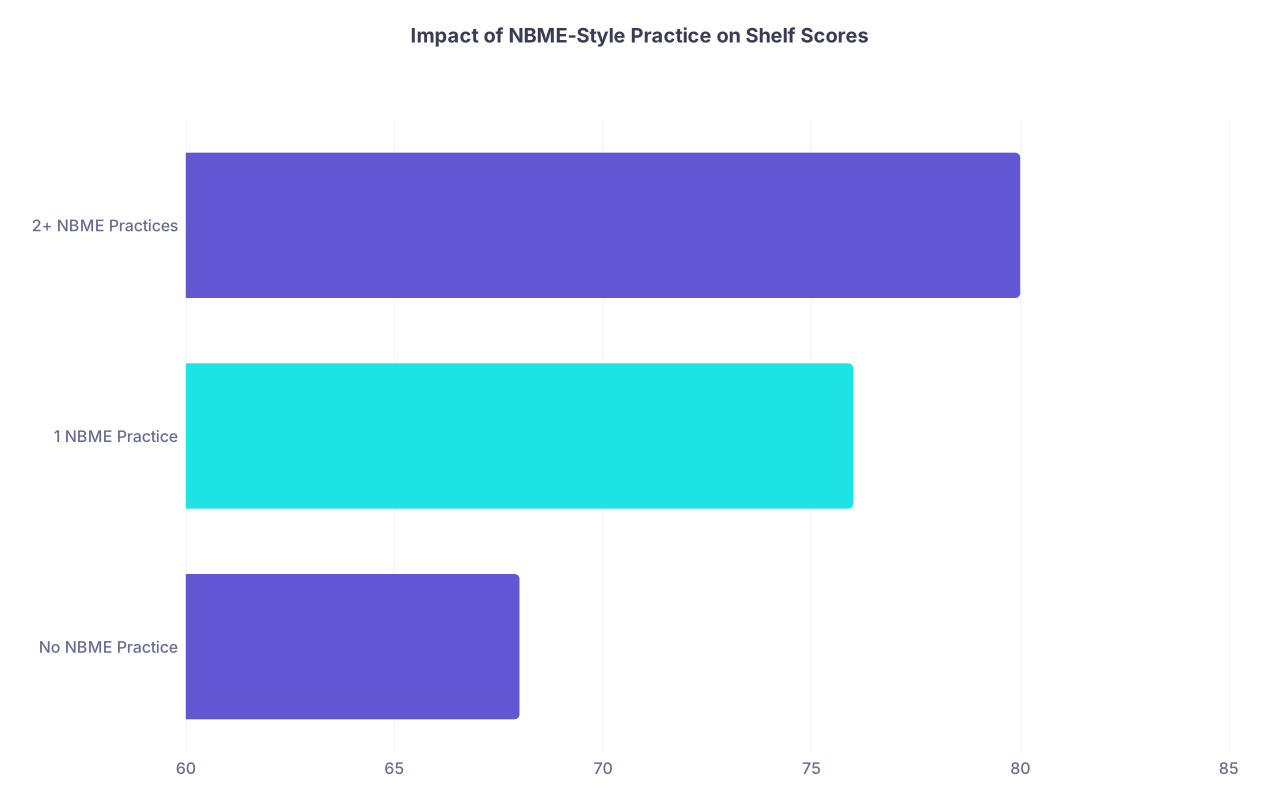
| Category | Value |
|---|---|
| No NBME Practice | 68 |
| 1 NBME Practice | 76 |
| 2+ NBME Practices | 80 |
Mistake #6: Using Videos as a Security Blanket
Videos have their place. They can clarify complex concepts, especially early in the rotation. But they are slow. And a lot of students use them like comfort food.
Typical trap on, say, OB/GYN:
- You spend hours watching video series “to build a foundation.”
- You feel productive.
- But you’ve barely done any questions.
- Two weeks in, you realize you’re behind on the qbank and your recall from the videos is…pretty fuzzy.
Here’s the harsh truth: shelf exams are built around clinical pattern recognition and management steps. You only get sharp at those by doing questions and actively retrieving information. Not passively watching someone else reason it out for you.
Videos become dangerous when:
- They replace active practice instead of support it.
- You watch them when you’re already too tired for real learning (post‑call).
- You treat them as “mandatory” completion items rather than optional clarifiers.
If you’re going to use videos:
- Set a strict time budget (e.g., 20–30 minutes a day max).
- Use them targeted:
- Watch for topics you consistently miss in questions.
- Not for everything under the sun.
If your average day is: “Work 11 hours, then watch 3 hours of videos,” don’t be shocked when your test performance doesn’t match your time investment.

Mistake #7: Zero Integration Between the Wards and Your Resources
Big missed opportunity: you separate what you see on the wards from what you study at home.
On pediatrics, you spend an entire week seeing bronchiolitis. But you don’t:
- Do bronchiolitis‑related questions that week
- Review distinctions between bronchiolitis vs asthma vs pneumonia in infants
- Look up guidelines for oxygen, fluids, or hospital admission criteria
Instead, at night you just do random questions in “tutor mode” from all topics because that’s how they were organized in the app.
You’re throwing away one of the biggest advantages you have over pure Step studying: context.
The integration you should be doing
- Identify 1–3 patients or topics you saw.
- That night or next morning:
- Do 10–20 questions focused on that topic if your qbank allows filtering.
- Or quickly read those sections in your chosen text/notes.
- Jot down 1–2 “pearls” you didn’t know before that could show up as test questions.
This is not about becoming the world’s expert in that condition. It’s about building strong mental links between:
- Real patient →
- Core pathophys/diagnosis/management →
- How the NBME likes to test it
When you keep your studying completely separate from your daily cases, you’re basically choosing the more painful, less efficient route.

Mistake #8: Burning Out Right Before the Exam
Last one, and it’s sneaky. You overdo it in the final week.
Pattern:
- You panic because your practice NBME wasn’t as high as you wanted.
- You cram:
- 2–3 question blocks per day
- Plus long review sessions
- Plus text review
- You cut sleep for 3–5 nights to “squeeze in more.”
- You show up to the exam cognitively dulled, more anxious, and with worse working memory.
Shelf exams are stamina tests. A tired, over‑caffeinated brain leaks points. You miss words like “first‑line,” “most appropriate next step,” “best initial test” vs “most accurate test.”
Your resources are only as useful as the brain interpreting them.
Minimum protection rules
- 72 hours before the shelf:
- No new resources.
- No marathon video binges.
- 48 hours before:
- 1–2 modest question blocks + targeted weak‑spot review.
- Night before:
- Light review only (if at all).
- Prioritize:
- Sleep
- Hydration
- Just enough review to feel oriented, not overloaded.
If your last 3 days feel like a war against your own schedule, you probably mis‑timed your prep weeks ago. Don’t let that become a pattern across every clerkship.
FAQ: Shelf Exam Resource Mistakes
Do I really need both UWorld and AMBOSS for shelves?
No. That’s one of the most common overkill mistakes. For most rotations, mastering one qbank deeply beats skimming two. If your school provides one of them free, use that as primary. If you truly have extra time after finishing and reviewing one well, then sure, cherry‑pick questions from a second source. But starting with both as “mandatory” is how you end up finishing neither.How many questions per day should I aim for during a rotation?
Depends on rotation length and your schedule, but a safe, sustainable target is usually 20–40 questions on weekdays and 40–60 on lighter weekend days. The key is consistency and thorough review of explanations. Doing 80 questions one day and zero the next three because you’re exhausted is worse than steady, manageable blocks.Are videos a waste of time for shelf exams?
Not automatically. They’re useful for clarifying hard concepts (like acid‑base, OB timelines, psych meds). The mistake is treating them as the backbone of your prep or binge‑watching them when you’re too tired to process content. If you use them, keep them focused and time‑limited, and always prioritize qbank + active recall over passive watching.When should I start using NBME practice exams?
On a 6–8 week rotation, aim for one NBME‑style practice about 7–10 days before your shelf. If you have time (and forms) for a second, do it earlier—around the midpoint—only if you can still adjust your study plan based on the results. Doing your first NBME 3 days before the real exam doesn’t give you enough time to correct patterns.What if I’m already halfway through a rotation and my current resource plan is a mess?
Cut your losses. Today. Pick one qbank as your primary and one secondary resource (short text/notes or focused videos). Drop the rest. Then map out what’s actually doable in the remaining days, including:- A realistic number of questions per day
- Time to review explanations
- Space for at least one NBME practice if possible
Salvaging honors is about making smart, focused adjustments now, not heroically trying to complete six resources in three weeks.
Key things to remember:
- Honors is usually lost on process mistakes, not IQ.
- Fewer well‑used resources beat a giant, half‑finished stack.
- Questions + explanations + timing + sleep will carry you further than chasing every “high‑yield” resource people hype online.