
What if the organ-system review books you’re clinging to are quietly hurting your exam scores instead of helping them?
Let’s talk about that. Because I’ve watched really smart students tank their shelf exams and Step prep while surrounded by “high-yield” organ-system books they thought were saving them.
Organ-system review books can be powerful. They can also be a trap. The difference isn’t the book; it’s how you’re using it.
Below are the five big mistakes I see over and over—and how to avoid becoming the next cautionary tale.
Mistake #1: Treating Review Books Like Primary Learning Resources
This is the classic first-year and early-second-year mistake: you grab BRS Physiology, a thin renal or cardio book, or a short “systems” text and decide, “I’ll just learn everything from this. It’s efficient.”
No. That’s not how this works.
Organ-system review books are condensed. They’re built on the assumption that you’ve already seen the full story in lecture, a primary textbook, or a structured video series. Using them as your main source leads to three specific problems:
- You memorize answers without understanding mechanisms.
- You miss context and integration (especially physiology + pathology + pharmacology).
- You think you “know” more than you actually do because the pages are short and dense.
You end up being great at filling in the blanks on simple recall questions and terrible at dealing with multi-step, clinical vignettes on NBME exams and Step.
A quick comparison
| Feature | Primary Resource | Organ-System Review Book |
|---|---|---|
| Depth of explanation | High | Low–Moderate |
| Intended for | First-pass learning | Consolidation/review |
| Amount of detail | Comprehensive | Selected, “high-yield” |
| Use case | Build understanding | Strengthen, summarize |
If you feel “comfortable” after one pass through a thin systems book but struggle to explain why a lesion causes a specific deficit, you’ve just met the limits of review books.
How to avoid this mistake
Use review books like this:
- First encounter topic in lecture / video / thorough resource.
- Then go to the organ-system book to tighten the knowledge, not to build it from scratch.
- Ask: “Could I explain this from first principles if this page didn’t exist?” If the answer is no, you’re using the book too early and too heavily.
Mistake #2: Using Books That Don’t Match Your Exam Style or Phase
Another big error: grabbing whatever review book upperclassmen mentioned, without asking for what exam, at what stage, and for which system.
Your needs in pre-clinical renal block are very different from your needs three weeks before Step 1.
Here’s what happens when you ignore that:
- You use an ultra-detailed organ-system book during a basic block and drown in minutiae you’ll never be tested on.
- Or you use an oversimplified system review during your dedicated board prep and wonder why NBME practice scores lag.
Different phases. Different jobs.
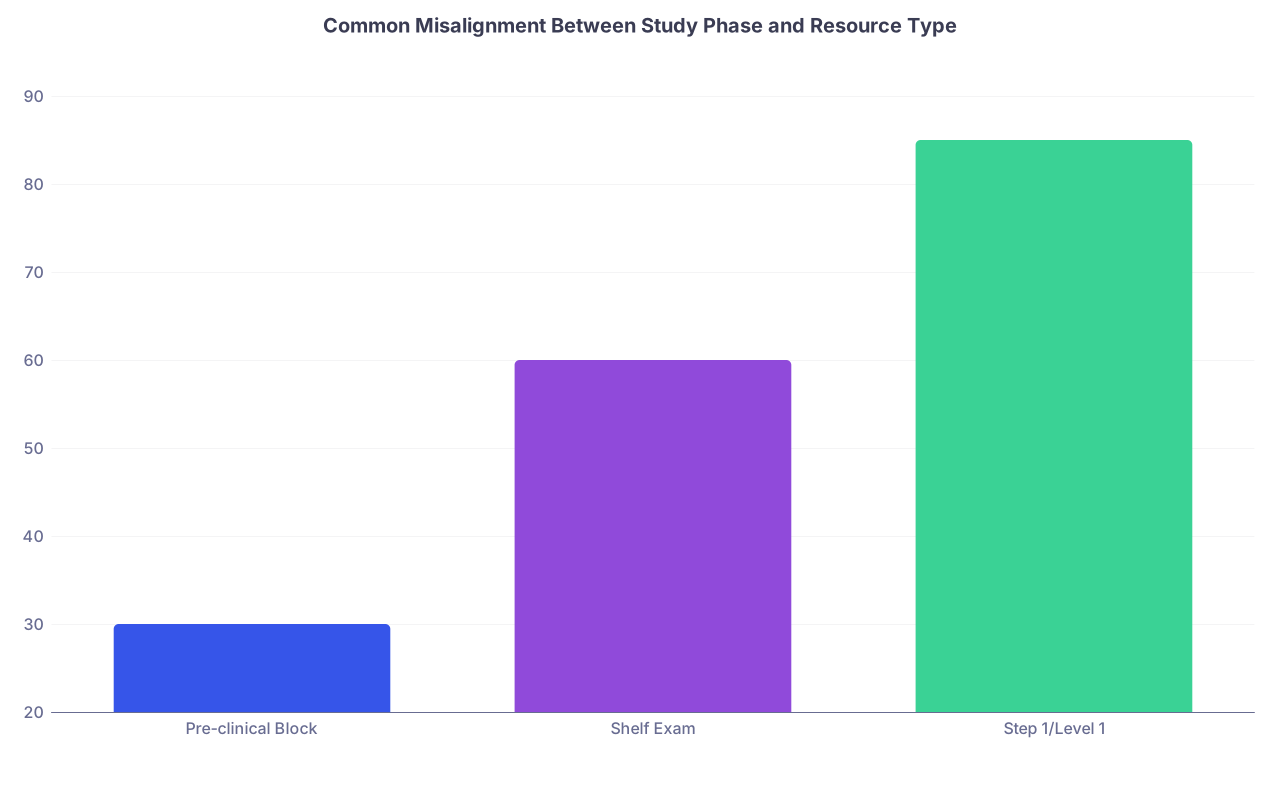
| Category | Value |
|---|---|
| Pre-clinical Block | 30 |
| Shelf Exam | 60 |
| Step 1/Level 1 | 85 |
(Those numbers roughly reflect how much integration and clinical framing you need. The later the phase, the more integrated and case-based your resources must be.)
Common mismatch scenarios I’ve seen:
- M2 student using a super-basic organ-system book aimed at undergrad physiology to prep for Step.
- M1 student using an advanced pathophys systems book for a course that only expects basic function and definitions.
- MS3 on an internal medicine rotation clinging to a pre-clinical cardio review instead of using a shelf-appropriate internal medicine text.
How to avoid this mistake
Ask three blunt questions before locking in a book:
- Is this written for pre-clinical, shelf, or boards?
- Does this book use NBME-style vignettes and clinical integration, or is it mostly straight facts?
- Do students with my exam (school, curriculum, grading) actually recommend it as helpful, or just “nice to have”?
If the answer to #3 is vague (“people say it’s good”), be suspicious. You don’t have time to carry dead weight.
Mistake #3: Reading Organ-System Books Like Novels (No Active Work)
This one kills scores quietly.
You sit down, open your cardio or neuro review book, and “crank through” 30–40 pages. You highlight, you underline, you maybe even feel productive. But you’re not engaging with the material, you’re just staring at it.
Then you hit UWorld or NBME practice questions and feel blindsided.
“Wait, I read about this. Why can’t I answer it?”
Because you made the classic passive-learning mistake.
Organ-system exams and boards test:
- Application
- Pattern recognition
- Integration of multiple concepts
Not your ability to recognize a sentence you once highlighted.
The passive vs active trap
Passive use:
- Read the “Respiratory System” chapter start to finish
- Highlight anything that “seems important”
- Re-read your highlights a week later and call it “review”
Active use:
- Read a short section, close the book, and write out the mechanism from memory
- Turn tables and diagrams into flashcards or quick sketches
- Immediately do 5–10 related questions from UWorld/AMBOSS/Anki and see if the review helped
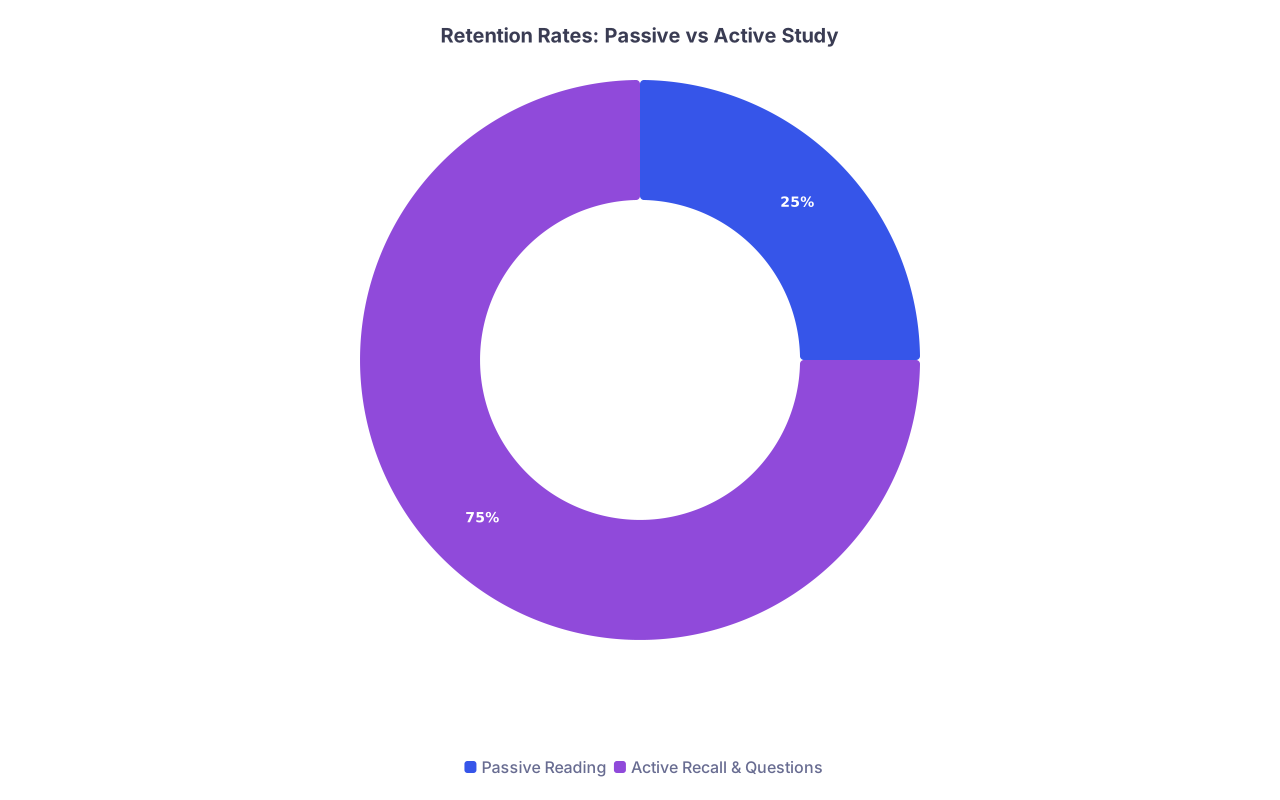
| Category | Value |
|---|---|
| Passive Reading | 25 |
| Active Recall & Questions | 75 |
The exact percentages will vary for each person, but the pattern does not: passive reading alone is a mistake.
How to avoid this mistake
When you use an organ-system review book:
- Limit yourself to short sections (2–4 pages), then close the book and test yourself.
- Force output: talk it out loud as if teaching a confused classmate.
- After each mini-chunk, do related questions. If your performance doesn’t improve, your “review” wasn’t real review.
If you can’t explain a concept without looking at the page, you don’t own it yet.
Mistake #4: Ignoring Integration Across Systems
This might be the sneakiest trap of organ-system books.
They’re organized beautifully by system. Which is great for your OCD and terrible for your understanding if you use them alone.
Real patients don’t present with “renal only” or “cardio only” problems. Real exam questions don’t either. But organ-system books make it seductive to live in silos:
- “Today is GI day.”
- “Tomorrow is cardio day.”
- “Next week I’ll worry about endocrine.”
Then you get a question with heart failure, chronic kidney disease, and diabetes meds interacting—and you freeze, because you only ever studied those topics in isolation.

| Step | Description |
|---|---|
| Step 1 | Organ-system book only |
| Step 2 | Cardio in isolation |
| Step 3 | Renal in isolation |
| Step 4 | Endo in isolation |
| Step 5 | Poor integration on exams |
| Step 6 | Organ-system + integrated questions |
| Step 7 | Better cross-system thinking |
How this shows up on exams
You’ll miss questions like:
- “Hypertensive patient with CKD starting ACE inhibitor develops increased creatinine and hyperkalemia—what’s the mechanism?”
- “Diabetic with autonomic neuropathy, taking beta-blocker, now has atypical angina—what symptom is blunted and why?”
The information is in your cardio, renal, and endocrine chapters. But if you only ever memorized them separately, you can’t pull them together under time pressure.
How to avoid this mistake
You can still use organ-system books. Just don’t stop there.
- After finishing a system, do question blocks that mix that system with at least one other.
- When reading a system chapter, actively ask: “What other system is most affected by this?”
- Make quick notes in the margins: “This connects to renal acid-base,” “This drug shows up in endocrine too.”
You want your brain to build cross-links, not silos.
Mistake #5: Never Updating or Letting Go of a Weak Resource
There’s a weird loyalty some students have to their first organ-system review book. “I’ve already highlighted half of it, I can’t switch now.”
Yes, you can. And often, you should.
If your scores aren’t moving, your understanding feels shallow, or you dread opening a particular book, that’s a red flag. Hanging onto a weak or misaligned resource out of sunk-cost guilt is a mistake that drags on for months.
I’ve seen students:
- Stick with a poorly written neuro review book that confuses them, because they’ve “already annotated it.”
- Use an outdated edition that doesn’t match current exam trends.
- Cling to an M1-level physiology book during dedicated Step prep instead of upgrading to a boards-level systems text or question bank.
They realize the mistake only after a bad exam. Sometimes more than one.
Signs your organ-system review book is holding you back
- You consistently miss questions on topics you “read twice.”
- You need to cross-reference YouTube or other books to understand what this one is trying to say.
- Friends using a different resource can explain concepts more clearly than your book can.
- Your practice scores plateau despite “more reading.”
At that point, the problem is not “you didn’t try hard enough.” The problem may be the resource.
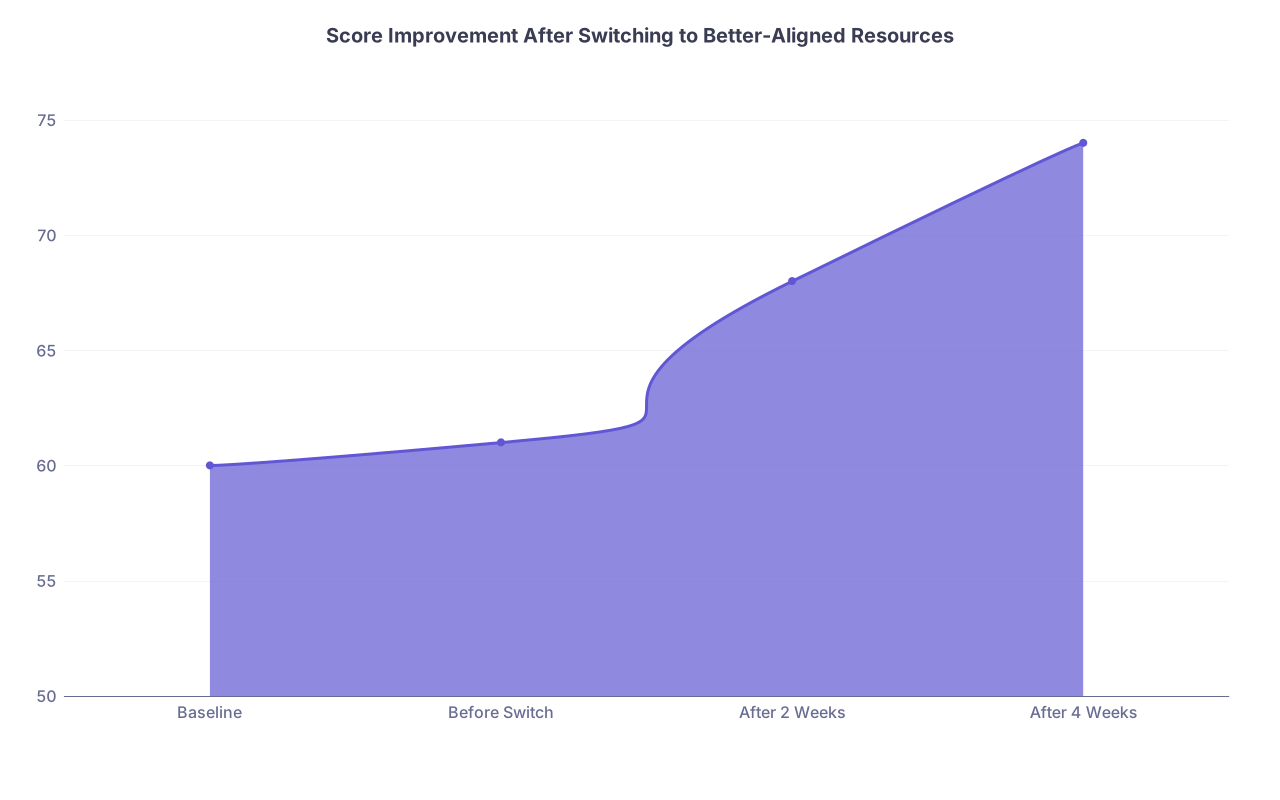
| Category | Value |
|---|---|
| Baseline | 60 |
| Before Switch | 61 |
| After 2 Weeks | 68 |
| After 4 Weeks | 74 |
Again, numbers will vary, but I’ve seen jumps like that when students finally drop the wrong book and move to something that fits their exam and learning style.
How to avoid this mistake
Give every resource a trial period:
- Use it seriously for 1–2 weeks.
- Track: Do your related question scores improve? Does your understanding feel clearer?
- If not, change course. You don’t get bonus points on exams for being “loyal” to a bad book.
And don’t be sentimental about highlights. Your exam doesn’t care how many pages you colored.
Putting It All Together: A Safer Way to Use Organ-System Review Books
Here’s a simple, no-nonsense pattern that avoids all five mistakes:
Start with a primary resource
For new material, use your course materials, a good textbook, or a structured video series. Build the foundation first.Layer in the organ-system review book for consolidation
Use it after lectures or after a first-pass to tighten and summarize. Not as your sole source.Study in active, small chunks
Short sections → close the book → explain from memory → do questions. No mindless cover-to-cover reading.Force integration
Mix question blocks that cover multiple systems. When reading, constantly ask, “What other system does this touch?”Audit your resources regularly
Every 2–3 weeks, take a practice block. If your scores aren’t budging, question your process and your books, not just your willpower.
If you treat organ-system review books as scalpels instead of blunt instruments, they’ll help you cut through the noise. If you cling to them as your only lifeline, they’ll quietly weigh you down.
FAQ (Exactly 3 Questions)
1. How many organ-system review books should I use at once?
Do not juggle five different system books at the same time. That’s how you fragment your attention and repeat the same superficial content. For a given block or exam period, one main organ-system review source plus your question bank is usually enough. If you find yourself “sampling” multiple books for the same system because none feels clear, that’s a sign to choose a single better resource instead of stacking mediocre ones.
2. Should I read an organ-system book cover to cover before starting questions?
No. That’s a common and costly mistake. Waiting to “finish the book first” delays the feedback you need from questions. You won’t know what’s actually sticking and what’s slipping through the cracks. A much safer approach: alternate. Read a small section, then immediately follow it with targeted questions on that topic. That way, you find gaps early instead of discovering them on your actual exam.
3. How do I know if an organ-system review book is “high-yield” for my school’s exams?
Don’t trust generic Amazon reviews or vague “upperclassmen loved it” comments. Look for very specific feedback from students who took the same exams you’re facing: “This aligned really well with our cardio block questions and NBME-style tests” or “Our school didn’t test most of what this book emphasized.” Even better: compare a chapter with released or practice questions from your school. If the book prepares you to handle the style, depth, and integration you see in those questions, it’s high-yield for you. If not, it’s just another glossy distraction.
Open the organ-system review book you’re currently relying on. Pick one random topic you “finished” last week. Close the book and, on a blank sheet of paper, explain that topic as if you were teaching a confused classmate. If you can’t do that cleanly, you’ve just found your first fixable mistake.