
Maximizing your Q-Bank use can be the difference between a passing score and a competitive score on high‑stakes exams like the USMLE, COMLEX, or other medical licensing assessments. Nearly every successful test taker uses Question Banks as a core part of their Medical Exam Prep—but not everyone uses them well.
This guide walks you through evidence‑informed, practical Q-Bank Strategies so you can turn question practice into predictable score gains, rather than just “doing questions and hoping for the best.”
Understanding Q-Banks: The Foundation of Smart Exam Prep Strategy
Before you can optimize your Q-Bank use, you need to understand what Q-Banks actually offer—and what they don’t.
What Is a Q-Bank in Medical Exam Prep?
A Question Bank (Q-Bank) is a large collection of exam-style questions designed to mirror the content, style, and difficulty of standardized tests like:
- USMLE Step 1, Step 2 CK, Step 3
- COMLEX Level 1, Level 2-CE, Level 3
- Shelf exams and in-training exams
Most high-quality Q-Banks include:
- Multiple-choice questions (MCQs) with single best answers
- Clinical vignettes that simulate real exam stems
- Integrated science questions that combine physiology, pathology, pharmacology, etc.
- Explanation and teaching points for each answer choice
- Performance analytics to track your progress and identify weak areas
When used deliberately, Q-Banks become your primary engine for both learning and assessment, not just a way to test what you already know.
Why Q-Banks Are Essential for USMLE and COMLEX Success
Q-Banks are not just “extra practice.” They directly support the key skills you need on exam day:
Focused Content Review
- Questions force you to retrieve information (active recall), which is proven to strengthen memory more than passive review.
- Topic-tagging helps you identify content gaps (e.g., consistently missing cardiac murmurs or renal physiology).
Familiarity with Exam Style and Logic
- USMLE and COMLEX questions have a distinct structure, length, and reasoning pattern.
- Repeated exposure trains you to recognize common traps, distractors, and high-yield patterns (e.g., how they ask about ethics, biostats, or OMM).
Performance Analytics and Feedback Loops
- Modern platforms show your score by system, subject, and question difficulty.
- You can compare your performance to peers to estimate where you stand in relation to passing or target score ranges.
Test-Taking Skill Development
- You learn pacing, flagging, and time-management strategies in a safe environment.
- You practice reading stems efficiently and extracting key details under timed conditions.
Key Features to Look For in a High-Quality Q-Bank
Not all Q-Banks are equal. When choosing one for your Medical Exam Prep, look for:
Comprehensive Content Coverage
- Aligned with current USMLE/COMLEX content outlines
- Robust coverage of systems, disciplines, ethics, biostats, and OMM (for COMLEX)
Realistic Question Style and Difficulty
- Stems similar in length and complexity to the actual exam
- Mix of easy, moderate, and challenging questions
Customizable Learning Options
- Ability to create custom quizzes by system, subject, difficulty, or previously missed questions
- Options for timed vs. tutor mode, random vs. subject-based blocks
Deep Explanations and Learning Tools
- Clear, concise rationales for all answer choices
- Integrated images, tables, diagrams, and references to trusted resources
Robust Performance Analytics
- Tracking of percent correct, trending performance, and comparison to peers
- Breakdown by system and discipline to inform your study plan
Mobile Compatibility and Offline Access
- Responsive apps or mobile interfaces for on-the-go question practice
- Offline or download options for times you don’t have reliable internet
Building a Structured Q-Bank Study Plan
Randomly doing questions when you “have time” is one of the fastest ways to underperform. High-yield Q-Bank Strategies start with structure.
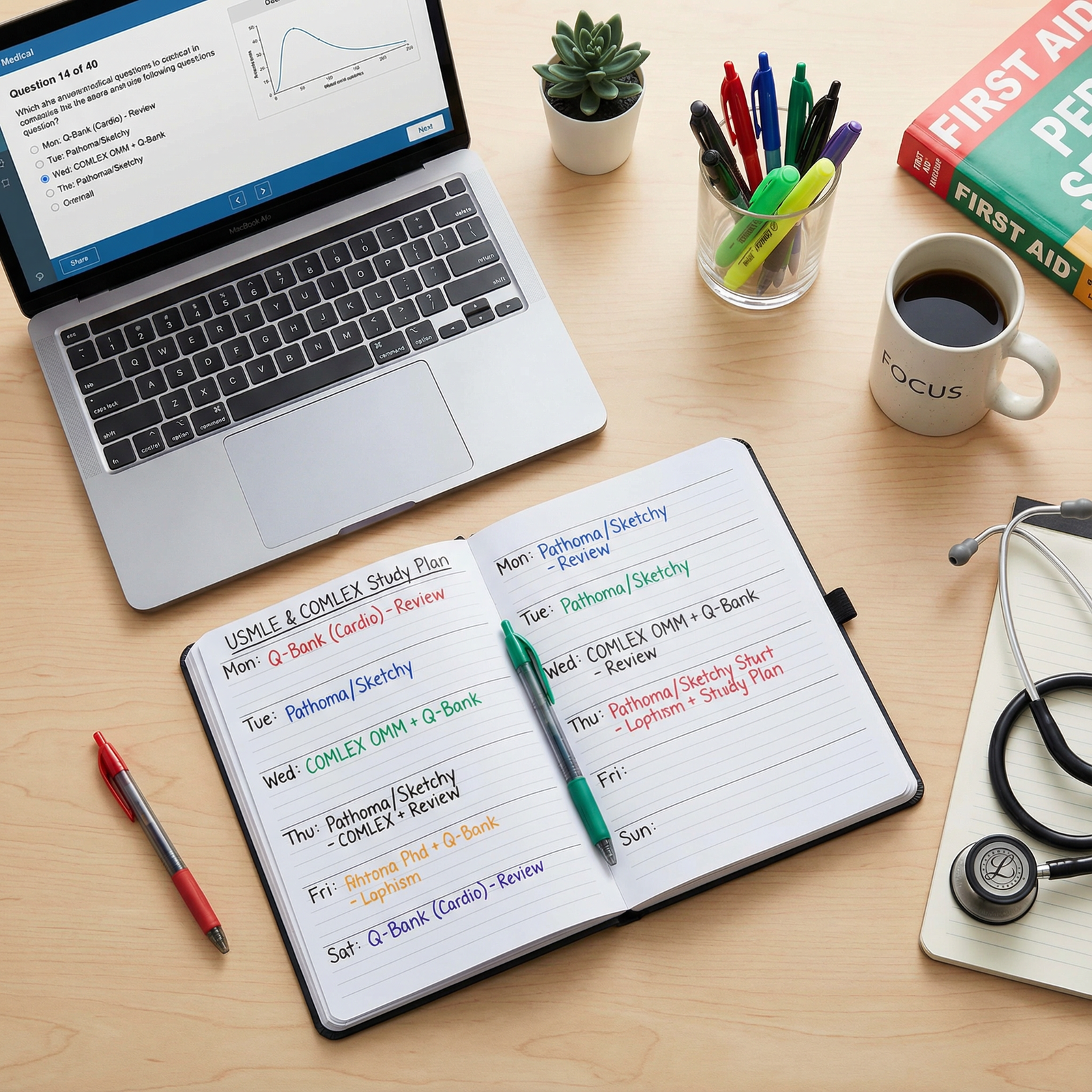
Set Clear, Measurable Q-Bank Goals
Tie your Q-Bank usage to specific goals rather than vague intentions:
Daily question targets
- Early dedicated period: 40–80 questions per day
- Closer to the exam: 80–120+ questions per day (as endurance builds)
Weekly progress goals
- Example: “Complete 350–500 questions/week with full review of all explanations.”
Completion goals
- Aim to complete your primary Q-Bank at least once, ideally 1.5–2 times if time allows.
Remember, the real work is not just in answering questions—it’s in reviewing them well.
Integrate Questions Into Your Overall Study Techniques
Q-Banks should interact with, not replace, your other resources:
During pre-dedicated phase (e.g., M2)
- 10–20 questions/day in tutor mode on the current system (e.g., cardio block)
- Use questions as learning tools alongside lectures and Anki/flashcards
During dedicated study period
- 2–3 blocks of 40 questions/day under timed conditions
- System-based early in dedicated, then shift to mixed blocks
During clerkships (for shelf exams)
- 10–40 questions/day focused on that rotation (IM, surgery, peds, etc.)
- Use incorrect questions to guide which sections of your textbook or review resource to read that night.
Use a Weekly Review Rhythm
To avoid superficial learning:
End-of-day review (micro review)
- After each block, review every question—right and wrong
- Annotate high-yield points into your notes or flashcards
End-of-week review (macro review)
- Look at your performance analytics for the week
- Identify:
- Top 2–3 weakest systems/subjects
- Most frequently missed question themes (e.g., acid-base, OMM counterstrain, psych pharmacology)
- Plan next week’s focus based on these data.
How to Use Q-Banks Effectively: Mode, Timing, and Review Strategy
The way you approach each block is as important as the number of questions you do.
Start With a Baseline Practice Exam
Before heavy Q-Bank use, consider taking:
- A practice NBME (for USMLE Step exams)
- A COMSAE (for COMLEX exams)
- Or a comprehensive Q-Bank self-assessment
Benefits:
Benchmark your preparedness
- Clarifies whether you’re near passing or far from it
- Highlights early weak areas you should emphasize
Set realistic goals
- Helps you decide if your target exam date and score are feasible
- Provides an anchor to measure improvement later.
Timed Mode vs. Tutor Mode: When to Use Each
Tutor Mode (learning mode)
Best for: Early phase, new topics, pre-clinical years
- Answer one question at a time with immediate feedback
- Use to:
- Build foundational understanding
- Learn new concepts in a question-based format
Timed Mode (exam simulation mode)
Best for: Dedicated period, late phase of prep
- Complete full blocks (e.g., 40 questions) without pausing
- Simulate exam environment:
- Quiet space
- No interruptions
- Use only scratch paper and what you’ll have on exam day
A strategic approach:
- Early: ~70% tutor mode, 30% timed
- Mid: 50% tutor, 50% timed
- Late (final 4–6 weeks): 80–100% timed mixed blocks
The Critical Step: Building a High-Yield Review Process
Just answering questions gives partial benefit. The gains come from systematic review:
Review every question—right and wrong
- Wrong answers reveal gaps.
- Right answers may be due to guessing or partial knowledge; you need to confirm understanding.
For each question, ask yourself:
- Why is the correct answer correct?
- Why is each incorrect option wrong?
- What is the key teaching point or pattern?
Write down or encode high-yield learning
- Add facts, mechanisms, or patterns to:
- Anki/flashcards
- A “mistake journal” or OneNote/Notion doc
- Keep it brief and focused—avoid rewriting textbooks.
- Add facts, mechanisms, or patterns to:
Use active learning while reviewing
- Cover the explanation and try to explain it yourself first
- Teach it out loud to an imaginary student or peer
- Summarize the core concept in 1–2 sentences.
Tag and return to missed questions
- Use platform tags like “marked,” “review,” or “weak area”
- Re-do missed questions 1–2 weeks later to check retention.
Targeting Weaknesses and Optimizing Question Selection
Not all questions are equally valuable for you. Smart Study Techniques prioritize your weaknesses while maintaining broad coverage.
Use Analytics to Drive Your Q-Bank Strategies
Most major Q-Banks provide:
- System breakdown (e.g., cardio, GI, neuro, MSK)
- Discipline breakdown (e.g., pharm, path, phys, biostats)
- Performance vs. peers
Use this data to:
- Identify your bottom 2–3 systems (e.g., renal, endocrine, OMM)
- Identify your bottom 2–3 disciplines (e.g., pharmacology, ethics)
- Direct extra question blocks and content review toward these areas.
For example:
- If your renal physiology questions are consistently <40% correct:
- Do a 40-question block focused on renal
- Then re-read a concise renal phys resource and do flashcards
- Repeat a few days later with a mixed block including renal questions.
Balancing Subject-Based and Mixed Question Sets
Both have specific roles.
Subject-based blocks (e.g., only cardiology, only GI):
- Best for:
- Early to mid-prep
- Reinforcing a recently studied system
- Remediating a targeted weak area
Mixed blocks (all systems randomized):
- Best for:
- Later stages of prep
- Simulating real exam conditions
- Testing integration and flexibility
Suggested progression:
- Weeks 1–2 of dedicated: ~60–70% subject-based, 30–40% mixed
- Middle of dedicated: 50–50
- Final 3–4 weeks: 80–100% mixed blocks under timed conditions
Prioritizing High-Yield Questions and Topics
While you should not “cherry-pick” only easy or preferred topics, you can prioritize:
- Systems heavily weighted on your specific exam
- Historically high-yield topics:
- USMLE: cardiac murmurs, acid–base, renal, biostats, ethics, micro pharm
- COMLEX: OMM techniques and models, high-yield MSK, autonomics, obstetrics emergencies
If short on time:
- Focus on completing at least one full pass of a trusted primary Q-Bank
- Use a secondary Q-Bank more selectively (e.g., just for weak topics or extra practice).
Collaborating, Adjusting, and Protecting Your Well-Being
Sustained, high-quality Q-Bank work requires more than just discipline. You also need support, flexibility, and self-care.

Learning With Others: Peers and Mentors
Study groups (used wisely) can enhance understanding:
- Work through 10–20 challenging questions together
- Have each person explain one question’s reasoning out loud
- Compare approaches to:
- Reading stems efficiently
- Ruling out answer choices
- Handling uncertainty and guessing strategiess
Guidelines for effective group sessions:
- Keep groups small (2–4 people)
- Set a clear agenda and time limit
- Avoid turning sessions into venting or distraction time.
Mentorship is also incredibly valuable:
- Ask upperclassmen or residents who scored well:
- How many questions/day did they do?
- Which Q-Banks helped most for USMLE vs. COMLEX?
- How did they switch from learning mode to exam mode?
Use their experiences to refine your own plan, but remember to individualize based on your needs and schedule.
Adjusting Your Study Plan Based on Performance
A strong plan is flexible:
If your scores plateau or drop:
- Reduce the number of daily questions slightly
- Increase time spent on review and targeted content refresh
- Check for burnout signs: poor focus, irritability, chronic fatigue
If your scores are steadily improving:
- Maintain or gradually increase daily block count
- Shift more questions into timed, mixed blocks
- Start incorporating more full-length practice exams.
Every 1–2 weeks, pause and ask:
- What’s working well with my Q-Bank Strategies?
- What’s not working, or feels unsustainable?
- How can I better align my Q-Bank use with my actual weak areas?
Protecting Your Physical and Mental Health
Your brain is part of your body. Protecting both will improve your retention and test-day performance.
Sleep hygiene
- Aim for 7–9 hours/night, especially in the month before your exam
- Avoid trading sleep for more questions; retention and reasoning suffer rapidly with sleep loss
Exercise and movement
- Short, regular sessions (even 20–30 minutes) boost focus and mood
- Walking while reviewing flashcards or listening to audio summaries combines both
Nutrition and hydration
- Stable blood sugar (protein-rich meals, limited simple sugars) improves concentration
- Practice your exam-day eating and hydration on full-length practice test days
Mindfulness and stress management
- Brief mindfulness sessions, breathing exercises, or short meditations can:
- Reduce anxiety
- Improve attention and emotional regulation
- Even 5 minutes between blocks can reset your focus.
- Brief mindfulness sessions, breathing exercises, or short meditations can:
Remember: The goal is not just to “grind harder.” It’s to study smarter and sustainably so you can peak on exam day—not two weeks before.
FAQs: Q-Bank Strategies for USMLE, COMLEX, and Beyond
1. How many hours per day should I spend on Q-Banks during dedicated study?
During dedicated Medical Exam Prep, most students benefit from 2–4 hours/day of focused Q-Bank work, which often corresponds to 80–120 questions plus thorough review. The exact number depends on:
- Your baseline score
- Your target score and exam date
- How fast you review explanations
If your review becomes rushed or shallow, slightly reduce daily question volume and increase review time.
2. Should I review questions I got right, or only the ones I missed?
Review every question, regardless of whether you got it right or wrong. Reasons:
- You may have guessed correctly for the wrong reasons.
- Explanations often highlight related concepts that can appear in other forms.
- Reviewing correct answers consolidates your knowledge and exposes you to efficient reasoning patterns.
Aim for more depth on wrong questions and slightly faster review on right questions, but don’t skip them.
3. Is it better to use multiple Q-Banks at the same time or focus on one?
For most students, it’s more efficient to:
- Commit to one primary Q-Bank and aim to complete it fully.
- Use a second Q-Bank selectively for:
- Extra practice in weak topics
- Additional exposure to question style variation
Using too many Q-Banks simultaneously can fragment your learning and make it harder to track progress. Depth of review with one solid resource usually beats shallow exposure to many.
4. When should I start using Q-Banks in medical school?
Ideally, begin early and gradually:
- Pre-clinical years:
- Start with 10–20 questions per week per system in tutor mode to reinforce lectures.
- 3–6 months before your USMLE/COMLEX:
- Increase to regular daily question sets.
- Dedicated study:
- Transition to full blocks and exam-style timing.
Starting earlier allows you to use Q-Banks as a learning tool, not just as last-minute assessment.
5. How do I know if my Q-Bank performance is good enough for my target exam score?
Use a combination of:
- Q-Bank percentile vs. peers (cautiously—each Q-Bank’s population is different)
- Trend over time (your average should rise or at least stabilize)
- Official practice exams (NBMEs, COMSAEs, UWorld self-assessments, etc.)
Ultimately, official self-assessment exams are more predictive than raw Q-Bank percentages. Use Q-Bank data to guide learning, and practice exams to gauge readiness.
By structuring your Q-Bank use, reviewing questions deliberately, targeting your weak points, and protecting your well-being, you transform Q-Banks from a box to “get through” into a powerful engine for score improvement. With thoughtful, consistent application of these Q-Bank Strategies, you’ll walk into your USMLE, COMLEX, or other board exam with confidence built on real, measurable progress.