
You've just wrapped up your last interview of the day. The adrenaline that carried you through eight hours of rapid-fire questioning is fading into a heavy, sleep-deprived fog. You look at your partner across the table, and you both realize the exact same thing: you have a mountain of thank-you notes to write before the 48-hour window closes.
Applying to residency as a couple doubles the workload. It also doubles the risk of burnout if you don't have a system. I've seen couples tank their rank list position simply because they dropped the ball on post-interview follow-ups. They got sloppy. They missed deadlines. They sent generic garbage.
Don't let that be you. Here is exactly how to handle the post-interview email grind as a team.
The Couple's Match Email FAQs
Before we get into the workflow, let's clear up the two most common arguments couples have about this process.
Is it okay to send one email for both of us? No. Programs want to see individual engagement. Sending one email for two people looks like you are trying to game the system and dilutes your individual connection to the program. You are two distinct applicants. Act like it.
What if we disagree on the tone of the email? You must agree on a "House Style" before you start. Pick the tone that is most professional and least likely to offend. If you can't agree, default to the most formal, standard medical correspondence style. Leave the quirky humor out of it.
Step 1: The Triage Protocol
Do not open your email client and start typing. You will burn out by Step 3.
When you're staring down 20+ interviews between the two of you, treating every email with the exact same level of immediate urgency is a recipe for disaster. You need a triage system. Create a "Triage List" based on interview date and perceived interest level.
Prioritize interviews that are closer to the deadline first to ensure you don't miss the window. If you interviewed at a top-tier program on a Tuesday, those emails go out Tuesday night. If you interviewed at a backup program on a Monday, and it's already Wednesday, push it to the bottom of the pile. Triage protects your energy for the programs that actually matter to your rank list.
Step 2: The Shared Template Vault
You need a centralized command center. Create a Google Doc or Notion page titled "Couple Match Templates."

Write one "Master Template" that covers the basics: gratitude, specific interest in the program, and the "why." This isn't about writing a mad-libs form letter. It's about standardizing your formatting, your sign-offs, and your structural flow.
This ensures your voices sound professional and consistent across all 20+ emails. When you're typing your 15th email at 11:30 PM, you shouldn't be reinventing the wheel. You should just be plugging in the specifics. Keep the master template clean, polite, and strictly professional.
Step 3: The Personalization Balance
The template is the skeleton; the personalization is the muscle. A skeleton without muscle is just a creepy skeleton.
Identify one specific conversation you had with a resident or faculty member during the interview. Insert that detail into the template immediately. This takes 5 minutes but signals that you were present and engaged.
Did the Program Director mention a new global health track? Put it in. Did a resident talk about the steep learning curve in the MICU? Reference it. "I really enjoyed our discussion about the MICU autonomy" beats "I enjoyed learning about the clinical environment" every single time. Programs can smell a copy-pasted email from a mile away. Give them the muscle.
Step 4: The 'Proxy' Strategy
Here is the reality of the couple's match: you will rarely be on the exact same schedule. One of you might be done with interviews while the other is deep in Step 2 CK prep and cannot write.
If one of you is studying, the other takes the lead on drafting. This is the Proxy Strategy. However, you must still ask the other partner about their specific conversation to ensure accuracy. You cannot invent a personalization detail for your partner.
Sit down for five minutes. Ask them, "What was the one cool thing you talked about with Dr. Smith?" Write it down. Draft the email for them. This prevents one person from becoming the "bureaucrat" of the relationship during the match cycle, and it keeps the studying partner from falling behind on their follow-ups.
Step 5: The 48-Hour Window
Residency programs track the timestamp of your email receipt. I know it sounds paranoid, but Program Coordinators notice when you send an email three days late. It signals poor time management.
Send the email within 24 hours of the interview if possible; 48 hours is the absolute hard limit. If you cross the 48-hour mark, you look disorganized. If you cross the one-week mark, you look like you don't care.
Set a calendar reminder for every single interview date immediately after the interview ends. Don't rely on your memory. Your memory is compromised by sleep deprivation and stress. Let the calendar do the heavy lifting. When the notification pops up, you sit down and write. No excuses.
Step 6: The Quality Control Audit
Fatigue makes you stupid. You will misspell words. You will forget to change the program name from your 10:00 AM interview to your 2:00 PM interview.
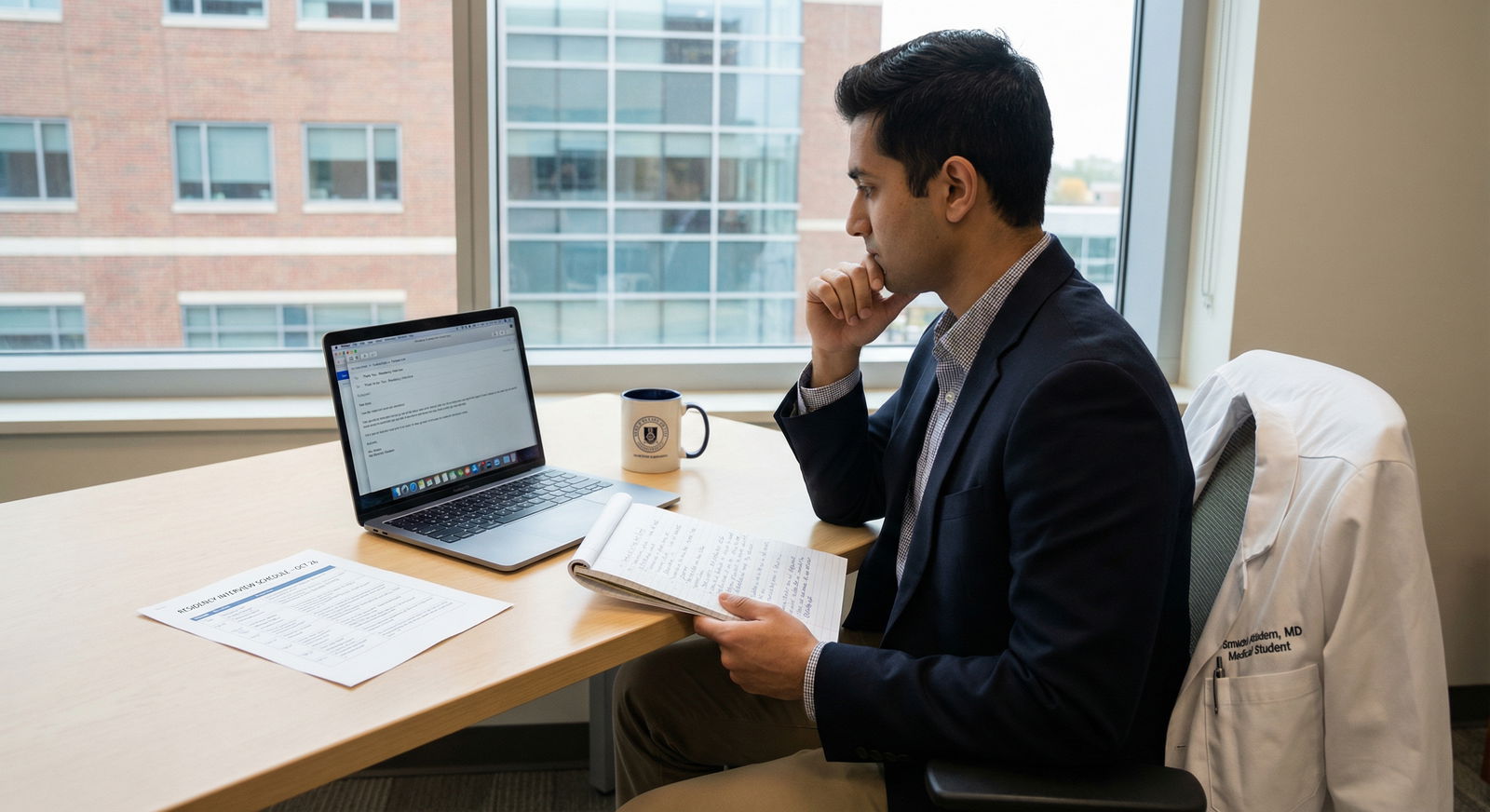
Before hitting send, run a "Spouse Check." Have your partner read the email to catch typos or awkward phrasing you missed due to fatigue. It takes two minutes.
Check that the program name, department, and interviewer names are spelled correctly. Calling the "Massachusetts General Hospital" the "Massachusets General Hospital" because you missed an 't' is a careless error that leaves a bad final impression. Check the names. Check the titles. Check the spelling. Then, and only then, hit send.
Step 7: The Gratitude Ledger
You will forget who you emailed by Match Day. The sheer volume of correspondence during interview season will wipe your short-term memory.
Create a simple spreadsheet. I call it the Gratitude Ledger. Columns should include: "Program Name", "Date Sent", "Interview Date", and "Notes".
This serves as your backup. If a program claims they never received your email during a post-interview communication, you have the proof. You can look at your ledger, see the exact date and time you sent it, and reply with confidence. It also gives you a massive psychological boost to see that "Sent" column filling up. Track every single email. Leave no program behind.
The Action Plan: Execute Today
You don't need to wait for the perfect moment. The perfect moment was an hour ago. The second best moment is right now.
- Block the time: Open your calendar and block out 30 minutes tonight to draft the first batch of emails. Treat this block like a clinical shift. You don't skip shifts.
- Build the vault: Open your Google Doc and paste the Master Template. Get the skeleton built before you get tired.
- Start the momentum: Do not wait for the weekend. The momentum you build today will save you from panic tomorrow.
Treat thank-you emails as a logistical operation, not a creative writing task. Use a shared template to maintain consistency while allowing for personalized touches. Track every email in a spreadsheet to ensure no program is left behind.
Get it done. Your rank list will thank you.