
It is 10:37 p.m. You are back in your hotel room or your apartment. Suit jacket is on the chair, tie or heels are off, and your brain is replaying the same 15 seconds from that interview over and over.
The awkward answer about your research.
The weird silence after they asked about your weaknesses.
The moment you realized you talked for three straight minutes and never actually answered the question.
And the worst part: you really liked this program.
You liked the residents. You liked the vibe. You could see yourself there. But you walk away thinking, “That was… fine? Maybe slightly below fine. Definitely not my best.” Now you are stuck on the question: Can I recover anything here with follow‑up, or did I just lose my shot?
You have two jobs now:
- Stop making things worse.
- Use follow‑up strategically to salvage everything that can be salvaged.
Let me walk you through exactly how to do that.
Step 1: Diagnose What Really Happened (Not the Panic Version)
You cannot fix what you have not defined. Before you write a single email or start planning some elaborate “update,” you need a clean, honest assessment of how “mediocre” this interview actually was.
1.1 Do a 24-Hour Post-Interview Download
Within 24 hours (before the details blur), sit down and write out three lists:
- What went well
- What was mediocre
- What was bad / cringe
Keep it concrete. Example:
Went well:
- Connected well with PGY-2 on cardiology rotation question.
- Asked good questions about program structure and electives.
- PD seemed interested when I talked about underserved care.
Mediocre:
- Generic answer about “Why this program?”
- Slightly rambled about research; no clear takeaway.
Bad:
- Could not fully answer when they challenged me on a clinical decision.
- Said “I’m not sure I prepared enough for that” (never say this).
If you cannot do this from memory alone, use:
- Your post-interview notes (if you kept any).
- Texts you sent friends right after (“Dude I just bombed the question about leadership”).
- Any feedback or comments you overheard from residents.
The point is to figure out: Was this actually bad, or just not your A-game?
1.2 Separate Feelings from Facts
Most applicants are terrible at judging their own interviews. I have watched people come out of fantastic interviews convinced they ruined everything, and others float out of disasters blissfully unaware.
Use this quick reality check:

Ask yourself:
Did anyone on the day:
- Smile and say, “You’ll be a great fit here”?
- Offer their contact info and say, “Reach out if you have questions”?
- Seem engaged and genuinely curious about your story?
Or:
- Did multiple interviewers look confused or disengaged?
- Did you contradict yourself (e.g., say you love research in one room and hate it in another)?
- Did you say anything that could be interpreted as unprofessional, biased, arrogant, or unsafe?
If what you did was:
- Slightly off, a bit rambly, not your best storytelling → This is salvageable. Very common.
- One truly bad answer but otherwise solid → Still salvageable with smart follow-up.
- Major professionalism or ethics red flag → Follow‑up will not fix this. You move on and focus on other programs.
Step 2: Understand What Follow-Up Can and Cannot Do
You are not going to “email your way out” of a catastrophic interview. That is fantasy. But you can accomplish three realistic things:
- Reinforce genuine enthusiasm for a program you loved.
- Clarify or strengthen a weak point (subtly, without sounding defensive).
- Keep yourself on their mental radar in a positive, professional way.
Here is what follow‑up cannot do:
- Turn a terrible fit into a rankable candidate.
- Override a pattern of poor performance across multiple stations.
- Magically erase red-flag behavior.
That said, programs are made of humans. Humans misjudge. They get tired. They may have liked you but felt something was missing. A clean, thoughtful, non-cringey follow-up can nudge you up a few spots. Sometimes that is the difference between matching and not.
Step 3: Immediate Move – The Same-Day or Next-Day Thank You
If you are still within 24–48 hours: do the basics right.
3.1 Who You Should Email
At minimum:
- Program Director (PD)
- Program Coordinator (PC)
If appropriate and you had meaningful conversations:
- Chair (if interviewed with them)
- Key faculty you clicked with
- Chief resident or resident interviewers who gave you their email
If the program explicitly said “no post-interview communication” in their policy, respect that. Some specialties (e.g., EM, some IM programs) are serious about this. Violating it makes you look either careless or entitled.
3.2 Structure of the Thank-You Email
Keep it short and controlled. You are not writing a novel.
Subject line examples:
- “Thank you – [Your Name], [Specialty] Interview on [Date]”
- “Grateful for the opportunity – [Your Name]”
Core structure:
- Thank them for the interview and their time.
- One or two specific things you liked about the program.
- One concise sentence linking your interests to what they offer.
- Close politely. That is it.
Here is a template that works:
Dear Dr. [Last Name],
Thank you for the opportunity to interview at [Program Name] on [date]. I greatly appreciated hearing about [specific feature – e.g., your approach to resident autonomy on the inpatient service / the global health track / the structured mentorship in the first year].
Our conversation about [brief reminder of a topic you discussed] reinforced my sense that [Program Name] would be an excellent place to grow as a [specialty] resident, particularly given my interests in [X/Y]. I left the interview day very impressed by the residents’ camaraderie and the program’s commitment to [specific value: underserved care, rigorous clinical training, etc.].
Thank you again for your time and consideration.
Sincerely,
[Your Name], MS4
[Medical School]
For resident or faculty thank-yous, make it a bit more informal but still professional.
3.3 Subtle Repair Work in the Thank-You
If one part of the interview felt weak, you can gently reinforce that area without saying “I messed up.”
Example: You fumbled a question on your research.
You do not write:
“Sorry I gave a poor answer about my research.”
You write:
I particularly appreciated discussing your program’s focus on scholarly activity. Reflecting on our conversation, I am even more excited about the possibility of continuing my work in [topic] and contributing to [specific project type or area] during residency.
See the difference? You are not apologizing; you are reinforcing. You are signaling: “Hey, that topic matters to me, and I actually have more depth here than my half-baked answer showed.”
Step 4: The “Loved the Program, Meh Interview” Strategy
Now to the core problem: You loved this place. They saw you at 70% power. How do you correctly follow up over the next few weeks?
4.1 Decide: Is This a Top-Tier Program for You?
Before you do anything beyond basic thank-yous, ask:
- Would I honestly be happy here for 3–7 years?
- Does this program realistically fit my application profile (Step/COMLEX, grades, LORs)?
- Is this in my top 3–5 programs?
If the answer is “yes, this is a top choice,” then it is worth a more deliberate follow-up plan. If it is just “nice but not top tier,” do your thank‑you, maybe one later update, and move on.
Step 5: Timing and Types of Follow-Up Messages
You basically have three windows:
- Immediate (0–48 hours) – Thank-you notes.
- Intermediate (2–4 weeks after interview) – Update / reinforcement.
- Late (post–rank list creation window) – Only if you will send a true “will rank you #1” communication (and only to one program).
5.1 The Intermediate Update (2–4 Weeks After)
This is where most applicants either do nothing (missed opportunity) or overdo it (annoying).
Your goals here:
- Remind them you exist.
- Add one or two pieces of new relevant information.
- Restate genuine enthusiasm.
What counts as “new information”?
- New publication accepted or submitted.
- New poster/presentation.
- Updated exam score (e.g., Step 2, COMLEX 2) if strong.
- New leadership role or project milestone.
- Meaningful new experience that strengthens your fit for their program (e.g., completed an away rotation in their city, new QI project, etc.).
Here is a clean template:
Dear Dr. [Last Name],
I hope you are well. I wanted to again thank you and the team at [Program Name] for the opportunity to interview on [date]. The experience confirmed my strong interest in your program.
Since we last spoke, I [briefly describe 1–2 substantive updates: e.g., had a manuscript accepted to [journal] on [topic]; completed my sub-internship in [specialty] where I further developed my skills in [X]]. These experiences have reinforced my interest in training at an academically rigorous program that emphasizes [specific value you saw at their program].
I remain very enthusiastic about [Program Name] and would be honored to train there.
Sincerely,
[Your Name]
No drama. No apologies. No, “I know my interview was not my best.” Do not drag their attention back to your weak moments. You are building a new mental snapshot: competent, motivated, good fit.
Step 6: Fixing a Specific Bad Answer (Without Sounding Desperate)
Sometimes you know exactly what you messed up.
Example scenarios:
- You misunderstood a clinical question and gave a borderline unsafe plan.
- You completely blanked on a core disease you should know.
- You rambled and never answered their actual question about a conflict or failure.
Can you fix that? Sometimes, yes. But you must be surgical about it.
6.1 When It Is Worth Addressing Directly
I only recommend directly addressing a bad answer when:
- It was clearly wrong on knowledge or judgment (clinical or ethical).
- The interviewer is someone central (PD, APD, chair).
- You can correct it clearly and concisely.
Example email:
Dear Dr. [Last Name],
Thank you again for the opportunity to interview at [Program Name] on [date]. I appreciated our discussion regarding [topic].
I wanted to briefly clarify my response to the clinical scenario involving [brief description]. After reflecting on our conversation and reviewing current guidelines, I realized that my initial answer did not fully emphasize the importance of [key point – e.g., early imaging, involving consultants, appropriate escalation of care].
In practice, I would [1–2 sentences with correct approach], and I am grateful that our discussion prompted me to review this area more carefully.
Thank you again for your time and consideration.
Sincerely,
[Your Name]
You are doing three things here:
- Owning the weakness without self-flagellation.
- Showing teachability and humility.
- Demonstrating you can update your knowledge quickly.
Do not do this for:
- Minor awkward answers (“I wish I’d phrased my strengths differently”).
- Every small miss. That just highlights flaws they may not have even noticed.
Step 7: “Will Rank You #1” – Use This Like a Scalpel, Not a Sledgehammer
Some specialties and programs expect a clear “I will rank you #1” email if that is true. Others do not care. Some explicitly say they do not want it.
The ethical rule is simple:
You send this to one program. Only one.
If you lie to multiple programs, you are part of the problem.
If this program that you “mediocre-interviewed” at ends up being your genuine #1, then yes, you can send a very specific, final communication later in the season.
Timing: After you have a clear rank list yourself. Often late January–February, depending on specialty.
Template:
Dear Dr. [Last Name],
I hope you are well. I wanted to thank you again for the opportunity to interview at [Program Name]. After completing all of my interviews and reflecting carefully on where I see myself training, I wanted to let you know that I will be ranking [Program Name] as my first choice.
My interview day, conversations with residents, and learning more about your approach to [specific elements: education / autonomy / patient population] have only strengthened my conviction that [Program Name] is the best fit for my training and career goals.
Thank you again for your time and consideration.
Sincerely,
[Your Name]
No need to mention the interview feeling “off.” At this stage, you are reinforcing commitment, not re-litigating the past.
Step 8: Common Mistakes That Make Things Worse
Let me be blunt. Here is how people tank a mediocre interview into a definite “no” with bad follow‑up:
| Mistake Type | What It Looks Like |
|---|---|
| Over-emailing | 3–5 emails in 2 weeks, forwarding updates constantly |
| Emotional dumping | Apologizing, oversharing anxiety, asking if you are ranked |
| Ignoring instructions | Contacting programs that banned post-interview communication |
| Group spamming | Sending obviously generic, copy-paste messages to all programs |
| Dishonest signaling | Telling multiple programs they are your “#1 choice” |
8.1 Over-Emailing
One thank-you + one update + possibly one final “#1 rank” communication → reasonable.
Four updates about every poster, every minor award, every new volunteer experience → needy.
If you find yourself thinking, “Maybe if I just send them one more thing…” you are probably crossing the line.
8.2 Emotional Dump Apologies
You never write:
- “I know my interview did not go well.”
- “I wish I could do it again because I was very nervous.”
- “I hope you do not hold my weak answers against me.”
Programs assume that everyone is nervous. Calling attention to your weakest moments cements them. Do not do their job for them.
8.3 Fishing for Rank Information
Do not ask:
- “Am I still being considered for ranking?”
- “Can you give me feedback on how my interview went for your rank list?”
- “Do you think I still have a chance to match at your program?”
Most programs are explicitly forbidden from answering rank-related questions. You put them in an awkward position and look inexperienced.
Step 9: Parallel Track – Fix the Problem for Future Interviews
You are not just trying to rescue one program. You are also trying to make sure the next interview is not another “mediocre.”
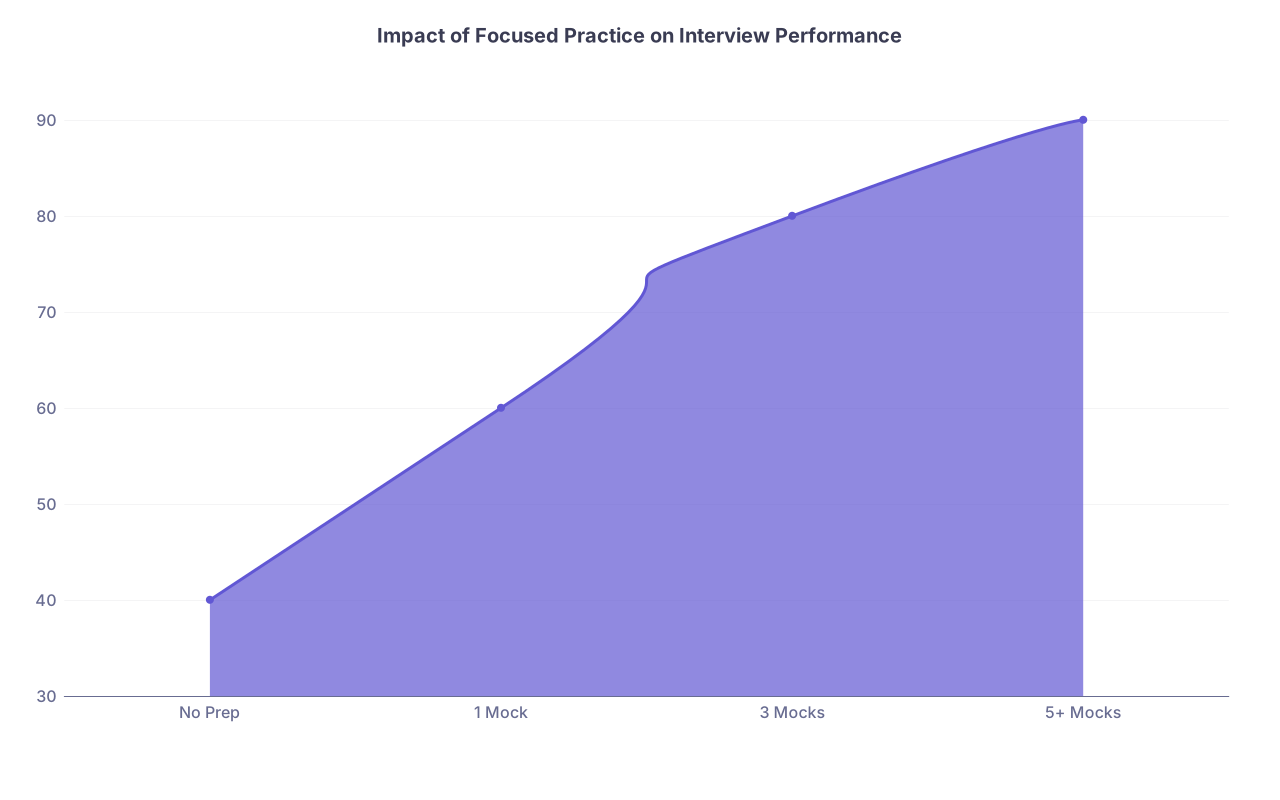
| Category | Value |
|---|---|
| No Prep | 40 |
| 1 Mock | 60 |
| 3 Mocks | 80 |
| 5+ Mocks | 90 |
Here is the short, tactical plan:
9.1 Identify Your Failure Mode
From your debrief, which pattern fits you?
- Rambling / not answering the question.
- Too generic, sounds like everyone else.
- Poor stories for “conflict,” “failure,” or “leadership.”
- Weak clinical reasoning questions.
- Awkward, low-energy interpersonal style.
9.2 Targeted Fixes
Rambling:
Practice with strict 1–2 minute limits per answer. Use a timer. Out loud. Use a simple framework (e.g., Situation–Action–Result for stories) and force yourself to hit the point by 90 seconds.Generic answers: Write down specific details for each program:
- 2 program-specific features you genuinely like.
- 1 way your background fits those features. Then rehearse customized “Why this program?” answers using those specifics.
Bad conflict/failure stories: Write out three concrete stories:
- One real failure (exam, rotation, project).
- One conflict with a team member.
- One situation that required leadership under stress. Practice telling each in 90 seconds, focusing on: what you learned and what changed.
Weak clinical reasoning: Review bread-and-butter conditions for your specialty. Practice explaining your thought process: differential → key tests → initial management → safety checks.
Low-energy vibe: Record yourself. Seriously. Most people do not realize how flat they sound on Zoom. Practice:
- Slightly faster speech.
- More facial expression.
- Sitting up, leaning slightly forward. These tiny changes make you seem more engaged.
9.3 One or Two Real Mock Interviews
Not 12. Just one or two serious mocks:
- Faculty who actually interviews for the residency.
- Or a senior resident who has been on interview committees.
- Or your dean / advisor who takes it seriously.
Give them permission to be blunt: “I want honest feedback, not reassurance.”
Step 10: Mental Reset – How to Not Obsess Over One Program
You are going to be tempted to mentally marry this one program and stalk them in your thoughts for two months. That is a mistake.
Here is the truth:
- You do not control how they rank you.
- You do control how you perform at your next 5–10 interviews.
- One mediocre interview does not define your match destiny unless you let it infect the rest.
Use a fixed ritual to reset after every interview:

| Step | Description |
|---|---|
| Step 1 | Finish Interview Day |
| Step 2 | Write 15-min Debrief |
| Step 3 | Send Thank-You Emails |
| Step 4 | Identify 1 Thing to Improve |
| Step 5 | Schedule Practice or Review |
| Step 6 | Stop Ruminating and Move On |
- 15 minutes to capture details and lessons.
- 30 minutes to send thank‑you emails.
- 15 minutes to write down exactly one thing to improve next time.
- Then you are done. No more replaying answers at 2 a.m.
If you genuinely loved the program:
- Follow the follow-up plan above.
- Put them high on your rank list if that stays true.
- Then build a rank list based on where you would be happy, not where you think you did “best.” Many people match at a place where they thought they were “just okay.”
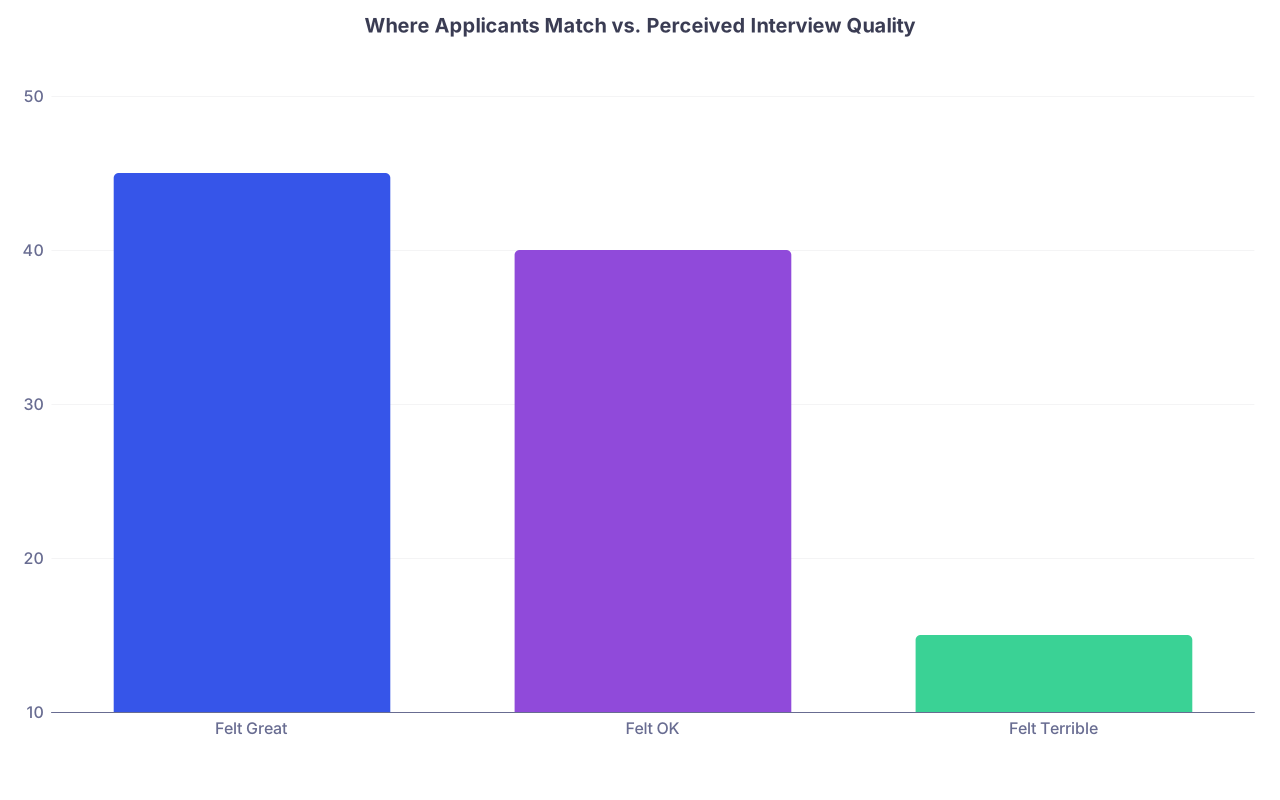
| Category | Value |
|---|---|
| Felt Great | 45 |
| Felt OK | 40 |
| Felt Terrible | 15 |
I have seen plenty of people match at their “OK” interview program, not the one they thought was perfect.
When You Should Actually Let It Go
I will be blunt here too. Sometimes, the right answer is: “This program is probably gone, and that is fine.”
If:
- You violated professionalism significantly.
- You directly contradicted yourself in a way that revealed dishonesty.
- You ignored explicit communication rules (e.g., kept contacting after “no contact” policy).
- You felt your values were not aligned with the program anyway.
Then your best move is not “more follow-up.” It is to:
- Learn the lesson.
- Fix the behavior.
- Focus your energy on programs where you can actually thrive.
Quick Recap: What Actually Helps
To wrap this up, here are the three essential moves:
Do thoughtful, concise follow-up.
- Same/next-day thank‑yous with specific, genuine details.
- One well-timed update email with real new information.
- A single, honest “I will rank you #1” email if, and only if, that is true.
Repair only what needs repairing.
- Clarify truly wrong clinical/ethical answers with a short, humble correction.
- Do not apologize for feeling nervous or “not being at your best.” It helps no one.
Fix your process for the rest of interview season.
- Diagnose your failure mode and run targeted practice.
- Debrief each interview, then move on.
- Build your rank list on where you would actually want to train, not where you think you “performed best.”
You had a mediocre interview at a place you liked. That is not the end of the story. Follow up like a professional, improve for the next one, and let the programs do their job while you keep doing yours.