
Last cycle, one of our senior residents opened yet another thank-you email on her phone between admissions. She smirked, turned the screen toward me, and said, “This kid just copied ChatGPT and hit send.” Two minutes later, she was in the group chat: ‘Nice student, but generic AF thank-you. Didn’t remember anything we actually talked about.’
Let me explain what you never see: those 30 seconds when a resident opens your thank-you note, judges you faster than they did during the actual interview, and then decides whether you get a quiet thumbs-up, a neutral shrug, or a subtle “nah” when the rank list meeting comes around.
You think thank-you notes are formalities. They’re not. They’re data points—small ones, but real. And residents absolutely talk about them.
The Truth: Do Thank-You Notes Actually Matter?
Here’s the unvarnished reality. Thank-you notes rarely save anyone. But they absolutely can:
- Confirm a good impression
- Quiet a small concern
- Or, occasionally, knock you down half a notch
Most programs will never say this on their website. Publicly, they’ll give some polite line like, “Thank-you notes are appreciated but not required and don’t affect ranking.” I’ve sat in those meetings. That statement is… not exactly a lie. But it’s incomplete.
Here’s what really happens.
Residents are the ones who actually read your emails. Attendings read a fraction. PDs and APDs even less. But when it comes time for resident input on the rank list—and yes, that part is real—your name shows up, and so do the memories:
- “Oh yeah, she sent that really thoughtful email about the clinic precepting model.”
- “He wrote this weird, over-the-top letter that felt fake.”
- “Honestly, I don’t think he even remembered who I was—he mixed me up with the chief.”
No one is bumping someone from #3 to #1 purely because of a thank-you note. But if you’re in the giant middle tier where half the list lives, that “slightly more favorable impression” can matter.
Thank-you notes are like seasoning. You’ll never turn bad meat into a gourmet dish, but you can absolutely make a good dish forgettable—or surprisingly memorable—depending on how you use them.
How Residents Actually Read Your Emails
Let me walk you through what happens on our side of the screen.
Imagine it’s 11:52 p.m. A PGY-2 is on night float. Between admissions, she checks her phone.
Subject line: “Thank you for the opportunity to interview!”
She opens it. Here’s the mental speed-run:
First 2 seconds: Vibe check.
Is this obviously a template? Is it a wall of text? Is the greeting correct? Spelled name? Correct program?Next 5–10 seconds: Specificity check.
Do you reference anything we actually discussed? Clinic? A case? A resident lounge? The vibe? Anything that proves you weren’t writing this before the interview even happened?Final 5–10 seconds: Signal check.
Do you sound genuinely interested in this program? Or is this a “you’re my top choice… among 35 programs I’m saying this to” email?
If it passes those three checks, you get a mental “solid.” Sometimes a screenshot to the group chat with, “This one’s sharp.” That comment ends up attached to your name when the rank list discussion comes.
If it fails? Best case, it’s ignored. Worst case, you’ve just made yourself memorable for the wrong reason.
The Hidden Categories Residents Sort You Into
No program labels these formally, but residents absolutely do this mentally. Your thank-you note puts you into one of a few buckets.
| Category | Resident Reaction |
|---|---|
| Specific & genuine | Positive signal |
| Generic but polite | Neutral, harmless |
| Over-the-top/awkward | Mild negative |
| Sloppy or wrong name | Strong negative |
| Obviously AI/template | Eye-roll, negative |
1. The “Specific & Genuine” Note
This is the gold standard. Not dramatic. Not flowery. Just obviously written by someone who was present and engaged.
Example of what residents like:
Dear Dr. Patel,
Thank you for taking the time to speak with me on Tuesday. I appreciated hearing how your program protects resident continuity clinic time, even on heavy inpatient months—that balance is exactly what I’m looking for in training. Our conversation about how you transitioned from residency into your current hospitalist role was really helpful as I’m thinking about my own career path.
I left the interview day even more excited about the possibility of training at [Program].
Sincerely,
[Name]
What residents say about this behind the scenes:
- “She actually listened.”
- “This sounds like her, not a template.”
- “Yeah, I liked her—this email tracks.”
You don’t need poetry. You need proof you were awake.
2. The “Generic but Polite” Note
This is what most people send.
Dear Dr. Smith,
Thank you for the opportunity to interview with your residency program. I enjoyed learning more about [Program] and appreciate your time.
Best,
[Name]
How residents react:
- “Fine.”
- “Whatever.”
- “At least they spelled my name right.”
Neutral isn’t bad. It won’t help you much, but it won’t hurt. If you’re short on time, “generic but clean” is infinitely better than “long and awkward” or “weirdly intense.”
3. The “Over-the-Top / Please Rank Me #1” Note
Residents really do see your “You’re my top choice” emails. And yes, they know you’re sending that to multiple programs.
Things that raise eyebrows:
- “Your program is my absolute top choice and I would definitely rank you #1.” sent… in November. To a place that knows you’re still interviewing elsewhere.
- Emotional oversharing: “I cried after interview day because I felt like I found my people.”
- Over-flattery: “Your leadership is truly inspirational, and I would be honored just to walk the same halls.”
What residents think:
- “Relax.”
- “This feels fake.”
- “If they’re already this intense as a student…”
That doesn’t mean you can’t signal interest. But there’s a line between clear enthusiasm and desperation. Residents are very good at spotting the second.
4. The “Sloppy” Note
This is where you start actively damaging yourself:
- Wrong program name
- Wrong specialty (yes, I’ve seen “I’d be honored to train in psychiatry” sent to IM programs)
- Wrong resident or faculty name
- Typos everywhere
Residents talk about these. They screenshot. They remember.
One applicant emailed: “Thank you again for the opportunity to interview at [COMPETING PROGRAM NAME].” We remembered that at rank time. Not because we were offended, but because it screamed: not detail-oriented, not careful, not fully present.
Do I want that person holding the pager at 2 a.m.? Not really.
5. The “Obviously AI / Template” Note
This is the new category in the last 2–3 cycles. And it’s growing.
Signs an email was AI-generated or lazily templated:
- Overly formal phrasing no human resident uses: “I remain deeply impressed by the comprehensive training paradigm fostered at your esteemed institution.”
- Identical structure across multiple faculty, with just the names swapped.
- Weirdly generic references that could apply to any program: “I appreciated learning how your program balances inpatient and outpatient opportunities” (that’s… every program).
Residents may not care how you wrote it, but they absolutely notice when you clearly didn’t think about it.
If your email sounds like a generic admissions brochure, you’re sending the message: “I didn’t care enough to write this myself.” That’s not the impression you want.
What Residents Actually Report Back to the Program
This is the part you do not see: how your thank-you note shows up when we’re actually making decisions.
At many programs, the resident voice is captured in a few ways:
- Post-interview surveys or forms
- A resident-only rank meeting
- Quick comments during the main rank-list meeting
Thank-you notes almost never appear as formal “criteria,” but they influence the narrative around you.
Here’s how I’ve seen it play out:
You were on the bubble.
Mixed reviews after interview day. Some people liked you, some didn’t notice you. Then a couple residents say, “They followed up with a really thoughtful email—seemed genuinely interested in our QI curriculum.” Now you’re slightly less “generic.”You had a slight red flag.
Maybe you came off scripted. Maybe you seemed uninterested in underserved populations at a safety-net program. Then your follow-up references a specific clinic we talked about and why mission-aligned work matters to you. Is that going to erase the concern? No. But it softens the edge.You were already loved.
Residents adored you. Then you send a good, specific note. Now we feel… validated. “Yup, we read them right.” People push a bit harder to keep you near the top.You annoyed people.
Overly intense thank-you notes. Multiple follow-ups. Pressure-y “I’ll rank you #1, can you tell me where I stand?” emails. Those get remembered negatively. “This person is going to be high-maintenance” is not what you want floating around when we’re deciding between you and 4 other similar candidates.
Residents don’t have a numeric “thank-you score.” But we absolutely bring up impressions that formed in that inbox window.
How to Write Thank-You Notes Residents Actually Respect
Let me be blunt: there’s no bonus for length, complexity, or drama. Residents respect notes that are short, specific, and sane.
Here’s the structure I’ve seen work over and over:
Correct greeting.
Dr. Lastname if you’re unsure. First name is sometimes fine for residents, but if you’re not certain how they signed off, stay formal.1 line of gratitude.
You’re thanking them for their time and conversation. Not their existence.1–2 specific callbacks.
Something you actually discussed. A detail about the program. A case. A clinic. A curricular structure. This is the core.1 line of genuine interest.
Not “I will rank you #1,” but something like: “Our conversation reinforced my strong interest in training at [Program].”Clean sign-off.
“Sincerely,” “Best,” whatever. Your full name.
That’s it.
This is what a resident sees and thinks: “They’re thoughtful, they were paying attention, and they’re not trying too hard.”
Timing, Number, and Logistics: What Residents Notice
You’re not just judged on what you send. The how and when matter too.
When should you send them?
Sweet spot: 24–72 hours after the interview.
Same-day can feel rushed, like you fired off a template before you processed anything. Two weeks later signals disorganization or low interest. Residents won’t usually care about the precise date, but they notice extremes.
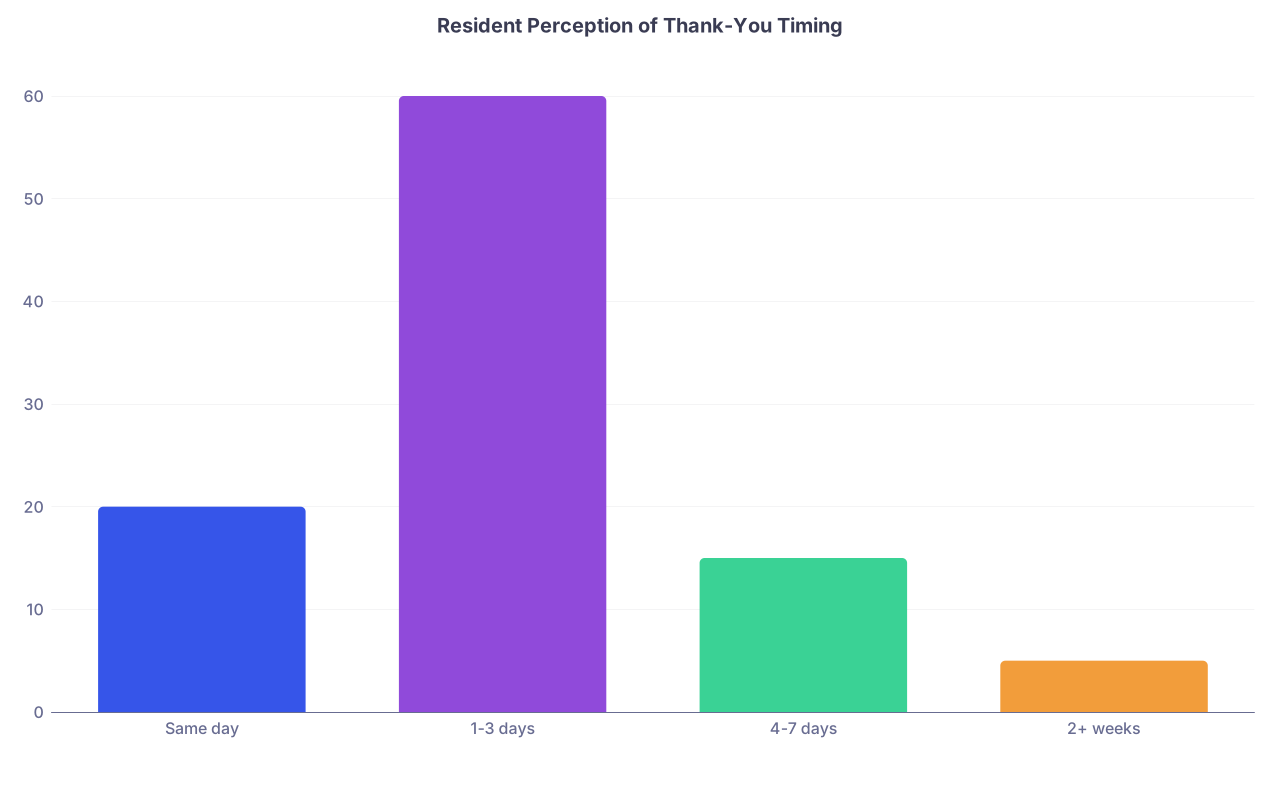
| Category | Value |
|---|---|
| Same day | 20 |
| 1-3 days | 60 |
| 4-7 days | 15 |
| 2+ weeks | 5 |
Think of that chart as a rough gauge of how often I hear, “Good timing,” versus, “Huh, that’s late.”
How many should you send?
Here’s the unspoken rule at most programs:
- PD / APD: almost always appropriate
- Your main interviewers: expected
- Residents you had longer conversations with: nice but optional
- Every single person you met for 5 minutes: unnecessary and annoying
A student once sent individual three-paragraph emails to six residents, plus PD, plus APD, plus coordinator. People noticed. Not in the way they hoped.
Better to send:
- 1–3 targeted, specific emails
- Possibly one group email to the residents, sent to the shared alias if they gave one (“Thank you to everyone who participated in the social hour…”), rather than spamming each person individually
Residents talk. “Did you get the novella from Applicant X too?” is not the vibe you want.
Email vs. Handwritten?
Handwritten notes used to be charming. Now they’re mostly late and irrelevant.
By the time a physical card arrives:
- We’ve forgotten details of your day
- The rank list is often already mostly formed
- No one has the bandwidth to circulate paper
If you’re dead set on a handwritten note, fine. But do not skip the email. The email is what residents read. The card is what they vaguely remember seeing on the coordinator’s desk once.
What Absolutely Backfires (That You Think Is “Going the Extra Mile”)
Let me list a few “power moves” that actually hurt you more often than they help.
Trying to fish for your rank position
Residents hate this. PDs really hate this.
Emails like:
- “Can you tell me where I’m likely to be ranked?”
- “Am I a competitive candidate for your top tier?”
- “I’m deciding between your program and another—can you give me a sense of my chances?”
No. We can’t. And trying to get us to break rules looks bad.
Multiple follow-ups when no one replies
Silence is the default. Residents are busy; most won’t respond. That’s not a sign they hated your note.
What is a bad sign: you emailing again 5 days later to ask, “Just wanted to be sure you saw my note!” Now we’re thinking, “Will this person blow up my pager during residency if I don’t respond immediately?”
Send once. Let it go.
Sounding like a brochure
If your note reads like you pasted together phrases from the program website, it feels lazy:
- “I was particularly impressed by your strong research opportunities and diverse patient population.”
- “Your commitment to excellence and innovation in patient care stood out to me.”
Every program says this about themselves. Don’t regurgitate marketing copy. Pick something you noticed. During your day.
How to Use AI Without Sounding Like a Robot
Let me be direct: residents are not running your email through an AI detector. They also don’t care if you brainstormed phrasing with a tool—as long as the final product sounds like a human who was actually there.
If you’re going to use AI at all, do it like this:
- Jot down 3 concrete things you remember from the conversation or interview day
- Draft a rough, messy email in your own words
- If you must, use AI to tighten phrasing but not to generate the content
Then read it out loud. If you wouldn’t say it that way in real life, tone it down.
The second most common resident comment I hear about thank-you notes now (after “generic”) is: “This has ChatGPT all over it.” That’s not a compliment.
What Actually Matters More Than the Note (But Is Connected)
Here’s the secret: your thank-you notes don’t exist in isolation. They’re interpreted in context.
Residents mentally line up:
- How you were on Zoom or in person
- How you interacted at the social
- How your personality came through in small talk
- Whether your application story made sense
Then they add:
- Did your follow-up match that same person?
If you were warm, curious, and genuine—and your note is stiff and over-polished—that dissonance is noticed. If you seemed nervous and guarded, but your note is thoughtful and grounded, that can help fill in the picture in a good way.
Consistency wins. Residents are trying to answer: “Who is this person really, and do I want them at sign-out with me?”
Your thank-you note is your last, small chance to answer that.
A Quick Visual: From Interview to Resident Feedback

| Step | Description |
|---|---|
| Step 1 | Interview Day |
| Step 2 | Resident Impression |
| Step 3 | Impression stays as is |
| Step 4 | Minor/No change |
| Step 5 | Impression slightly strengthens |
| Step 6 | Impression slightly worsens |
| Step 7 | Resident Input at Rank Meeting |
| Step 8 | Thank-You Note? |
That’s the real game. You’re tweaking the dial, not rewriting the story.
Bottom Line: How Residents Read You
Let me leave you with the three truths most applicants never hear.
- Residents do read your thank-you notes—and they remember the ones that feel specific, grounded, and sane. Not dramatic. Not “perfect.” Just real.
- Thank-you notes rarely change your fate, but they absolutely shape the story residents tell about you when your name comes up. You want that story to be, “Attentive, thoughtful, and genuinely interested in us.”
- Sloppy, desperate, or obviously templated emails do more harm than good. A short, specific, error-free message that sounds like you is enough. Anything more should be in service of clarity, not theatrics.
Write like a future colleague, not a supplicant. Residents are deciding if they can trust you next to them at 3 a.m.—keep that in mind when you hit send.