
The fastest way to hurt yourself after a great residency interview is with a bad email.
Not a crazy, unhinged email. Those are rare. I mean the “polite,” “thoughtful,” over-long, overly-sweet follow-up that program leadership rolls their eyes at and then quietly forgets you existed.
Let me walk you through the three biggest traps I see over and over: flattery, length, and tone. If you get these wrong, you will not “stand out.” You’ll just stand out as someone they do not want on their team.
The Hidden Rules Of Post‑Interview Emails
Here’s the part nobody spells out clearly: your post‑interview emails are not really about gratitude. They’re about signaling judgment.
Faculty and program directors read your emails asking:
“Does this person get it?”
“Will they be normal to work with at 3 a.m.?”
“Do they respect boundaries?”
They do not want:
- Clingy
- Needy
- Over-familiar
- Dishonest
- Demanding
- Long-winded
They do want:
- Brief
- Sincere
- Specific
- Professional
- Neutral in ranking language
Miss those signals, and your beautifully formatted thank-you turns into a small red flag.
Let’s go straight at the traps.
Trap #1: Flattery That Backfires
Unpopular opinion: most “heartfelt” post‑interview flattery sounds fake or manipulative to the people reading it.
Program leadership has seen hundreds of these. They know the templates. They literally forward the worst ones to each other with “pls enjoy” in the subject line.
The 4 kinds of flattery that hurt you
Program-wide worship
“XYZ is my absolute top choice. I have dreamed of training here for years. Your program is unmatched in every way.”
Problems:
- Sounds copy‑pasted (because it usually is).
- “Unmatched in every way” is obviously false.
- If you say this to five programs, you’re lying to at least four.
Personal pedestal building
“Speaking with you was life-changing. Your passion and brilliance were truly inspiring.”
I’ve watched an associate PD read an email like this and say, “I was on autopilot that day.” Overblown praise makes you look either insincere or lacking perspective. Both are bad.
Flattery plus ranking pressure
“You’ve cemented yourself as my #1 choice, and I hope to be your #1 as well.”
This reeks of bargaining. Also, it uncomfortably nudges NRMP rules without actually helping you. Programs do not want to be guilted or emotionally cornered.
Compliments with no specifics
“Your program’s dedication to excellence and patient care really stood out to me.”
This means nothing. It shows you didn’t pay enough attention to pick one real, concrete detail.
What genuine, low‑risk appreciation actually looks like
You’re safe when you’re:
- Brief
- Specific
- Understated
Instead of “Your resident camaraderie is unmatched,” you write:
“I appreciated how open the residents were about both the strengths and challenges of the program.”
Instead of “You’re an inspiring teacher,” you write:
“I’ve already used your advice about how to structure my presentations on rounds.”
Notice the difference. Concrete. Calm. Not syrupy.

The most dangerous flattery move: “You are my #1”
Programs are split on this, but here’s what I’ve seen repeatedly:
- Some PDs literally don’t care. They barely register it.
- Some find it faintly manipulative.
- Some track it—and remember when it turns out to be a lie.
You can absolutely tell one program they are your number one if:
- You mean it.
- You’re willing to back it up with your rank list.
- You understand it will not magically get you in.
But spraying “you’re my #1” emails at multiple places? That’s how your name ends up in the “do not trust” column.
If you’re not sure you truly mean it, don’t say it. You will not lose a spot because you skipped fake ranking declarations.
Trap #2: Emails That Are Way Too Long
Residents, faculty, PDs—none of them are sitting with coffee lovingly reading your 600‑word email about your childhood, personal growth, and renewed passion for academic medicine.
They’re skimming. On their phone. Between cases. In the workroom. Next to a beeping monitor.
Your long email does not make you look thoughtful. It makes you look unaware.
The red flags in overlong emails
I’ve seen emails like this sink people:
- Five paragraphs describing why they chose medicine
- A recap of the entire interview conversation
- Attachments: updated CV, extra LOR, manuscript in review
- “One more thing…” follow‑up emails every few days
Here’s what your length communicates (even if you don’t intend it):
- Poor prioritization – You can’t filter what matters.
- Boundary blindness – You’re using their time for your closure.
- Neediness – It sounds like you’re trying to “convince” them after the fact.
Programs like residents who know when to stop talking. Your email is a tiny audition for that skill.
What the right length actually is
Aim for this:
- 3–6 sentences total
- One short, clean paragraph
- No attachments
- No questions that require a long response
If you absolutely must add one specific follow‑up question (about something concrete and appropriate, like a research area you discussed), that’s fine. But:
- One question.
- Not urgent.
- Not something clearly listed on their website.
| Type of Email | Ideal Word Count | Red Flag Range |
|---|---|---|
| Thank-you to faculty | 60–120 | 200+ |
| Thank-you to PD | 80–150 | 250+ |
| Update note (rare) | 50–100 | 180+ |
If you’re routinely above the red flag range, you’re not “being thorough.” You’re making more work for busy people and subtly showing you don’t get the environment you’re trying to join.
The “essay-in-disguise” mistake
Watch for this pattern:
- “Thank you so much for the opportunity to interview…”
- Paragraph about your entire journey.
- Paragraph about how the program uniquely matches all your values and interests.
- Paragraph about why you’d be a perfect fit.
- Closing sentence repeating everything again.
That’s a personal statement. Not a thank-you note.
The people reading it don’t need to be sold again. They’ve already seen your application. They already ranked you in their minds based on the interview.
Your job now is simply:
- Nudge a faint positive memory.
- Show professional courtesy.
- Then get out of their inbox.
Trap #3: Tone That Sends The Wrong Signal
You can write the right length and still blow it on tone. And this is where many strong applicants quietly hurt themselves.
Think of tone as three dials:
- Formality
- Familiarity
- Neediness
If you turn any of these too far in one direction, you cause problems.
Mistake A: Over‑formal, robotic tone
Example:
“Dear Dr. Smith, I would like to express my utmost gratitude for the opportunity to interview with your esteemed program. The faculty and residents exemplify unparalleled clinical excellence, research productivity, and professionalism.”
This reads like it was built from residency email Mad Libs. Programs know when ChatGPT (or a template) wrote the thing.
Overly formal tone sends a few messages:
- You might be stiff or uncomfortable in real interactions.
- You’re performing for them instead of talking to them.
- You lack voice and authenticity.
Instead, try:
“Dear Dr. Smith, thank you for the opportunity to interview at ABC. I enjoyed hearing about how your residents are involved in QI projects from the first year.”
Still professional. But human.
Mistake B: Too casual or friendly
On the flip side:
“Hey Sarah, it was awesome meeting you guys!! I’m seriously obsessed with your program.”
I watched an APD scroll through one like that, sigh, and say, “No.” Not because they were offended by “hey,” but because it screamed poor judgment.
Too casual tone can look like:
- Disrespect for hierarchy
- Immaturity
- Inability to read professional contexts
Obvious landmines:
- “Hey guys” / “Hi team!!”
- Emojis
- Slang (“low-key,” “vibes,” “super stoked”)
- Jokes about drinking / partying with residents
- Nicknames unless they clearly introduced themselves that way
You’re not texting a friend. You’re writing to people who decide your ranking.
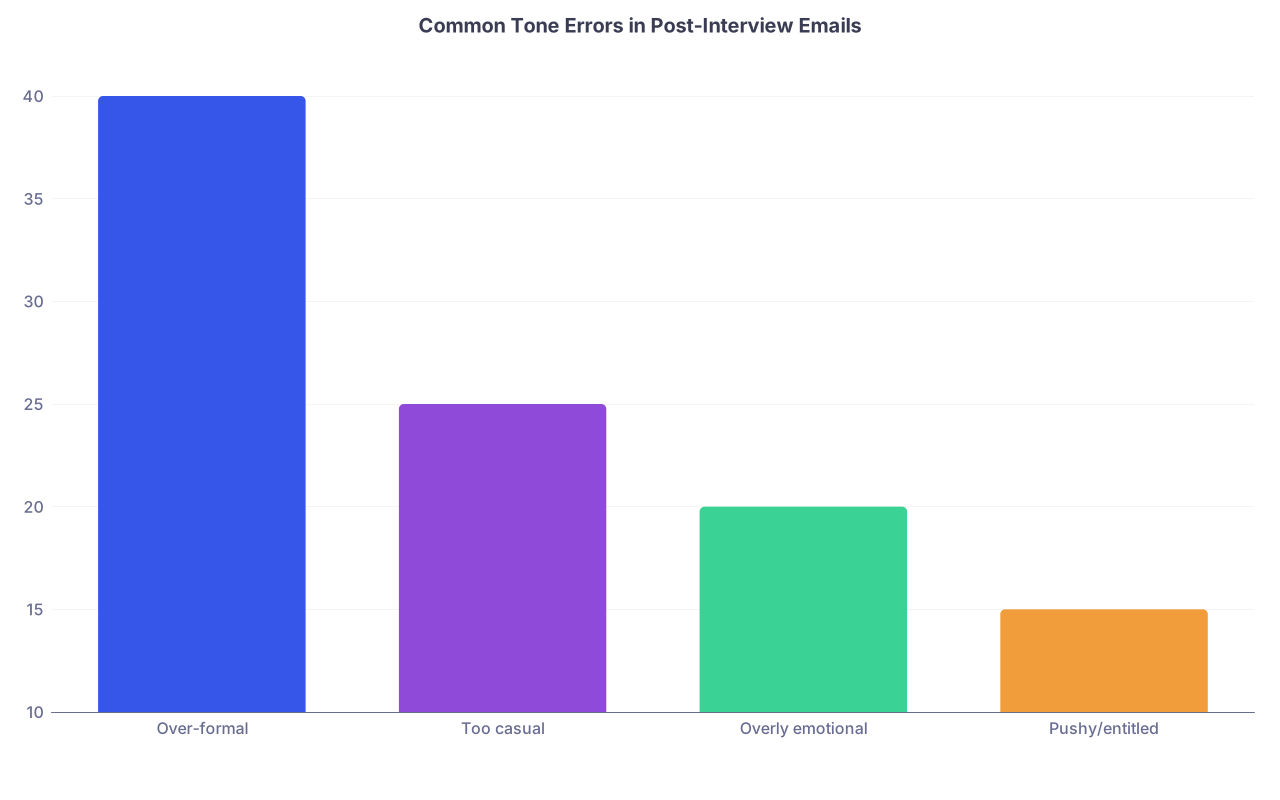
| Category | Value |
|---|---|
| Over-formal | 40 |
| Too casual | 25 |
| Overly emotional | 20 |
| Pushy/entitled | 15 |
Mistake C: Emotional oversharing and neediness
This one is more subtle and more common.
Examples:
- “This process has been so stressful, and your program gives me hope.”
- “I would be devastated if I didn’t match with you.”
- “My family is counting on me to be near them, so this would mean everything.”
You may think you’re being honest and vulnerable. On their side, it reads as emotional burden and pressure.
Programs are terrified of one thing above almost anything else: residents who are unstable or unable to cope with stress. Any hint that you might need extra emotional management is a big problem.
Use this filter:
If it sounds like something you’d say to a close friend, don’t put it in a follow‑up email.
Mistake D: Implicit bargaining or entitlement
These are the lines that make PDs raise an eyebrow:
- “If you rank me highly, I will definitely rank you highly as well.”
- “I believe I would significantly raise the caliber of your program.”
- “Given my strong research background, I would expect to have protected time to continue my projects.”
Remember:
You have zero leverage at this stage. None. Trying to bargain or “sell” yourself after the fact comes off as naïve at best and arrogant at worst.
If you’re genuinely asking about opportunities, it should sound like curiosity, not conditions.
Trap #4: Using Emails To Influence The Rank List
Let’s be blunt: your email is not going to overturn a bad interview.
By the time you’re sending that thank-you note, programs have usually already formed a pretty firm impression. Many have already roughly sorted candidates even if they haven’t finalized the list.
They are not sitting there waiting to be persuaded by a follow-up message.
What follow-up emails can realistically do
They can:
- Slightly reinforce a good impression.
- Keep you in the “pleasant, normal” category.
- Show basic professionalism.
They cannot:
- Upgrade you from “meh” to “must-have.”
- Make up for a weak interview.
- Compensate for big red flags in your file.
Where people get into trouble is trying to use the email as a stealth lobbying tool.
Examples:
- Over-emphasizing “fit” in a way that sounds like a speech.
- Listing all the ways you’d contribute to the program.
- Strategically hinting at other interviews or offers (“I’ve been fortunate to interview at many top programs, but yours stood out…”).
That last one especially is poison. It reads as “I think you should be impressed I’m interviewing other places.” They are not impressed.
Trap #5: Over-emailing And Bad Targeting
You don’t get points for volume. In fact, excessive emailing can move you from “fine” to “please, not this one.”
How many emails is reasonable?
Baseline approach that does not annoy anyone:
- One email to the PD/program leadership (PD or PC, depending on culture).
- Optionally, individual thank-you notes to 1–3 interviewers if:
- You had substantive conversations.
- You have their direct email (not always given, and you shouldn’t go hunting through hospital directories like a detective).
Do not:
- Email every single resident you met on the social.
- Track down someone’s personal or alternate institutional address if they didn’t provide it.
- Send repeated “update” emails unless a program specifically invites them.
You’re applying to be a resident, not campaigning for office.

| Step | Description |
|---|---|
| Step 1 | Finished Interview Day |
| Step 2 | Skip or send 1 brief note to PD/PC |
| Step 3 | Send 1 brief thank-you to PD/PC |
| Step 4 | Send 1 brief thank-you to that person |
| Step 5 | Stop emailing |
| Step 6 | No more emails unless invited |
| Step 7 | Program policy mentioned? |
| Step 8 | Strong connection with interviewer? |
The “update email” obsession
Unless:
- You got a major, legitimately significant update (new first-author pub accepted, big national award).
- The program or specialty culture explicitly encourages updates.
…you don’t need to send updates.
What most applicants label as “updates” are really:
- Repackaged self-promotion.
- Attempts to “remind” the program they exist.
- Another excuse to say “you’re my top choice” again.
If you do have a genuine major update, keep it to 2–4 sentences. No attachments. No “I hope this positively impacts my candidacy” type lines.
Ignoring program-specific instructions
Some programs tell you directly:
- “No post‑interview communication is required or expected.”
- “Please direct all communication to the program coordinator.”
- “We do not consider post‑interview communication in our ranking decisions.”
When they say this, they mean it. Sending multiple “just in case” emails anyway doesn’t make you a go-getter. It brands you as someone who doesn’t follow directions.
Trap #6: Timing, Subject Lines, And Little Technical Errors
You don’t have to be perfect. But you should avoid the easy, stupid mistakes.
Timing errors
Common bad moves:
- Same-day multiple emails. You send one from your phone on the shuttle, then another “better” one that night. They see both.
- Weirdly late email, like three weeks later, with a big dramatic reflection on the experience.
- Flooding the inbox the night before rank lists are due. Programs notice this pattern. It’s desperate.
Reasonable timing:
- Within 24–72 hours of the interview.
- One email per recipient.
- Done.
Subject line mistakes
Please don’t write:
- “Thank you and ranking intentions”
- “My top choice program”
- “Strong interest in your program”
You’re trying too hard. And again, hinting at rankings is useless at best, uncomfortable at worst.
Safe, boring, perfectly fine options:
- “Thank you – [Your Name], [Specialty] applicant”
- “Appreciation for [Date] Interview – [Your Name]”
Boring is good here.
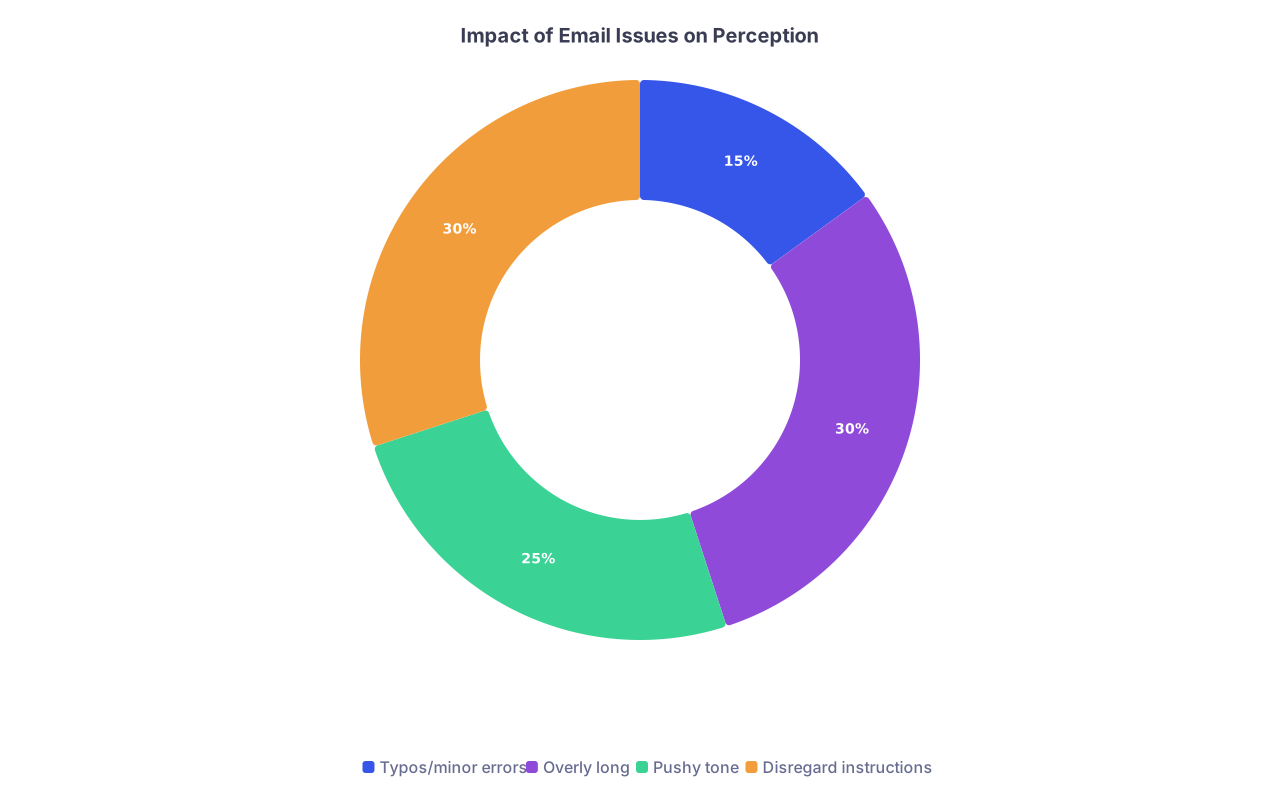
| Category | Value |
|---|---|
| Typos/minor errors | 15 |
| Overly long | 30 |
| Pushy tone | 25 |
| Disregard instructions | 30 |
Sloppy technical issues
A few things that leave a bad taste:
- Misspelling the program name
- Addressing the wrong person or wrong title
- Copy‑pasting and forgetting to change details (“I loved my visit to [Other Program]” — yes, this happens)
- Using the wrong specialty in the email body (surgery vs. internal medicine)
Nobody expects perfection, but two or three of these together signal you’re careless.
Read your email out loud once. Check name, program, date. Then send it and be done.
So What Should A Good Email Actually Look Like?
Not a template to mindlessly copy—use your own words—but here’s the structure you should keep in mind.
Core components of a safe, strong post‑interview email
- Direct greeting with correct title.
- One sentence of thanks for the interview opportunity.
- One specific thing you appreciated or learned.
- One sentence that briefly reinforces your interest or fit (without overpromising).
- Simple closing.
Example of something that will never hurt you:
“Dear Dr. Jones,
Thank you for the opportunity to interview at the ABC Internal Medicine Residency Program on January 5th. I appreciated hearing how your residents are supported in pursuing QI projects, especially the example you shared about improving discharge communication. Our conversation reinforced my interest in training at a program that balances strong clinical exposure with mentorship in systems-based practice.
Sincerely,
[Name]”
Notice what’s not there:
- No ranking games
- No over-the-top flattery
- No extra life story
- No neediness
Just… normal. Professional. That’s what you want.

The One Thing You Can Control
Here’s the bigger truth: post‑interview emails rarely change outcomes dramatically. But they can hurt you if you misuse them.
So the play is simple:
- Don’t try to game the system with flattery.
- Don’t write essays.
- Don’t use email to manage your anxiety about the match.
Act like someone they’d trust on call: clear, concise, stable, and respectful of other people’s time.
Today, do this:
Open one of your post‑interview email drafts and cut it down to a single paragraph of 3–6 sentences. Delete any sentence that:
- Repeats your personal statement,
- Mentions rankings,
- Or uses dramatic praise like “unparalleled,” “life-changing,” or “dream program.”
What’s left is probably the only part that should be sent.