
It’s 10:47 p.m. the night after your interview.
Your suit is still hanging on the closet door. Your phone is on the bed, open to your email. You’ve typed, deleted, and retyped the same sentence three times: “Just checking in regarding my continued interest in your program…”
You feel that nervous itch: If I do not say something, will they forget me?
Let me stop you right there.
Programs do not forget people because they did not send enough emails. But they absolutely do remember the people who crossed the line from “professional follow-up” into “this is weird and uncomfortable.”
I’ve seen this from the program side. I’ve sat in rooms where someone’s name came up and a coordinator said, “That’s the one who kept calling the office” with an eye roll. You do not want to be that story.
You’re here to avoid that mistake. Good. Let’s make sure your “interest” never looks like stalking.
The Line You Really Don’t Want to Cross
Before we go into the seven specific behaviors, you need to understand one thing programs care about more than your Step score after interviews: professionalism.
They’re asking:
“Can I trust this person to behave appropriately with patients, staff, nurses, attendings—and yes, with us?”
Your follow-up behavior is not just “communication.” It’s data. It becomes a proxy for:
- How you’ll respond to feedback or silence
- How you’ll handle boundaries
- Whether you respect people’s time
- Whether you can tolerate uncertainty without losing it
You do not get graded on enthusiasm. You get graded on judgment.
So here are the seven follow-up behaviors that routinely get labelled as creepy, desperate, or unprofessional by programs.
1. Repeated “Just Checking In” Emails
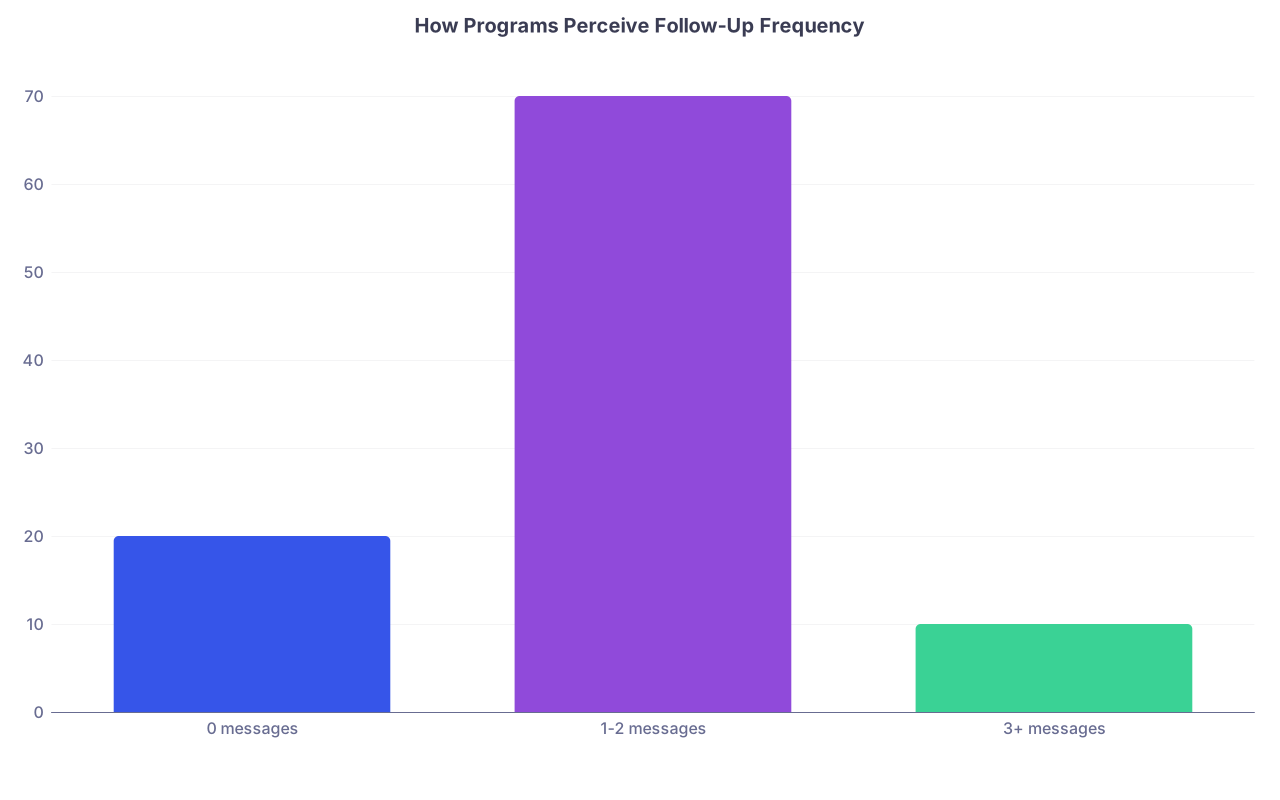
One thank-you or one “letter of interest/intent” is fine. Normal. Expected, even.
The mistake: sending a string of “just checking in” or “any updates yet?” emails to the program coordinator, the PD, or faculty.
Examples I’ve seen:
- Email 1: “Thank you so much for the opportunity” (good)
- Email 2 (3 days later): “Just checking if there are any updates to my status” (not good)
- Email 3 (next week): “This program is my top choice, I remain very interested” (worse)
- Email 4: “I haven’t heard back—just wanted to reiterate my interest” (now you’re in the “we talk about you in the office” zone)
Programs hate this. Not mild annoyance—hate.
Why this gets you labeled as a problem:
- It shows poor understanding of the Match process. They’re not allowed to tell you anything meaningful anyway.
- It creates extra work for staff who are already drowning in admin.
- It signals you may be high-maintenance and unable to tolerate ambiguity.
Reasonable guideline:
One post-interview thank-you per interviewer (if you want), ideally within 24–72 hours.
Optional: one genuine, well-written “this program is my top choice” letter later in the season.
And then stop.
If your fingers are hovering over the keyboard to send a third message to the same program? That’s your sign. Don’t.
| Category | Value |
|---|---|
| 0 messages | 20 |
| 1-2 messages | 70 |
| 3+ messages | 10 |
2. Calling the Program Office “Just to Ask a Question”
Calling once for a genuine logistics concern? Fine.
Calling to “check in on your status” or “see where I stand on your rank list”? Absolutely not.
I’ve watched coordinators put people on speaker and mute the call while mouthing “again?!” to the room. That’s the reputation you’re creating.
Red-flag calls include:
- “I just wanted to know if you’ve submitted your rank list yet.”
- “Am I still being considered seriously?”
- “I interviewed on X date and haven’t heard anything—should I be worried?”
- “Can you tell me how competitive I am compared to other candidates?”
Programs cannot and will not answer these. When you call anyway, what they hear is:
“This applicant does not respect the process or my time.”
Reasonable behavior:
- Call only for true administrative needs (interview day issues, tech problems, disability accommodations, urgent scheduling conflicts).
- For everything else, email. Once.
- Never ask about ranking decisions. Ever.
If you find yourself wanting to call “because email feels too slow,” that’s your anxiety talking—not logic.
3. Messaging Faculty or Residents on Social Media
Huge one. And getting worse every year.
Reaching out on LinkedIn once to say, “Thanks for the interview day, learned a lot about your program” is okay if done very professionally.
Sliding into residents’ or attendings’ DMs on Instagram, Twitter/X, or Facebook? Programs talk about this.
Examples that cross the line:
- Following every resident you met, then DM’ing: “Hi! Do you know where I stand?”
- Commenting on their non-professional content: “Hope you rank me highly!” under a vacation photo.
- Sending multiple DMs after no reply: “Just bumping this!” or “Did you see my last message?”
- Trying to send unofficial updates or letters of intent through social media.
This comes off as boundary-blind. And that’s exactly the opposite of what a residency program wants in someone who will be in intimate, high-stakes situations with patients.
Ask yourself: Would I want a future intern messaging my personal Instagram about work decisions? No? Then do not be that person.
Safe rule:
- Treat all social media as off-limits for follow-up unless they explicitly told you otherwise (e.g., “Connect with us on LinkedIn for professional networking”).
- If you do connect on LinkedIn, keep it to one message max, purely professional, and never about ranking or status.
4. Dropping by the Hospital or Program in Person
Yes, people actually do this. And yes, programs remember them—in the worst way.
Scenario I’ve seen:
An applicant happens to be “in town,” decides it would be a great idea to “swing by and say hi,” shows up unannounced at the residency office asking if the PD or coordinator is available.
From your side, it feels like “showing initiative.”
From their side, it feels like: “This person doesn’t understand basic boundaries.”
Problems with this move:
- Staff are busy. Clinics are full. Nobody has time for surprise visits.
- It forces them into an awkward situation. They can’t really talk about rankings with you.
- It can look like you’re trying to pressure or corner them in person.
The only time an in-person visit is appropriate post-interview:
- If the program specifically invites you for a second look or optional visit.
- And even then, you follow their structure, not your own improvisation.
Otherwise, no “I’m just in the area” drop-ins. That’s not enthusiasm. That’s intrusive.

5. Sending Overly Personal or Emotional Messages
You’re stressed. You care a lot. That’s understandable.
But pouring that emotion into your messages to programs is a mistake.
I’m talking about emails that sound like:
- “This program is my dream and I’ll be devastated if I do not match here.”
- “My entire family is counting on me matching at your institution.”
- “I’ve been crying every night thinking about this program.”
- Multi-paragraph life stories that read more like a breakup letter than professional correspondence.
Or worse, guilt-tripping language:
- “I ranked you first, so I hope you’ll rank me highly as well.”
- “Given my strong commitment, I trust you’ll honor my interest.”
Programs are not your therapist. Or your family. Or your emotional support system.
They’re evaluating whether you’ll be safe and stable under stress.
These kinds of messages scream: “I may not cope well when things don’t go my way.”
What’s appropriate:
- Brief, sincere appreciation.
- One clear sentence expressing strong interest or intent (“I will be ranking your program first.”) if it’s true and allowed by policy.
- No emotional pressure. No drama. No oversharing.
If your email reads like a diary entry, don’t send it.
6. Trying to “Game” the System with Backdoor Communication
You might be tempted to use every connection you think you have. That often backfires.
Here’s what crosses the line:
- Asking a faculty member at your home institution to “call the PD and ask where I stand.”
- Emailing multiple people at the same program (PD, APD, chief, coordinator, random faculty) with versions of the same “I’ll rank you first” message.
- Having family friends who are attendings at that hospital reach out repeatedly to “put in a word” after interviews are done.
- Re-sending your CV, personal statement, or new “updates” that do not actually change your application (like minor volunteer hours) just to get attention.
From the program side, this quickly looks like:
- Pressure.
- An inability to accept that the process has structure and rules.
- A tendency to go around established channels when you want something.
Programs absolutely talk when they feel manipulated.
Reasonable advocacy:
- One letter or email from a mentor on your behalf can be fine, if that’s standard in your specialty and they keep it professional.
- One update if you’ve had a substantial change (accepted manuscript, major award, new degree) and the specialty norms support sending updates.
Unreasonable:
- Multiple contacts.
- People they barely know calling them repeatedly.
- Anyone asking directly where you stand or implying they should rank you highly.
If you’re orchestrating a campaign, stop. You’re not running for office.
| Situation | Normal Response | Creepy / Stalking Response |
|---|---|---|
| Day after interview | One thank-you email | Thank-you + “any updates?” email |
| Strong interest in program | One clear letter of intent | Weekly emails restating interest |
| New minor experience | Keep for ERAS updates only (if allowed) | Email PD with every small activity |
| Family knows an attending | One discreet, professional note if appropriate | Multiple calls/emails from family friend pushing you |
| Curious about rank status | Accept uncertainty | Call coordinator/PD to ask directly |
7. Ignoring Explicit Program Policies About Communication
Many programs now state their communication policies clearly:
- “We do not respond to post-interview interest letters.”
- “We do not consider post-interview communication in our ranking.”
- “Please direct all communications to the program coordinator only.”
- “We will not disclose ranking information.”
The fastest way to get labeled as someone who doesn’t follow instructions is to ignore those lines.
I’ve seen this:
- Program says: “Please do not send thank-you emails.”
Applicant emails four faculty plus the PD anyway. - Program says: “We do not accept updates after interviews.”
Applicant sends a “quick update” about every poster and volunteer shift. - Program says: “We won’t be able to respond to post-interview emails.”
Applicant sends three emails and then complains about the silence.
This is a basic professionalism test. Can you read, can you follow directions, can you respect boundaries you don’t like?
Programs care less about the actual email and more about what your choice says about how you’ll behave as a resident.
Rule:
If the program gives a clear policy, treat it like an order set. You follow it, even if you think your email is special.
So What Is Safe, Professional Follow-Up?
Let’s be concrete. Here’s what almost never gets you in trouble.
A short, specific, polite thank-you email within 24–72 hours to your interviewers, if they gave you contact info or the program said that’s okay.
Something like:“Dear Dr. X,
Thank you for the opportunity to interview for the [Program Name] residency position on [date]. I appreciated our conversation about [specific topic] and learning more about [specific aspect of the program]. My interest in your program remains strong.
Sincerely,
[Name], AAMC ID [#######]”A single, honest “letter of intent” or “I will rank you first” email later in the season, if you truly mean it and your specialty/program culture allows it.
One brief update email only if:
- Your specialty considers updates normal, and
- You have a meaningful change (accepted publication, degree, national award; not “I did another shadowing shift”).
No expectations of a reply. The message is for clarity, not conversation.
Here’s the mindset shift: Your follow-up is not a sales campaign. It’s documentation of your professionalism.

| Step | Description |
|---|---|
| Step 1 | Want to contact program |
| Step 2 | Email/call coordinator once |
| Step 3 | Send one professional message |
| Step 4 | Send one brief update email |
| Step 5 | Do NOT contact again |
| Step 6 | Is it logistics/urgent? |
| Step 7 | Already sent thank-you or LOI? |
| Step 8 | New, significant update? |
How to Tell If You’re About to Cross the Line
Quick self-check before you hit send:
- Would I be uncomfortable if an intern on my team did this to me repeatedly?
- Am I trying to get information that the Match rules say they cannot give (rank position, competitiveness, etc.)?
- Have I already contacted this program more than twice post-interview?
- Am I sending this because it’s truly necessary—or because I cannot tolerate silence?
- Has the program explicitly said they don’t want this kind of communication?
If your honest answers make you cringe, trust that feeling.
Silence from a program does not equal “we hate you.” It usually equals “we’re busy and we’re following the rules.”
But overcommunication from you often does equal “we’re uncomfortable with you now.”
Your real risk is not being forgotten. Your real risk is being remembered for the wrong reason.
FAQs
1. Do I have to send thank-you emails, or can that hurt me?
No, you don’t have to. Many programs don’t care either way, and some explicitly say not to send them. If a program says “no thank-you emails,” believe them and skip it. If they’re neutral, a short, professional email won’t hurt you—but no program is ranking you #1 because you wrote the nicest thank-you note. Think “neutral to slightly positive,” not “essential.”
2. Is it okay to send a letter of intent to more than one program?
That’s a bad idea. A “you are my #1” letter is a promise, and programs know people sometimes lie—but it still looks dishonest if it gets out. If you’re sending a true letter of intent, pick one program only. If you want to express strong interest to multiple programs, use softer language like “I remain very interested” without calling any of them your top choice.
3. What if I forgot to send a thank-you and it’s been two weeks?
You can still send one, but keep it simple and don’t apologize excessively. Something like: “Thank you again for the opportunity to interview on [date]. I appreciated learning about [specific detail].” Then stop. Do not add, “Sorry this is so late” with a paragraph of explanation—that just shines a spotlight on the timing for no reason.
4. Can I ask a resident off the record where I stand if we got along well?
You can, but you shouldn’t. It puts them in an awkward position, and most residents either don’t know or aren’t allowed to share anything meaningful. Worse, they might mention to the chief or PD that you asked, and now your judgment is in question. Enjoy the connection, ask program-related questions, but leave ranking and status alone.
5. What if I haven’t heard anything from a program since the interview—should I send a “just checking in” email?
No. Silence is normal. Many programs don’t send post-interview communication at all. If you already sent a thank-you and/or a letter of interest, you’ve done your part. Anything beyond that quickly becomes noise—or worse, a red flag. The Match is designed so you don’t need secret information or extra contact to have a fair shot.
Open your drafts folder right now and look at any unsent messages to programs.
For each one, ask: “Is this necessary, or is this my anxiety?”
Delete at least one email you were about to send that programs would only roll their eyes at. That’s how you stay out of the “stalking” category.