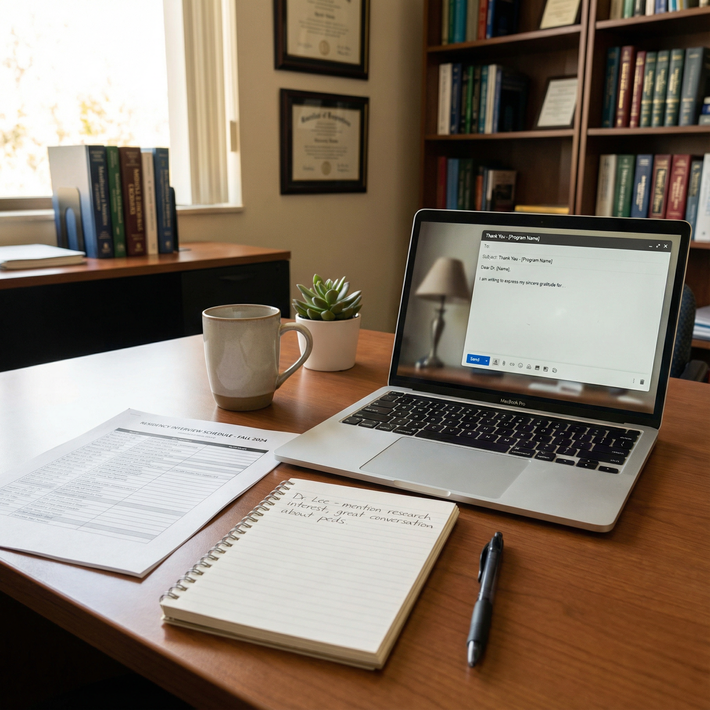
The fastest way to undo a great residency interview is to send a lazy, generic thank‑you note.
Program directors and faculty won’t tell you this directly, but I will: weak thank‑you emails are noticed. They are read. They go into the mental “lukewarm” bucket. And in a tight ranking meeting, “lukewarm” gets buried.
You’re not graded on your thank‑you notes like a test. But you are judged. And most applicants are making the same avoidable mistakes.
Let’s fix that.
The Biggest Myth: “Thank-You Notes Don’t Matter”
This belief quietly sabotages a lot of applicants.
Here’s the reality I’ve seen:
- Some programs truly do not care about thank‑you notes.
- Some say they don’t care but still subconsciously factor them into “professionalism,” “interest,” and “fit.”
- Some explicitly track them (yes, I’ve heard faculty say “She even followed up with a thoughtful thank‑you – shows maturity”).
The problem? You don’t know which is which. And you will not find out.
So no, a perfect thank‑you note won’t rescue a disastrous interview. But a careless one can hurt you in three ways:
- It makes you look disinterested.
- It makes you look immature or unprofessional.
- It makes you blend into the mass of generic applicants.
The bar isn’t that high. You just have to avoid the common traps.
Mistake #1: Sending the Same Generic Template to Everyone
If your note could be copy‑pasted to any program, you’ve already lost points.
I’ve seen this exact thing in faculty inboxes:
“Dear Interviewer,
Thank you for taking the time to interview me. I enjoyed learning more about your program and I look forward to the possibility of working with you.
Sincerely, [Name]”
Word‑for‑word. To every interviewer. Every program. Sometimes even with “Dear Interviewer” still there.
This screams:
- I did the bare minimum.
- I didn’t remember anything specific about our conversation.
- You’re interchangeable to me.
You do not want any of that associated with your name.
How to avoid looking generic
You need at least one specific anchor per note:
- A topic you discussed
- A comment they made that stuck with you
- A unique aspect of the program they highlighted
- A patient story or teaching example they shared
Even one sentence can make the difference:
“I appreciated your candid discussion about resident autonomy in the MICU and how seniors are encouraged to run the list independently.”
Suddenly you sound like:
- You were actually present.
- You were paying attention.
- You processed what they said.
Red flag test
After you write a thank‑you email, ask yourself:
- Could I send this exact note, unchanged, to a completely different program and it would still “work”?
If yes, it’s too generic. Fix it.
Mistake #2: Writing a Novel No One Wants to Read
Over‑correcting is just as bad. The other extreme: three giant paragraphs, life story, everything you forgot to say in the interview, plus your rank intentions, plus another mini personal statement.
Faculty are busy. PDs are drowning in email.
I’ve literally watched an attending open a 400‑word thank‑you email, scroll once, sigh, close it, and say, “I’ll come back to that later.” They didn’t.
Long-winded thank‑you notes create these impressions:
- Poor judgment about length and audience.
- Neediness or desperation.
- Inability to communicate concisely (which matters in medicine).
Aim for this instead
- 3–6 sentences total.
- Short, direct, clean.
- One specific detail from the conversation.
- One brief line reaffirming interest (if true).
Something like:
Dear Dr. Smith,
Thank you for taking the time to speak with me during my interview day at [Program]. I especially appreciated hearing about your work integrating ultrasound into the intern curriculum and your examples of how this has improved patient care in the ED. Our conversation reinforced my strong interest in training at [Program], particularly given the emphasis on resident education and hands-on learning.
Best,
[Name]
That’s enough. Do not turn your thank‑you into a second interview.
Mistake #3: Waiting Too Long (or Firing It Off Immediately)
Timing sends a message.
Send it too late (2–3+ weeks later), and you look:
- Disorganized
- Uninterested
- Like the program is an afterthought
Send it too fast (from your phone on the Uber ride home), and you risk:
- Typos
- Sloppy tone
- Zero personalization
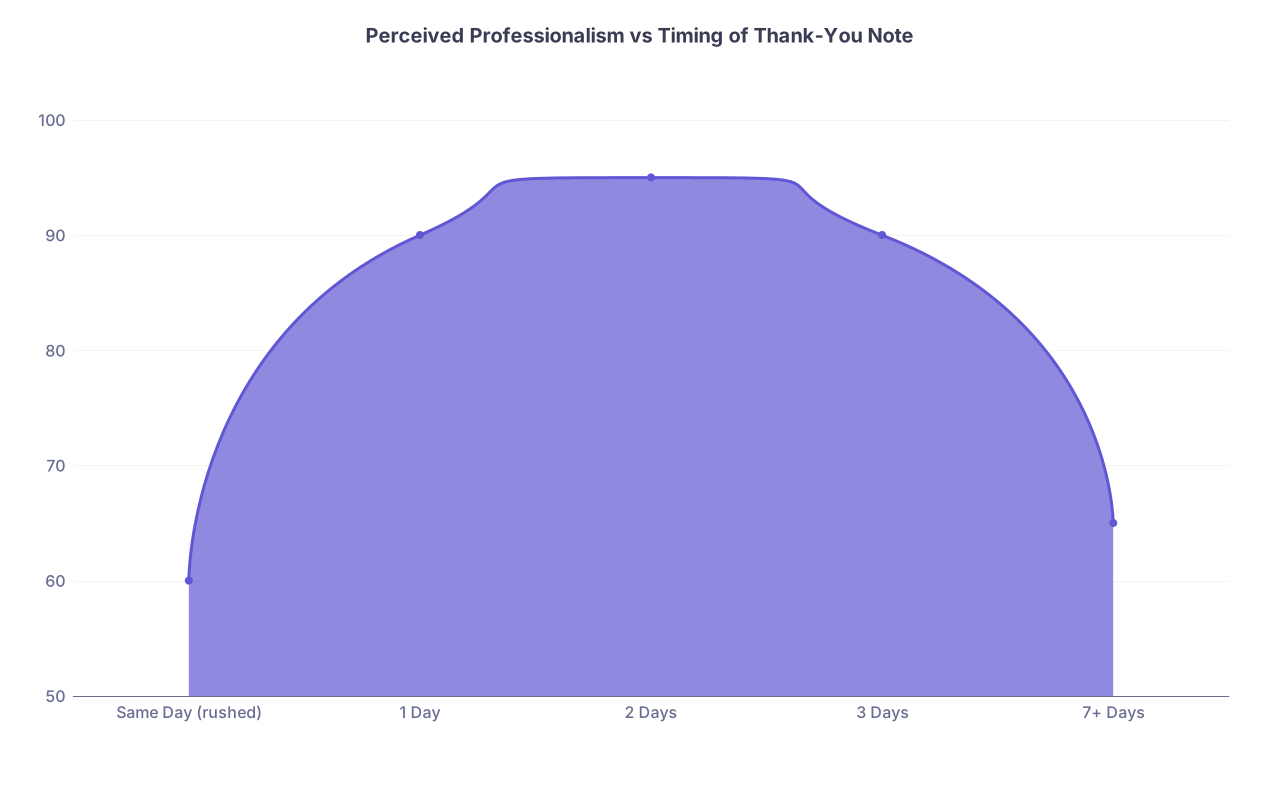
The sweet spot: 24–72 hours after your interview day.
| Category | Value |
|---|---|
| Same Day (rushed) | 60 |
| 1 Day | 90 |
| 2 Days | 95 |
| 3 Days | 90 |
| 7+ Days | 65 |
Interpret this as:
- Same day: can feel rushed/templated unless you’re careful.
- 1–2 days: ideal.
- 3 days: still fine.
- After a week: starts to feel like a checkbox or afterthought.
Practical tip
If you had multiple interviews back‑to‑back and you’re exhausted:
- Jot down bullet notes on each interviewer the same evening (names, topics, anything memorable).
- Draft the emails the next morning or evening.
- Send within that 48‑hour window.
Mistake #4: Sounding Robotic, Obsequious, or Fake
You’re not writing to your dean. You’re writing to a physician who just met you as a potential colleague.
The three tones that kill your credibility:
- Overly formal / robotic
“I humbly extend my deepest gratitude for the distinct honor of interviewing at your esteemed institution…”
Nobody talks like this in a workroom. It creates distance.
- Overly casual / unprofessional
“Hey Dr. S, thanks a ton for chatting! Your program seems super chill, would def love to be there next year.”
You’re not texting a friend. This is still work.
- Excessively flattering
“Your program is absolutely my dream in every way and speaking with you was one of the greatest honors of my medical career.”
This reads as insincere. Or manipulative.
Aim for this tone instead
- Polite
- Warm
- Direct
- Normal human voice
If you wouldn’t say the sentence out loud to a respected attending you like and know a little — do not write it.
Mistake #5: Repeating Your Personal Statement or Selling Too Hard
Another rookie error: using your thank‑you as a sales pitch.
You do not need to:
- Re-state your entire “why this specialty” story.
- List your research projects again.
- Re-argue why you’re a strong fit.
I’ve seen notes like:
“As I mentioned in my personal statement, my experience caring for underserved populations in [clinic] has deeply shaped my commitment to internal medicine. My research in [topic] has prepared me to contribute meaningfully to your scholarly environment…”
This doesn’t help you. They just interviewed you. They’ve already read your application (or at least skimmed it).
Your job now is simple:
- Be gracious.
- Show you listened.
- Leave a professional, mature impression.
Where applicants cross the line
You cross the line when your note becomes:
- “Here’s why you should rank me highly…”
- “Here are three more reasons I’m an excellent candidate…”
- “Let me attach my updated CV and another publication for your review…”
Don’t. That’s what ERAS and interviews are for.
Mistake #6: Making Promises You Shouldn’t (or Violating Communication Rules)
Match communication is a minefield. Do not step on it with your thank‑you note.
Programs and the NRMP have guidelines. Some programs explicitly say: “Please do not send us post‑interview communication stating how you will rank our program.”
If you ignore that? Faculty notice. And they don’t think, “How flattering.” They think, “Can this person follow instructions?”

Dangerous phrases to avoid in thank‑you notes
- “I will be ranking your program #1.”
- “You are my top choice and I will definitely be coming if I match.”
- “I can’t see myself training anywhere else.”
These are:
- Often against policy.
- Sometimes interpreted as binding when they’re not.
- Very awkward if you tell multiple programs the same thing (yes, they sometimes find out).
If you genuinely want to express strong interest, use safer, honest language:
- “My interview day strengthened my interest in [Program].”
- “I would be very excited to train at [Program].”
- “Your program is one of my top choices.” (Only if true, obviously.)
And if the program explicitly asked applicants not to send rank‑related communication? Respect that. Full stop.
Mistake #7: Messing Up Names, Titles, or Program Details
Nothing screams “I don’t actually care about you” like:
- Spelling the interviewer’s name wrong
- Getting their title wrong (calling the PD “Dr. Smith, Associate Program Director” when they’re the Program Director)
- Using the wrong program name (“I really enjoyed learning about [Other Hospital]”)
This happens more than you think. Especially with copy‑paste templates.
I once watched a faculty member show an email to another: “They thanked me for the ‘great insight into the pediatrics program.’ We’re internal medicine.”
Not a great look.
Simple ways to avoid this
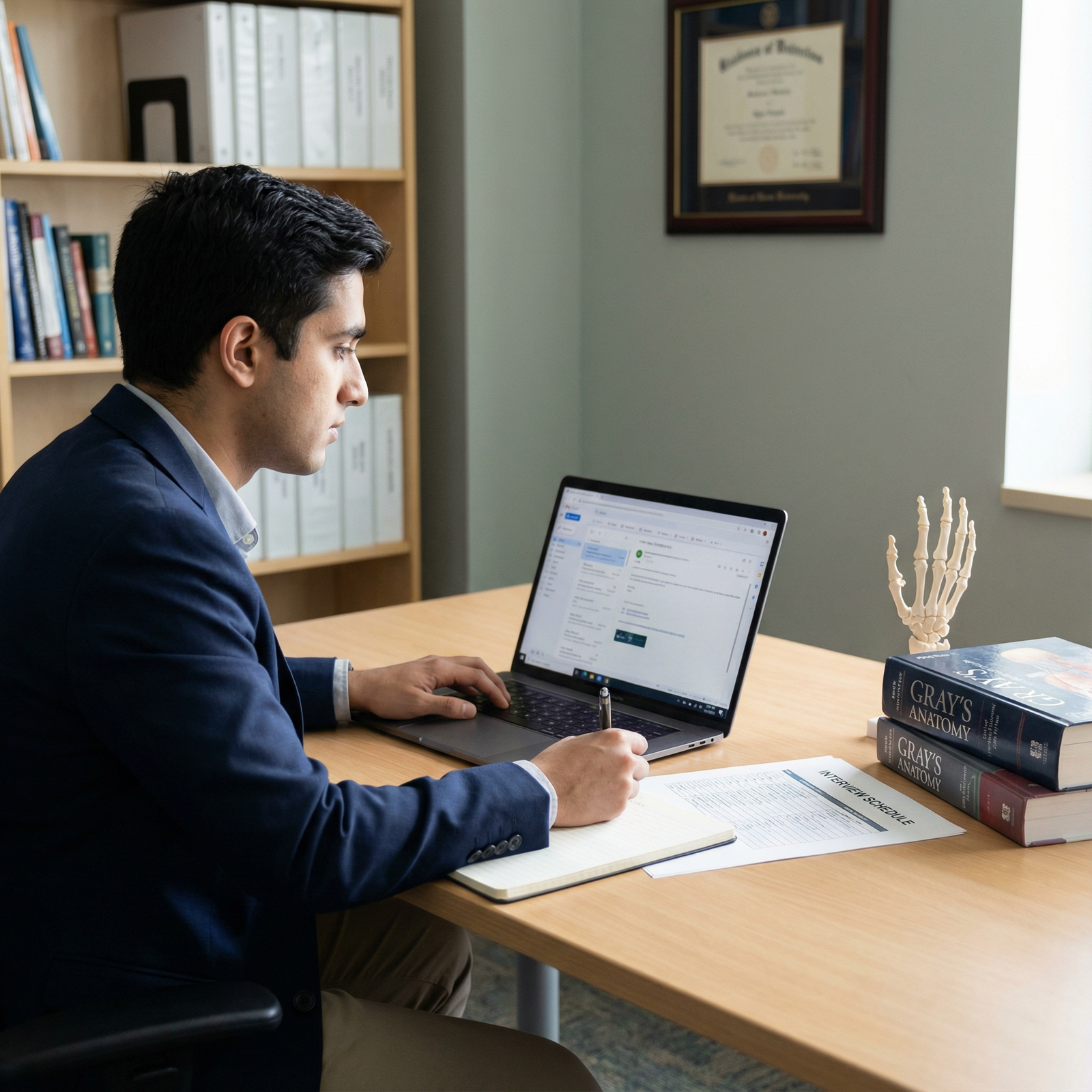
- Keep your emails open side‑by‑side with the interview schedule so you can triple‑check names and titles.
- If you’re unsure of their role, default to just “Dr. [Last Name]” and mention the program, not the title.
- Paste the program name from the official website into your draft once and reuse that exact phrasing.
| Item Type | Example Error |
|---|---|
| Interviewer name | "Dr. Smyth" instead of "Smith" |
| Program name | Mixing up two sister hospitals |
| Specialty | Writing "pediatrics" for IM |
| Institution | Wrong university/health system |
| Title | Calling PD an APD or vice versa |
If you get any of these wrong, you instantly look careless, even if the rest of the note is perfect.
Mistake #8: Over‑Automating or Outsourcing Your Voice
Some applicants let friends, mentors, or even AI tools write 90% of their emails, then send them without editing.
The result?
- Stiff, generic language that doesn’t sound like you.
- Phrases no human would use in normal email.
- Inconsistent tone compared to how you spoke on interview day.
Faculty pick up on this disconnect — especially if your spoken English was casual and your email reads like a Victorian letter.
Use help as a tool, not a replacement.
- Draft your own version first.
- Get feedback for clarity and professionalism.
- Keep your voice; just polish the rough edges.
If your thank‑you note sounds like a corporate memo, redo it.
Mistake #9: Skipping Thank-You Notes Entirely (or Only Emailing “Important” People)
Yes, some programs say explicitly: “We do not expect thank‑you notes.” If they say that, you’re not punished for skipping them.
But completely skipping everyone when they don’t say that? Or only emailing the PD and ignoring the residents and faculty you spent the most time with?
That sends a different message:
- You only care about people who influence your ranking.
- You treat others as less important.
- You’re strategically performative, not genuinely professional.
I’ve heard a chief resident say, “Funny, he emailed the PD but not me or the APD who actually interviewed him.” You don’t want that sentence about you.
Who to email
- Every faculty member who interviewed you one‑on‑one.
- Key residents you had formal interviews with (optional for more informal group chats, but still nice if they had a big role).
- The PD and/or APD if you had meaningful interaction with them (and if the program hasn’t asked you not to send emails).
You do not need separate essays for everyone. Reuse core structure. Just customize a sentence or two per person and keep it honest.
Mistake #10: Terrible Formatting, Typos, or Weird Email Habits
No one’s grading your grammar like an English teacher. But glaring issues are distracting and unprofessional.
Common offenders:
- No greeting (“Thanks for the interview” as the entire email body).
- No sign‑off or name.
- Walls of unbroken text.
- Typos in the first line.
- Sending from joke email addresses (yes, people still do this).
Or this classic: including your entire phone email signature with random motivational quotes, graphics, or unrelated job titles.
Bare-minimum structure that works
- “Thank you – [Your Name], [Specialty] Interview”
- “Thank you for the interview – [Your Name]”
Email body:
- Greeting: “Dear Dr. [Last Name],”
- 3–6 sentence body (as we covered).
- Sign‑off: “Sincerely,” “Best regards,” or “Best,”
- Full name + “MS4, [School]” or “MD, PGY‑1 applicant in [Specialty]”
Keep your signature clean. No need for quotes, logos, or six lines of unrelated affiliations.
Putting It All Together: A Simple But Strong Thank-You Template
Here’s a straightforward structure you can safely adapt. Do NOT copy-paste this word‑for‑word to every person; tweak it to sound like you.
Subject: Thank you – [Your Name], [Specialty] Interview
Dear Dr. [Last Name],
Thank you for taking the time to speak with me during my interview day at [Program Name]. I especially appreciated [specific thing you discussed, saw, or learned about the program]. Our conversation reinforced my interest in [Program], particularly [brief reason that actually matches what you value].
I’m grateful for the opportunity to interview and to learn more about the program.
Best regards,
[Your Full Name]
MS4, [Medical School]
That’s it. Clean, specific, respectful.

| Step | Description |
|---|---|
| Step 1 | Finish Interview Day |
| Step 2 | Same Day: Jot notes on each interviewer |
| Step 3 | Within 24-48 hours: Draft emails |
| Step 4 | Customize 1-2 sentences per person |
| Step 5 | Proofread names, program, specialty |
| Step 6 | Send thank-you emails |
FAQ: Residency Interview Thank‑You Notes (Read This Before You Hit Send)
1. Do programs actually care about thank-you notes, or is this just busywork?
Some genuinely don’t care. Some pretend they don’t but still subconsciously use them as a “professionalism and interest” check. You have no way of knowing which is which. Since they take 5–10 minutes each and can only help (if done correctly), not sending any is a gamble you don’t need to take. Think of them as low‑risk insurance for your first impression.
2. Should I send a handwritten thank-you card instead of an email?
For residency interviews, email is standard and safer. Handwritten cards can arrive weeks later, get lost, or never reach the actual interviewer. Faculty often work across multiple sites; mail gets misrouted. If you really want to do handwritten cards for a home institution or away rotation where you know the mailing system, fine. But do not use them instead of email for most residency interviews. Email is the default.
3. Is it okay to tell a program they are my number one choice in a thank-you note?
Only if three things are true:
- They have not explicitly asked applicants not to send rank‑related communication.
- They actually are your unequivocal #1.
- You’re comfortable with that statement being taken seriously if it’s documented.
Even then, I’d usually separate pure “thank‑you” emails from any later, single communication expressing final rank intentions. And never tell more than one program they’re #1. That’s not strategy; that’s lying.
4. What if I forgot to send a thank-you and it’s been two weeks?
You’ve lost the ideal window, but you haven’t committed a felony. Don’t panic and don’t make it worse by over‑explaining. If you still want to send something, keep it very simple:
“Dear Dr. [Last Name],
I wanted to thank you belatedly for the opportunity to interview at [Program] on [date]. I appreciated our conversation about [specific topic], and I remain very interested in the program.
Best,
[Name]”
Send it once. Then let it go. Don’t apologize excessively; that just draws attention to the delay.
5. Can I reuse most of my thank-you note for multiple interviewers at the same program?
Yes, the core structure can be the same. You’re not writing a novel for each person. But if you send five people the exact same email, word‑for‑word, it will look lazy if they compare notes (and yes, they occasionally do). Keep the skeleton identical if you want, but personalize:
- The specific detail you mention from your conversation.
- Any reference to their role or interest. You want “clearly part of the same person’s style,” not “Ctrl+C, Ctrl+V with different names.”
Open your most recent thank‑you draft right now and look at the second sentence. If you could send that line to any program in the country with no changes, rewrite it until it proves you were actually in that room, on that day, with that person.