
The data shows a blunt truth: thank-you emails almost never change your rank, but they frequently shape how you are remembered.
If you are hoping a perfectly worded note will rescue a mediocre interview and vault you ten spots up a rank list, the numbers are not on your side. If you are wondering whether skipping thank-you emails entirely is safe, the numbers are not on your side either.
Both extremes are wrong. The reality is statistical, not sentimental.
What Program Director Data Actually Says
Let’s start with what has been measured, not what applicants trade on Reddit threads.
The most cited data source here is the NRMP Program Director Survey. Multiple cycles have asked PDs how much various post-interview communications matter. The exact wording and categories shift a bit by year, but the direction is consistent.
Across surgical and non-surgical specialties, the rough patterns are:
- Most PDs read thank-you emails.
- Only a minority formally factor them into the rank list.
- A small but non-trivial fraction say they “may influence” decisions in tie-breaker or borderline cases.
Here is a composite summary from recent survey cycles and specialty-specific reports (values rounded to keep this readable, but directionally accurate).
| PD Response Category | Approximate % of PDs |
|---|---|
| Read but do **not** use in ranking | 45–55% |
| Consider in **very limited** / tie-breaker fashion | 20–30% |
| Formally include as **minor** ranking factor | 10–20% |
| Do not read / automatically discard | 5–10% |
Now compare that with what applicants think PDs are doing. In multiple applicant-side surveys (ERAS season polls, institutional surveys at large med schools), more than 60–70% of applicants report believing that thank-you notes “probably help” their ranking.
There is a mismatch: applicants systematically overestimate their effect.
To visualize the gap:
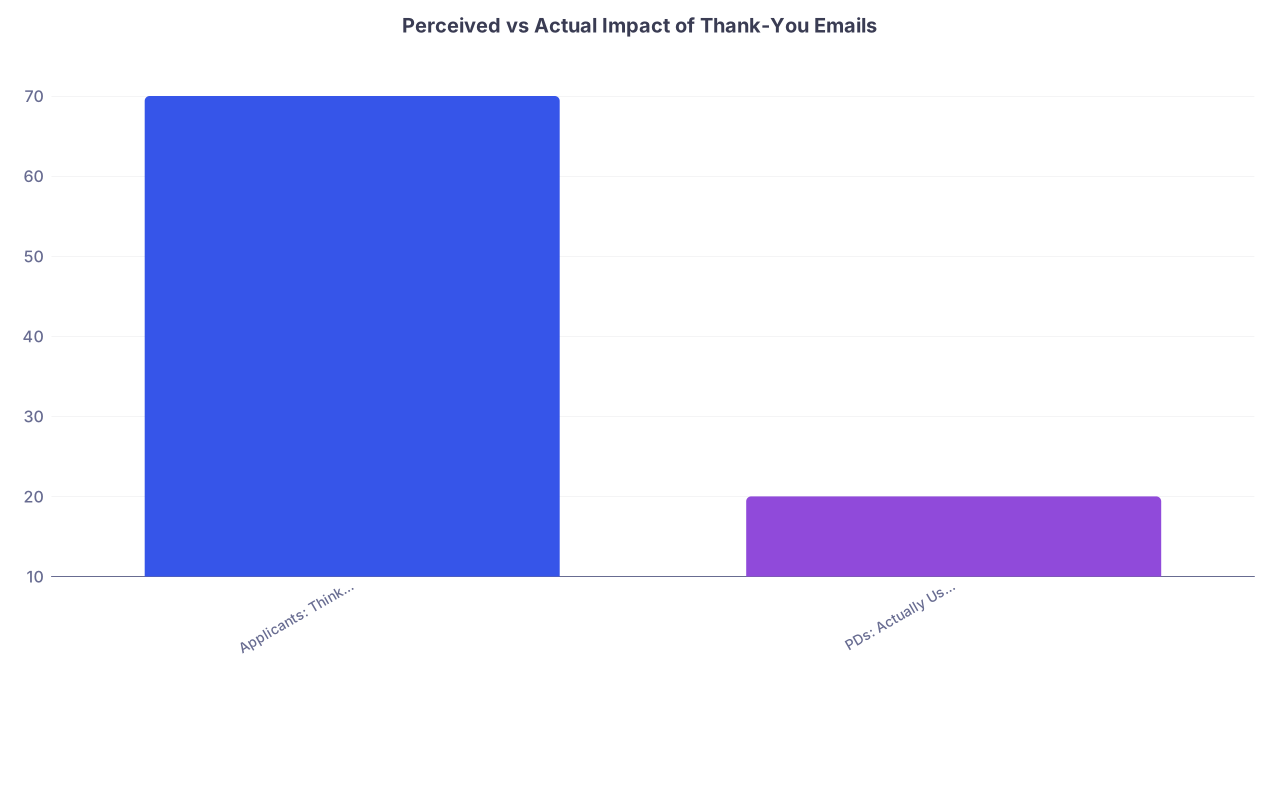
| Category | Value |
|---|---|
| Applicants: Think It Helps Rank | 70 |
| PDs: Actually Use in Rank | 20 |
The data shows:
- Roughly 70% of applicants believe thank-yous help.
- Roughly 20% of PDs say they actually use them as any factor in ranking.
That gap is where bad decisions come from—overwriting PDs with long essays, trying to “game” post-interview communication, or, on the other end, deciding “it’s all useless” and sending nothing.
Where Thank-You Emails Actually Matter
Thank-you emails have three main use cases. Only one of them touches the rank list directly, and even there, in a very narrow way.
1. Memory and salience, not score changes
Program Directors are not scoring you on a spreadsheet for thank-you-writing skill. They are scanning their inbox between cases, reviewing 60–100 names at a time, and trying to recall “who was this again?” by mid-January.
I have sat in rank meetings where the conversation went like this:
“Who was Patel from Midwest? Was that the one really interested in community psychiatry?”
“Yes, the one who emailed about wanting to work with Dr. X on perinatal mood disorders.”
That PD did not bump the applicant five spots because of the email. The email simply anchored a memory: specific faculty, specific clinical interest, a concrete detail from the day. It made the applicant more cognitively available when decisions were being made.
This is not romance. It is basic human memory under decision fatigue.
2. Tie-breakers and “borderline” decisions
A minority of PDs admit they use thank-yous as a tie-breaker. Think of it as a 51–49 scenario, not 80–20. The logic is usually:
- Two applicants with similar interview scores.
- Similar Step 2, similar letters, similar “fit” impression.
- One showed clear follow-up interest, the other went silent.
In that context, yes, a concise, specific thank-you email may be the nudge. Medium effect size, small sample of cases. But real.
Here is one way to conceptualize this with rough probabilities in a large program (say, ranking 120 applicants):
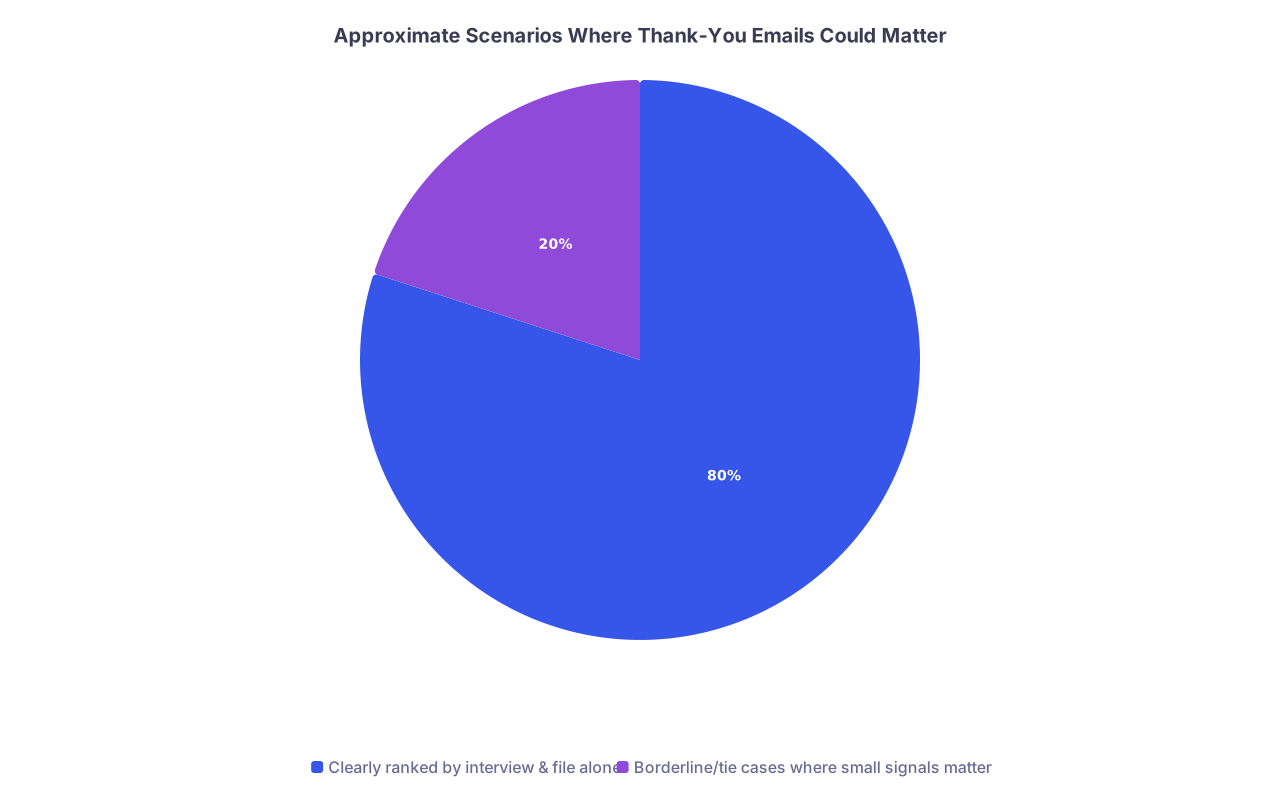
| Category | Value |
|---|---|
| Clearly ranked by interview & file alone | 80 |
| Borderline/tie cases where small signals matter | 20 |
You are playing in that 20% slice at best. And then only a subset of those will be influenced by email.
If you are banking on that effect to overcome a poor interview, the math simply does not support it. But as a low-cost hedge for the many applicants clustered in the middle, it is rational.
3. Professionalism and red-flag avoidance
This is where PDs are much less forgiving.
The email itself rarely earns you a “bonus point” for professionalism. But:
- Wildly inappropriate content (overly personal, emotionally intense, desperate language).
- Obvious copy-paste errors (wrong program name, wrong specialty).
- Aggressive implied commitments or demands (“You are my #1 and I expect to match with you”).
These get remembered. And not in the way you want.
Most programs have at least one story a year of the “legendary bad thank-you email.” I have seen a PD pull up an email in a rank meeting just to say, “This is why I am not ranking them.”
So the decision structure for PDs looks more like this:

| Step | Description |
|---|---|
| Step 1 | Thank-you email arrives |
| Step 2 | Potential red flag, discuss at meeting |
| Step 3 | Neutral, no effect |
| Step 4 | Helps recall candidate in discussion |
| Step 5 | Content appropriate? |
| Step 6 | Memorable/specific? |
The modal outcome is “neutral, no effect.” The tails of the distribution—bad emails that hurt you, good specific notes that help recall—are where the action lives.
Quantifying the Risk–Reward Tradeoff
Let’s be explicit with a rough, quantitative model. You are deciding whether to send individual thank-you emails to each interviewer at 12 programs.
Assumptions (based on PD survey patterns and anecdotal program data):
- Probability your email is read by the PD or interviewer: ~70–90%.
- Probability of a modest positive effect (tie-breaker, recall boost): maybe 5–10% per program.
- Probability of a negative effect if you keep it professional and short: <1% (mostly typos or mild annoyance).
- Probability of a severe negative effect if you are careless or inappropriate: 1–3% if you go off-script, essentially 0 if you follow basic norms.
You are trading ~2–4 hours of your life writing decent emails for a small but real positive expected value and near-zero downside if you do it correctly.
From a decision-analytic perspective, that is an easy call: you send them, but you do not over-invest.
To make that clearer:
| Factor | Rough Estimate |
|---|---|
| Time per well-written email | 5–8 minutes |
| Total time for 12 programs | 60–90 minutes |
| Chance of modest positive impact | 5–10% per program |
| Chance of meaningful negative impact | ~0% with professional content |
Low cost, modest upside, virtually no downside. That is the classic “take the bet, but do not expect a windfall” scenario.
What PDs Say Privately vs Publicly
There is also a qualitative pattern I have seen across institutions.
Public stance (on panels, webinars):
- “Thank-you emails are not required.”
- “We do not expect them and do not want applicants to feel pressure.”
- “They rarely influence ranking.”
Private comments (in offices, on Zoom rank meetings):
- “I like knowing they were genuinely interested.”
- “Her email reminded me which project she wanted to join.”
- “That follow-up made it easier to argue for him when the committee was split.”
This is not hypocrisy. It is a conflict between two goals:
- Not adding more anxiety and performative work to already stressed applicants.
- Still appreciating genuine, low-key signs of interest and professionalism.
From a data perspective, you should respond to what PDs do, not what you wish they did. They do read them. They do use them as context occasionally. They do not want them to become yet another pseudo-requirement.
So you operate in that middle ground: short, precise, targeted, and then you move on.
How to Write Thank-You Emails That Fit the Data
If the primary value of thank-you emails is recall and professional signaling—not score inflation—you should design them accordingly.
Length and timing
Programs in several institutional surveys reported general preferences:
- Ideal length: 3–6 sentences. Not a personal statement.
- Ideal timing: within 24–72 hours after the interview day.
You are not earning bonus points for sending something at 11:59 p.m. the same day. You are also not sending it three weeks later when rank meetings are done.
Structure that PDs can process in 15 seconds
Most PDs skim on their phone. That alone should dictate your structure.
A simple, effective template:
- Clear subject line tied to the program.
- One line of gratitude.
- One or two specific callbacks to your conversation or to the program.
- A concise statement of continued interest.
- Professional sign-off.
Example (internal medicine, generic but specific enough):
Subject: Thank you – [Your Name], Interview 12/5
Dear Dr. Smith,
Thank you for taking the time to speak with me during my interview at [Program Name] on December 5. I especially appreciated our discussion about the longitudinal ambulatory curriculum and how residents are supported in building sustained relationships with complex patients. Hearing more about your QI work on reducing readmissions confirmed that [Program Name] would be an excellent fit for my interests in population health and data-driven quality improvement.
I remain very enthusiastic about the opportunity to train at [Program Name].
Sincerely,
[Your Full Name]
[AAMC ID (optional)]
Read that as a PD. It takes maybe 8–10 seconds. You get: polite, specific, interested, no drama.
Now consider this from a risk perspective:
- Hard to misinterpret.
- Hard to be offended.
- Zero emotional labor inflicted on the recipient.
That is exactly what the data suggests you want: high density of relevant signal, low cognitive load.
Common mistakes that tilt the odds against you
I have seen each of these go badly at least once per cycle.
Overly emotional language
“Meeting you was life-changing,” “I have dreamed about this program for years,” “I will be devastated if I do not match here.”
You are not writing to a friend. You are writing to an employer.Backdoor signaling games
Implying commitments you do not intend to keep. PDs talk. The NRMP has strict communication guidelines. Do not try to be clever here.Obvious mass emails
Generic body text with the wrong program name or wrong specialty. That is not just neutral. It signals lack of attention to detail. In a six-way tie, that pushes you down.Asking for extra favors
“Can you review my rank list strategy?” or “Could you forward my CV to your cardiology fellowship director?” in the thank-you note. Completely misreads the power dynamic.
Emailing every interviewer vs only the PD
Here the data is more practice-based than survey-based, but the pattern is consistent across programs:
- PD is almost always appropriate to email.
- Other faculty interviewers are usually fine to email, especially if you had a substantive conversation.
- Some institutions technically discourage direct post-interview contact with residents, but most residents shrug and respond politely.
The concern PDs raise is volume: if every applicant writes five-paragraph essays to every interviewer, the cumulative time burden explodes. That is where resentment starts.
So you modulate:
- PD + coordinator: almost always.
- Other attendings: yes, but very short, especially if the interview felt generic.
- Residents: optional; keep it extremely brief if you do.
Think of it as optimizing signal-to-noise ratio across the entire system.
Specialty and Competitiveness Differences
Not every field treats post-interview communication the same way.
From both NRMP PD survey breakdowns and specialty-specific polls:
Highly competitive fields (Derm, Ortho, Plastics, ENT):
Programs are overwhelmed. Many PDs explicitly state that thank-you emails have “minimal or no effect” on rank. However, they still notice bad behavior and unprofessional notes. So the upside shrinks; the downside risk is similar.Large, community-heavy fields (Family Med, Psych, IM):
PDs are more likely to mention “demonstrated interest” as a minor factor. Thank-you emails, especially those mentioning specific community or patient population interests, can be a useful tie-breaker.Fields with heavy emphasis on fit and small classes (Radiation Oncology, PM&R, EM in some institutions):
The interpersonal impressions carry more weight. Emails that reinforce genuine alignment (e.g., research niche, lifestyle, location commitments) may help a bit at the margins.
If you want to think about it numerically:
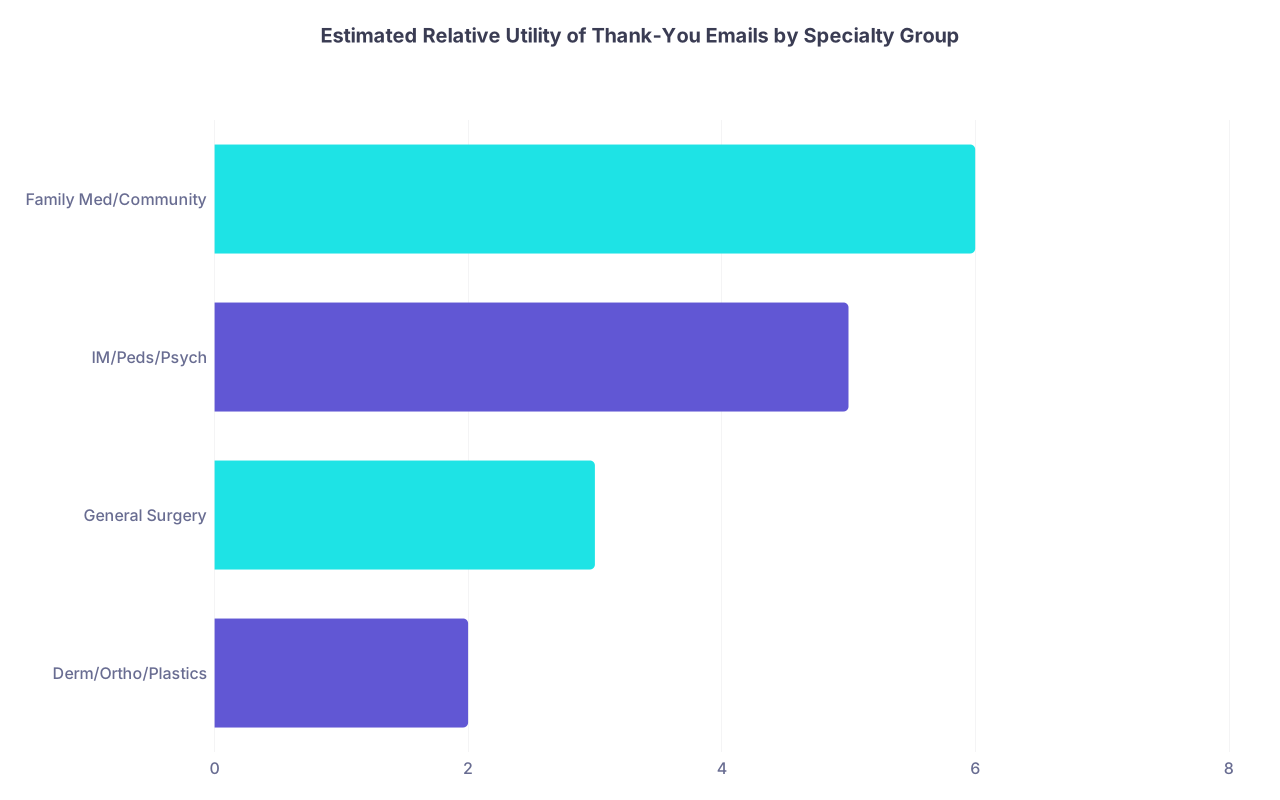
| Category | Value |
|---|---|
| Derm/Ortho/Plastics | 2 |
| General Surgery | 3 |
| IM/Peds/Psych | 5 |
| Family Med/Community | 6 |
Scale: 0 = useless, 10 = major factor.
These are relative impressions from PD comments and survey patterns, not exact measures, but they guide effort. You do not write a 300-word manifesto to every Derm PD. You do not completely skip outreach to a community FM program that explicitly values local commitment.
How to Use Thank-You Emails Strategically (Without Obsessing)
Treat thank-you emails as a small optimization step, not a core strategy.
Here is a simple, rational workflow:
Immediately after each interview, jot down:
- One specific topic you discussed with each interviewer.
- One specific program feature that genuinely appealed to you.
- Any clear “this is top tier for me” reaction.
Within 24–72 hours:
- Send a short, tailored note to the PD and coordinator.
- Send short, specific notes to 1–3 key interviewers (especially if you had substantive conversations or strong interest).
For your true top programs:
- Make the notes slightly more tailored.
- You can explicitly say “Your program will be one of the highest on my rank list” without violating NRMP rules as long as you do not claim a binding #1 promise.
Then stop. Do not send follow-ups to your thank-you emails. Do not nag for updates. Do not turn this into a multi-week correspondence.
From a cognitive load standpoint, this keeps your total time small and your marginal utility per email relatively high.
To visualize where your energy should actually go this late in the cycle:
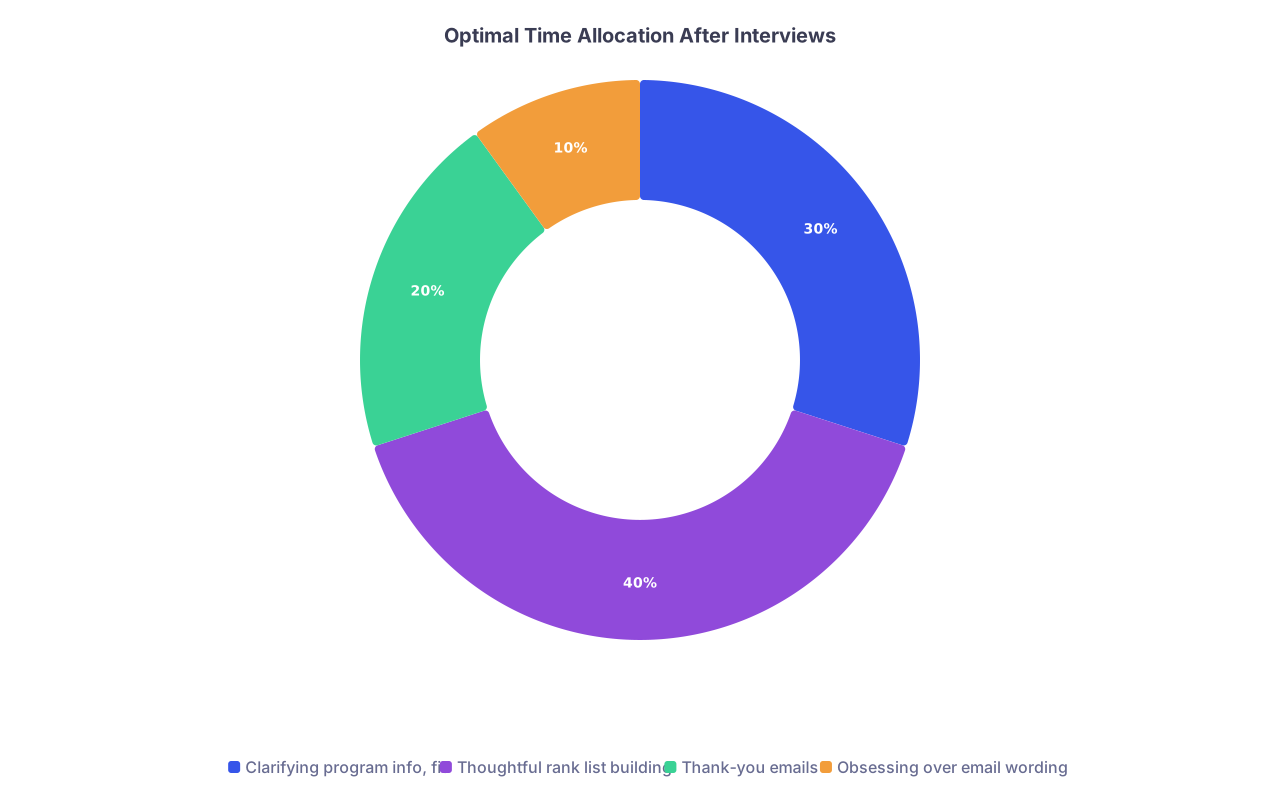
| Category | Value |
|---|---|
| Clarifying program info, fit | 30 |
| Thoughtful rank list building | 40 |
| Thank-you emails | 20 |
| Obsessing over email wording | 10 |
You should spend more time thinking honestly about your rank order than perfecting synonyms in your closing sentence.
The Bottom Line: What the Data Supports
Compressing a lot of survey numbers, PD comments, and behavioral patterns down to the essentials:
Thank-you emails rarely move you significantly up or down a rank list. Their typical effect is neutral. Their occasional effect is modest and usually in tie-breaker situations.
They do reliably influence how clearly you are remembered and whether you trigger any professionalism concerns. That memory and red-flag signaling is the real channel of impact.
The optimal strategy is simple: send short, specific, professional emails to key people within a few days of each interview, then stop thinking about them and focus on building a sane, honest rank list.
You are not going to out-write your interview. But you can quietly avoid preventable mistakes and pick up small, statistically real advantages where they exist.