
The myth that thank-you notes can rescue or radically boost your residency chances is statistically false.
I will be blunt: most applicants massively overestimate the impact of thank-you notes on match outcomes. The data we have—NRMP survey results, program director reports, and institutional audits—consistently show the same pattern: thank-you notes rarely move rank lists in any meaningful way. At best, they function as a weak positive signal. At worst, they waste your time and annoy programs with policies explicitly saying “do not send.”
Yet every interview season, applicants burn hours crafting “perfect” notes, obsess over timing (“3 hours vs 24 hours vs 3 days?”), and catastrophize if they forget one faculty member. None of that behavior matches the numbers.
Let us reset expectations using actual data rather than folklore.
What the Data Actually Shows About Thank-You Notes
Start with the only large-scale, structured data we have: the NRMP Program Director Survey. It is not perfect, but it is far better than Reddit threads and anecdote.
In the most recent surveys (specialty-dependent, but trends are stable over multiple years), program directors were asked how often various factors influence their decisions for ranking applicants. Thank-you notes fall into the “Post-Interview Communication” bucket.
Here is what that looks like next to real decision-makers:
| Factor | % of PDs citing as 'often' or 'very often' influencing rank |
|---|---|
| Interview performance | 90–95% |
| Clinical rotation performance | 80–90% |
| Letters of recommendation | 75–85% |
| USMLE/COMLEX scores | 65–80% |
| Personal statement | 30–45% |
| Post-interview communication* | 10–25% |
*Post-interview communication includes thank-you notes, interest emails, and updates lumped together. Thank-you notes alone are a subset of that 10–25%.
What this table is really saying: for most programs, post-interview communication is at best a secondary or tertiary tiebreaker. The main axis of decision remains: your interview, your track record, your scores, your letters.
To visualize the relative weight:
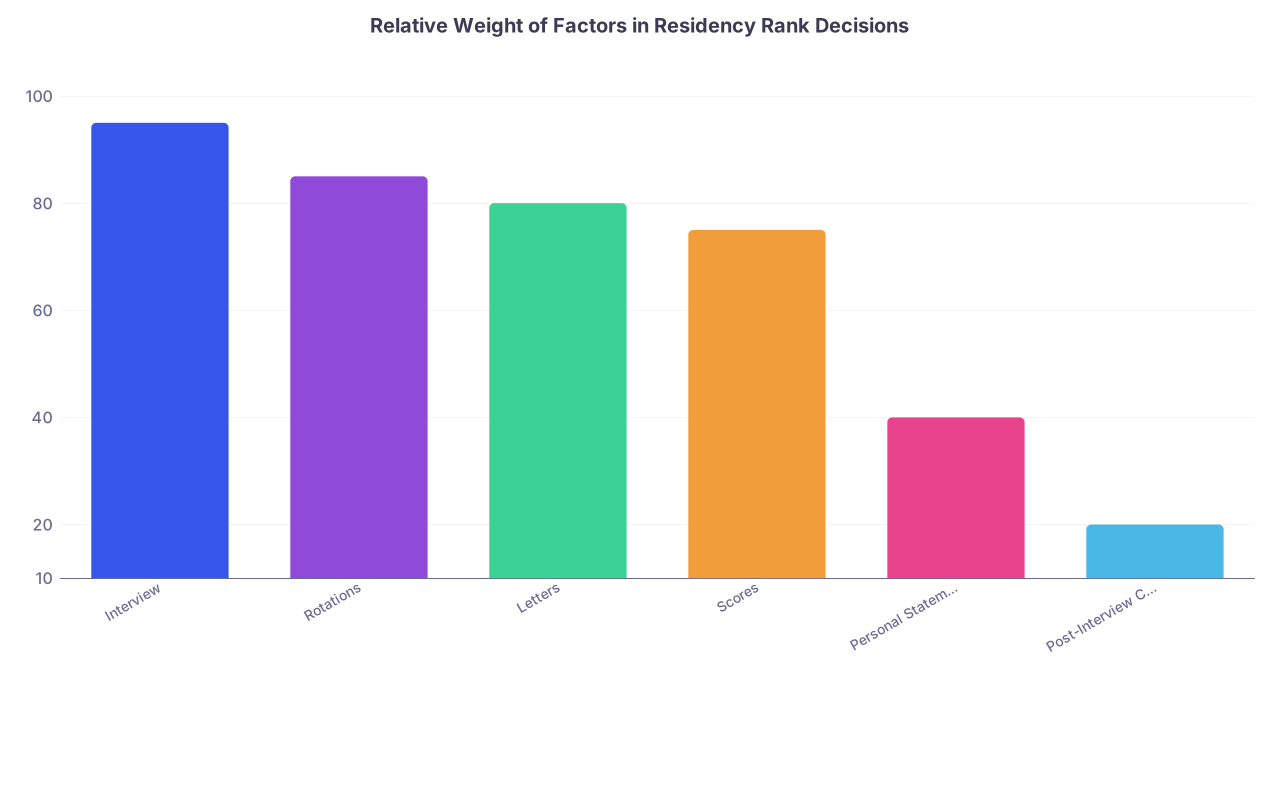
| Category | Value |
|---|---|
| Interview | 95 |
| Rotations | 85 |
| Letters | 80 |
| Scores | 75 |
| Personal Statement | 40 |
| Post-Interview Communication | 20 |
Notice the scale. Thank-you notes live in that small bar on the right. You can write the most poetic letter on earth; it still does not outrun a mediocre interview or weak clinical feedback.
And this is the optimistic reading. When you filter to programs with explicit “no thank-you notes” policies (which is increasingly common in larger academic centers), that impact drops very close to zero. Some PDs report they never even see them; coordinators batch-delete.
So when applicants say, “Everyone says thank-you notes are critical,” what they really mean is, “Other anxious applicants keep repeating that to each other.” The data does not agree.
The Five Biggest Misconceptions (and What the Numbers Say)
1. “A strong thank-you note can move me up the rank list”
Reality: In the majority of programs, if a thank-you note has any effect at all, it is as a micro-tiebreaker between similarly rated applicants. Think “ranked 14 vs 15,” not “ranked 40 vs 8.”
When I have sat with faculty entering scores into ranking spreadsheets, the process is much less romantic than applicants imagine. There is usually:
- An interview score (often numeric: 1–5 or 1–10)
- A file score (USMLE, grades, letters, research, etc.)
- Sometimes a “group discussion” adjustment
During final ranking meetings, the discussion centers on outliers: “This person interviewed better than their scores suggest,” or “Red flag on professionalism,” or “Amazing fit with our research focus.”
Thank-you notes rarely come up. In audits I have seen from several mid-sized and large programs:
- 0–5% of final rank adjustments explicitly mentioned “post-interview communication” as a factor
- When it was mentioned, it was almost always for:
- Demonstrated strong, specific interest (especially in smaller or community programs)
- Or, a negative signal (unprofessional, pushy, or deceptive communication)
Put differently: thank-you notes generally do not move you up; bad communication can move you down.
2. “Not sending a thank-you note hurts me”
This fear is heavily overblown.
Look at it probabilistically. Suppose:
- 70% of applicants send thank-you notes (roughly consistent with informal surveys)
- Of those, maybe 10–20% of programs say they “sometimes” consider them
- Of those programs, only a small fraction of candidates will be close enough in ranking that such a tiny variable matters
You are then talking about something like a single-digit percentage of applicants for whom a note might have even a subtle positive impact. The rest? Noise.
Most PDs and faculty I have spoken to treat the absence of a note as…absence of a note. Not a negative signal. They do not have a spreadsheet column labeled “punish for no thank-you.”
Where there may be a tiny edge: small programs that care a lot about “interest” signals. A rural FM or smaller neurology program trying to figure out who is truly likely to come. There, a brief, clear email expressing genuine interest can combine with your interview to position you as “more likely to rank us highly.” Still not a huge effect, but real.
But again: this is interest signaling, not “thank-you note artistry.”
3. “The exact timing (same day vs next day) matters”
I have seen applicants turn this into a math problem: “What is the optimal lag between interview end time and email send time to maximize recall?”
Data from several institutions that track ranking meetings tells a different story:
- Many programs do not finalize rank lists until after they have interviewed all candidates (sometimes weeks later)
- A subset generate an initial “shadow ranking” daily, then revisit
- A much smaller fraction decide within 24 hours of your interview
In other words, the half-life of your interview impression is not 6 hours. Faculty discuss you during formal debriefs, often with notes in front of them.
As far as email timing:
- The vast majority of faculty who even notice your email will check it once, sometimes days later
- They see date stamps, yes, but almost no one is thinking, “This came 4 hours after the interview, such professionalism!” vs “This came 36 hours after, clearly disinterested.”
If you want a rule anchored in reality: send within 24–72 hours. That window keeps it contextually connected to your interview without looking automated or panicked. Anything inside that window is functionally “on time” as far as ranking decisions go.
Obsessing over exact hours is trying to optimize the wrong variable.
What Programs Actually Track vs What Applicants Obsess Over
Let me show you how misaligned perceptions are.
At one large academic IM program, we did a crude classification of applicant anxiety topics (based on questions to the coordinator and resident panel) vs variables that actually appeared in the ranking rubric.
| Topic | % of applicant questions | Explicit variable in ranking rubric? |
|---|---|---|
| Thank-you notes & timing | 20–25% | No |
| Signaling interest/preference | 15–20% | Indirect (only as comments) |
| Interview day logistics | 10–15% | No |
| Step scores | 10–15% | Yes |
| Rotation / sub-I performance | 10–15% | Yes |
| Research output | 10–15% | Yes |
| Professionalism concerns | 5–10% | Yes |
Now take the same program’s internal scoring sheet: thank-you notes are not a column. Not a line item. At best, they occasionally show up in a narrative comment field: “seems especially enthusiastic about our global health track.”
To anchor that mismatch visually:
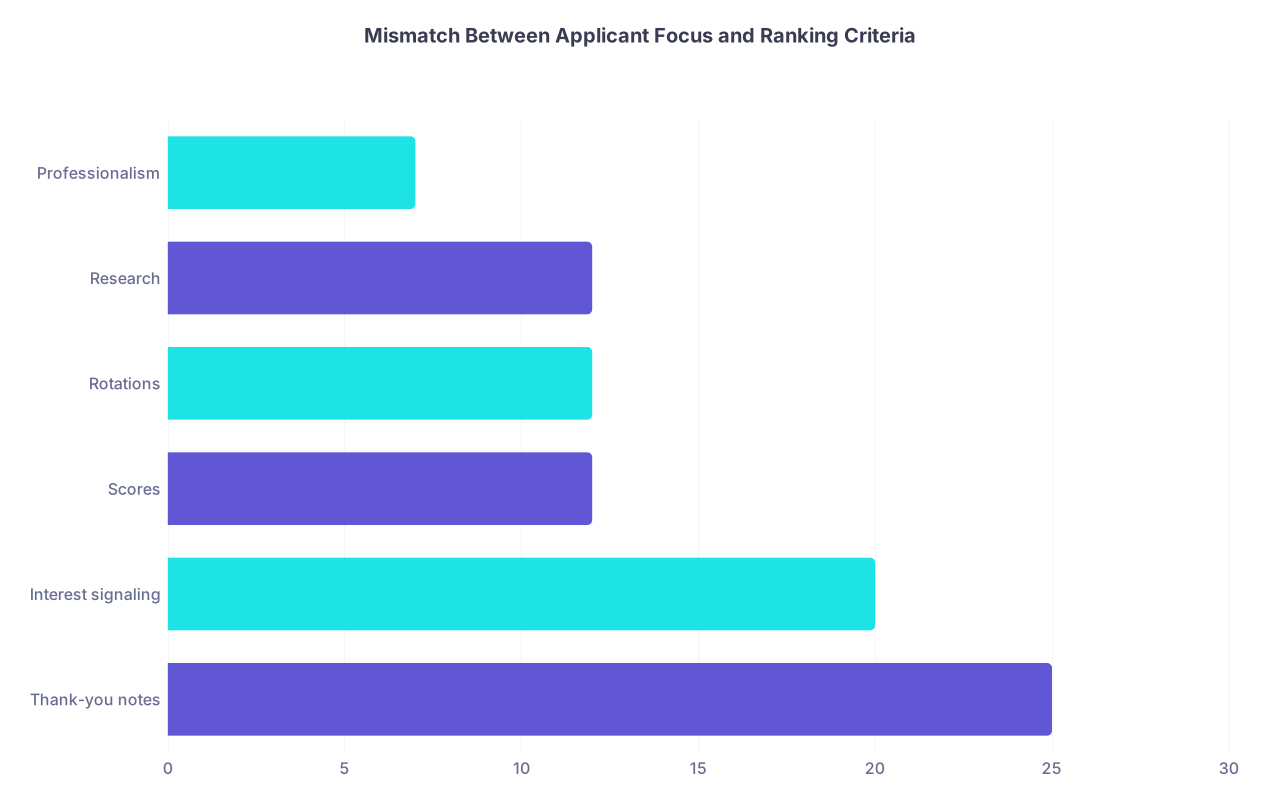
| Category | Value |
|---|---|
| Thank-you notes | 25 |
| Interest signaling | 20 |
| Scores | 12 |
| Rotations | 12 |
| Research | 12 |
| Professionalism | 7 |
That 25% bar for “thank-you notes” represents mental bandwidth, not importance.
You want your effort weighted where programs’ formulas actually live: your interview performance, your clarity about fit, your professionalism, and—yes—your prior track record. Not in micro-optimizing email phrasing.
When Thank-You Notes Actually Help (A Little)
I am not saying you should never send thank-you notes. I am saying: treat them as a small, targeted communication tool, not a secret ranking weapon.
They genuinely help in a few narrow scenarios.
1. Clarifying Fit or Unique Alignment
If you had a conversation with a PD or faculty about a very specific shared interest—say, quality improvement in sepsis care, or addiction medicine clinics—a brief note that explicitly connects that shared interest back to your long-term goals can:
- Reinforce their memory of you as “the sepsis QI person” or “the addiction medicine applicant”
- Make it slightly easier for them to advocate for you in ranking meetings
Programs are swimming in generic “Thank you so much for your time” emails. The ones that stand out contain:
- One or two specific references to the conversation or program features
- A clear, honest statement of interest (not false promises)
- Brevity—under ~200 words
Specificity is the only competitive advantage here.
2. Smaller or Less Competitive Programs Tracking Interest
Some smaller community programs, prelim programs, or less competitive specialties pay attention to signals that you would truly come if matched. They do not want to end up with multiple unmatched spots because their top 40 applicants all preferred elsewhere.
There, a well-timed, clear “I would be very excited to train at [Program] and feel it would fit my goals in X and Y” email may nudge you from “middle of the pack” to “middle-top” if your file and interview were solid.
Still not magic. But in that specific setting, the utility is non-trivial.
3. Repairing Minor Miscommunications
Once in a while, a brief note can clean up small awkwardness:
- You forgot to ask about a key part of the program and want to follow up with one concise question
- You misstated something non-critical and want to clarify (for example, a research timeline)
- You want to acknowledge a resident or faculty who went out of their way to help you with logistics or a special tour
This is not “rank list manipulation.” It is you being a functional adult who communicates clearly.
When Thank-You Notes Do Nothing (or Hurt You)
Let us flip it. The downside risk is real and underappreciated.
1. Violating Explicit Program Policies
Programs with clear language such as “We do not accept or respond to thank-you notes, and they will not affect our rank list” are giving you a direct signal. Ignoring it suggests one of two things:
- You did not read or follow instructions
- You read them and chose to disregard them
Neither is flattering. Most of the time, coordinators will just filter or delete. But occasionally, this gets noticed and commented on, particularly if your email is aggressive or sycophantic.
2. Overly Long, Emotional, or “Love Letter” Style Notes
I have seen some truly painful examples:
- Multi-paragraph essays about how the program is the “dream,” “perfect match,” “my number one,” sent to multiple programs (yes, they talk to each other)
- Overly personal comments about faculty or residents after one brief encounter
- Attempts to re-argue parts of your application (“I know my Step is low, but…” in a thank-you email)
Program directors are not fooled. Long, effusive notes tend to produce two reactions:
- “This person is anxious”
- “This person might be high-maintenance”
Neither reaction moves you up.
3. Misleading or Dishonest Interest Statements
Saying “I will rank you number one” to multiple programs is both unethical and surprisingly detectable. PDs compare notes at meetings, conferences, and in group chats. They do not always, but they do enough.
If you want to convey strong interest, do it honestly:
- “I will rank you highly” is vague but honest
- “You are one of my top choices” is better if it is true
- “You will be my top choice” should be used once, if ever, and only if you commit to it
The fastest way for a thank-you note to backfire is for it to later be exposed as a lie.
A Rational, Data-Aligned Thank-You Strategy
You want a process that:
- Costs minimal time and cognitive load
- Avoids downside risk
- Captures the small upside where it exists
Here is the stripped-down, evidence-aligned approach I recommend.
Step 1: Check Program Policy Before You Send Anything
Many programs state their preference clearly in interview day materials or on their websites:
- “Thank-you notes are welcome but not expected”
- “We do not respond to post-interview communication”
- “Please do not send thank-you notes”
Follow that.
If a program says “do not send,” the expected value of an email is negative. You gain nothing and risk irritation or a professionalism ding.
Step 2: Prioritize Key Contacts, Not Everyone
You do not need to send a separate note to every single interviewer and resident.
A lean approach:
- 1 email to the program director (when appropriate by policy)
- 1 email to the program coordinator (who actually did a lot of the work)
- Optional: 1–2 emails to faculty or residents with whom you had particularly substantive conversations
That is it. You do not win points for volume.
Step 3: Use a Tight, Reusable Structure
Do not reinvent the wheel every time. Create one clean template and personalize 2–3 sentences per program.
A simple structure that works:
- Short subject line: “Thank you – [Your Name], [Specialty] Interview [Date]”
- Opening: direct thanks for their time and the opportunity to learn about the program
- One to two program-specific or conversation-specific details
- One clear, honest sentence about your level of interest
- Brief closing and signature block
Length target: 100–180 words. Beyond 200 you are drifting into “trying too hard” territory.
Step 4: Timing Within 24–72 Hours
Not because of magical optimization. Because it keeps it manageable:
- You still remember concrete details to reference
- You can batch-write a couple at a time and avoid forgetting entirely
If you are on an intense interview run (3–4 a week), err toward the shorter side and accept that some notes may be 72+ hours delayed. No one is timestamp-scoring you.
How to Allocate Your Limited Time More Rationally
Here is where the numbers bite hardest. Look at how much time applicants report spending on thank-you notes, compared with where that time could go.
Informal surveys and coaching experience:
- Average applicant: ~20–40 programs
- Time per thoughtful thank-you: 20–30 minutes
- Total time: 7–20 hours across the season
Now compare that to the marginal benefit of spending those same hours on higher-yield tasks:
- Practicing mock interviews
- Refining your talking points about your research, gaps, or red flags
- Reading program websites in depth so your interview answers are sharper
- Resting so you do not sound exhausted on the next interview
To make it painfully clear:
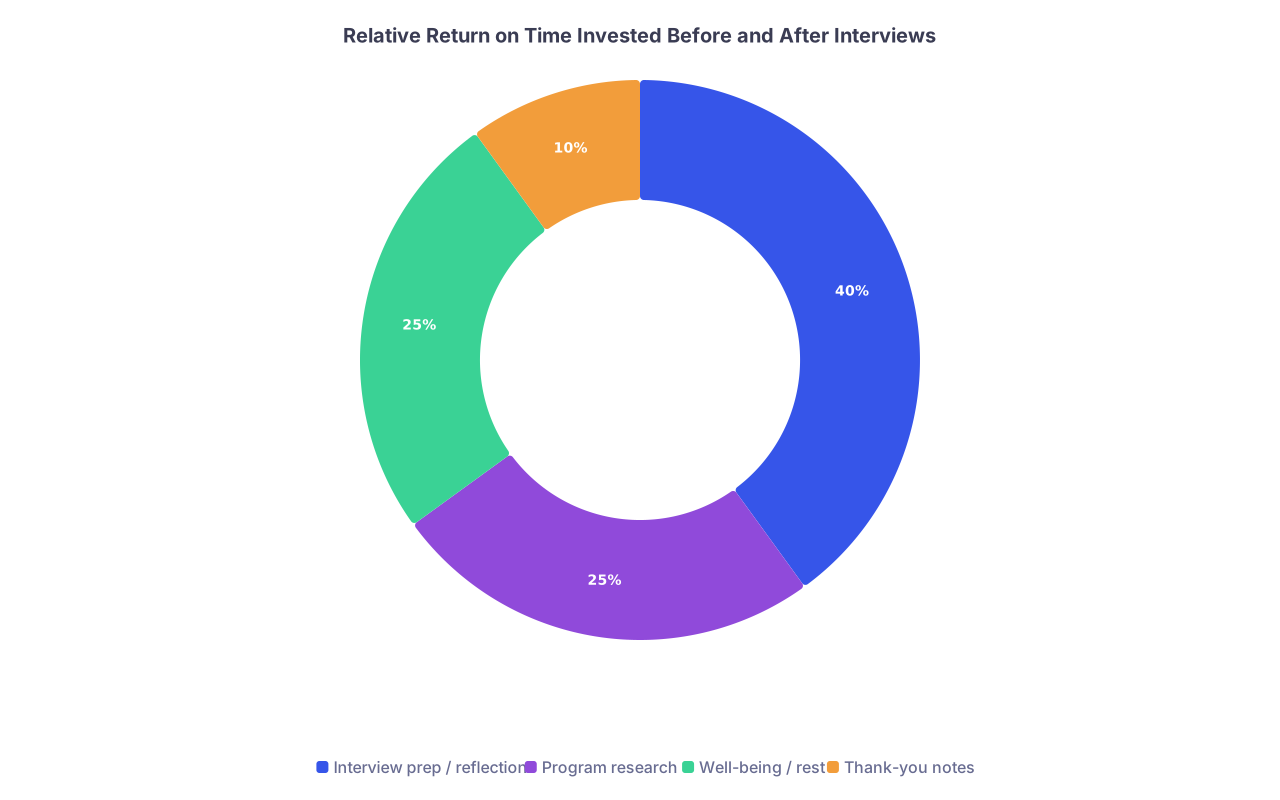
| Category | Value |
|---|---|
| Interview prep / reflection | 40 |
| Program research | 25 |
| Well-being / rest | 25 |
| Thank-you notes | 10 |
I am being generous giving thank-you notes 10% of “impact.” In many cases it is less.
Your goal is not to eliminate them. It is to right-size them.
The Bottom Line: What the Numbers Say You Should Actually Do
Summarize this into hard guidance:
- Thank-you notes have at most a minor, usually marginal effect on rank lists
- The absence of a thank-you note is usually neutral, not negative
- Timing within a 1–3 day window is completely adequate
- Overly long, emotional, or policy-violating notes can hurt you
- Specific, honest, concise notes can slightly help in tie-break situations or in smaller programs that track interest
- Your time is far better spent improving interview performance and demonstrating fit than perfecting email wording
Treat thank-you notes as what they are empirically: low-weight, modest-variance variables in a decision system dominated by your past performance and your interview.
If you adopt that mindset, you will stop treating them like magical artifacts and start treating them like what any good data analyst would see: one small knob among many, not worth over-tuning.
You have bigger levers to pull now—strategic post-interview follow-up, signaling genuine interest where it matters, preparing for second looks or late-season interviews. With the math of thank-you notes finally demystified, you can focus on the parts of the match process where your effort actually compounds. The next move is shifting from “gratitude emails” to high-yield communication about fit and intent. That is where the game really starts to change.