
Faculty talk about your emails. You just never hear about it.
I’ve watched program directors pull up an applicant’s email on a conference room screen and say, “This is what not to do.” I’ve heard coordinators say, “If they CC one more random person, I’m done.” And I’ve seen an otherwise solid candidate quietly drop down the rank list because they came off as pushy or clueless in follow-up emails.
You’re not overthinking the CC line. Programs actually notice it. And there are unwritten rules that nobody bothers to teach you.
Let me walk you through what really happens on the other side of that inbox.
How Emails Actually Move Inside a Residency Program
Let me strip away the fantasy first.
Most applicants picture this: PD opens email, reads carefully, reflects thoughtfully, maybe forwards to faculty with comments.
Reality? Very different.
In a typical mid-to-large program:
- The coordinator is the gatekeeper. Easily 70–90% of applicant-facing email flows through them.
- The PD is drowning. Clinical work, admin, teaching, meetings, a dozen committees. Their email is a war zone.
- The PD relies on the coordinator to filter. Questions, scheduling, thank-you’s, minor updates—coordinator screens, triages, deletes, or forwards.
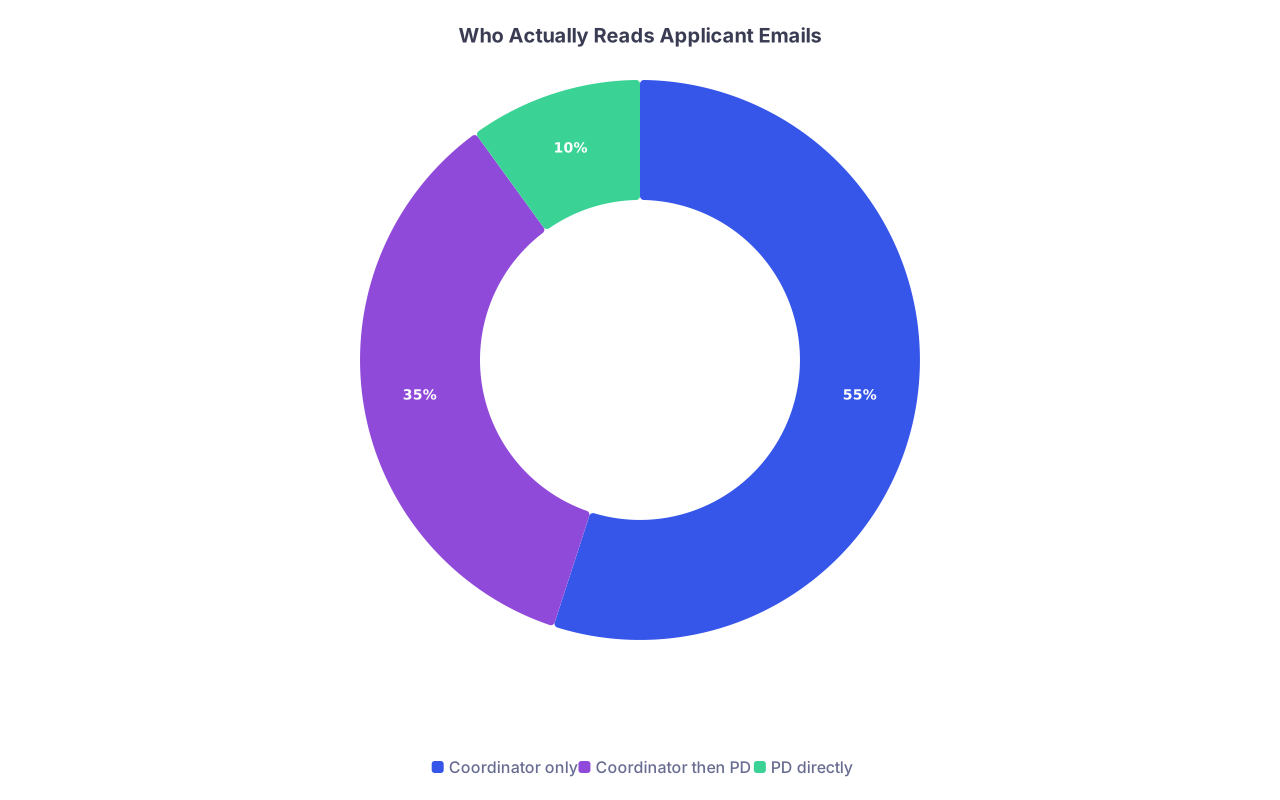
| Category | Value |
|---|---|
| Coordinator only | 55 |
| Coordinator then PD | 35 |
| PD directly | 10 |
So who really sees your message?
- If you email the coordinator only with a routine question: they handle it. PD never sees it.
- If you email the PD only about logistics or minor stuff: coordinator often gets it forwarded with a “Can you handle?” and a bit of eye-rolling.
- If you CC both on something that doesn’t merit the PD: you look like you don’t understand the hierarchy.
- If you send something PD-worthy and CC the coordinator: that can actually help. The coordinator keeps the train moving.
There’s a basic social structure here. Ignore it and you look tone-deaf.
Golden Principle: Who You CC Signals How You See the Power Structure
Every time you choose whom to CC, you’re sending two messages:
- How important you think the issue is
- How you perceive their roles and authority
Program insiders pick up on this instantly, even if they never say it to your face.
Here’s the blunt internal translation:
Email only the coordinator
Translation inside the office: “This applicant gets how this works. Good.”Email only the PD about a trivial thing
Translation: “High maintenance. Doesn’t respect that my time is limited.”CC the PD on purely logistical stuff
Translation: “Trying to signal importance where there is none. A little performative.”Email PD for an appropriate reason and CC coordinator
Translation: “Understands workflow. Makes my life easier.”CC every person you met, plus the coordinator, plus the PD, on one giant thank-you or update
Translation: “Red flag for drama. Needs coaching.”
That’s the subtext nobody tells you.
When You Should CC the Coordinator, the PD, Both, or Neither
Let’s go scenario by scenario, because that’s where people screw this up.
1. Basic Scheduling / Logistical Questions
Examples:
- “I need to switch my interview date.”
- “I’m having trouble accessing the virtual platform.”
- “What time does the dinner start?”
Who to email: Coordinator only. No CC.
Insider view: These are 100% coordinator territory. PD doesn’t want to see these. At all. When an email like this hits the PD’s inbox, they usually forward it with some version of, “Can you help them?” and forget about you.
If you CC the PD here, the coordinator will help you anyway—but you’ve signaled that you don’t understand roles.
2. Thank-You Emails After the Interview
This is where people overcomplicate everything.
Reality:
- Some PDs read them.
- Some skim.
- Some don’t open them unless there’s a clear update or signal of strong interest.
You have three common patterns:
Pattern A: Individual thank-you to each interviewer
- Email each faculty individually
- If the PD interviewed you: email them directly
- Coordinator is not CC’d
This is the cleanest approach and what most faculty are used to. You don’t need to CC the coordinator on thank-you notes. They already did their job.
Pattern B: One consolidated thank-you to PD
Something like: “Thank you for the opportunity to interview at X. I enjoyed speaking with Dr. A and Dr. B about Y and Z…”
- Send to PD only
- Do not CC the coordinator unless the PD and coordinator send everything together from a shared template and obviously work as a joint unit (some small programs do)
Insider reaction: Totally fine. Professional. Neutral-to-positive signal.
Pattern C: Thank-you to coordinator
This is underrated.
A short note: “Thank you for organizing a smooth interview day, I appreciated your help with X” sent just to the coordinator—no PD CC—is a subtle green flag.
Coordinators remember who treated them like humans and who treated them like servants. I’ve heard exact phrases like, “She was such a pleasure; she even emailed to thank me afterward,” right before rank list discussions.
What you should not do:
Send a single thank-you that CCs PD, coordinator, and every faculty you met. Inside, that reads as mass-blast, lazy, and a little thirsty.
The High-Stakes One: Expressing Strong Interest or LOIs
This is where people really start to sweat about CC’ing.
You want to tell a program:
- “You’re my top choice.”
- Or: “I will rank you highly.”
- Or: “If matched, I’d be thrilled to train there.”
Who should see that?
Hierarchy here is very clear inside programs:
- The PD owns the rank list strategy.
- The coordinator manages the mechanics and can quietly remind PD about particularly interested applicants.
- Faculty may have input, but they’re not tracking your LOIs day-to-day.
Here’s how to handle it.
If you are sending a TRUE “you are my #1” letter
- Address it to the PD only
- It’s acceptable, and often smart, to CC the coordinator
Why CC the coordinator here?
Because:
- The coordinator often keeps a side list of “expressed strong interest” candidates.
- They can nudge the PD if your name gets lost in the avalanche.
- PDs sometimes rely on coordinators to remind them: “By the way, this person said we are their top choice.”
Inside talk I’ve literally heard:
- “Didn’t she say we were her number one?”
- “Let me check with [coordinator].”
- Coordinator pulls up your email quickly because you CC’d them.
What you do not do is CC random faculty on that top-choice email. That splashes your intentions too widely and looks like you’re campaigning.
If you’re sending a “strong interest but not explicit #1” email
Something like: “I was very impressed with your program and intend to rank it highly.”
- Send to PD only
- Optional: CC coordinator—but not mandatory
If you’ve already emailed the coordinator about other things and you feel the relationship is positive, CC is reasonable. If you’re unsure, PD alone is perfectly fine.
One thing you don’t want:
Your email chain getting turned into a spectacle. Too many recipients = more chances for some cynical attending to say, “Oh, they probably sent that to everyone.”
Updates: New Publications, Scores, Awards, or Honors
Programs get flooded with “update” emails between interview and rank list certification. Some matter. Most don’t.
So who do you CC?
Academic / CV Updates
Examples:
- New first-author publication
- National abstract/poster acceptance
- New leadership role or award
- Step 2 score if significantly strong and not yet reported
Standard approach that plays well inside:
- Email the coordinator as primary recipient
- CC the PD
Why this order? Coordinator-first respects the workflow. CC’ing PD ensures it’s in their inbox, but subtly signals: “I know the coordinator manages the file.”
Internal workflow: The coordinator usually adds the update to your file, flags it, and may say to the PD, “This is the one who just got a paper in [journal].”
If it’s truly big—like a major national award—PD may comment in a rank meeting: “Since interview, they added X, which is impressive.”
What you should not do:
Email a random faculty interviewer with your CV update and CC no one else. Faculty are unreliable as conduits for this. Some won’t forward. Some will forget. Some will trash it.
Problem Emails: Rescheduling, Illness, Travel Disasters
These are land mines. Handled well, no one cares. Handled poorly, you get labeled.
Classic scenarios:
- You’re sick the morning of the interview
- Your flight is canceled and you’re arriving late
- You double-booked interviews accidentally
Who you email matters a lot.
If it’s before the interview day and not emergent
You realize a conflict, a family event, or you just messed up:
- Email coordinator only
- No PD CC unless coordinator is nonresponsive
Tone: Own the problem. Be clear, brief, and apologetic without drama.
Coordinators handle this every season. They don’t need the PD watching. If you CC the PD on a minor scheduling screw-up, it looks like you’re trying to show how “serious” you are, when really you just created more work.
If it’s day-of and time-sensitive
You woke up vomiting. Your flight is diverted. Your internet dies 10 minutes before a Zoom interview.
In that setting:
- Email the coordinator immediately
- It is entirely reasonable to CC the PD
Why? It actually helps. The coordinator can say later, “Yes, they let us know early, and the PD saw it.” It frames you as responsible under bad circumstances.
I’ve seen PDs say, “They handled that well; they’re organized and honest,” and still rank the person normally, precisely because communication was clean and appropriately CC’d.
The Stuff That Makes You Look Bad (and People Talk About)
Let’s go through a few patterns that reliably get mocked behind closed doors.
1. CC’ing Upwards to “Increase Pressure”
Some applicants think: “If I CC the PD, the coordinator will move faster.”
Behind the scenes reaction? Annoyance.
Coordinators remember this. They’ll still help you, but in rank meetings, if your application is borderline, that “demand energy” sometimes colors how they talk about you.
This is the equivalent of CC’ing your boss’s boss every time you email your supervisor. Transparent and off-putting.
2. Emotional or Dramatic Multi-Recipient Emails
The dreaded version:
- Subject line: “My Deep Passion for Your Program”
- To: PD
- CC: coordinator, 4 faculty, chief resident
- Body: 12 paragraphs about destiny, calling, childhood illness, etc.
Faculty reading this think three things:
- “Did they send a version of this to every program?”
- “This is too much emotional labor for me right now.”
- “Are they going to be like this as a resident?”
You want to signal interest, not emotional instability. Keep it directed and lean. PD + maybe coordinator. That’s enough.
How Coordinators Actually View Your Emails
Let me tell you something applicants underestimate: coordinators have more influence than you think.
Not on whether a 230 vs 250 gets ranked higher. But on the soft stuff:
- Are you easy to schedule?
- Do you respond promptly and clearly?
- Are you polite?
- Do you show basic professional judgment?
When PDs are on the fence about two similar applicants, I’ve literally heard:
“Who was easier to work with?”
Coordinator answers. That answer matters.
So:
- Thanking the coordinator? Quiet plus.
- Not dumping every email on the PD? Plus.
- Not CC’ing 10 people when one would do? Plus.
And yes, they notice when you treat them like a real colleague versus a nameless admin.
Programs Differ: Big University vs Community vs Small Specialty
You asked about etiquette; the nuance lives in the program type.
| Program Type | Who to Email for Most Things | LOI Best Practice |
|---|---|---|
| Large University IM | Coordinator; CC PD for LOI | PD + CC Coordinator |
| Small Community FM | Often PD directly | PD only |
| Competitive Surgical | Coordinator first | PD + CC Coordinator |
| Small Niche (e.g. Derm) | PD or small admin team | PD only, brief and direct |
| Transitional/Prelim | Coordinator mostly | PD + CC Coordinator |
You can usually infer from:
- Who signed your initial invite email
- How many names are on the program’s website contact page
- Whether the PD seems “hands-on” or more figurehead-like
If every communication all season has come from the coordinator and the PD’s name never appears in your inbox, it’s a big sign: logistics → coordinator, high-stakes message → PD + maybe coordinator.
A Simple Flow for Deciding Whom to CC
Here’s the mental algorithm I’d use if I were you.

| Step | Description |
|---|---|
| Step 1 | Need to send email |
| Step 2 | Email coordinator only |
| Step 3 | Email PD, CC coordinator |
| Step 4 | Email individual only, no CC |
| Step 5 | Email coordinator, CC PD |
| Step 6 | Default: coordinator only |
| Step 7 | Is it purely logistics? |
| Step 8 | Is it expressing interest/LOI or important update? |
| Step 9 | Is it a personal thank-you? |
| Step 10 | Is it urgent day-of issue? |
You’ll notice something:
Most arrows point away from “CC everyone.”
Restraint reads as professionalism.
What PDs Actually Care About in Your Follow-Up
Let’s anchor this, so you don’t obsess over the wrong variable.
PDs care about:
- Are you clearly interested in the program?
- Did you communicate any important new information?
- Do you show basic maturity and professionalism in how you interact?
They don’t care about:
- Whether your thank-you email was 3 or 8 sentences
- Whether you sent it within 24 vs 72 hours
- Whether you used “Dear Dr. X” or “Hi Dr. X” (within reason)
But they do care if:
- You blast LOIs to multiple programs and word it badly
- You pressure them about rank lists
- You CC half the department on every minor question
- Your tone is entitled, panicky, or manipulative
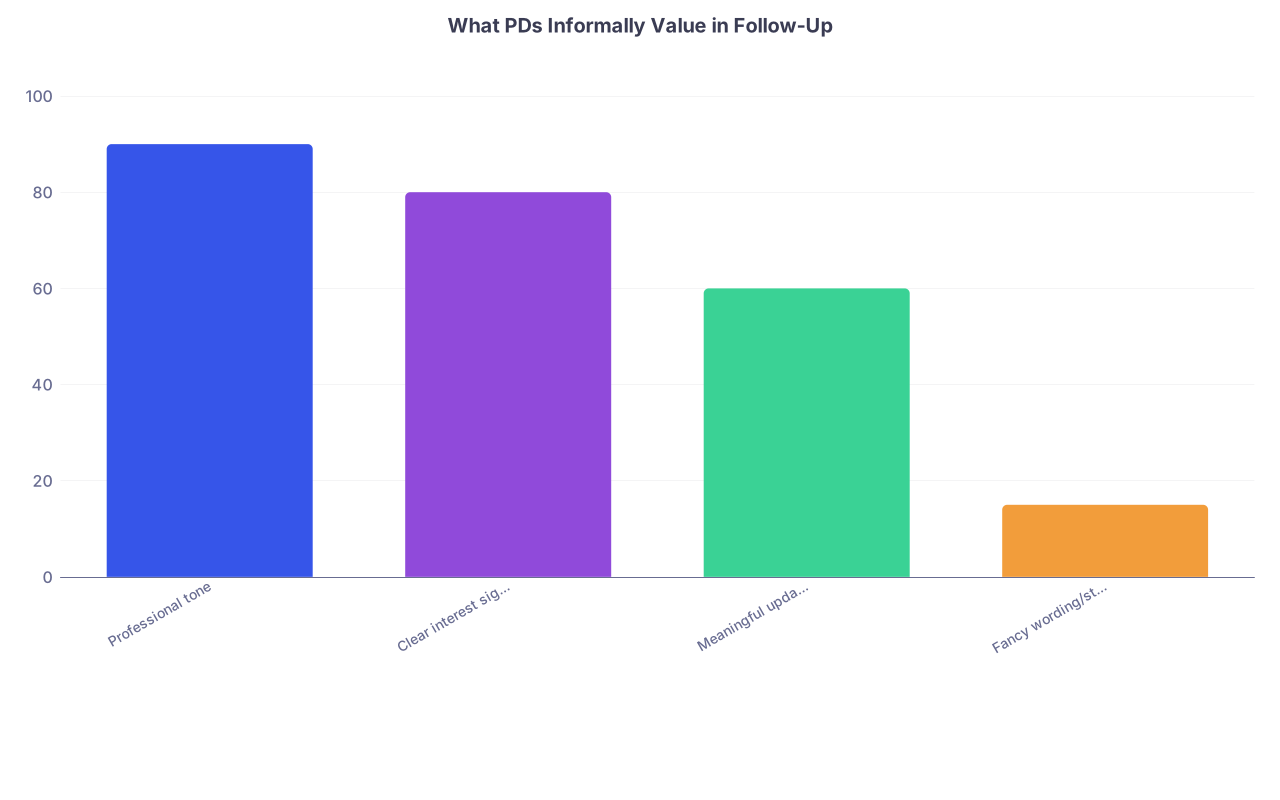
| Category | Value |
|---|---|
| Professional tone | 90 |
| Clear interest signal | 80 |
| Meaningful updates | 60 |
| Fancy wording/style | 15 |
The CC line is one of the quiet signals, but it feeds straight into that “professional tone” bucket.
Quick Reference: Specific Common Situations
Let’s run through several classic follow-up moments and what I’d do if I were in your shoes.

Post-interview thank-you to PD
- To: PD
- CC: Nobody
- Exception: If every official email came from a “PD + coordinator” joint address, CC coordinator is fine.
Post-interview thank-you to coordinator
- To: Coordinator
- CC: Nobody
- Short, sincere, done.
-
- To: PD
- CC: Coordinator
- Keep it under ~3 short paragraphs. Do not copy-paste generic language you sent somewhere else.
Non-top but strong interest note
- To: PD
- Optional CC: Coordinator
- Don’t promise “rank you to match” if it’s not true.
New publication / major academic update
- To: Coordinator
- CC: PD
Step score update that helps you
- To: Coordinator
- CC: PD
Minor schedule question
- To: Coordinator
- CC: Nobody
Day-of emergency (illness/flights/internet)
- To: Coordinator
- CC: PD
Do that across all your programs and you’ll look far more put-together than the average applicant.
The Part Nobody Tells You: Programs Know You’re Anxious
Most PDs are not monsters. They remember what it felt like to wait for interviews, agonize over every word, second-guess every email.
If you slightly over-CC once, you’re not doomed. People get that you’re trying to do the right thing. They’re not sitting there with a spreadsheet tallying your CC sins.
What does stand out are patterns:
- Chronic over-escalation
- Emotional volatility in email
- Inability to respect channels
Those are the things that make PDs say, quietly, after you leave the Zoom room, “I’m not sure how they’ll be at 3 a.m. on a bad call night.”
You’re not just selling your CV. You’re selling your future behavior as a colleague.
Choose your recipients like someone who understands systems, hierarchy, and respect. That’s what they’re really measuring under all the noise.
Years from now, you won’t remember the exact wording of your LOI or who you CC’d on a scheduling email. You’ll remember whether you carried yourself like the resident you wanted to become.