The lazy, copy‑paste thank‑you note is not neutral. It is a liability.
If you treat your residency thank‑you messages like a checkbox formality, program coordinators and PDs will notice. And yes, they talk about it. I have watched faculty scroll through a batch of near‑identical emails and say, out loud, “Generic. Generic. Generic. Ok, this one actually paid attention.” Guess whose name they remember when the rank list gets built?
You are competing with people who take follow‑up seriously. Do not be the applicant who looks like they blasted the same paragraph to twelve programs.
Let me walk you through how copy‑paste notes get spotted, why they quietly count against you, and how to avoid the traps without spending your entire life writing emails.
How Programs Actually See Your Thank‑You Notes
First mistake: assuming your email lives in a vacuum, seen only by the one faculty you sent it to.
That is not how this works.
Here is what actually happens at many programs:
- Faculty forward thank‑you notes to the program director or coordinator.
- Some coordinators literally create a folder in Outlook or Gmail with all applicant thank‑yous.
- On rank-list meetings, someone occasionally says, “Any follow‑up from this person?” and those notes are pulled up.
- In small and mid‑size programs, the same people interview for multiple positions and see patterns very quickly.
So when you send the same block of text to every interviewer in the same program—sometimes with the same typo, same awkward phrase, same “I enjoyed learning more about your program’s strong clinical training”—you are not fooling anyone. They can see the duplicates on one screen.
And across programs? Faculty move. Attendings moonlight. Fellows talk to their old institutions. Your “unique” template is not as invisible as you think.
The Red Flags That Scream “Copy‑Paste”
There are very specific tells that give away a mass‑produced thank‑you note. I have seen these patterns enough to recognize them in three seconds.
1. The Overly Generic Opening Line
“I wanted to sincerely thank you for taking the time to speak with me about your program.”
This sentence, or some mutation of it, shows up in about 80% of weak thank‑you emails. On its own, it is fine. When it is the entire emotional content of the message, it reads as empty.
Programs spot this when:
- Every email from you to different interviewers starts with precisely the same first two sentences.
- There is no mention of the actual conversation, day, or role of the person you are emailing.
- You could swap out the program name and send it to a bank recruiter.
If your first line could apply to any specialty, any city, any year, it is too generic.
2. Identical Paragraphs Across Recipients
This is the big one. The classic copy‑paste mistake.
Example pattern I have seen more than once:
Email to PD:
“I was truly impressed by the collegial atmosphere of your program and the strong clinical training offered at University Hospital.”
Email to APD:
“I was truly impressed by the collegial atmosphere of your program and the strong clinical training offered at University Hospital.”
Email to the chief:
“I was truly impressed by the collegial atmosphere of your program and the strong clinical training offered at University Hospital.”
Same sentence. Same order. Same wording. Sent within minutes of one another. When those get forwarded into one email thread, it looks absurdly mechanical.
Faculty are not offended that you reused a thought. They are annoyed that you did not bother to rephrase it for different people, or add any interview‑specific detail. It reads like mass marketing, not gratitude.
3. Mis‑Matched Details and Sloppy Edits
This is where copy‑paste actively hurts you, not just bores them.
I have personally seen:
- Emails to a surgery PD that still said “family medicine” from a previous template.
- Wrong program name (“I am excited about the opportunities at Mercy…” sent to a Methodist program).
- Wrong city or institution.
- One attending’s name in the greeting, a different attending’s name referred to in the body.
Those are instant red flags. If you cannot proofread a five‑sentence email when you say you are “detail‑oriented” and “committed to patient safety,” it is not a flattering contrast.
You do not want to be the cautionary story: “We got a beautiful thank‑you about our amazing pediatrics ICU. We are an anesthesia program.”
4. No Reference to the Actual Conversation
Interviewers remember what they talked to you about. They might not recall your Step 2 score, but they remember the applicant who discussed:
- Rural health and their outreach clinic.
- AI tools in radiology and how that might impact training.
- Work‑life balance after they had mentioned co‑parenting or childcare.
If your email could have been written before you ever met them, it is obvious you did not connect anything to reality.
Lines like:
- “I enjoyed hearing more about the program.”
- “Our conversation reinforced my interest in your institution.”
By themselves, they are fluff. Without a single specific reference—an elective, a rotation site, a case, a resident story—they scream “template.”
5. The Same Closing Line Sent to 20 Programs
Another giveaway: recycled closings that scream “broadcast.”
Things like:
“I look forward to the possibility of working with you and your esteemed colleagues.”
“Your program remains one of my top choices.”
“This interview has solidified my strong interest in your residency.”
If you send that last line to six “top choices,” understand that programs know applicants do this—and some are jaded enough to roll their eyes at it. When it is pasted word‑for‑word to every single attending in the same program, it becomes a punchline.
How Generic Follow‑Ups Quietly Hurt You
Let me be blunt: a generic thank‑you letter is unlikely to destroy your rank position at a place that already loved you. But it can:
- Fail to save you when you are on the bubble.
- Nudge you down a couple of spots when someone else did this better.
- Undermine the supposedly “detail‑oriented,” “genuine,” “patient‑centered” image you spent your entire application building.
Here is how the damage happens in real life.
1. You Become Forgettable in Tie‑Break Situations
During rank meetings, I have heard:
- “Remind me who this was again?”
- “Did we get anything from them afterward?”
- “Anyone have a strong feeling either way?”
If your thank‑you was a generic blur, it does not help anyone advocate for you. A specific, personalized note can jog memory:
“Oh yeah, she was the one who asked about the refugee clinic and emailed me about that article. I liked her.”
That is what you want. Not, “I think they sent a follow‑up? It was fine. Very standard.”
2. It Raises Quiet Concerns About Authenticity
Programs are used to some amount of game‑playing. But there is a difference between strategic and insincere.
When every email from you reads like a scripted performance, it feeds the suspicion that:
- You are saying what you think they want to hear, not what you actually mean.
- Your interview persona might have been rehearsed as well.
- You will tell every program they are “one of your top choices” without thinking.
Is this fair? Not always. But it is human. People rely on tone and specificity to gauge sincerity when they make high‑stakes decisions.
3. Sloppy Copy‑Paste Becomes an Actual Professionalism Concern
The egregious errors—wrong name, wrong program, obvious leftover text—do not just look lazy. They look unprofessional.
I have seen PDs write comments like:
- “Thank‑you to wrong program, seems careless.”
- “Cut‑and‑paste error; attention to detail?”
Residency is full of repetitive notes and templates. Programs are not naïve about that. But if you cannot manage safe copy‑paste on your own behalf in an email, they will worry about what your Epic notes or order sets are going to look like.
A Simple System That Looks Personal (And Is)
You do not need to write literature‑level emails for every single person. You just need to look like you were awake when you typed them.
Here is the system that avoids almost all the common mistakes.
Step 1: Take Notes During or Immediately After Each Interview
Do not rely on your memory after a 6‑interview day. You will mix people up.
Right after each conversation, jot 3 things:
- One specific topic you discussed (e.g., global health trips, ultrasound curriculum, their research on CKD).
- Any personal detail they volunteered (career path, kids, hobbies, fellowship, city move).
- Something they seemed to care about in the program (resident autonomy, wellness, diversity, QI).
You can keep this in a simple table by program.
| Interviewer | Program | Key Topic | Personal Detail | Follow-Up Sent? |
|---|---|---|---|---|
| Dr. Smith | IM A | QI curriculum | Former hospitalist | Yes |
| Dr. Lee | IM A | Refugee clinic | Moved from NYC | Yes |
| Dr. Patel | IM B | Cardiology research | Loves teaching | Pending |
This is your goldmine when you sit down to write. It prevents the “What did we even talk about?” blur that produces generic garbage.
Step 2: Use a Skeleton, Not a Script
You are allowed to have a basic structure. In fact, you should. The problem is not structure; it is laziness.
A safe skeleton:
- Greeting with correct title + name.
- One sentence thanking them for their time.
- One to two sentences referencing something specific from your conversation.
- One sentence connecting that to why you are interested in their program.
- Simple, clean closing.
The only part you should consistently reuse is pieces of #2 and #5. Everything else needs at least minor customization.
Bad approach: Paste the whole body for every single person and swap one noun.
Good approach: Have a few stock phrases but force yourself to write at least 2 new sentences per person.
Step 3: Make the Specificity Do the Work
Two examples. One is safe but forgettable; the other actually sounds like you were present.
Forgettable: “Thank you for the opportunity to speak with you about your program. I enjoyed learning more about the strong clinical training and supportive environment at [Program]. Our conversation further solidified my interest in your residency.”
Better: “Thank you for taking the time to talk with me on Tuesday, especially for walking me through how your night float system works. Hearing how you protect your interns from 28‑hour calls while still giving them ownership over their patients really matched what I am looking for in training.”
Second version proves you listened, uses a real program detail, and shows your priorities. That is all you need. Nothing poetic. Just real.
Timing, Volume, and Other Ways People Trip Themselves Up
Copy‑paste is not the only hazard. The way you send thank‑yous can also send the wrong message.
Mass Sending at Weird Hours
Coordinators notice when 10 emails from the same applicant arrive at 1:47 a.m. with nearly identical text. It looks like what it is: you sat down one night, dumped your template everywhere, and went to bed.
You do not need to fake it, but spread them out a bit. Or at least ensure each program’s set of emails feels tailored to that day, not sprayed across your entire interview season.
Waiting Too Long, Then Sending a Batch
If you wait 10–14 days and then send a wave of generic “thank you again for speaking with me last week” emails, you have lost most of the goodwill.
Programs know you are busy. One to three days is ideal; up to a week is fine if you are stacked with interviews. Beyond that, keep it very simple, acknowledge the delay briefly if needed, and still make it specific.
Writing Novels No One Wants to Read
Overcompensation is another mistake. A 500‑word essay disguised as a thank‑you note does not make you seem more earnest. It makes you seem unaware of your audience’s time.
Your target length: 4–8 sentences. Enough to show attention; short enough that they will actually read it. If you find yourself re‑arguing your entire application, stop.
How Programs Read “Program Ranking” Language
This part gets messy because applicants get a lot of conflicting advice.
Yes, some programs will take “Your program is my first choice” seriously. Others have been burned enough that they ignore all such statements. But copy‑pasted ranking language is almost universally distrusted.
If you tell three programs that they are each your “unequivocal top choice,” you are lying to at least two of them. That is not strategy. That is dishonesty. And people in this world know each other.
You want to avoid two traps:
- Overcommitting to multiple places and creating a trail of contradictory emails.
- Using vague but still clearly templated “top choice” language in every single note.
Better options:
- For a true #1 program: Use clear, honest language in one targeted communication near rank time, not buried in every routine thank‑you.
- For programs you genuinely like: Emphasize specific program features that fit you, without trying to game them with rank talk.
Example that does not sound copy‑pasted: “Our conversation only reinforced that [Program] aligns closely with what I am looking for—especially your emphasis on early autonomy in the MICU and the strong mentorship structure you described.”
Notice: No “top choice.” No ranking promise. But clear, specific enthusiasm.
The Minimum Viable Non‑Embarrassing Thank‑You
If you take nothing else, take this: your thank‑you notes do not need to be perfect. They just need to avoid obvious laziness and obvious lies.
Before you hit send, check three things:
- Correct recipient and program. Name spelled right, correct titles, right institution. No leftover “family medicine” in a surgery email.
- One concrete detail. At least one sentence that would make no sense if you accidentally sent it to a different program or interviewer.
- Clean, short, not dramatic. 4–8 sentences, no over‑the‑top ranking promises, no weird flattery.
If an email fails any of these three, fix it. Or do not send it.
Quick Visual: Specific vs Generic Impact
Just to hammer this in, here is what programs often feel—even if they would never put numbers to it.
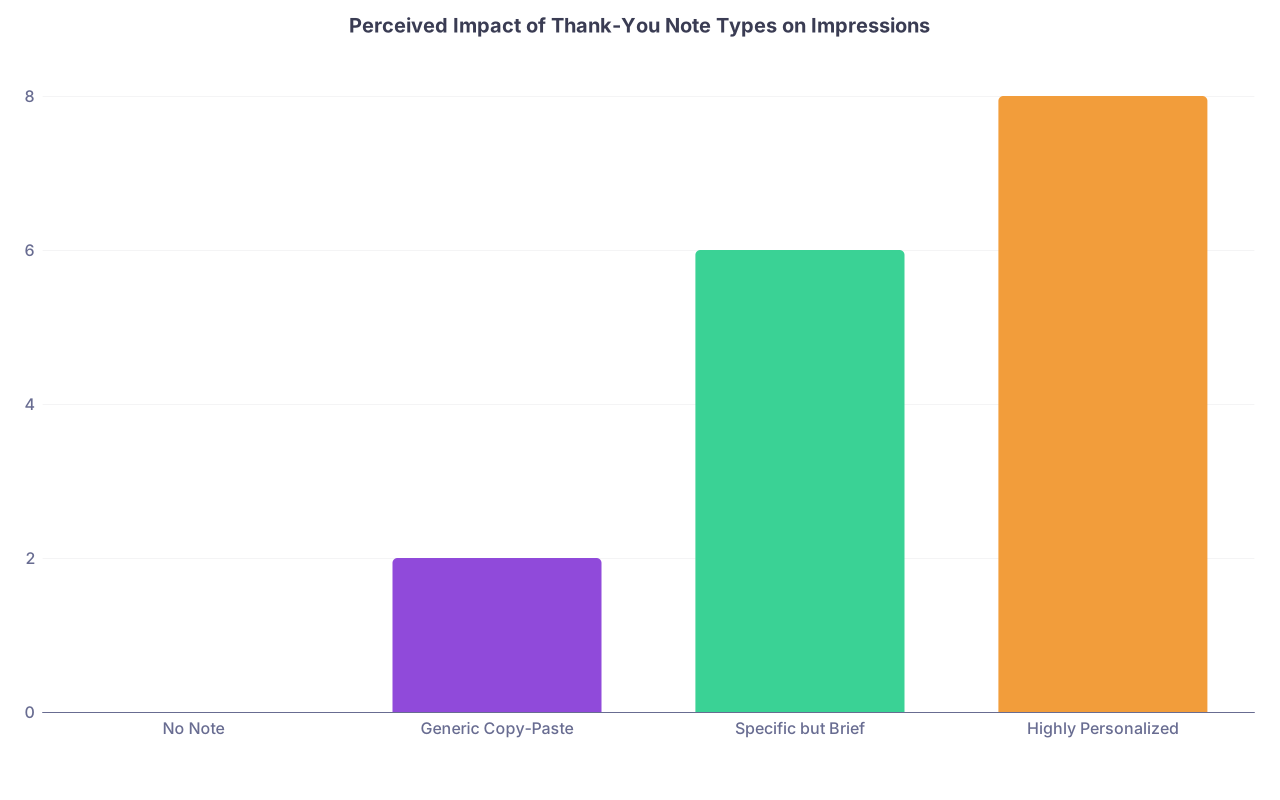
| Category | Value |
|---|---|
| No Note | 0 |
| Generic Copy-Paste | 2 |
| Specific but Brief | 6 |
| Highly Personalized | 8 |
You can match or beat most applicants just by landing in that “specific but brief” category. You do not need to live at “highly personalized” for every single interaction.
How to Stay Sane When You Have 60+ Interviewers
By January, you are tired. You are juggling interviews, sub‑I’s, maybe research. This is exactly when people default to bad copy‑paste behavior.
A few sanity tricks that do not sacrifice quality:
- Draft a program‑specific paragraph you can lightly adapt for each interviewer at that site. Not word‑for‑word identical, but the same core details.
- Block one hour at the end of each interview day for quick notes and 2–3 emails. Do not let it pile into a mountain.
- Accept that you will not send a note to every single resident you met on a resident panel. Prioritize PD, APD, and anyone you had a substantive one‑on‑one with.
And if you truly cannot keep up without devolving into sloppy templates? Then it is better to send fewer, better thank‑yous than a tidal wave of generic ones.
Final Takeaways
Three points you should not forget:
- Programs recognize copy‑paste thank‑you notes immediately, especially when multiple similar emails land in the same inbox. It makes you look generic at best, careless at worst.
- One or two specific details tied to the actual conversation are what separate a meaningful note from template noise. You do not need poetry. You need proof you were present.
- When you are exhausted, resist the urge to blast the same paragraph everywhere. Fewer, well‑written, specific thank‑yous will help you more than mass‑produced fluff that quietly drags you down.